u/AlertStrength3301

Image 1 —
Image 2 —
Image 3 —
Image 4 —
Image 5 —
Image 6 —
▲ 10 r/Horsegenetics+1 crossposts

I may have spent more time on this than I'd like to admit! No Ai was used, just lots of image editing. After reading research papers on how extension (red/black), agouti (bay/recessive black), and Non-dun (primitive markings/sunfading) interact with bay to create different shades. So I decided to make a visual on how it all interacts.

It made me think about how multiple genes will either "turn up" or "turn down" how extensive or restrictive black points on a bay will express. It reminded me of switches on a sound mixer. But different coffee roasts representing different shades of bay felt right. And it stayed on theme with the cream dilution visualization I also made lol.

The first version of this visual had regular wild bay and regular seal bay as the top and bottom of the spectrum with all switches turned up or down. But it didn't seem right. I've seen seal bays with nd1/nd1 and some wild bays express more extensive black points than others. So I included the utter extremes of the bay spectrum in the form of MP Festival the Arabian mare for "flaxen" wild bay and Pieorities the Quarter Horse stallion for "black" seal bay. This way it shows that there is some wiggle room between them and the standard expressions of their bay shades.

We also don't know everything involved in coat shade expression so I included the "Other" category. This is a catch-all for things we currently lack tests for like sooty, unknown mutations, ect. I have a suspicion that since flaxen and mealy create a reduction to overall body pigment that they may also influence and reduce black points. But this is simply a hunch and there is absolutely no proof of it being reality. So anything unknown goes in this category.

Let me know if this gets the idea across. And if you have any suggestions to make it more accurate or easier to understand I would absolutely love to hear them! :)

Research Cited:

Synergy between MC1R and ASIP for coat color in horses ( Equus caballus )

Variation in the ASIP and Dun genes responsible for Coat Colour in Bosnian Mountain Horse

An Independent Locus Upstream of ASIP Controls Variation in the Shade of the Bay Coat Colour in Horses

TBX3 and ASIP genotypes reveal discrepancies in officially recorded coat colors of Hucul horses
u/AlertStrength3301 — 22 days ago

So I have been compiling together info on Champagne horses recently and something I've noticed is that we really don't have a lot of studies on this dilution outside its initial mutation discovery.

But thanks to the internet, we get a lot of owners posting their tested champagne horses and their DNA results. Because of champagne's resemblance to cream dilutions it was heavily mixed in with cream lines. It's considered a simple dominant, but the more I've looked into it the more it looks like champagne may be a partial dominant with distinct heterozygous and homozygous phenotypes.

Most know that homozygous champagne horses are lighter and have pinker skin with less freckles than heterozygous ones. But I've also noticed that the colors of homozygous champagnes often look near indistinguishable from those with champagne + cream. (Note: Lots of Facebook links)

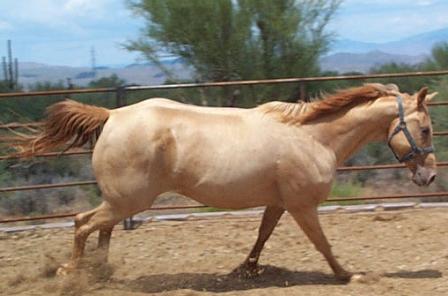
Homozygous champagnes seem to generally have fewer freckles than the champagne creams. But overall these color combos are so close that a gene test would be needed to tell them apart. This shows that the homozygous version of champagne acts very similar to a known double dilute combo. But I think it goes even further than that. To make things even more interesting, there seem to be 3 main phenotype / genotype combos I've been coming across in gold champagnes.

  • Palomino-mimic gold champagnes. Gold coats and light manes/tails. Seen as the quintessential gold champagne phenotype. Test heterozygous.
  • Self-colored gold champagnes: Look darker than the palomino mimics with a diluted red color. And they have similarly reddish colored manes/tails, hence "self-colored". Test Heterozygous.
  • Isabella-mimic gold champagnes. Look like a very light palomino. Test homozygous gold champagne without other dilutions involved.

The self-colored individuals always confused me. They happen fairly often and have such a unique appearance. They didn't seem like sooty chestnut bases since their tone is so consistent and red over the entire body. I'm starting to think that we may be so used to comparing gold champagnes to palominos that we have been missing something about this expression.

Many of the breeds the initial champagne study looked at populations that wanted to breed anything looking like palomino or cream. Because back in the day all breeders had were phenotypes to work off of. So palominos, champagnes, mealy and flaxen chestnuts were all prioritized for their similar look of a lighter mane and tail with a darker reddish-to-golden body. Heck, the world's most famous "palomino" Mr. Ed (aka Bamboo Harvester) was actually a gold champagne the whole time. So multiple color factors have often been mixed in with champagne horse populations. Something I'm wondering is if champagne in one dose doesn't actually dilute the mane and tail.

Here is my following unproven hypothesis:

  • The self-colored phenotype is possibly the baseline of heterozygous gold champagne expression without other color influences.
  • The palomino-mimic gold champagnes are heterozygous champagne and possibly have flaxen and/or mealy lightening the mane and tail color just like they do on non-dilute chestnuts.
  • The Isabella-mimics are the standard appearance for homozygous gold champagnes. All tested homozygotes I've come across so far fit this phenotype. (Note: My personal findings are not a guarantee all homozygotes will look like this)

I know that there is no available test for flaxen or mealy at the moment, so this is all hypothetical. The lighter manes and tails in some black-based champagnes are easily tested with the silver dilution as the culprit. But what we can do is look at pedigrees and populations with flaxen/mealy in them, and those without.

The American Cream Draft (ACD) has a misnomer for a name. The breed has champagne to thank for its unique coloration. The overwhelming majority of the breed is gold champagne. Their coloration is often the palomino-mimic or Isabella-mimic phenotype. I did find an image of a rare non-champagne ACD with a very noticeable mealy chestnut color. The same page also has an image of a chestnut-based ACD cross with a similar appearance and dramatically flaxen mane. This would fit the hypothesis since it would represent a population of homozygous and heterozygous gold champagnes with mealy.

Something else that could prove this hypothesis is if self-colored gold champagnes crossed with non-flaxen chestnuts would only produce more foals looking like themselves. And so for I have found an example on All Breed Pedigree that has images of both parents and their offspring. Just One Fantasy is a self-colored filly out of a self-colored sire and non-flaxen chestnut dam. The filly's sire SW Champagne Fantasy also seems to throw self-colored foals that look like him out of non-flaxen mates. Here are more of the dam and her foal (left) sired by him from the previous link.

If this is hypothesis is shown to be true then it would mean that the champagne dilution has distinct phenotypes when heterozygous vs homozygous. So classifying it as a partial dominant would be accurate over its current classification as a simple dominant. This by no means counts as a research paper, but it is instead a collection of observations. It could absolutely be partially true, totally wrong, etc. But I had to share what I kept seeing. Let me know what you think.

u/AlertStrength3301 — 26 days ago

Came across this guy on Pinterest and was able to locate another image of the same individual with a face and stripe closeup. They have a very diluted mane and tail with faint mane stripes. Their dark body stripes are less diluted to a very dark brown and the nose is also a lighter brown tone. Meanwhile their skin and eye color are unaffected.

I immediately thought of the silver dilution in horses which has a similar effect on coat coloration. This guy even has light eyelashes like many silver horses do. Makes me think that a mutation on PMEL17 (the same locus for the silver dilution) is possible. Another interesting feature is that their stripes seem wider than those of their non-dilute herd mates. The decreased pigment possibly influencing their expression.

Let me know what you guys think!

u/AlertStrength3301 — 1 month ago