u/Roguestate00

On a scale of 1-10, how surprised were you that Luigi plead guilty and who do you think was the driver behind this decision, his lawyers, him or both equally?

I didn’t think a deal would be offered because of the politics around the case. But I changed my mind when the state prosecutors wrote that letter to Carro saying they will interfere if there is a deal they don’t like. I am sure they have connections and trusted sources (spy buddies) among the Feds who gave them a heads up. But surprised it’s an open plea, so like a 7 on the scale for me.

I believe that once it became certain that Carro refuses to let the Feds go first, Luigi’s team ran him through all possible outcomes. I think his lawyers would have been ok to go through trial and appeal but my impression is he doesn’t want to hand Joel or the Feds all of the control and rather puts his life into Garnett’s hands. That’s why I think he was driving that decisiony.

reddit.com
u/Roguestate00 — 5 days ago

Joel Seidemann is head-faking the defense

At the end of June, ABC News reported that anonymous “sources familiar with the matter” told them plea discussions with Luigi Mangione had taken place before a recent federal court hearing, but no agreement had been reached. The defense team responded by attacking the leak, arguing that it was an effort to manipulate public opinion and deny him a fair trial. 

I tend to agree with the defense here that the story is serving only to suggest that Luigi is guilty and looking for a way out, and the vague information reported doesn’t support that conclusion. 

Without specificity, we don’t know if these “discussions” were a detailed back-and-forth negotiation or the prosecution conveying a plea offer and receiving “See you at trial” as a response. And in any event, plea offers that don’t culminate in a deal are routine and ordinary parts of our criminal processthat mean nothing more than that the prosecution would like to avoid the necessity of a trial, and the accused intends exercise his right to make the State prove it.

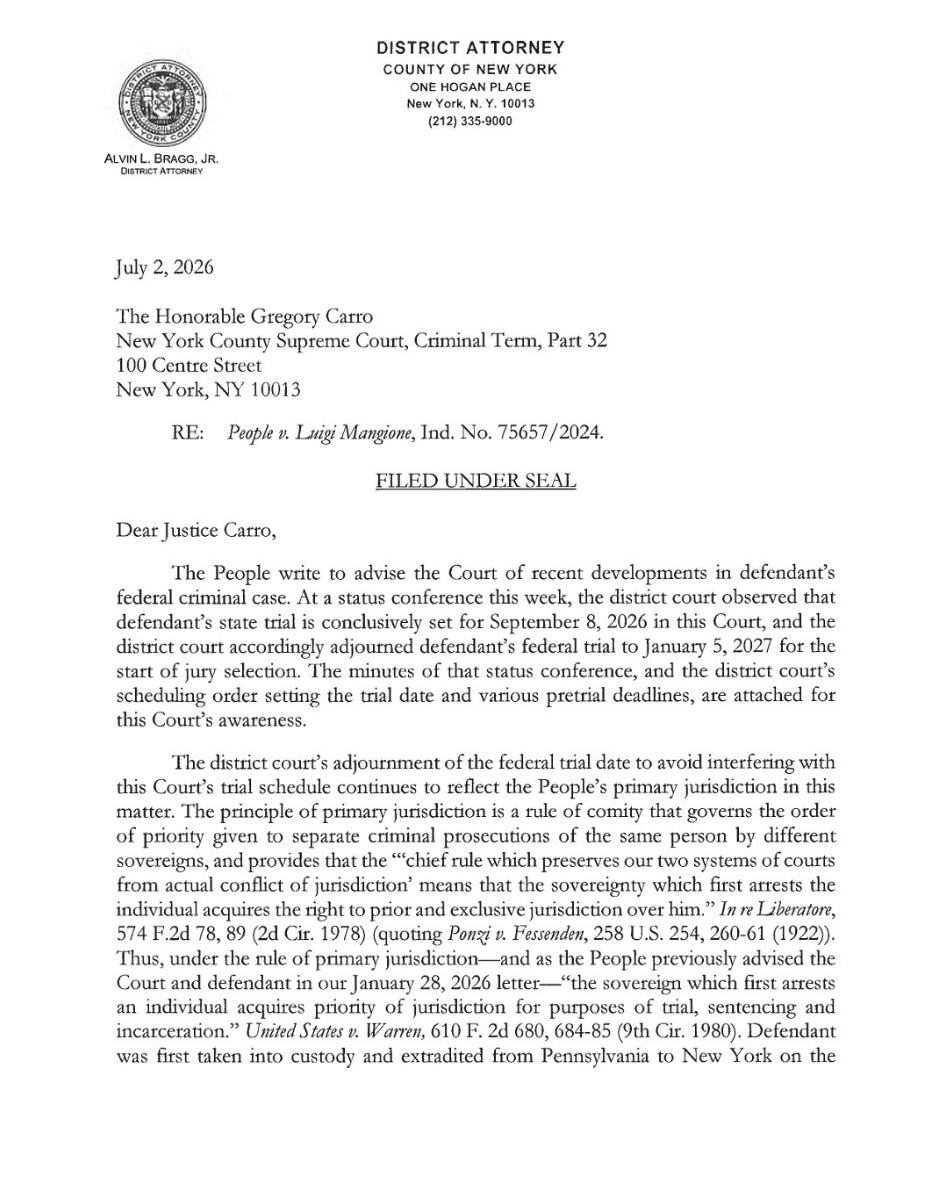
But then this week, a new document, originally filed under seal in New York state court, was unsealed and publicly released. The document is, as I will explain, peculiar; it is a letter from lead state prosecutor Joel Seidemann to state Judge Gregory Carro, expressing concern that a possible federal plea could interfere with the state prosecution:

This letter is peculiar because there is no obvious purpose for it. Judge Carro has no authority over what happens in federal court, so whether the state prosecutors intend to lobby the federal prosecutors or district court over the possibility of a federal plea is immaterial to anything happening in state court. 

FULL ARTICLE LINKED.

andreaburkhart.substack.com
u/Roguestate00 — 22 days ago

Ex-Eric Adams aide Frank Carone pushes city contract bribery trial date back and hires Luigi Mangione’s defense attorney

After insisting upon an August trial date to a federal judge, Frank Carone, a former aide to ex-Mayor Eric Adams, pushed his trial date back to next May, sparking some annoyance from a federal judge Monday.

Carone, who was arrested by the FBI on June 24, is charged with allegedly accepting $120,000 in bribes from Long Island City hotel Microtel to push top city officials to give Microtel a roughly $7 million city contract to house immigrants during the height of the 2022 migrant crisis after City Hall repeatedly turned the hotel down, citing its small size and location. He was indicted alongside his brother, attorney Anthony Carone, who’s charged with helping funnel those alleged bribe payments through a firm he worked for, and Microtel owner and employee, Yan Po Zhu and Crystal Chen. 

Frank and Anthony Carone’s attorneys pushed for an Aug. 24 trial date at their July 1 hearing, saying the brothers did nothing wrong and didn’t want to delay the trial.

U.S. District Judge Kiyo Matsumoto expressed skepticism at that early July appearance, saying she didn’t believe Aug. 24 was a “real date,” but issued the scheduling order as Carone’s attorneys said they had every intention of going to trial then. 

During Monday’s hearing, she referenced that skepticism and let the defense team know her court’s calendar was packed, so last-minute changes and document filings would not necessarily be welcome.

“As I — we all — knew, this trial that we had scheduled is not going to go forward,” Matsumoto said. If the earliest the defense teams wanted to start trial was March, the judge went on to note, then the earliest her schedule could accommodate would be a May 3, 2027, start date.

“May 3 is certainly much further out than Carone wanted,” Frank Carone’s attorney, Andrew Goldstein, told the judge, “but given the circumstances and court schedule,” the defense team consented.

The defense team says the reason they were pushing the trial back is because Chen and Zhu’s attorneys wanted more time to prepare. The Carones and their attorneys have been aware of this investigation into their conduct for years, so they were ready to start trial immediately, they claimed, but that wasn’t the case for the Microtel duo.  

Setting court dates proved difficult, as the four defendants have amassed a team of roughly a dozen busy defense attorneys. 

Carone’s also brought on to his defense team Marc Agnifilo — the attorney representing Luigi Mangione, accused of killing UnitedHealthcare CEO Brian Thompson; and who previously represented the Alexander brothers, high-profile realtors recently found guilty of federal sex trafficking.

Goldstein said that Frank Carone hiring a large contingent of attorneys should speak to his innocence.

“As you can see, Frank Carone has assembled a formidable legal team, and that is because all of us on this team believe in his innocence,” Goldstein told reporters outside the courtroom. “The evidence – which we have reviewed – is going to show what we all know to be true … Frank Carone followed the law and was a dedicated public servant [when in office].”

“We will soon be making motions [filings] exposing weaknesses in the government’s case,” he added.

Frank Carone’s attorneys have consistently maintained there’s “no evidence” of him partaking in any misconduct. Another of his defense attorneys, Arthur Aidala, said the indictment was “based on assumptions” and he expected to “rip it to shreds,” after Carone’s June arraignment.

“Our system of justice is supposed to be better than this,” Aidada said in June. “If you really look at the facts that are alleged here, there is not one fact that indicates Frank Carone did anything specific to influence anything in our government.”

The indictment contains text messages between Frank Carone and Microtel staff Chen and Zhu, and messages between Carone and City Hall officials that allegedly show Carone pressuring City Hall officials to grant Microtel a contract, even after Carone was told Microtel’s bid for a contract had been “taken this as far as it could go.” 

After Carone allegedly continued pushing for the contract, messages between the city officials say Microtel “had come directly from the top” and they should “assume it is approved.” 

Goldstein maintained in court Monday that government prosecutors hadn’t provided exact dates and times of Carone’s misconduct and that he did not believe the case should be designated as “complex,” a marking that typically comes with high-profile trials and creates greater leniency in granting delays for preparation. Prosecutors have said the indictment contains that information but they would discuss this with the defense later this week. The judge said she would reserve her decision on whether the case was that complex.

All four defendants remain out on bond. They are due back in court on Oct. 16 for a status conference, though it appeared likely that date would get pushed due to the defense teams’ packed schedules.

amny.com
u/Roguestate00 — 24 days ago

Defense lawyer Joe Tacopina talks about the filing and withdrawal EED mess

Joe Tacopina is a famous defense attorney who represented Trump and A$AP Rocky in their criminal cases. I believe he is also currently representing Wendy Williams. He is like a smarter Mark Geragos. A little bit less thirsty too.

m.youtube.com
u/Roguestate00 — 28 days ago

The "folk hero" narrative surrounding Luigi Mangione increased Democrats' support for violence against Republicans, study finds

A recent study published in Public Opinion Quarterly suggests that highly publicized, morally framed acts of violence can influence public attitudes toward political aggression. The research provides evidence that the arrest of Luigi Mangione, following the assassination of the UnitedHealthcare chief executive officer, led to an increase in support for partisan violence among Democrats.

The study was conducted by Chiara Vargiu, an assistant professor of political communication at Vrije Universiteit Amsterdam, and Alessandro Nai, an associate professor of political communication and journalism at the University of Amsterdam. Vargiu and Nai also co-authored the 2026 book The Psychology of Attack Politics: Perceptions, Evaluations and Effects. Their research regularly examines political hostility and how it shifts public opinion.

“In our research, my co-author and I have looked at different forms of aggressive political rhetoric, focusing, among other things, on when and why citizens come to see it as acceptable,” Vargiu said. “But over the past few years, we have witnessed not just aggressive rhetoric, but numerous episodes of actual political violence.”

“In a polarized context, such as the US, where political opponents are increasingly seen as enemies or threats (partly due to that same aggressive rhetoric we have been studying), this raises the question of how people respond to such violence,” Vargiu explained. The political landscape in the United States features rising polarization and occasional acts of politically motivated aggression. In this environment, scholars want to understand what drives ordinary citizens to justify violence against political opponents.

“There are longstanding theories in social psychology suggesting that violence on one’s in-group generates hostile reactions toward the group seen as responsible, sometimes to the point of supporting aggression in return,” Vargiu noted. “But the actual research on this is a bit mixed, with recent studies not finding evidence for such a retaliatory response in the context of inter-partisan violence.”

Previous research into attacks on political figures showed that such events do not usually increase the public appetite for violence among the victims’ supporters. Supporters of victimized politicians tend to pull back from endorsing aggressive tactics. The December 2024 assassination of UnitedHealthcare chief executive officer Brian Thompson presented a completely different scenario. The perpetrator, Luigi Mangione, targeted a corporate executive rather than a politician or elected official.

The health insurance industry is highly unpopular among many Americans, who view it as a broken and exploitative system. A public narrative quickly emerged online that framed the shooter as a vigilante fighting back against institutional corruption. The researchers had a unique opportunity to test how this specific narrative impacted partisan animosity. “We happened to be in the field with a survey when the UnitedHealthcare CEO assassination occurred, which allowed us to explore this question directly,” Vargiu said.

To explore this dynamic, the scientists used data from a two-wave survey of American adults. The first wave took place between September 4 and November 5, 2024, and included 3,100 respondents. A second wave followed from November 6 to December 17, 2024, retaining 2,479 of those participants. The researchers worked with the polling company YouGov to recruit a sample that reflected the demographic makeup of the country based on factors like age, gender, and education.

The survey utilized a rolling cross-section design. This means that small, random subsets of participants were invited to take the survey every other day over a span of time. This method is highly beneficial for studying unexpected events. It avoids the problem of people choosing to take a survey simply because a major news story broke. It allows researchers to compare the attitudes of people who took the survey just before a specific event to those who took it immediately afterward.

The assassination occurred on December 4, right in the middle of the second wave of data collection. A few days later, on December 9, authorities arrested and publicly identified Mangione. The researchers used these two dates as specific dividing lines to measure shifts in public opinion.

During the survey, participants read a hypothetical newspaper article to measure their tolerance for political violence. The text described a man violently attacking a political opponent with a baseball bat following an ideological argument. Respondents then answered five questions using a scale from 0 to 100 to indicate their level of support for the fictional attacker. They rated whether they could support the act, if the violence could be justified, and if they believed the attacker was likely provoked.

Participants also rated if such things happen all the time in America, and whether the perpetrator should face criminal charges. The scientists combined these answers to create an overall index of support for partisan violence. When looking at the entire group of respondents, the overall support for political violence did not change much. Splitting the data by political affiliation, however, revealed a different pattern.

“First, violence itself didn’t immediately trigger more support for violence,” Vargiu told PsyPost. “In fact, right after the killing, Democrats actually became slightly less supportive of partisan violence, not more.”

“The shift only happened later, after Luigi Mangione was arrested and identified, and public discourse began reframing him as a ‘folk hero,'” Vargiu noted. “That suggests that it wasn’t the act of violence itself that mattered most, but the narrative that followed.”

The reaction to the corporate executive’s murder also crossed over into the political sphere. “Second, and maybe more unsettling: even though the killing was not explicitly linked to partisan politics (the victim wasn’t a politician and the shooter wasn’t acting on behalf of either party) people still filtered it through a partisan lens,” Vargiu explained.

“Democrats became more supportive of violence against Republicans specifically, not violence in general. This shows that in a country as polarized as the US currently is, a formally non-partisan act of violence can still generate partisan reactions.”

“Third, the direction of that shift is itself telling,” Vargiu said. “We might have expected Republicans, whose side was more associated with the victim, to become more supportive of retaliatory violence (acting in defense of their own side). But that is not what happened.”

“Instead, it was Democrats, whose views aligned more closely with the perpetrator’s cause, who became more supportive of violence,” Vargiu explained. “This suggests that public acceptance of political aggression may have less to do with in-group defense, and more to do with hostility toward the opposing side. That is, people may not become more willing to endorse violence because their side was attacked, but because they already feel enough animosity toward the other side that violence against them seems justified.”

To analyze the data over time, the scientists also used an interrupted time series analysis. This statistical technique examines data collected at multiple points in time before and after a specific intervention to detect any changes in the underlying trend. The analysis confirmed that Democrats became more likely over time to say the hypothetical attacker was provoked, specifically after Mangione’s arrest.

To ensure their findings were accurate, the scientists tested additional psychological and personal factors. They looked at whether a general desire for social chaos, feelings of relative deprivation, or a person’s physical health status played a role in how they answered. The concept of Need for Chaos describes a desire to disrupt or overturn established social hierarchies.

Individuals with a high need for chaos showed an increased tendency to justify the hypothetical violence and were less likely to want criminal charges for the fictional attacker. Participants reporting poor physical health also displayed more support for the fictional violence, possibly reflecting negative personal experiences with the medical system. Even after accounting for these variables, the partisan differences remained a consistent finding across the analysis.

The researchers note that this data requires appropriate context to avoid misinterpretations. “We want to be very clear that our results should not be read as ‘Democrats are violent’ or ‘liberals are more prone to political violence,'” Vargiu cautioned. “That would be a misinterpretation of both our data and the broader research on this topic.”

“In fact, prior research (including some of the work we discuss in our paper) suggests that people on the left tend to be, on average, dispositionally less inclined toward aggression, thanks to traits like empathy and openness to experience that are more common on that end of the spectrum.”

“What our findings actually show is something different, and in some ways more concerning, namely that a compelling narrative around violence can be powerful enough to shift attitudes even among groups who are generally less likely to endorse violence in the first place,” Vargiu said. “The real takeaway is that moralizing narratives about violence can move public opinion regardless of where people start out, and not that one side is inherently more violent than the other.”

It is necessary to consider the limitations of this natural experiment. The study measured stated attitudes toward a hypothetical scenario, rather than actual violent behavior in the real world. Expressing sympathy for an attacker on an anonymous survey does not necessarily mean a person would act aggressively in real life.

The specific details of the Mangione case are also highly unique and might not apply to other situations. The viral appeal of the perpetrator, the intense unpopularity of the health insurance industry, and the specific polarized climate in the United States all contributed to the public reaction. Similar acts of violence in different cultural contexts might not produce the same shifts in public opinion.

The researchers also note that they could not directly track which survey participants actually saw the viral internet narratives framing the shooter as a hero. They can only observe that the timing of the arrest aligned with the shift in attitudes. Future research should aim to test the exact psychological mechanisms at play. Scientists need to explore how people process moral framing in the media and how these narratives directly interact with personal grievances.

The study, “Partisan Differences in Support for Political Violence: Results from a Natural Experiment in the United States,” was authored by Chiara Vargiu and Alessandro Nai.

psypost.org
u/Roguestate00 — 28 days ago