
NEW JAX TO THE BLACK HILLS A Tale of 2179 -By Noel C Krieser
Welcome to 2179
A World Guide & Setting Overview - A Lesson for Our Future
Before diving into the journey of the Sanchez family, it helps to understand the altered Earth they inhabit. The story is set in the year 2179—a century after ecological tipping points transformed the planet’s geography, climate, and daily human existence.
The Global Reality: +5 Degrees Celsius and the Great Shift
By 2179, global average temperatures have stabilized at roughly +5 Celsius over pre-industrial baselines, accompanied by a global sea-level rise of 5 to 6 feet.
- The Drowned Coasts: Low-lying regions across the globe have been permanently altered. In North America, much of coastal Florida and the lower St. Johns River basin are submerged under brackish “Salt Wastes”—vast, flooded ecosystems of dead ghost-forests and mangrove swamps. The original city of Jacksonville, Florida, was abandoned in the mid-21st century as rising tides and subterranean saltwater intrusion made excavation impossible.
- Fire Season: Summer as a distinct season no longer exists. Instead, the interior continent cycles between severe winter drought and an intense, multi-month “Fire Season.” High surface temperatures—frequently exceeding +125 degrees F to +130 degrees F —trigger massive, repeating scrubland wildfires that prevent traditional canopy forests from ever fully maturing.
- Ecosystem Shift: Large mammals and cold-water aquatic species have largely gone extinct across the continental United States. The surface landscape is dominated by grasses, deep-rooted chaparral scrub, and hyper-adaptable animals: feral hogs, coyotes, vultures, rattlesnakes, and fire-adapted insects.
Life Below Ground: The Pit Cities
To survive extreme heat domes, lethal wet-bulb events, and surface fires, human civilization retreated into engineered, subterranean cities known as Pit Cities.
New Jax (Formerly New Jacksonville)
Located 70 miles inland from the old drowned coast, New Jax is anchored on the elevated, high-density clay and granite ridge of Trail Ridge, Georgia/Florida. To maintain structural stability and keep physical dimensions manageable, New Jax is built as a network of four distinct terraced pit basins, each roughly a mile wide and 200 to 300 feet deep:
- Pit 1 (The Domes): The agricultural heart, housing vertical grow towers and closed-loop aquatic systems.
- Pit 2 (The Foundry): The industrial basin for protein processing, energy exchange, and heavy manufacturing.
- Pit 3 (The Hub): The logistics center housing the deep-bore regional transit systems.
- Pit 4 (The Residential Terraces): A series of stepped residential neighborhoods where historic architecture from Old Jax—including stone facades, ironwork, and cobbles—was reassembled beam-by-beam to preserve the city’s identity.
The four pits are connected at ground level by rock-bored transit tunnels equipped with heavy hydraulic blast doors to isolate any basin in the event of an environmental breach.
The Plasma Canopy
Stretched across the top rim of each pit basin is a suspended automated plasma field window. Held by high-energy magnetic pylons, the ionization field allows regulated sunlight to pass through while instantly vaporizing incoming wind-blown grit, ash, and locust swarms—creating a distinct electric hiss-and-crackle sound that pit residents recognize as the sound of the sky keeping them safe.
The Technology of Daily Life
- The Food Stack: Open-field agriculture is a thing of the past. Daily nutrition relies on two primary systems:
- Insect Farming: Industrial micro-pulped mealworms, crickets, and soldier flies provide cheap, nutrient-dense protein (”Chit-Flour” and pastes) for mass consumption.
- Closed-Loop Aquaponics: Vertical hydroponic crop beds (kale, tomatoes, dwarf fruit trees) are fed by nitrate-rich wastewater from large catfish and carp vats. The plants filter the water, which drains back down to the fish—a zero-waste cycle providing fresh produce and fresh fish to the upper tiers.
- Acoustic Hygiene: Liquid water is far too valuable to flush down a drain. Daily hygiene is accomplished using ultrasonic acoustic showers—high-frequency sound waves (20–40 kHz) combined with a microscopic micro-mist that use acoustic cavitation to instantly lift oil, sweat, and dead skin off the body without running water.
- Subterranean Hyperloop: Inter-city travel takes place through vacuum-sealed steel tubes buried deep in the bedrock. Magnetic levitation capsules cruise at speeds exceeding 1,000 miles per hour, connecting major Pit Cities across the North American continent in under two hours.
The Two Worlds: Pit Dwellers vs. Nightwalkers
Humanity in 2179 has split into two operational survival modes:
- Pit Dwellers: Residents who live inside enclosed, high-energy institutional cities with climate control, aquaponics, and plasma skies.
- Nightwalkers (Surface Scavengers): Descendants of populations who did not make it into the pit networks during the Great Surge. They live a nocturnal, subterranean existence in the surface ruins—sleeping in deep basements during the lethal +130 F daylight hours and emerging at night to hunt, forage, and collect dew under tattered, improvised shade-cloth structures.
The American Pastime: Subterranean Baseball
Despite the ecological collapse, baseball remains the undisputed American Pastime. Major Pit Cities boast team franchises that travel via Hyperloop to compete in massive, cavern-carved stadiums under flickering plasma skies. In New Jax, the local team—the New Jax Sun Dogs—serves as the pride of the city, and youth league scouting is every local kid’s ultimate dream.
The Sanchez Family
- Augusto Sanchez (44): A structural analyst for the inter-pit transit tunnels. A mild-mannered man obsessed with 19th- and 20th-century American presidential history, Augusto has spent his entire life inside the safe, clay walls of New Jax, harboring a quiet fear of the chaotic surface world.
- Lucy Sanchez: (42):Augusto’s steady, pragmatic wife, who keeps the family grounded and manages the home’s resource budgets.
- Angie Sanchez (14): A sharp, forward-looking teenager who spends her time tracking Martian orbital launch schedules, dreaming of a future beyond Earth.
- Matty Sanchez (12): An energetic kid wearing number 24 for the New Jax Sun Dogs, obsessed with baseball and dreaming of getting scouted for the junior league farm team.
Chapter 1: Morning in Pit 4
The apartment in Pit 4’s third terrace was always quietest right at dawn, before the ambient lighting array along the upper rim shifted from deep twilight cobalt to simulated morning gold.
Augusto Sanchez stood by the narrow balcony rail, his hands wrapped around a ceramic mug of hot, sweetened meal-chicory. Two hundred feet above his head, the sky wasn’t blue—it was a pale, violet-tinted haze framed by the terraced clay and granite lips of the pit. Every few seconds, a stray particle of ash or dry surface grit drifted down into the upper perimeter, triggering a microscopic, electric thrum-sizzle. A faint, magenta spark would flash, vaporize the debris, and fade.
The sound of the canopy. To Augusto, it was the sound of being safe.
Behind him, the soft, rhythmic click-clack of the kitchen print-head hummed to a stop. Lucy had set the breakfast cycle before she went into the bathroom. On the counter, four perfectly warm, 3D-printed Chit-Flour cakes sat next to a small dish of aquaponic tomato jam—fresh stuff from Pit 1, a small splurge Lucy had authorized last night.
Augusto turned forty-four today.
He adjusted his thin, wire-rimmed glasses and looked at the small digital slate propped against the water recycler. It was open to an archived, high-resolution rendering of the 1930s Black Hills. He swiped through the images with his thumb: Teddy Roosevelt’s stubborn granite jaw, Lincoln’s hollow eyes, Washington’s stern brow.
For a man who could recite the cabinet appointments of the Polk administration from memory, Augusto’s actual physical footprint on the Earth was embarrassingly tiny. He had been born in Pit 4, educated in the subterranean classrooms of Pit 3, and worked as a structural analyst for the inter-pit transit tunnels. He had never seen the ocean—not that there was much left of the Old Jax coastline anyway, just the drowned, brackish Salt Wastes seventy miles east. He had never seen a real, unmanaged mountain range.
The surface scared him. Plain and simple.
The thought of an unconditioned sky, of +130 F heat domes, of sudden monsoon flash floods, and the desperate, nocturnal “Nightwalker” tribes who scavenged the ruins—it was enough to make the reinforced, climate-controlled clay walls of New Jax feel less like a cage and more like a blessing.
“You’re staring at the old men again,” Lucy’s voice cut through his thoughts. She stepped into the kitchen area, drying her hands on a cloth, her dark hair pulled back into a practical clip. She walked over, kissed the side of his neck, and nudged his hip. “Happy birthday, Auggie.”
“Forty-four,” he muttered, turning off the slate. “Franklin Pierce was forty-four when he took office. Youngest president up to that point.”
“And he had a miserable time,” Lucy smiled, picking up a Chit-cake and tearing off a piece. “Don’t sell yourself short. You’ve survived four decades in the pits. That’s an achievement.”
The bedroom door slid open with a soft metallic click. Fourteen-year-old Angie stumbled out first, her hair a wild, sleep-tangled nest, dragging her bio-node monitoring strap behind her while staring intently at a projected orbital launch schedule on her wrist-comm.
Twelve-year-old Matty followed right on her heels, wearing a sun-burnt orange and ash-grey New Jax Sun Dogs jersey—number 24—tossing a real, scuffed synthetic-leather baseball from hand to hand.
“Dad, tell her she can’t hog the acoustic stall for twenty minutes,” Matty groaned, flopping onto the dining bench and catching the ball with a sharp, dry pop against his bare palm. “My frequency-cycle was supposed to start five minutes ago. I’ve got double-header BP in Pit 2 at ten.”
“I wasn’t hogging it, Matty, I was running the high-frequency scalp cycle,” Angie shot back without looking up from her wrist display, where a heavy-lift cargo transport was being rendered over a rusted Martian landscape. “Some of us actually care about personal hygiene. Besides, the Sun Dogs scouts aren’t looking at Pit 4 local leagues until July.”
“Coach says two more scouts from the Ozark Circuit are riding the Hyperloop in for the weekend series!” Matty protested, spinning the ball on the table. “If I hit over .400 this month, I get an invite to the Sun Dogs junior farm camp!”
Augusto looked at his kids. Angie, with her sharp, inquisitive eyes that spent far too much time staring at surface-drone feeds or outer-space launches; Matty, who lived and breathed a 20th-century surface game that had survived down in the caverns.
They were pit kids. They had never known anything else. To them, the sky was something you viewed through a plasma filter, and the world outside was just a hot, empty rumor.
Augusto set his mug down on the counter. The ceramic made a sharp clink against the composite stone.
“Put the jam down, Angie,” Augusto said.
Angie froze, her spoon hovering an inch over her plate. “What did I do?”
“Nothing,” Augusto said. His voice was steady, but there was a sudden, strange tightness in his chest—a sudden, terrifying leap of nerve that surprised even him. He looked at Lucy. She was watching him, her eyebrow raised in quiet suspicion.
“We aren’t eating breakfast here today,” Augusto announced.
Matty stopped spinning his baseball. “Did the Pit 1 hydro-crop fail again? Are we on emergency paste?”
“No,” Augusto said. He stepped over to the main terminal by the front door, pulled his personal authorization key from his pocket, and slotted it into the port. The screen flashed green. “I just booked four passenger slots on the 08:30 northbound corridor out of Pit 3.”
Lucy lowered her Chit-cake. “Auggie... what are you talking about? The 08:30 to where?”
Augusto looked at his family. His heart was hammering against his ribs like a trapped bird, the ingrained paranoia of a lifelong pit-dweller screaming at him to cancel the prompt, to pull the key back out, to stay safe inside the clay.
He ignored it.
“Pack light coats and high-UV eye gear,” Augusto said, a small, nervous smile breaking across his face. “We’re taking the Hyperloop to South Dakota. We’re going to see Mount Rushmore.”
Chapter 2: The Inter-Pit Transit
The transit car slid out of the Pit 4 station with the quiet, hydraulic sigh of a magnetic sled finding its track.
In New Jax, nobody owned an automobile. The terraces were designed strictly for human feet, light cargo runners, and the occasional three-wheeled bio-service scooter. Everything else moved on the Inter-Pit Circuit. The tram itself was a sleek, driverless capsule made of matte-grey composite, its floor-to-ceiling side viewports completely clear.
Matty sat near the front, his palm slapping a rhythm against his scuffed synthetic baseball as he stared out the glass. Angie sat opposite him, her eyes glued to her wrist-comm as she cross-referenced the Hyperloop’s northbound vacuum specs with atmospheric drag models.
“Dad,” Matty called out, pointing toward the floor of Pit 4 as the tram began its steady ascent along the terraced wall track. “Look at the field down on Terrace Two. The Sun Dogs farm squad is doing morning long-toss.”
Augusto leaned over his son’s shoulder. Two hundred feet below, on the manicured green oval of the local community diamond, a dozen figures in sun-burnt orange jerseys were throwing lines across synthetic turf. Above them, the morning sun-simulators mounted along the pit’s upper rim were steadily brightening, illuminating the terraced rings of apartment blocks that stepped up the earth like a giant, ancient amphitheater. And high above the top ring, suspended over the entire mile-wide mouth of Pit 4, the plasma canopy hummed its endless, low-register tune.
“They’ve got double-headers all weekend against the Ozark Ironclads,” Matty said, a rare note of genuine awe in his voice. “Coach says if the Ironclads win the series, they take the top seed in the Central Corridor League.”
“The Ironclads are playing on artificial turf in a granite cave,” Angie remarked dryly, not looking up from her screen. “Hardly a high-stakes athletic achievement when humanity’s entire existence is confined to four clay holes in Georgia.”
“It’s not just ‘four clay holes,’ Angie,” Augusto said, stepping in gently. “It’s three hundred thousand tons of engineered earth holding back a hundred and thirty degrees of surface heat. Give the city a little credit.”
“I’m just saying,” she muttered, though her tone softened slightly. “Mars has three times the surface area and zero heat domes. If we spent half the energy we use running the inter-pit trams on heavy-lift propulsion—”
“We’d freeze in orbit before we reached the asteroid belt,” Lucy finished smoothly, sliding onto the bench next to her daughter and tucking a stray lock of hair behind Angie’s ear. “One step at a time, spacefarer. Today we’re crossing four state lines under the earth. That’s enough propulsion for one morning.”
The tram slowed, curving smoothly toward the western wall of Pit 4. Directly ahead lay the Gorge—the massive, rock-bored transit portal drilled straight through two miles of solid granite and high-density clay that separated Pit 4 from Pit 3. The entrance was flanked by two massive, six-foot-thick steel blast doors, resting in open hydraulic housings like the jaws of an ancient subterranean leviathan.
“Sensors active,” the tram’s automated voice chimed. “Entering Inter-Pit Connector Three. Transit time to Logistics Hub: one minute, forty seconds.”
The bright, sun-lit air of Pit 4 vanished instantly as the tram plunged into the dark, circular throat of the rock tunnel.
For a few seconds, the viewports reflected only the family’s own faces back at them. Then, low-energy guide lights installed every fifty feet along the curved rock walls began to flick past in a rhythmic, golden rhythm—zip, zip, zip. The air inside the cabin grew slightly cooler, smelling of damp stone, ozone, and cold machine oil.
Matty stopped tossing his baseball. Even for pit kids who grew up riding the circuit, passing through the bare, unshielded rock between the basins always brought a quiet hush over the cabin. You could feel the sheer, crushing weight of the planet pressing down on the three-inch composite walls of the tube.
Then, as quickly as it had enveloped them, the darkness broke.
The tram shot out of the rock face, bursting into the immense, cavernous expanse of Pit 3—The Hub.
Where Pit 4 was residential and leafy, Pit 3 was pure, utilitarian muscle. It was the deepest of the four basins, its terraced walls lined with industrial freight bays, cargo cranes, automated sorting tracks, and the massive intake pipes of the city’s primary geothermal exchangers.
And at the very center of the pit floor sat the Central Terminal—a flattened, steel-and-glass dome anchored into a bed of dark granite. Radiating outward from its base like the spokes of a subterranean wheel were six massive, vacuum-sealed steel tubes, each twelve feet in diameter, diving down at steep angles into the deep earth.
“Northbound Line Seven,” Augusto murmured, his eyes tracking one of the heavy steel lines where it vanished into the dark rock floor. “Direct corridor to the Black Hills Terminal.”
The tram glided down its terminal ramp, coming to a smooth stop alongside Platform 4. The composite doors slid open with a soft, pneumatic chump.
The air inside Pit 3 was different—crisp, bustling, and charged with the energetic hum of a continent on the move. Hundreds of travelers moved along the wide, polished stone concourses: freight handlers in heavy bio-work vests, regional administrators carrying glowing slates, families with travel packs, and uniformed players from visiting athletic leagues.
Augusto stepped off the tram first, taking a deep breath. His heart was still doing a quick, nervous flutter against his ribs, but the sheer momentum of the terminal was infectious.
“Alright,” Augusto said, checking his wrist-comm as the family gathered around him on the platform. “Boarding for Capsule 804 starts in ten minutes. We need to pass through the bio-node scanner at Gate Nine, clear our thermal checks, and get our bags stowed.”
Matty looked around the vast terminal, his eyes wide as he took in the sheer size of the vacuum-tube housings. “Dad... how fast does this thing actually go once we hit the deep-bore line?”
Augusto smiled, reaching out to ruffle his son’s hair.
“One thousand and fifty miles an hour, Matty,” Augusto said. “We’ll be passing under the old Ohio River valley before you finish your lunch.”
Chapter 3: Under the Surface
The boarding gate at Gate Nine smelled of clean ozone and high-grade synthetic carpet.
Augusto led the family through the bio-node portal, holding his breath out of instinct as the overhead ring swept a pale amber light across their bodies, checking hydration indices, core thermal levels, and atmospheric particulate footprints. The scanner clicked green, a smooth chime authorizing their entry, and they walked down the pressurized gangway toward Capsule 804.
The pod itself looked less like a train and more like a sleek, wingless fuselage suspended inside a matte-black steel sleeve. Its outer shell was constructed of seamless, dark carbon-composite, engineered to withstand the brutal friction of near-vacuum travel.
“Row Four,” Lucy said, guiding Matty and Angie ahead of her through the narrow oval hatchway.
The interior was shockingly quiet. Four high-backed, shock-absorbing seats faced forward, lined in soft grey weave with built-in thermal regulators and six-point safety harnesses. Instead of glass windows, the side walls were covered in seamless, high-resolution organic LED viewports, currently displaying a warm, ambient mirror image of the Pit 3 boarding concourse outside.
Matty immediately claimed the left viewport seat, stowing his scuffed leather baseball in the net beneath his knees. “Dad, are the external feeds live yet?”
“Not until we clear the acceleration tube and hit the main deep-bore corridor,” Augusto said, settling into his seat next to Lucy and pulling his harness straps snug across his chest. He reached over and squeezed his wife’s hand. Her palm was slightly damp. She was trying to hide it, but she was just as nervous as he was.
A low, subterranean rumble vibrated through the floorboards—the deep, resonant pulse of heavy magnetic coils energizing beneath the track.
The heavy composite hatch slid shut with a solid, airtight thunk. The cabin pressure dropped slightly, a soft pop settling in Augusto’s ears as the environmental controls equalized them to the capsule’s internal atmosphere.
“Passenger check complete,” the soft overhead chime announced. “Capsule 804 cleared for Northbound Line Seven. Destination: Black Hills Regional Terminal, South Dakota. Transit velocity: 1,020 miles per hour. Pumping vacuum sequence in three... two... one.”
There was a sudden, thrilling sensation of weightlessness as the magnetic levitation field lifted the pod three inches off the guide-rail. Then, without a sound, the capsule was pulled backward thirty feet into the launch breech.
For two seconds, total silence.
Then the mag-coils fired.
The force pressed Augusto back into his headrest like a heavy, invisible hand. Matty let out a sharp, breathless gasp of delight, his fingers digging into his seat armrests as the acceleration pushed them through zero to four hundred miles an hour in less than six seconds. The ambient light of Pit 3 outside the viewports dissolved into a blinding blur of grey rock, then vanished entirely as Capsule 804 shot into the deep-bore subterranean vacuum tube.
The crushing force relaxed, smoothing out into an eerily quiet, effortless glide.
“Cruising velocity achieved,” the chime reported casually. “One thousand twenty miles per hour. External synthetic feeds now active.”
The dark grey side walls vanished. In their place, the high-definition viewports flickered to life, rendering a crisp, low-light thermal camera feed from the automated drone-array mounted on the tube’s surface superstructure three hundred feet above their heads.
The cabin gasped in unison.
The world above ground was a ghost of what human history remembered.
The camera feed, shifted to low-light infrared to cut through the oppressive mid-morning haze, showed a vast, pale-yellow expanse of scorched chaparral scrub and brittle, dry earth. As the capsule tore northward past the old Georgia-Tennessee border, the landscape stretched out in flat, brutal silence under a pale, washed-out sky.
“Look,” Angie whispered, her eyes wide as she leaned toward the viewport screen.
She was pointing at the skeletal remains of an ancient interstate highway interchange. The concrete had cracked and buckled under decades of extreme thermal expansion, overgrown with invasive, drought-hardened kudzu that had long since died and turned to brittle brown huck.
Nestled beneath the hollowed-out concrete span of an abandoned overpass sat a collection of improvised shelters. They weren’t tents—they were crude, tactical burrows built from heat-bleached corrugated tin and layers of heavy, dark shade-cloth stretched taut between rusty rebar stakes.
“Nightwalkers,” Matty breathed, his baseball forgotten in his lap.
“Scavengers,” Augusto corrected softly, his voice heavy.
Even in the harsh daylight, there was no movement around the shelters. The surface people were subterranean by necessity during the sun’s peak hours, sleeping deep in the shaded concrete culverts or dug-out basements beneath the ruins. But the evidence of their nocturnal survival was everywhere: solar-still plastic tarps weighted down with stones to catch night dew, crude observation perches built on the highest, most dangerous corners of crumbling rooftops, and the blackened, ash-circled rings of cold campfires where they had cooked wild rattlesnake or beetle-pulp under the stars.
“They’re watching,” Angie said quietly, tracking a high-mounted shade tent that had been rigged to look out over the dry river valley. “Even if they’re in the shade... somebody’s up there right now with a scope, watching the horizon.”
“Watching for rain that doesn’t come,” Lucy said softly, her eyes reflecting the pale yellow light of the surface feed. “Or watching for other tribes.”
Augusto looked at his children. Matty’s eyes weren’t filled with excitement anymore—they held a quiet, sober realization. To grow up in New Jax was to believe that the world was neatly divided into four clean, engineered clay pits with plasma skies and hydro-domes. But looking through the viewport, seeing those tattered shade-cloths fluttering in the hot, +125 F surface wind, was a stark reminder of what lay outside the walls.
The capsule shot past the ruined valley at over a thousand miles an hour, leaving the ghost-dwellers of the surface far behind in the shimmering heat haze.
Underneath the earth, sealed in their air-conditioned pod, the Sanchez family glided smoothly across the dead heartland of America, racing toward the high granite crags of the north.
Chapter 4: The Granite Giants
“Total elapsed transit time: one hour, forty-eight minutes,” the soft chime announced as Capsule 804 decelerated into the deep-bore receiving bay. “Welcome to the Black Hills Regional Terminal. External temperature: ninety-two degrees Fahrenheit. Relative humidity: eighteen percent.”
Matty blinked, looking at his wrist-comm in disbelief. “Under two hours... Dad, we just crossed the entire country in the time it takes to play five innings.”
“One thousand four hundred miles,” Augusto said, unbuckling his six-point harness and standing up, stretching his stiff legs. “At ground level, our great-grandparents would have spent three days in an automobile to make this trip.”
They stepped out of the capsule into the Black Hills Terminal concourse. The air here felt different from New Jax—sharper, cooler, and noticeably thinner. At four thousand feet above sea level, the Black Hills were one of the few high-altitude sanctuaries where ancient, drought-hardened ponderosa pines had managed to survive the century’s warming trends.
Following the overhead signage toward the Mount Rushmore National Monument Transit Center, the family joined a small crowd of around
thirty other travelers—families from the Ozark Pit Basin, research staff from the Great Lakes Agri-Hubs, and a pair of uniformed Park Rangers wearing wide-brimmed, sun-reflective hats over bio-node climate suits.
“Welcome to the Black Hills Reserve,” the lead Ranger announced, her voice projected through a small, crisp throat-mic as she guided the group toward an electric, double-deck glass tram. “Please ensure your UV-filtering eyewear is secured before step-out. While the high elevation keeps our daytime ambient temps under ninety-five degrees today, solar intensity at this altitude remains severe.”
The glass tram ascended slowly out of the deep granite terminus, climbing an engineered notch carved into the mountain ridge.
Through the panoramic UV-tinted viewports, the landscape unfolded. It wasn’t the lush, green forest from 20th-century history books, nor was it the flat, scorched dust-bowl of the lower plains. It was a stark, dramatic high-desert steppe—jagged granite spires rising out of rust-red earth, dotted with hardy, silver-green scrub pine and deep yellow bunchgrass that rippled under a vast, pale-blue sky.
And then the tram rounded the final granite shoulder.
Augusto stopped breathing.
There, looming massive and unyielding against the northern horizon, was Mount Rushmore.
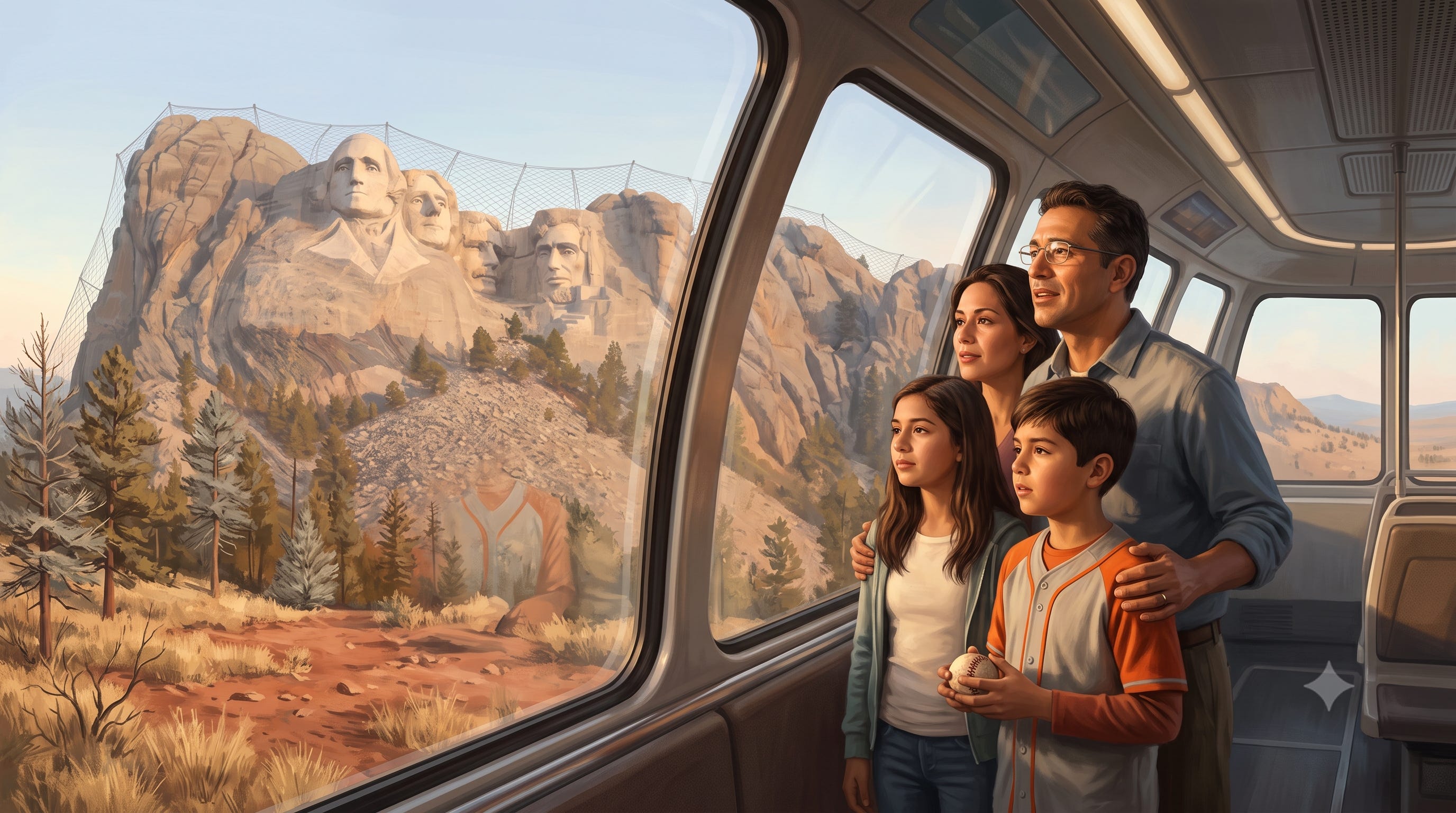
The four faces carved into the mountain’s granite face—Washington, Jefferson, Roosevelt, and Lincoln—stared out over the transformed, post-ecological landscape. A delicate, near-invisible weave of atmospheric stabilization mesh was anchored along the upper ridge of the mountain, preventing thermal cracking from the extreme heat cycles, but the faces themselves remained untouched. The sixty-foot-high features carved two centuries ago by human hands were as sharp and resolute as the day they were finished.
Augusto stepped up to the glass, his fingers pressing against the cool composite pane. His eyes welled with sudden, overwhelming heat.
“Look at them,” Augusto whispered, his voice cracking slightly.
Lucy stepped beside him, placing a gentle hand on his shoulder, while Matty and Angie quieted down, caught up in their father’s sudden, profound stillness.
“George Washington,” Augusto said softly, pointing with a trembling finger. “Thomas Jefferson. Theodore Roosevelt. Abraham Lincoln. Built during a time when people thought the forests would last forever, when they thought the ocean would stay where it belonged.”
“They look like they’re guarding the valley, Dad,” Matty said, leaning against Augusto’s arm, his baseball held loosely in his hand.
“They are guarding something better, Matty,” Augusto said. He reached out and pulled Angie close on his other side, wrapping his arms around both of his children while Lucy leaned her head against his shoulder.
Standing there on the high ridge of South Dakota, bathed in the sharp, pale sunlight of 2179, Augusto didn’t feel the familiar grip of fear or paranoia that had kept him locked inside the clay walls of Pit 4 for forty-four years. He didn’t see a ruined, dying planet.
He saw a species that refused to quit.
He thought of the Nightwalkers under their shade-tents, finding a way to live through the night. He thought of the engineers in New Jax, weaving plasma fields out of thin air to keep three hundred thousand people safe. He thought of the men and women who climbed this granite peak two hundred years ago with chisels and dynamite, carving human dignity directly into the bedrock of the earth.
It was a harsh world—a dangerous, altered, heat-scarred world. But as he looked at his wife and children standing under the gaze of those four stone giants, Augusto knew it was still their world. Full of grace, full of history, and fundamentally unbroken.
“Happy birthday to me,” Augusto murmured, a quiet, luminous smile washing over his face as the mountain held them in its shadow.
Thanks for reading! Subscribe to my Substack for free to receive new posts and support my work.