MTGO Modern Breakdown: Midrange takes 25 Top 8 slots and no trophies, Combo is the biggest archetype with the worst conversion, Jeskai Energy takes the RC Super Qualifier

MTGO Modern Breakdown: Midrange takes 25 Top 8 slots and no trophies, Combo is the biggest archetype with the worst conversion, Jeskai Energy takes the RC Super Qualifier

Welcome to the latest edition of the traditional Modern metagame overview. There was no article last week because I took a short trip to the mountains and simply didn’t have time to prepare it. However, the time away gave me a chance to rethink the format, so this week’s data presentation differs slightly from the usual style. The key figures for each archetype and deck are summarized at the beginning of their respective sections, followed by my commentary. I believe this layout makes it easier to compare specific values ​​against one another.

As always, for anyone who wants the video version with my commentary, here is the YouTube link. If you prefer text with the full charts and figures, it is all on my Substack. I post on X most days, too, mostly league results and smaller data bits that don't make it into the weekly write-up.

 TL;DR

●        Midrange had 25 Top 8 entries, but  no trophies across 23 events

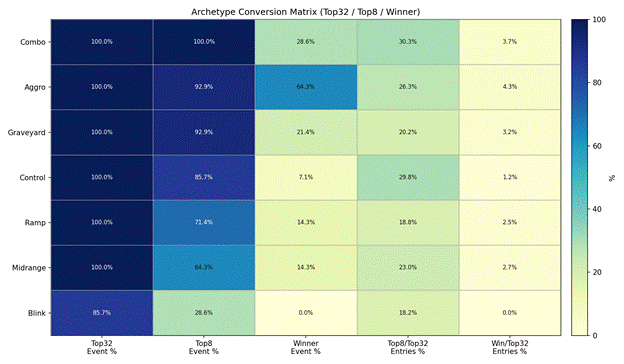
●        Midrange conversion is 27%, the highest of all archetypes,

●        In the other end is  Combo with 22% conv.,

●        But Combo is now 28% of the field, with 6 trophies,

●        Aggro with 18% is second and gets 6 trophies

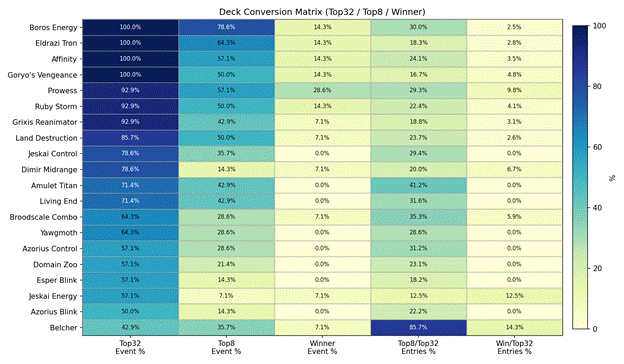
●        Goryo’s Vengeance Top32 23/23, delta +91pp, best in field

●        Devoted Combo had 66 Top32 entries, 1 trophy, and conv. 21% under the median

●        Three decks above the field median on both delta and Top 8 conversion: Prowess, Dimir Midrange, Living End

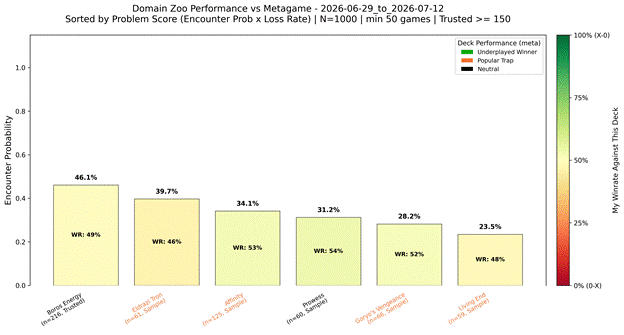
●        Four decks above 33% encounter probability, two of them are  Combo decks.

 This window in numbers

●        In this breakdown, we had: 23 Challenges, 3 tiers: C64 x15, C32 x5, C96 x3

●        Universe A (encounter probability over 5%): 24 decks, Universe B: 25 decks

●        Median delta +65pp, median conv 27%,

●        15 different decks took the 23 trophies; no deck won more than three,

●        Trophy split by archetype: Combo 6, Aggro 6, Graveyard 4, Control 3, Blink 2, Ramp 2, Midrange 0

Combo

meta share: 28.5%

Top32: 23/23

Top8: 21/23

Win/Top32: 3%

Trophies: 6

Conversion: 22%

Delta: +71.5pp

WR: 49% (95% CI 46 to 51, n=1494)

It is the biggest archetype in the field right now and growing, so we can say that Modern is now dominated by Combo, accounting for almost 1/3 of the meta. As is typical of the highest-representation archetype/deck, it has a low conversion rate. It is basically because many new players try to play this archetype, and they are not as consistent as combo devoted players. Despite the low conversion rate, Combo wins 6 trophies, which is a lot. But why? In my opinion, it is the volume effect, not necessarily the quality. We had a lot of combos entering the challenges, so the chances that Combo wins are quite high. I think Combo is something you have to respect and learn to play against, or learn to play this archetype. At least to a moment when players who like to change decks for new and popular decks will start to play something else. It is common in MTGO but not in a Pauper metagame.

Devoted Combo | Combo | Neutral | Trend: Rising

meta share: 10.4%

Top32: 22/23

Top8: 13/23

Win/Top32: 2%

Trophies: 1

Conversion: 21%

Delta: +85pp

WR: 47% (95% CI 43 to 52, n=533)

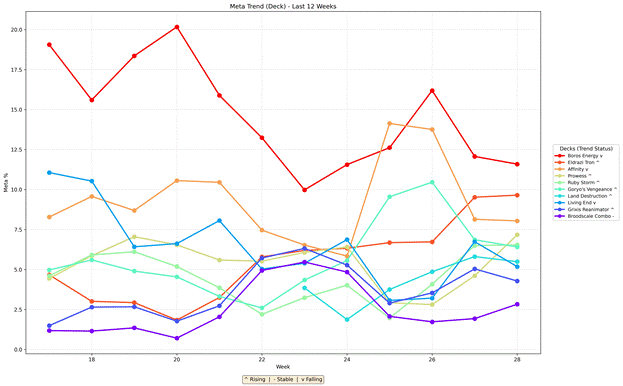
Now it is the largest deck in the format, but it has the typical popular-deck sickness: a lot of people who saw good results with this deck rent it and now do not have the best stats. The popularity of this deck skyrocketed a few weeks ago and is correlated with some good challenge results and Riley Hicks’ article on MTG Rocks. I will not say that it is the best deck in the format right now, low Top32 to Win, low conversion, and only one trophy suggest that this deck is harder to play than a lot of people may think. It may also have a surprise effect at the start, and as people learn to play against it and know its weaknesses, it may decrease in popularity. Still is a large piece of the metagame, the deck can be fast and win. One trophy might not look like a lot if we take into account how many copies of the deck we see, but it is a trophy, and it proves that the deck needs to be taken seriously.

Broodscale Combo | Combo | Neutral | Trend: Rising

meta share: 7.7%

Top32: 22/23

Top8: 11/23

Win/Top32: 6%

Trophies: 3

Conversion: 24%

Delta: +88pp

WR: 53% (95% CI 48 to 58, n=400)

This is, I think, the best combo deck in a format. Solid WR from a large sample, get to a top8 and get trophies quite consistently and with a high degree of effectiveness. It has been in a format for a while and proves that it’s a deck you can rely on. It is also one of the reasons why Affinity is losing popularity. As a good Combo deck, it also had a plan B to win when the combo is disrupted, so when playing against it, remember that not only the combo but also Emarkul can easily kill you. I’m really happy that something I can call a fair combo deck is doing so well. I’ve always enjoyed playing against this deck because the games are exciting and full of twists and turns, and they give you the feeling that you can actually do something. Maybe it’s because the deck doesn’t kill you on turn two, so even when you’re on the draw, you’re still able to make a move. Maybe I will even try to learn it as my second modern deck? I think this deck’s strong performance stems from a really solid blend of consistency, flexibility, and a favorable meta, specifically, the limited presence of Consign to Memory and the prevalence of decks that lack a proper answer to the Broodscale Combo, allowing this deck to simply ignore them, execute its own game plan, and win. Besides, this isn’t a “pick-up-and-win” deck; I believe many of the pilots have really mastered it and know exactly what they’re doing. You definitely need to be prepared for this deck.

Ruby Storm | Combo | Neutral | Trend: Stable

meta share: 3.3%

Top32: 17/23

Top8: 2/23

Win/Top32: 0%

Trophies: 0

Conversion: 9%

Delta: +71pp

WR: 43% (95% CI 36 to 51, n=169)

This is quite an interesting case in this Breakdown, super low conversion, not the best win rate, and almost no presence in top8. Ruby Strom does not have the best time right now. I think there is a lot of graveyard hate in the format, as well as efficient combo hate. Recent popularity of Neoform and great scores of Goyro’s Vengeance produce a quite toxic metagame for a Ruby Strom. I will not ignore this deck, but also do not prepare for it, especially. Hate pieces for GY and other combo decks are quite fine. Remember that Prowess is on fire, so High Noon/ Deafening Silence are great SB additions. Oh, and a rule of thumb, if Storm Player keeps 7, it probably has the possibility to kill you on turn 2-3. If mull to six, you are quite safe to turn 3.

Belcher | Combo | Neutral | Trend: Stable

meta share: 1.4%

Top32: 10/23

Top8: 5/23

Win/Top32: 9%

Trophies: 1

Conversion: 55%

Delta: +42pp

WR: 57% (95% CI 47 to 67, n=87)

Belcher’s data looks really interesting, high conversion and nice WR, but all of those came from a small sample, so I will not focus on that. Sure, Belcher wins a trophy, but next week’s show if he can repeat that. I must say that I have not seen this deck for a while in the metagame, and I was surprised that it won a Trophy. Congrats on a pilot! Maybe he is here on Reddit and can share some thoughts how Belcher feel in combo reach metagame?

Amulet Titan | Combo | Neutral | Trend: Falling

meta share: 1.2%

Top32: 7/23

Top8: 2/23

Win/Top32: 14%

Trophies: 1

Conversion: 29%

Delta: +29pp

WR: 53% (95% CI 42 to 63, n=82)

Similar story as Belchaer, small sample, high conversion, and WR. Unlike Belcher, however, Amulet Titan appears in the Top 8 quite frequently. In my opinion, this is because the deck has dedicated and truly skilled pilots who continue to perform exceptionally well despite the deck being weakened by bans. Of course, the deck no longer wins as easily on T3, but someone who knows how to play it (and which lines to choose) will still perform really well with it. It might not be worth a dedicated SB slot, but you certainly need to know how to handle it when you do encounter it, because the person piloting it is sure to be a strong player.

Aggro

meta share: 17.9%

Top32: 23/23

Top8: 19/23

Win/Top32: 4%

Trophies: 6

Conversion: 25%

Delta: +82.1pp

WR: 51% (95% CI 48 to 54, n=1009)

Aggro gets back to second place in a metagame, and here is a surprise: it is no longer a Boros archetype. Sure, energy is not going anywhere, but the new Aggro king is Prowess, and I’m quite happy about that. This is a fair deck that requires good skill and experience to play well. Also, Aggro took 6 trophies and has the best Trophies to meta share ratio in this window. Still, the conversion is not exceptional because it is lower than, let’s say, midrange and Ramp, so Archetypes that are lower in meta share. Still a great window for Aggro.

Prowess | Aggro | Challenge Overperformer | Trend: Rising

meta share: 6.7%

Top32: 22/23

Top8: 12/23

Win/Top32: 5%

Trophies: 3

Conversion: 28%

Delta: +89pp

WR: 55% (95% CI 50 to 60, n=411)

Yes, the king of Aggro in this window. I remember when Prowess did not perform very well, but that is in the past now. This deck is perfectly prepared for combo meta, is super fast, has counterspells to stop combo, and can kill you faster than you can say Griselbrand. The numbers confirm that, Great WR from a large sample and CI starts at 50% (!), solid conversion, and three trophies. But if you think that it is an easy deck to play, do not get fooled. I like it so much because it requires skill and experience, so think twice before you pick it up and expect an instant 5-0 in a league.

Boros Energy | Aggro | Neutral | Trend: Falling

meta share: 5.7%

Top32: 20/23

Top8: 9/23

Win/Top32: 2%

Trophies: 1

Conversion: 24%

Delta: +81pp

WR: 48% (95% CI 42 to 54, n=304)

Old King of Format and Aggro archetype is not on the top, but still a solid performer. Fine WR from a good sample, conversion below median, and one trophy in a window. Unfortunately, it has quite a low number of Top8 entries compared to other top decks. Still is one of the best choices to enter Modern. It can win, it is quite easy to play, and has plenty of good materials to learn. Ok, it is not the most popular in the format, but a solid choice.

Affinity | Aggro | Neutral | Trend: Falling

meta share: 3.3%

Top32: 17/23

Top8: 4/23

Win/Top32: 6%

Trophies: 2

Conversion: 19%

Delta: +71pp

WR: 49% (95% CI 41 to 57, n=157)

What happened here is quite interesting, some time ago Affinity was basically out ot Trophies and some players in Reddit predicted that Affinity would not get to the trophy any soon. Ok, it is falling in popularity, has a really low conversion, and WR came from a small sample, so do not say much, but it takes two trophies from four T8 entries. That means if it gets to the top, there is a high chance that Affinity will win. Sure, it came from a small sample, but it is a sign that this deck is not dead and might surprise us.

Graveyard

meta share: 17.3%

Top32: 23/23

Top8: 16/23

Win/Top32: 3%

Trophies: 4

Conversion: 25%

Delta: +82.7pp

WR: 48% (95% CI 44 to 51, n=917)

Last week, Graveyard was second; now it is third, dropping slightly. It was present in all of the Challenges, but from the Big 3 has the lowest T8 conversion. Probably people just prepare better for GY decks to beat them, and this seems to work. Still a super powerful archetype, that has the second most popular and probably the best decks in the format.

Goryo’s Vengeance | Graveyard | Neutral | Trend: Rising

meta share: 9.0%

Top32: 23/23

Top8: 11/23

Win/Top32: 4%

Trophies: 3

Conversion: 25%

Delta: +91pp

WR: 48% (95% CI 44 to 53, n=472)

This is, in my opinion, actually the best Modern deck, has a lot of answers for each deck in the format, and few ways to kill you because even with GY hate, you may easily lose the game. Not impressive WR and conversion probably came from its popularity, as it is the only deck to be in the top 32 of all challenges. It says that many people play it, and in a large sample, you will find more inexperienced players. For me, it is one of the scariest decks in the format. Maybe you will not read it from numbers, but when you play against it, you will admit that.  

Living End | Graveyard | Challenge Overperformer | Trend: Falling

meta share: 3.5%

Top32: 18/23

Top8: 7/23

Win/Top32: 0%

Trophies: 0

Conversion: 29%

Delta: +75pp

WR: 48% (95% CI 41 to 55, n=185)

In this window, LE is an overperformer, great conversion, over median delta, good top32 presence, but what might surprise you is no trophies! For me, it looks like a continuation of a trend we have seen over the past few weeks: LE is losing popularity, and only devoted players are staying with it. Still, in the current metagame, this deck just struggles with winning.

Grixis Reanimator | Graveyard | Neutral | Trend: Stable

meta share: 2.6%

Top32: 11/23

Top8: 4/23

Win/Top32: 0%

Trophies: 0

Conversion: 25%

Delta: +45pp

WR: 46% (95% CI 37 to 55, n=118)

Reanimator continues the “nothing special” trend. Right now, it is the weakest deck in the GY archetype, and I do not expect that to change any time soon.

Midrange

meta share: 12.8%

Top32: 22/23

Top8: 17/23

Win/Top32: 0%

Trophies: 0

Conversion: 27%

Delta: +82.9pp

WR: 52% (95% CI 48 to 55, n=711)

So this is something that I do not expect to see. Midrange has the best conversion in a field, quite solid WR, a lot of Top8 entries, but no trophy. It is the only archetype that did not get a trophy. We will see in a couple of weeks if it changes, I hope so. I have no idea what happened in all of those Top8s because Midrange is quite well prepared to beat the current metagame. If I had to guess, it’s a mix of unfortunate matchups and variance. Still, zero wins out of 17 attempts is a bit concerning. The problem might be that the broad metagame preparation required to advance from the Swiss rounds to the Top 8 results in pilots of this archetype facing decks in the Top 8 that are better optimized for Game 1. Furthermore, trying to catch up after a loss, especially when playing a deck that demands a lot of focus during a long tournament, is no easy thing to do. Consequently, decks with a more linear game plan may hold an advantage here. I hope Midrange pilots find a way to break this deadlock.

Dimir Midrange | Midrange | Challenge Overperformer | Trend: Rising

meta share: 4.9%

Top32: 19/23

Top8: 9/23

Win/Top32: 0%

Trophies: 0

Conversion: 29%

Delta: +78pp

WR: 56% (95% CI 50 to 62, n=268)

The best midrange in a format, great WR from a solid sample (low CI 50%!), really good conversion. Answer to basically everything in format and no trophy this time. The overperformer badge is not a wrong decision; you do not need to win challenges to be a good deck. Remember, Top8 in Challenge is a great score, and all numbers about this deck confirm that Dimir Midrange is a Tier 1 deck; it only needs a win some trophy to seal this up.  

Domain Zoo | Midrange | Neutral | Trend: Falling

meta share: 2.8%

Top32: 13/23

Top8: 5/23

Win/Top32: 0%

Trophies: 0

Conversion: 28%

Delta: +54pp

WR: 47% (95% CI 39 to 55, n=150)

Not the best time for my pet deck, I still think that deck is struggling after Phlage ban, and trying to find its place in the metagame. Not an impressive WR, but a fine conversion, still delta under the median. Still fun deck to play and can do some solid league results. Also, it is not absent in Challenge top8, so it is still a solid choice for players who enjoy this type of play.

Yawgmoth | Midrange | Neutral | Trend: Falling

meta share: 1.2%

Top32: 8/23

Top8: 3/23

Win/Top32: 0%

Trophies: 0

Conversion: 30%

Delta: +34pp

WR: 53% (95% CI 42 to 64, n=77)

Third deck in the Midrange archetype. It can be scary if you meet it, but as you can see, it is not a very popular deck right now, and I do not expect it to change soon. Still interesting choice if you want some rogue midrange deck.

Blink

meta share: 9.0%

Top32: 22/23

Top8: 14/23

Win/Top32: 3%

Trophies: 2

Conversion: 25%

Delta: +86.6pp

WR: 51% (95% CI 46 to 55, n=466)

Ok, so Blink is back in the form of Esper Blink. Basically, it is only the deck in this archetype, so times when we had 4-5 different shades of Blink are gone. But it does not mean that this one last Blink is weak, great delta, solid conversion, and good WR from a large sample. I think Blink, in the form of Esper, will be in the meta for a longer time. I’m thinking about merging Blink into a Midrange archetype because I used the Blink archetype when we had a lot of these decks; now we have only one, and it might be a clearer option.

Esper Blink | Blink | Neutral | Trend: Rising

meta share: 8.25%

Top32: 22/23

Top8: 13/23

Win/Top32: 3%

Trophies: 2

Conversion: 26%

Delta: +87pp

WR: 52% (95% CI 47 to 57, n=426)

I wrote a lot in the archetype section, but Esper Blink deserves a few more sentences. It is the third-largest deck in format, and as was said, the whole archetype basically. Solid WR, fine conversion, a lot of T8 presence, and two trophies say a lot about this deck. It delivers a solid game plan and card advantage that is probably the best in the whole format. None of the decks made such good use of the best creature in the format, Quantum Riddler. I expect that this deck will continue its Rising trend, and I will be no surprised if at some point it will be the most played deck in the format.

Bant Blink | Blink | Emerging | Trend: Stable

meta share: 0.6%

Top32: 4/23

Top8: 0/23

Win/Top32: 0%

Trophies: 0

Conversion: 0%

Delta: +17pp

WR: 39% (95% CI 24 to 57, n=30)

Only other than Esper Blink deck in challenges, but it is here only because of its show in the challenge, we also had a Mardu Blink that has solid scores in leagues, so maybe in the next window we will have three decks in here.

Ramp

meta share: 7.5%

Top32: 22/23

Top8: 12/23

Win/Top32: 3%

Trophies: 2

Conversion: 29%

Delta: +88.2pp

WR: 51% (95% CI 46 to 56, n=408)

Ramp has solid results in this window, nice conversion, got two trophies from a low metashare, it is something. Also, as an archetype, Ramp has almost 50% T8 presence, which is impressive.

Eldrazi Tron | Ramp | Neutral | Trend: Falling

meta share: 3.0%

Top32: 15/23

Top8: 8/23

Win/Top32: 0%

Trophies: 0

Conversion: 35%

Delta: +62pp

WR: 57% (95% CI 49 to 64, n=166)

Here we have a deck with a 3% meta share and really good conversion. It was in 15 Top32 events and got into over half the T8. Unfortunately, I did not get any trophy. It may look strange, but if we look into the decks that actually win challenges, we can see there are a lot of super-fast decks that put clock that might be too fast for E-Tron to handle. Still, it is a really powerful deck that performs really well, especially taking into consideration how the metagame looks right now.

Mono-Green Eldrazi | Ramp | Neutral | Trend: Falling

meta share: 2.8%

Top32: 16/23

Top8: 3/23

Win/Top32: 5%

Trophies: 1

Conversion: 14%

Delta: +67pp

WR: 44% (95% CI 36 to 53, n=131)

For Mono Green Eldrazi Ramp, we have a different situation than with E-Tron. This deck has the second-lowest conversion in the field, but it still managed to win one trophy from the three T8S it entered. It clearly shows what I say basically every time: all decks that enter Top8 are good choices and can win it despite the numbers. Mono Green tho had a small advantage over E-Tron; it is not that easy to hate its mana cause he had more basics than E-Tron, and this might be a secret of this trophy, especially if we had a lot of LD options in the format.

Eldrazi Ramp | Ramp | Neutral | Trend: Stable

meta share: 1.8%

Top32: 11/23

Top8: 5/23

Win/Top32: 8%

Trophies: 1

Conversion: 38%

Delta: +46pp

WR: 53% (95% CI 44 to 62, n=111)

Second-best converting deck in the format, solid WR, and one trophy confirm that there is a place in the metagame for Ramp decks. Remember that Eldrazi Ramp and Mono Green-Eldrazi Ramp are not that different decks; there are slight differences between those two that also show that Tron might be a worse strategy for a Ramp than this, which is what Eldrazi Ramp does.

Control

meta share: 7.1%

Top32: 21/23

Top8: 9/23

Win/Top32: 6%

Trophies: 3

Conversion: 27%

Delta: +84.2pp

WR: 49% (95% CI 45 to 54, n=423)

The last archetype for today, Control, is at 7% of the meta, which is quite good, taking into account that a few months later, there was basically no control at all, and now it has the highest conversion to top32 to win, but it might be a low-sample artifact. Also, the archetype had solid WR, and it is quite diverse cause we had three different strategies, not only different flavors of one deck.

Land Destruction | Control | Neutral | Trend: Falling

meta share: 1.6%

Top32: 8/23

Top8: 2/23

Win/Top32: 10%

Trophies: 1

Conversion: 30%

Delta: +33pp

WR: 55% (95% CI 45 to 64, n=103)

One trophy goes to one of the most hated decks in the format, Boros Land Destruction. This construction is falling in popularity but presents quite a solid challenge for 1.6% meta deck scores. Nice top-32-to-win ratio and solid conversion. Dropping in popularity may be caused by the fact that people who were interested in the deck after it emerged drop it for another prince charming, and now only true LD lovers play it.

UW Control | Control | Neutral | Trend: Stable

meta share: 1.4%

Top32: 11/23

Top8: 3/23

Win/Top32: 9%

Trophies: 1

Conversion: 27%

Delta: +46pp

WR: 51% (95% CI 40 to 62, n=71)

It is a Scepter Control deck, quite a heavy control deck that can lock you in if you aren’t careful enough. Not a super popular deck, but it does a good job in challenges, and as far as I remember, most of the trophies that came from that deck came from one pilot. It is another example that supports my theory that it is better to play one deck that you enjoy playing than to jump between different ones. I do not think that Scepter Control has become a super popular deck, but it is something that you meet from time to time, and I have a lot of respect for players who play a fair, control deck in such an unfair format as modern and do well with it. Cudos!

Azorius Control | Control | Neutral | Trend: Stable

meta share: 1.4%

Top32: 6/23

Top8: 2/23

Win/Top32: 0%

Trophies: 0

Conversion: 33%

Delta: +25pp

WR: 48% (95% CI 38 to 58, n=90)

Classic control deck, that performs quite well if you consider its metashare. I will not expect to see it often in leagues, but it shows up quite consistently in challenges, so it is better to know the basic lines of this deck so you are not surprised if you meet it from time to time.

Premier events

●        1 premier event in window: RC Super Qualifier, 2026-08-15, EventID 12851608

●        winner Jeskai Energy, pilot TrueHero

●        Top 8 by deck: Jeskai Energy, 4c HollowOne, Mono-Black Midrange, Prowess, Prowess, Goryo’s Vengeance, WBRG Cosmogoyf, Broodscale Combo

●        separate pool from Challenges, single event, no metagame weight

●        Jeskai Energy in Challenge data: meta 1.0%, Top32 8/23, Top8 2/23, trophies 0

●        Prowess two of eight Top 8 slots, consistent with its Challenge profile

There was one RC Super Qualifier in this window, and Jeskai Energy won it. In T8, we see: 4c HollowOne, Mono-Black Midrange, Prowess, Prowess, Goryo’s Vengeance, WBRG Cosmogony, and Broodscale Combo. So it shows something interesting: Premier Event was won by a deck that does not show up a lot in challenges. Sure, it is a variation of Boros Energy, but still. It is only one event, so the sample is small, but the Top8 in this tournament shows that the format is quite diverse right now, as we see less popular decks like mono black midrange or WBRG Cosmogony in the Top8 of a major event.

On the Radar (Universe B, below 5% encounter, present in Challenges)

Here we have decks that are at an encounter rate under 5% in a league, but were present in challenges. Any of those decks can easily jump into universe A decks because people will see them in the challenge results and will try to play them. Worth noting is that all of those decks are competitive because you do not win the challenge trophy or get into T8 by mistake. In the case of those decks, I will not focus on WR because the sample is so small that it says basically nothing special; more important is how deep they go into challenges.

●        Lantern: no league presence at all, Top32 1/23, Top8 1/23, 1 trophy

●        Jeskai Energy: meta 1.0%, Top32 8/23, Top8 2/23, trophies 0, WR 51% (95% CI 38 to 64, n=53), won the RC Super Qualifier

●        4c HollowOne: meta 0.4%, Top32 4/23, Top8 2/23, 1 trophy, WR 47% (95% CI 30 to 64, n=29)

●        Rakdos HollowOne: meta 0.8%, Top32 6/23, Top8 1/23, trophies 0, WR 59% (95% CI 46 to 71, n=59)

●        Grixis Midrange: meta 0.6%, Top32 4/23, Top8 1/23, trophies 0, WR 62% (95% CI 45 to 77, n=31)

●        Song of Creation: meta 1.0%, Top32 5/23, Top8 1/23, trophies 0, WR 40% (95% CI 27 to 55, n=45)

●        WUBRG: meta 0.8%, Top32 6/23, Top8 2/23, trophies 0, WR 47% (95% CI 34 to 60, n=52)

Trophy distribution, all 23

●        3: Goryo’s Vengeance, Prowess, Broodscale Combo

●        2: Esper Blink, Affinity

●        1: Devoted Combo, Boros Energy, Mono-Green Eldrazi, Eldrazi Ramp, UW Control, Belcher, Land Destruction, Amulet Titan, 4c HollowOne, Lantern

●        15 different decks, no deck above 3

●        Archetype split: Combo 6, Aggro 6, Graveyard 4, Control 3, Blink 2, Ramp 2, Midrange 0

 That’s all for today. I hope this new way of presenting the data is clearer for you and allows you to glean more information about what’s been happening in Modern during the current window. If you have any comments, feel free to share them. Constructive criticism is always welcome, as my goal is to ensure the community gets the most out of what I do.

Karol Małota

aka WarLord1986pl / TribalFlamesInYourFace
u/No-Bet7157 — 2 days ago
▲ 16 r/MTGO

MTGO Modern Breakdown: Land Destruction posts the best conversion in the format, Aggro wins 4 from the largest presence, Broodscale takes the Showcase Qualifier

This is a repost from r/ModernMagic cause Redit told me that you might like it. If it is true I can repost those weekly post here ;)

Traditional weekly modern metagame breakdown. It is still a combo meta; aggro is going down, and the second-most-played archetype is graveyard. Challenge results are quite diverse; there is no one deck domination, which is good. But under the last post, I had a discussion with u/Slacker_87, and we both agree that meta might look diverse and healthy, but in reality, it is not that good. From my point of view, when you have a deck that, if you do not have an answer for them in the opening hand, you will lose quite quickly, it's not a great place to be.

As always, for anyone who wants the video version with my commentary, here. If you prefer text with the full charts and figures, it is all on my Substack. I post on most days, too, mostly league results and smaller data bits that don't make it into the weekly write-up.

TL;DR

**Twenty-four Challenges gives us twenty-four different winning pilots.** Nineteen different decks took at least one trophy. Nobody won twice!

**The three biggest decks all convert below the field median.** Goryo’s Vengeance and Broodscale Combo made Top 32 in every single event and turned that into one and two trophies, respectively. Boros Energy missed only two events.

**Control has the best conversion of any archetype at 35%,** from the second smallest presence in the format. Midrange took six trophies, more than any other archetype.

**Aggro is no longer the biggest archetype and has the worst conversion in the field.** It reached Top 32 in all 24 events and turned that into 18% Top 8 entries.

**Domain Zoo posted 32% conversion against a 28% field median,** with one trophy and a positive delta. The 49% win rate reads worse than the Challenge results do.

How to read the numbers

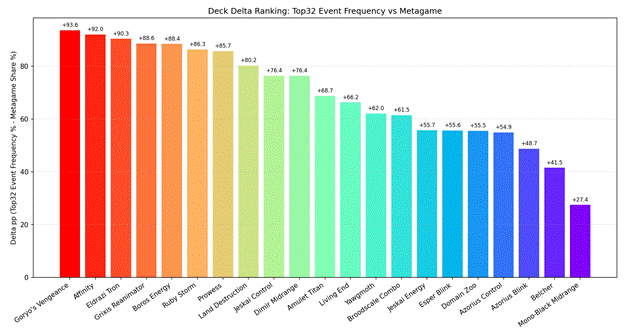
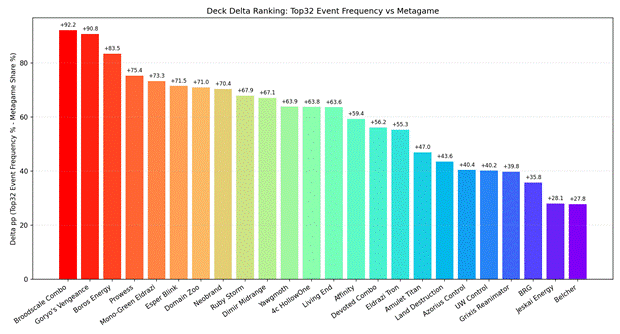
Top 32 presence means the number of Challenges where a deck put at least one pilot into the Top 32. Top 8 presence is the same thing for the Top 8. Conversion is the Top 8 entries divided by the Top 32 entries, which tells you how often getting there turns into going deep. Delta is Top 32 event frequency minus metagame share, so a high delta means a deck shows up in results more often than its raw popularity would suggest. *The field median for this window is +64.*

Thresholds are recalculated from the actual distribution for each window, never carried over. This window, the median delta is +64, and the median conversion is 28%. A deck needs to beat both to earn a Challenge Overperformer flag.

Win rates come with a 95% confidence interval and a sample size. They are context, not the argument. A deck can post a good win rate and still fail to close tournaments, and this window has several examples.

Combo, 23% of the field

Combo is now the largest archetype in Modern. It reached the Top 32 in every one of the 24 Challenges and the Top 8 in 21 of them, with four trophies and a 25% conversion rate. That is solid, but it hides a real split between the decks inside.

Broodscale Combo

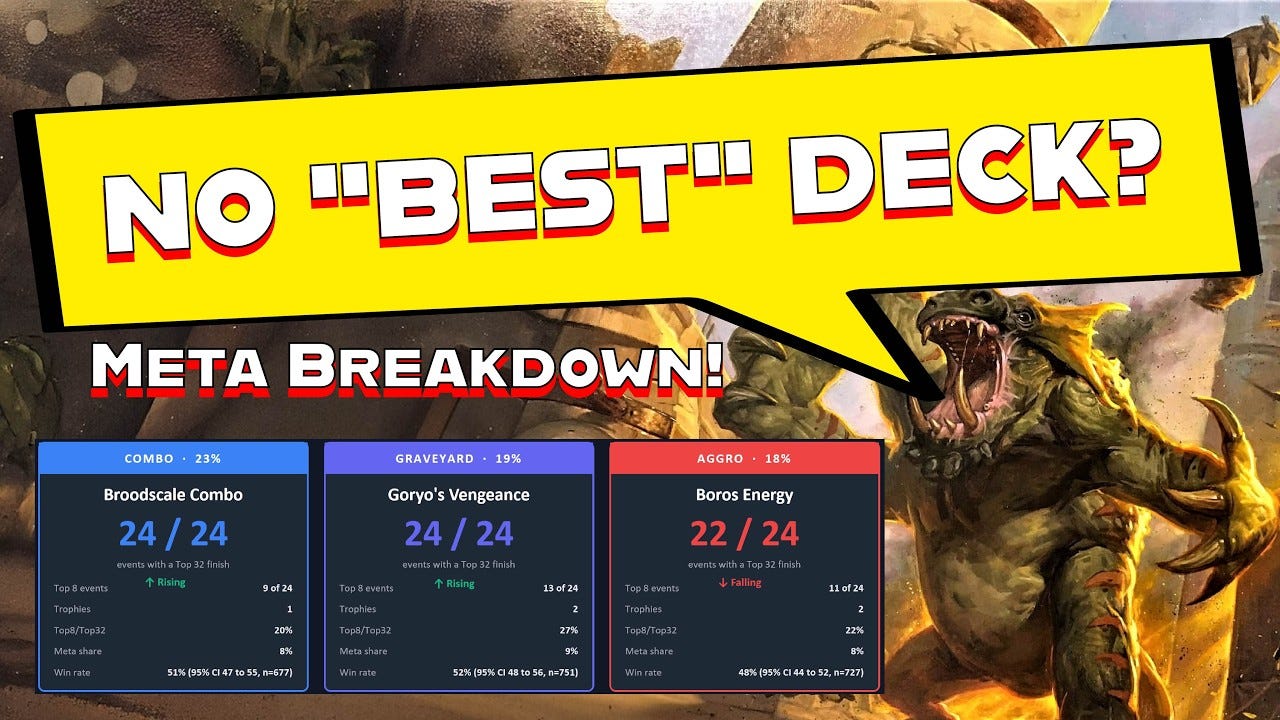
Broodscale sits at 8% metagame and rising; it did something only one other deck managed: a Top 32 finish in all 24 events. Its delta of +92 is the highest in the entire field, but it is in the Top 8 in only 9 of 24 events (20% conversion) and has a single trophy.

The win rate is 51% (95% CI: 47-55, n=677), based on a large sample. Those two things together show the shape of the deck right now: it qualifies for the Top 32 basically every time, it wins about half its matches, and it does not run away with the trophy. Remember that it is the deck you will face most often after Goryo’s, so be prepared!

Neobrand

Neobrand is at 5% share and climbing hard. Top 32 in 18 events, Top 8 in 7, one trophy, 23% conversion. The win rate of 47% (95% CI 42 to 52, n=377) is the weakest of the major Combo decks, and the interval sits mostly below even.

That combination usually means a deck is being picked up faster than it is being learned, which is not so surprising after good PT performance. Also, it is quite a glass cannon deck; if the opponent has something to stop the combo, he will win. A delta of +70 indicates it appears in the results; a conversion below the median indicates those results are shallow. Worth respecting, not worth panicking about.

Amulet Titan

Amulet is the quiet one. Only 12 of 24 events with a Top 32 finish, which is the lowest presence of any deck in this section, but 27% conversion and one trophy from that smaller base. Win rate 49% (95% CI 43 to 55, n=271).

This is what a pilot-dependent deck looks like in aggregate data. It is not everywhere, and when it is there, it goes quite well.

Two other Combo decks matter for context. Ruby Storm posted 36% conversion, one of the best ratios in the entire field, and zero trophies in 24 events. Its win rate is 46% (95% CI: 40-52, n=260), and its metagame share is declining. Devoted Combo has a similar 37% conversion rate, one trophy, and a 55% win rate (95% CI 48 to 61, n=223), on a rising trend. I think that this deck needs some attention because it can be a rising star.

Graveyard, 19% of the field

Graveyard is the second largest archetype, and it also hit Top 32 in every event. Top 8 in 18 events, five trophies, and 23% conversion. Unlike previous windows, the graveyard decks are actually closing and breaking a pattern we have observed for some time.

Goryo’s Vengeance

Goryo’s is now the largest single deck in the format at 9%, and it is still rising. Top 32 in all 24 events, Top 8 in 13, two trophies, 27% conversion, delta +91. The win rate is 52% (95% CI 48 to 56, n=751), from the biggest sample in the data.

Almost everything about this deck is at or near the top of the field, and yet the conversion is under the 28% median. That is not a criticism, but a statement about how flat this format is right now. The most popular deck in Modern, with the largest sample and the most Top 8 appearances, still cannot turn presence into a disproportionate number of trophies. It looks a little bit different from what we see when Boros was on top.

Living End

Living End is at 3% and falling. Reached Top 32 in 16 events, but Top 8 in only 4. It did take one trophy. It has 16% conversion rate, well below the median and a win rate 48% (95% CI 44 to 52, n=532).

This looks like a deck the format has adapted to. Enough interaction and enough graveyard hate are being played for other reasons that Living End is getting caught in the crossfire.

4c HollowOne

HollowOne is at 3% and rising, with Top 32 in 16 events, Top 8 in 6, one trophy, and a 29% conversion rate. Delta +64. That clears both medians, so it takes a Challenge Overperformer flag this window.

The win rate of 47% (95% CI 41 to 53, n=272) does not support that reading at all, which is something worth looking into more closely. Either the deck is concentrated among pilots who know it well, or the raw match data is picking up a lot of people trying it out. Both are plausible, but the challenge results count more, in my opinion.

**Grixis Reanimator** rounds out the archetype with the best win rate of any graveyard deck at 57% (95% CI 50 to 64, n=174), one trophy, but presence in only 10 of 24 events. Small, sharp, and not widely played.

Aggro, 18% of the field

Aggro was the biggest archetype in Modern for most of this year, but it ends for now at least. It still reached the Top 32 of every single event, which tells you the decks are fine, but it converted only 18% of those entries into Top 8 finishes. That is the worst ratio of any archetype in this breakdown, and it comes with four trophies.

Boros Energy

Boros is at 8% and falling. Top 32 in 22 of 24 events, Top 8 in 11, two trophies, 22% conversion, and delta +84. Win rate is 48% (95% CI 44 to 52, n=727), based on a quite large sample.

The story here is the same one as three weeks ago, just with smaller numbers. Boros gets into the events almost every time. It reaches the elimination rounds at a decent level, but it does not finish at a rate that we might expect.

Prowess

Prowess is at 4% and falling, with Top 32 in 19 events and Top 8 in only 5. The 18% conversion is quite low, but it took two trophies, which is more than Broodscale managed with twice the presence.

That combination is interesting. A deck that rarely reaches Top 8 but wins when it does is either running very hot or has a small number of pilots who are much better than average with it. The win rate of 49% (95% CI 44 to 54, n=344) leans toward the second reading, especially since Prowess is not an easy deck to play properly.

Affinity

Affinity has the worst conversion of any big decks in the format in this breakdown. Top 32 in 15 events, Top 8 in 2, zero trophies, 9% conversion. But the win rate is 53% (95% CI 47 to 59, n=285), one of the better figures in the data.

A 53% win rate and a 9% conversion rate should not coexist. The most likely explanation is that Affinity is beating up on the middle of the field and losing consistently to whatever it meets at the top tables. If you are playing Affinity, you may comment on what your feelings are about the metagame right now. My idea is that Affinity has a really bad time against all of those combo decks in the format.

Midrange, 16% of the field

Midrange took six trophies witch is more than any other archetype. Top 32 in every event, Top 8 in 16 (28% conversion). It is quietly having the best window in a long time.

Domain Zoo

Zoo is at 4% and rising. Top 32 in 18 of 24 events, Top 8 in 7, one trophy, 32% conversion against a 28% median, delta +71 against a +64 median. That clears both thresholds and earns a Challenge Overperformer flag.

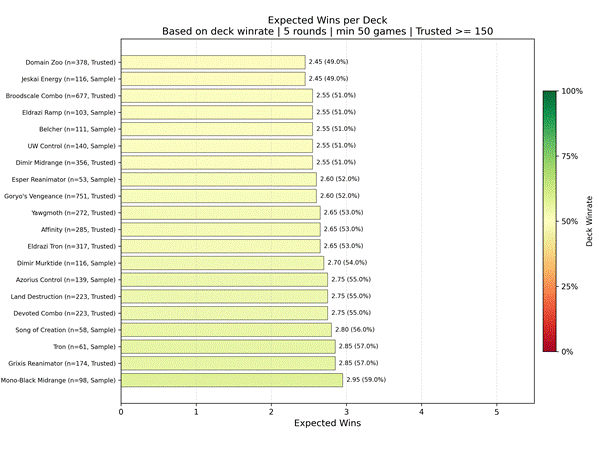
The win rate is 49% (95% CI 44 to 54, n=378), which is the number people will quote if they only look at one thing. It is also the number that tells you the least. A deck that reaches Top 32 in three-quarters of all events and converts above median is doing the thing that matters.

Dimir Midrange

Dimir is at 4% (similar to Zoo) and rising, with Top 32 in 17 events, Top 8 in 9, two trophies, and a 36% conversion rate. With delta +67, it gets the Overperformer flag, and probably the deck most likely to be underrated going into next week.

Win rate 51% (95% CI 46 to 56, n=356). Nothing about the profile is spectacular in isolation, but everything is above median. Two trophies from 4% of the field are real, and I think it is right now one of the best decks in the format. It had a lot of removal, played on tempo, and had answers to basically all decks in the format. But it is also (like every good midrange deck) quite hard to pilot.

Yawgmoth

Yawgmoth is at 3% and rising. Top 32 in 16 events, Top 8 in 5, one trophy, 22% conversion. Win rate 53% (95% CI 47 to 59, n=272). Solid without being exciting, and the graveyard hate flying around for other reasons is not helping it.

Jund (BRG) deserves a mention as the fourth deck here: 2% share, Top 32 in 9 events, one trophy, 33% conversion, and a rising trend on a small sample.

Ramp, 11% of the field

Ramp had the second-best conversion of any archetype at 32%, with Top 32 presence in 23 of 24 events and three trophies. Most of that is one deck.

Mono-Green Eldrazi (also called Rigging Eldrazi)

Mono-Green Eldrazi is at 6% and rising fast, with Top 32 in 19 events, Top 8 in 9, two trophies, 30% conversion, and Delta +73; it learns the Overperformer flag.

This deck is new enough that lists still vary quite a bit, which makes it awkward to sideboard against, and it took two trophies from a presence smaller than Boros or Goryo’s. Win rate 49% (95% CI 45 to 53, n=523) on a large sample, so nothing about the raw match data is alarming, but the results are there.

Eldrazi Tron

Eldrazi Tron is at 3% and falling, gets Top 32 in 14 events, Top 8 in 6, zero trophies, and 29% conversion. Win rate is 53% (95% CI 48 to 58, n=317). Perfectly fine numbers and no trophies.

Eldrazi Ramp

Eldrazi Ramp sits at 1% and took a trophy, with Top 32 finishes in 8 events and a 38% conversion rate. A small presence, a good ratio, and a win at that share are worth noting.

Control, 6% of the field

Control had the best conversion of any archetype in this window at 35%, from the second smallest presence in the format. Top 32 in 23 of 24 events, Top 8 in 13, two trophies. Control is in a good spot, and it looks like it is not going anywhere. It is a little bit of a shame that the best one is a Land Destruction Control. That is one of the most annoying types of decks.

Land Destruction

Land Destruction is the standout at 2% share with 44% conversion, the highest of any deck with real presence. Top 32 in 11 events, Top 8 in 7, one trophy. Win rate 55% (95% CI 48 to 61, n=223).

When it shows up, it delivers a really good result. But similar to Dimir Midrange, it is not an auto-win deck; you need to play a lot with it to know it and deliver results.

Scepter Control

Scepter (UW) Control is at 1% with Top 32 in 10 events, one trophy, and 30% conversion. Win rate 51% (95% CI 43 to 59, n=140). eclipse4343 took the trophy on July 27, which will surprise nobody who follows that pilot and reads the comments on the last post about how he did it! Cudos!

Azorius Control

Azorius Control has a similar profile without the trophy: 1% share, Top 32 in 10 events, 30% conversion, and the best win rate in the archetype at 55% (95% CI: 47 to 63, n=139), not a big sample but still fair enough for 1% deck.

Blink, 4% of the field

Blink is the weakest archetype in the window and the only one with zero trophies. Top 32 in 19 events, Top 8 in only 6, 23% conversion.

Esper Blink is basically the whole archetype at 3% share, rising, with Top 32 in 18 events, Top 8 in 6, and 26% conversion just under the median. Its win rate is 49% (95% CI: 44-54, n=318). Azorius Blink and Orzhov Blink are both under 1%, and neither did anything of note.

The premier event

One Modern Premier event took place within this window: a Showcase Qualifier on July 25. Broodscale Combo won it in the hands of ls149950, with Boros Energy second and a second copy of Broodscale third. Esper Blink took fourth, and Domain Zoo placed fifth, piloted by moon11.

Premier events use a restricted entry pool and a different player mix, so none of this feeds into any metagame number in this article. One event is also a tiny sample and should be read as a qualitative signal rather than evidence of deck strength.

On the radar

These decks sit below the 5% encounter threshold but showed up in Challenge results often enough to be worth a mention. They are not compared against the field medians because the samples do not permit such a comparison.

Mono-Black Midrange took a trophy from under 1% of the field, with Top 32 in 7 events and the best win rate in the entire dataset at 59% (95% CI 49 to 68, n=98). Selfeisek was the pilot. Small sample, but a real result!.

Dimir Murktide is rising, with Top 32 in 8 events, 38% conversion, and a 54% win rate (95% CI: 45-63, n=116), but no trophy yet.

Rakdos HollowOne is the negative entry: Top 32 in 7 events, Top 8 in none, and a 39% win rate (95% CI 29 to 50, n=87). The interval sits entirely below even. If you are on this deck, the data is not kind and maybe is better to go into 4C version?

The big picture

Twenty-four events, twenty-four different winning pilots, nineteen different winning decks. No deck won three times. No pilot won twice. The highest conversion belongs to an archetype with 6% of the field, and the worst belongs to the one that used to be the biggest.

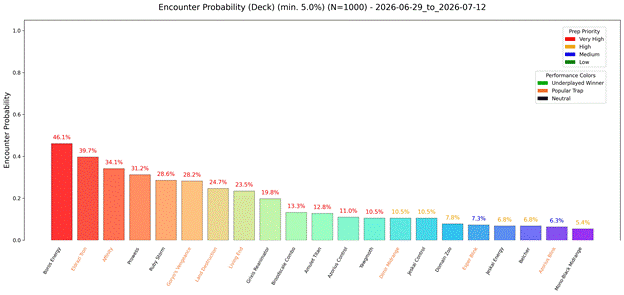
The practical consequence is that there is nothing to metagame against. You cannot build a sideboard aimed at the deck that is beating everyone, because there is no such deck. What you can do is weight your testing by encounter probability, which is the only number in this dataset that behaves predictably right now. Also, you can focus on sideboarding against the archetype rather than the deck, which makes your life easier.

For Zoo specifically, that means Goryo’s, Boros, and Broodscale as the compulsory three, then Mono-Green Eldrazi as the gap in your knowledge. The rest is variance, and this window had a lot of it.

>

u/No-Bet7157 — 16 days ago

MTGO Modern Breakdown: Land Destruction posts the best conversion in the format, Aggro wins 4 from the largest presence, Broodscale takes the Showcase Qualifier

Traditional weekly modern metagame breakdown. It is still a combo meta; aggro is going down, and the second-most-played archetype is graveyard. Challenge results are quite diverse; there is no one deck domination, which is good. But under the last post, I had a discussion with u/Slacker_87, and we both agree that meta might look diverse and healthy, but in reality, it is not that good. From my point of view, when you have a deck that, if you do not have an answer for them in the opening hand, you will lose quite quickly, it's not a great place to be.

As always, for anyone who wants the video version with my commentary, here is the YouTube link. If you prefer text with the full charts and figures, it is all on my Substack. I post on X most days, too, mostly league results and smaller data bits that don't make it into the weekly write-up.

TL;DR

Twenty-four Challenges gives us twenty-four different winning pilots. Nineteen different decks took at least one trophy. Nobody won twice!

The three biggest decks all convert below the field median. Goryo’s Vengeance and Broodscale Combo made Top 32 in every single event and turned that into one and two trophies, respectively. Boros Energy missed only two events.

Control has the best conversion of any archetype at 35%, from the second smallest presence in the format. Midrange took six trophies, more than any other archetype.

Aggro is no longer the biggest archetype and has the worst conversion in the field. It reached Top 32 in all 24 events and turned that into 18% Top 8 entries.

Domain Zoo posted 32% conversion against a 28% field median, with one trophy and a positive delta. The 49% win rate reads worse than the Challenge results do.

How to read the numbers

Top 32 presence means the number of Challenges where a deck put at least one pilot into the Top 32. Top 8 presence is the same thing for the Top 8. Conversion is the Top 8 entries divided by the Top 32 entries, which tells you how often getting there turns into going deep. Delta is Top 32 event frequency minus metagame share, so a high delta means a deck shows up in results more often than its raw popularity would suggest. The field median for this window is +64.

Thresholds are recalculated from the actual distribution for each window, never carried over. This window, the median delta is +64, and the median conversion is 28%. A deck needs to beat both to earn a Challenge Overperformer flag.

Win rates come with a 95% confidence interval and a sample size. They are context, not the argument. A deck can post a good win rate and still fail to close tournaments, and this window has several examples.

Combo, 23% of the field

Combo is now the largest archetype in Modern. It reached the Top 32 in every one of the 24 Challenges and the Top 8 in 21 of them, with four trophies and a 25% conversion rate. That is solid, but it hides a real split between the decks inside.

Broodscale Combo

Broodscale sits at 8% metagame and rising; it did something only one other deck managed: a Top 32 finish in all 24 events. Its delta of +92 is the highest in the entire field, but it is in the Top 8 in only 9 of 24 events (20% conversion) and has a single trophy.

The win rate is 51% (95% CI: 47-55, n=677), based on a large sample. Those two things together show the shape of the deck right now: it qualifies for the Top 32 basically every time, it wins about half its matches, and it does not run away with the trophy. Remember that it is the deck you will face most often after Goryo’s, so be prepared!

Neobrand

Neobrand is at 5% share and climbing hard. Top 32 in 18 events, Top 8 in 7, one trophy, 23% conversion. The win rate of 47% (95% CI 42 to 52, n=377) is the weakest of the major Combo decks, and the interval sits mostly below even.

That combination usually means a deck is being picked up faster than it is being learned, which is not so surprising after good PT performance. Also, it is quite a glass cannon deck; if the opponent has something to stop the combo, he will win. A delta of +70 indicates it appears in the results; a conversion below the median indicates those results are shallow. Worth respecting, not worth panicking about.

Amulet Titan

Amulet is the quiet one. Only 12 of 24 events with a Top 32 finish, which is the lowest presence of any deck in this section, but 27% conversion and one trophy from that smaller base. Win rate 49% (95% CI 43 to 55, n=271).

This is what a pilot-dependent deck looks like in aggregate data. It is not everywhere, and when it is there, it goes quite well.

Two other Combo decks matter for context. Ruby Storm posted 36% conversion, one of the best ratios in the entire field, and zero trophies in 24 events. Its win rate is 46% (95% CI: 40-52, n=260), and its metagame share is declining. Devoted Combo has a similar 37% conversion rate, one trophy, and a 55% win rate (95% CI 48 to 61, n=223), on a rising trend. I think that this deck needs some attention because it can be a rising star.

Graveyard, 19% of the field

Graveyard is the second largest archetype, and it also hit Top 32 in every event. Top 8 in 18 events, five trophies, and 23% conversion. Unlike previous windows, the graveyard decks are actually closing and breaking a pattern we have observed for some time.

Goryo’s Vengeance

Goryo’s is now the largest single deck in the format at 9%, and it is still rising. Top 32 in all 24 events, Top 8 in 13, two trophies, 27% conversion, delta +91. The win rate is 52% (95% CI 48 to 56, n=751), from the biggest sample in the data.

Almost everything about this deck is at or near the top of the field, and yet the conversion is under the 28% median. That is not a criticism, but a statement about how flat this format is right now. The most popular deck in Modern, with the largest sample and the most Top 8 appearances, still cannot turn presence into a disproportionate number of trophies. It looks a little bit different from what we see when Boros was on top.

Living End

Living End is at 3% and falling. Reached Top 32 in 16 events, but Top 8 in only 4. It did take one trophy. It has 16% conversion rate, well below the median and a win rate 48% (95% CI 44 to 52, n=532).

This looks like a deck the format has adapted to. Enough interaction and enough graveyard hate are being played for other reasons that Living End is getting caught in the crossfire.

4c HollowOne

HollowOne is at 3% and rising, with Top 32 in 16 events, Top 8 in 6, one trophy, and a 29% conversion rate. Delta +64. That clears both medians, so it takes a Challenge Overperformer flag this window.

The win rate of 47% (95% CI 41 to 53, n=272) does not support that reading at all, which is something worth looking into more closely. Either the deck is concentrated among pilots who know it well, or the raw match data is picking up a lot of people trying it out. Both are plausible, but the challenge results count more, in my opinion.

Grixis Reanimator rounds out the archetype with the best win rate of any graveyard deck at 57% (95% CI 50 to 64, n=174), one trophy, but presence in only 10 of 24 events. Small, sharp, and not widely played.

Aggro, 18% of the field

Aggro was the biggest archetype in Modern for most of this year, but it ends for now at least. It still reached the Top 32 of every single event, which tells you the decks are fine, but it converted only 18% of those entries into Top 8 finishes. That is the worst ratio of any archetype in this breakdown, and it comes with four trophies.

Boros Energy

Boros is at 8% and falling. Top 32 in 22 of 24 events, Top 8 in 11, two trophies, 22% conversion, and delta +84. Win rate is 48% (95% CI 44 to 52, n=727), based on a quite large sample.

The story here is the same one as three weeks ago, just with smaller numbers. Boros gets into the events almost every time. It reaches the elimination rounds at a decent level, but it does not finish at a rate that we might expect.

Prowess

Prowess is at 4% and falling, with Top 32 in 19 events and Top 8 in only 5. The 18% conversion is quite low, but it took two trophies, which is more than Broodscale managed with twice the presence.

That combination is interesting. A deck that rarely reaches Top 8 but wins when it does is either running very hot or has a small number of pilots who are much better than average with it. The win rate of 49% (95% CI 44 to 54, n=344) leans toward the second reading, especially since Prowess is not an easy deck to play properly.

Affinity

Affinity has the worst conversion of any big decks in the format in this breakdown. Top 32 in 15 events, Top 8 in 2, zero trophies, 9% conversion. But the win rate is 53% (95% CI 47 to 59, n=285), one of the better figures in the data.

A 53% win rate and a 9% conversion rate should not coexist. The most likely explanation is that Affinity is beating up on the middle of the field and losing consistently to whatever it meets at the top tables. If you are playing Affinity, you may comment on what your feelings are about the metagame right now. My idea is that Affinity has a really bad time against all of those combo decks in the format.

Midrange, 16% of the field

Midrange took six trophies witch is more than any other archetype. Top 32 in every event, Top 8 in 16 (28% conversion). It is quietly having the best window in a long time.

Domain Zoo

Zoo is at 4% and rising. Top 32 in 18 of 24 events, Top 8 in 7, one trophy, 32% conversion against a 28% median, delta +71 against a +64 median. That clears both thresholds and earns a Challenge Overperformer flag.

The win rate is 49% (95% CI 44 to 54, n=378), which is the number people will quote if they only look at one thing. It is also the number that tells you the least. A deck that reaches Top 32 in three-quarters of all events and converts above median is doing the thing that matters.

Dimir Midrange

Dimir is at 4% (similar to Zoo) and rising, with Top 32 in 17 events, Top 8 in 9, two trophies, and a 36% conversion rate. With delta +67, it gets the Overperformer flag, and probably the deck most likely to be underrated going into next week.

Win rate 51% (95% CI 46 to 56, n=356). Nothing about the profile is spectacular in isolation, but everything is above median. Two trophies from 4% of the field are real, and I think it is right now one of the best decks in the format. It had a lot of removal, played on tempo, and had answers to basically all decks in the format. But it is also (like every good midrange deck) quite hard to pilot.

Yawgmoth

Yawgmoth is at 3% and rising. Top 32 in 16 events, Top 8 in 5, one trophy, 22% conversion. Win rate 53% (95% CI 47 to 59, n=272). Solid without being exciting, and the graveyard hate flying around for other reasons is not helping it.

Jund (BRG) deserves a mention as the fourth deck here: 2% share, Top 32 in 9 events, one trophy, 33% conversion, and a rising trend on a small sample.

Ramp, 11% of the field

Ramp had the second-best conversion of any archetype at 32%, with Top 32 presence in 23 of 24 events and three trophies. Most of that is one deck.

Mono-Green Eldrazi (also called Rigging Eldrazi)

Mono-Green Eldrazi is at 6% and rising fast, with Top 32 in 19 events, Top 8 in 9, two trophies, 30% conversion, and Delta +73; it learns the Overperformer flag.

This deck is new enough that lists still vary quite a bit, which makes it awkward to sideboard against, and it took two trophies from a presence smaller than Boros or Goryo’s. Win rate 49% (95% CI 45 to 53, n=523) on a large sample, so nothing about the raw match data is alarming, but the results are there.

Eldrazi Tron

Eldrazi Tron is at 3% and falling, gets Top 32 in 14 events, Top 8 in 6, zero trophies, and 29% conversion. Win rate is 53% (95% CI 48 to 58, n=317). Perfectly fine numbers and no trophies.

Eldrazi Ramp

Eldrazi Ramp sits at 1% and took a trophy, with Top 32 finishes in 8 events and a 38% conversion rate. A small presence, a good ratio, and a win at that share are worth noting.

Control, 6% of the field

Control had the best conversion of any archetype in this window at 35%, from the second smallest presence in the format. Top 32 in 23 of 24 events, Top 8 in 13, two trophies. Control is in a good spot, and it looks like it is not going anywhere. It is a little bit of a shame that the best one is a Land Destruction Control. That is one of the most annoying types of decks.

Land Destruction

Land Destruction is the standout at 2% share with 44% conversion, the highest of any deck with real presence. Top 32 in 11 events, Top 8 in 7, one trophy. Win rate 55% (95% CI 48 to 61, n=223).

When it shows up, it delivers a really good result. But similar to Dimir Midrange, it is not an auto-win deck; you need to play a lot with it to know it and deliver results.

Scepter Control

Scepter (UW) Control is at 1% with Top 32 in 10 events, one trophy, and 30% conversion. Win rate 51% (95% CI 43 to 59, n=140). eclipse4343 took the trophy on July 27, which will surprise nobody who follows that pilot and reads the comments on the last post about how he did it! Cudos!

Azorius Control

Azorius Control has a similar profile without the trophy: 1% share, Top 32 in 10 events, 30% conversion, and the best win rate in the archetype at 55% (95% CI: 47 to 63, n=139), not a big sample but still fair enough for 1% deck.

Blink, 4% of the field

Blink is the weakest archetype in the window and the only one with zero trophies. Top 32 in 19 events, Top 8 in only 6, 23% conversion.

Esper Blink is basically the whole archetype at 3% share, rising, with Top 32 in 18 events, Top 8 in 6, and 26% conversion just under the median. Its win rate is 49% (95% CI: 44-54, n=318). Azorius Blink and Orzhov Blink are both under 1%, and neither did anything of note.

The premier event

One Modern Premier event took place within this window: a Showcase Qualifier on July 25. Broodscale Combo won it in the hands of ls149950, with Boros Energy second and a second copy of Broodscale third. Esper Blink took fourth, and Domain Zoo placed fifth, piloted by moon11.

Premier events use a restricted entry pool and a different player mix, so none of this feeds into any metagame number in this article. One event is also a tiny sample and should be read as a qualitative signal rather than evidence of deck strength.

On the radar

These decks sit below the 5% encounter threshold but showed up in Challenge results often enough to be worth a mention. They are not compared against the field medians because the samples do not permit such a comparison.

Mono-Black Midrange took a trophy from under 1% of the field, with Top 32 in 7 events and the best win rate in the entire dataset at 59% (95% CI 49 to 68, n=98). Selfeisek was the pilot. Small sample, but a real result!.

Dimir Murktide is rising, with Top 32 in 8 events, 38% conversion, and a 54% win rate (95% CI: 45-63, n=116), but no trophy yet.

Rakdos HollowOne is the negative entry: Top 32 in 7 events, Top 8 in none, and a 39% win rate (95% CI 29 to 50, n=87). The interval sits entirely below even. If you are on this deck, the data is not kind and maybe is better to go into 4C version?

The big picture

Twenty-four events, twenty-four different winning pilots, nineteen different winning decks. No deck won three times. No pilot won twice. The highest conversion belongs to an archetype with 6% of the field, and the worst belongs to the one that used to be the biggest.

The practical consequence is that there is nothing to metagame against. You cannot build a sideboard aimed at the deck that is beating everyone, because there is no such deck. What you can do is weight your testing by encounter probability, which is the only number in this dataset that behaves predictably right now. Also, you can focus on sideboarding against the archetype rather than the deck, which makes your life easier.

For Zoo specifically, that means Goryo’s, Boros, and Broodscale as the compulsory three, then Mono-Green Eldrazi as the gap in your knowledge. The rest is variance, and this window had a lot of it.

>

u/No-Bet7157 — 16 days ago

MTGO Modern Breakdown: Control wins 3 on 6% of the field, Boros Energy blanks all 24 events, Goryo's takes the Super Qualifier

Ok, so another metagame breakdown of the Modern metagame. It looks quite diverse; aggro is no longer the king of the field, now we have a Combo Modern, and this is interesting. Also, Control is on fire, so everybody can find a place for themselves.

And u/ExtraPolishPlease, where is Mill??!! You made a promise.

As always, for anyone who wants the video version with my commentary, here is the YouTube link. If you prefer text with the full charts and figures, it is all on my Substack. I post on X most days, too, mostly league results and smaller data bits that don't make it into the weekly write-up.

One note on the data before anything else. This is the first breakdown built on the rebuilt event pipeline, which now reads events directly from mtgo.com and captures all three Challenge tiers, including the Challenge 96 events that ran on Mondays and Wednesdays and were previously missing entirely. Every event ID in this window was checked against the official decklist, so the 24 events below are the complete set rather than a sample. I know that there will still be some mistakes but I try as hard as I can to fix it 😉

TL;DR

Boros Energy is the story of the week, and not in a good way. It reached the Top 32 in 23 of the 24 Challenges and the Top 8 in 14 of them, and won none. Its winrate of 45% (95% CI 42 to 48, n=902) is the clearest sub-50 signal in the whole data set.

Combo passed Aggro as the largest archetype in the format. Combo sits at 24% of the field against 22% for Aggro, driven by Broodscale Combo at 8% and a broad tail behind it.

Midrange took 8 of the 24 trophies from 14% of the field. It reached the Top 8 in only 15 events, fewer than Combo, Aggro, or Ramp, and still finished with the most wins of any archetype.

Graveyard reached 16 Top 8s and closed twice. The same pattern as previous windows: high presence, very low trophy count.

Amulet Titan won three events from 3% of the field. It made only four Top 8s all window and converted three of them into trophies, the best win rate per Top 32 entry in the format.

Mono-Green Eldrazi appeared from nothing and is already the fourth-largest deck. It sits at 5% of the field, with a 43% win rate (95% CI 38 to 48, n=391) and no trophies. Popularity is running ahead of results.

Control quietly had the best window of any archetype. It took 3 trophies from 6% of the field, converted 35% of its Top 32 entries into Top 8s, the best figure in the format, and posted the highest archetype delta at +94pp.

Domain Zoo took two trophies and converted a third of its Top 32 entries into Top 8s. From 4% of the field, that is one of the better return rates in the window.

Quick definitions

Top 32 presence is the number of Challenges out of 24 in which a deck appeared in the Top 32. Top 8 presence is the same for the Top 8. Conversion is the percentage of Top 32 entries that become Top 8 entries. Win per Top 32 is how often a Top 32 entry becomes an actual trophy. Delta is Top 32 event frequency minus metagame share, so a high delta means a deck shows up in results more often than its raw popularity would suggest. Thresholds for this window are a median delta of 60pp and a median conversion of 26%, both recalculated from this window only rather than carried over.

Winrates are reported with a 95% Wilson confidence interval and the sample size. They are context, not the main argument. The main argument is what happened in the Challenges.

Key observations

Boros Energy

Boros Energy is still the largest single deck at 10% of the field, and it is still the deck you are most likely to sit across from, at a 41% encounter rate over five rounds. It appeared in 23 of the 24 Top 32s and 14 of the 24 Top 8s. But it does not win any challenge.

The delta of +86pp is the highest in the entire field, which normally reads as a deck outperforming its popularity. Here, it mostly reads as sheer volume. Conversion sits at 23%, below the 26% median, and the winrate is 45% (95% CI 42 to 48, n=902). That interval does not include 50, and with over 900 games behind it, this is not a sample-size problem. Boros Energy is a deck that gets you into the room, but it does not guarantee a win.

The trend label is Falling, and the metagame share supports that. What has not fallen is how often you will play against it. Plan for the matchup because it is an explosive deck and can still kill you on a spot.

Amulet Titan

Amulet Titan is the cleanest counterexample in the data. It has 3% of the field, reached the Top 32 in 16 events, and the Top 8 in only four. It won three of those four.

The conversion rate is 18%, well below the median, which is why the classification lands on Neutral rather than Overperformer. That is the correct read, and it is worth sitting with: the label describes how reliably a deck reaches elimination rounds, not how dangerous it is once there. Amulet Titan almost never gets there and almost always wins when it does. Winrate is 48% (95% CI 42 to 54, n=303), which tells you nothing useful about a deck that wins by ending games on turn three. You also need to remember that there are plenty of Amulet players who love that deck, and it is harder to play after the Lotus Field ban. Those players know the deck and know how to play it.

The graveyard problem, again

Graveyard as an archetype appeared in the Top 32 of all 24 events and reached 16 Top 8s. It won two. Goryo’s Vengeance is the third largest deck in the format at 8%, made 22 Top 32s and seven Top 8s, and finished with nothing. Living End made 19 Top 32s and eight Top 8s, also nothing. Both post-win rates just above even: 52% (95% CI 48 to 56, n=652) and 51% (95% CI 47 to 55, n=722).

This has now repeated across enough windows that a variance explanation is strained. Something about how these decks play in single elimination is costing them, and the two decks doing the actual winning inside the archetype are the small ones: 4c HollowOne and Grixis Reanimator, one trophy each, both converting at 33%. I think that we have a combo meta right now, and despite that, Goyro’s is a powerful deck. There is a lot of hate against GY, and also, there are a lot of decks that can win with you, even if you put Atraxa on BF. Also, Control is back, and it is prepared to fight back against this archetype.

Archetype breakdown

Combo, 24% of the field

Combo is now the largest archetype in Modern. It appeared in the Top 32 of all 24 events, reached 22 Top 8s and won seven, the second-highest trophy count of the window. Conversion sits at 23%, which is unremarkable, and delta at +76pp. The story here is breadth rather than any one deck dominating.

Broodscale Combo is the largest deck in the archetype at 8% and the second largest in the format. It made 22 Top 32s, 11 Top 8s, and won twice, with a 52% winrate (95% CI 48 to 56, n=772) and a rising trend. The 21% conversion rate is below median, so it lands on Neutral despite the trophies, which is the honest description: it is everywhere, it wins a fair share, but it is not converting better than the field.

Neobrand sits at 4% with 16 Top 32s, six Top 8s, and one win, on a 47% winrate (95% CI 42 to 52, n=342). Ruby Storm is the interesting one. At 3% of the field, it made 20 Top 32s and nine Top 8s, converted at 41%, the third-best figure among the larger decks, and won nothing at all. Its win rate is 51% (95% CI: 46-56, n=335). This is the third window in a row where Ruby Storm posts elite conversion and no trophy. Both for Neobrand and Storm, not winning the Challenges might be due to the rise of Control and overall combo hate in the metagame. After PT, where Neobrand and Broodscale ran really well, people prepare to beat combo decks, and it is more visible at high-stakes games like top 8 in challenges.

Aggro, 22% of the field

Aggro appeared in all 24 Top 32s but reached only 19 Top 8s, and finished the window with two trophies. Its win rate per Top 32 entry is 1%, the lowest of any archetype that won anything. Conversion is 23%. The archetype is losing share, and Boros Energy accounts for close to half of what remains.

Boros Energy is covered above. Prowess is at 3% and had a rough window: 19 Top 32s but only four Top 8s, a conversion of 15% that is the worst among decks with real presence, and one win. Winrate 47% (95% CI 41 to 53, n=295), trend falling. Affinity at 3% looks healthier, with 18 Top 32s, seven Top 8s, one trophy, and a 52% winrate (95% CI 46 to 58, n=292), converting at 25%.

The deck worth flagging is further down. Jeskai Energy has 1% of the field, made nine Top 32s and six Top 8s, and converted half of its Top 32 entries into Top 8s, the second-best rate in the format. It won nothing, with a 56% win rate (95% CI 48 to 64, n=154). A deck that small reaching that many elimination rounds is not something you want to meet unprepared in round five. Aggro had a bad time against combo win T2-4, but the rise of the control deck in response to combo might give a nice window to get back on top soon.

Graveyard, 17% of the field

Covered in detail above. In summary: all 24 Top 32s, 16 Top 8s, two trophies, a conversion of 23%, and the fourth-highest archetype delta at +83pp. Presence without payoff.

Goryo’s Vengeance at 8% and Living End at 3% both finished without a win. 4c HollowOne is the bright spot: 2% of the field, 10 Top 32s, four Top 8s, one trophy, 33% conversion, and a 53% winrate (95% CI 46 to 59, n=223) on a rising trend. Grixis Reanimator matches that conversion rate on a falling trend, with the best win rate in the archetype at 57% (95% CI 50 to 63, n=222).

Midrange, 14% of the field

This is the archetype that actually won the window. Midrange appeared in all 24 Top 32s but only 15 Top 8s, fewer than Combo, Aggro or Ramp, and converted that into eight trophies, a third of everything on offer. Its win per Top 32 entry, 7%, is the highest of any archetype by a wide margin.

Domain Zoo leads it at 4%, with 17 Top 32s, seven Top 8s, two trophies, and a 33% conversion. Dimir Midrange is level with it at 4% with 16 Top 32s, five Top 8s, and two wins on a 53% winrate (95% CI 48 to 58, n=378), also rising. Yawgmoth at 2% took two trophies from 13 Top 32s and five Top 8s, converting at 28% with the strongest winrate of the three at 57% (95% CI 51 to 63, n=257).

Below those, BRG and Mono-Black Midrange each took a trophy from around one percent of the field. Six of the eight Midrange wins came from decks nobody is preparing for.

I believe that the reason for that is that midrange decks have a chance to beat combo decks and also can fight against control better than aggro. It is also true for a GY strategy, where midrange can interrupt this plan. It is happy to see that Zoo climb back to a really good spot this window, but as a Zoo player, I'm a little bit worried about Dimir Midrange deck because it is quite rough MU for us.

Ramp, 13% of the field

Ramp has the second-highest archetype delta of the window at +87pp and the second-best conversion at 31%. It appeared in all 24 Top 32s and 18 Top 8s. It won two events. Once again, presence and conversion are not translating into trophies.

Mono-Green Eldrazi is the newcomer and is already the fourth-largest deck in the format at 5%. It made 13 Top 32s and five Top 8s, converting at 22%, and won nothing. Its winrate is 43% (95% CI 38 to 48, n=391), an interval that sits entirely below even. That combination, a fast rise in popularity with results that do not support it, is worth watching rather than copying.

Eldrazi Tron is the opposite case. At 4%, it made 21 Top 32s and 11 Top 8s, converted at 29% with a delta of +83pp, and is one of the four Challenge Overperformers this window. It still has no trophy, and its trend is falling. Eldrazi Ramp at 2% took the archetype’s other win, converting at 40% from nine Top 32s. Tron proper is a curiosity: three Top 32s, three Top 8s, a 75% conversion on a sample far too small to mean anything.

Control, 6% of the field

Control is the story the metagame chart hides. It placed in the Top 32 across all 24 events, reached 14 Top 8s and won 3 of them, from 6% of the field. Its conversion of 35% is the best of any archetype, and its delta of +94pp is the highest, ahead of Ramp and Midrange. On the two metrics that actually describe closing, no archetype did better this window.

Land Destruction is the largest of them at 2%, with 14 Top 32s, seven Top 8s, one win, and a 35% conversion on a 54% winrate (95% CI 47 to 60, n=218). UW Control is right behind at 2% and is the efficient one: 13 Top 32s, six Top 8s, two trophies, and a 46% conversion that is the best figure of any deck in the field. Its win rate is 56% (95% CI 49 to 63, n=181), and the trend is rising. This is the Isochron Scepter build, not an aggressive energy deck as often marked on websites, and it is doing a lot of damage from under two percent of the metagame. Azorius Control is the third piece at under 1% of the field, with five Top 32s, two Top 8s, no trophy, and the highest winrate in the entire data set at 59% (95% CI 49 to 68, n=98) on a sample small enough that the interval is wide. 4C control rounds out the visible part of the archetype at under half a percent, with four Top 32s and a 42% winrate (95% CI 30 to 56, n=52).

Blink, 3% of the field

Blink is the smallest archetype and the only one that finished the window without a trophy. It reached 17 Top 32s and five Top 8s, converting at 25%. There are only two Blink decks in the data with any real presence, so this section is shorter than the others by necessity.

Esper Blink is the largest at 2%, with 14 Top 32s but only 3 Top 8s, an 18% conversion rate and a 49% win rate (95% CI 42 to 56, n=207). Azorius Blink is the more efficient of the two: under 1% of the field, six Top 32s, three Top 8s, and a 50% conversion, on a 50% winrate (95% CI 40 to 60, n=97). Neither closed an event, and the archetype trend is not moving in a helpful direction.

Premier events

Two Modern Premier Events ran within this window. They are a separate pool from the Challenges, with restricted entry and a different player base, so none of their results feed into any of the numbers above. Two tournaments are also far too small a sample to conclude anything about deck strength. They are worth reporting because the field is better, and because this week, they disagree with the Challenge data in an interesting way.

The RC Super Qualifier on July 19 was won by Goryo’s Vengeance in the hands of Felider. The Top 8 also contained a second Goryo’s Vengeance, two copies of Boros Energy, Prowess, Grixis Reanimator, Through the Breach, and 4c HollowOne.

The Showcase Qualifier on July 25 was won by Broodscale Combo, piloted by ls149950, with a second Broodscale Combo in the Top 8 alongside Boros Energy, Esper Blink, Domain Zoo, Belcher, Dimir Midrange, and Devoted Combo.

The disagreement is worth naming. Goryo’s Vengeance went 0 for 24 in the Challenges despite 22 Top 32s, and then won the higher stakes event. Boros Energy also finished the Challenge window without a trophy and put three pilots across these two Top 8s. Through the Breach does not appear anywhere in the Challenge data. None of that overturns 24 tournaments' worth of results, but if you believed the graveyard decks and Boros Energy were simply incapable of closing, the better field says otherwise. So this is why I always said that all that data is just to inform you: all the decks that regularly make it to the Challenges top 32 are capable of winning it. Some more often, some once in a while, but still. Remember that next time when you think that Boros energy is weak, or you play against an off-meta rogue deck.

On the Radar

These are decks below the 5% encounter threshold that still showed up in Challenge results, so they are tracked separately rather than ranked against the field medians.

Azorius Blink, under 1% of the field, six Top 32s and three Top 8s. Converting half its Top 32 entries into Top 8s at that share of the field is a signal worth a second look, even without a trophy.

Azorius Control, under 1% of the field, five Top 32s and two Top 8s. No win, but the highest win rate in the data at 59% (95% CI 49 to 68, n=98) and a 40% conversion.

Mono-Black Midrange, 1% of the field, six Top 32s, two Top 8s, and one trophy, on a 56% winrate (95% CI 46 to 65, n=103). Part of the broader Midrange trophy run.

Devoted Combo, under 1% of the field, five Top 32s, two Top 8s, and one win, converting at 40% with a 51% win rate (95% CI 40 to 62, n=77).

Naya Scapeshift, under half a percent of the field, two Top 32s, and one trophy. A win at that share of the field usually means one pilot found something, but it deserves the note.

Rakdos Burn is the counterexample, and the reason presence alone is not enough. Seven Top 32s from under 1% of the field, zero Top 8s, and a 25% win rate (95% CI 15 to 38, n=50) that is the worst in the data by some distance.

Big picture

The theme of this window is that presence and trophies came apart. The three most common decks in the format, Boros Energy, Broodscale Combo, and Goryo’s Vengeance, account for 27% of the field between them and produced two trophies. Meanwhile, 17 different decks won the 24 events, and only Amulet Titan won more than twice.

If you are building for the next event, the encounter chart tells you what to beat, and the conversion chart tells you what actually beats people. Those two lists have very little overlap right now. Prepare for Boros Energy because you will play against it, not because it is the deck to fear in the last round. The decks closing tournaments are Midrange piles and fast combo, and most of them sit under 4% of the field.

By Karol Małota

aka WarLord1986pl / TribalFlamesInYourFace
u/No-Bet7157 — 23 days ago
▲ 6 r/Pauper

Modern Zoo player diving into Pauper for the first time: Learning Naya Gates live tonight!

I’ve been grinding Modern with Domain Zoo for a long time, but I’m finally jumping into Pauper tonight.

I’m starting a new series called "The Lab" where I focus on technical field testing. First up is Naya Gates. I really like the technical side of this deck, so I’ll be talking through every play and sideboard choice as I go.

If you’re a Pauper veteran, I’d honestly appreciate it if you dropped by to help me with the nuances of the meta or just to point out where I’m punting. If you’re thinking about picking up Gates, come see how it handles in the wild.

Going live at 10:45 PM (CEST) / 4:45 PM (EST) here: https://youtube.com/live/IkL57_1Co9A

Hope to see some of you there. Let's see if those Gates are as strong as they look. Cheers!

u/No-Bet7157 — 28 days ago
▲ 7 r/Pauper

Greatsword of Tyr in Naya Gates?

I play a littlebit with naya gates and yesterday I face a deck that play Greatsword of Tyr. This looks like something that might fit into this deck. What you think?

reddit.com
u/No-Bet7157 — 29 days ago

MTGO Modern Breakdown: Ichikawa wins on 4% of the field, Boros and Affinity flop in Amsterdam, Aggro dominates the Challenges

Almost as traditional, but one day later, because I was listening to some nice Heavy Metal music in Master of Rock in the Czech Republic, I posted my weekly Metagame breakdown.

This past weekend, we had the Pro Tour, and its metagame looked broadly similar to what we see on MTGO, with one big exception: Broodscale Combo was 12% of the field in Amsterdam, compared with roughly 2.5% online, and it put three pilots into the Top 8. I expect this deck will skyrocket in popularity over the coming weeks.

From my point of view, the format looks healthy right now. There are plenty of viable decks, none of them dominate, and rogue builds still take trophies. Azorius Energy won two Challenges from under 1% of the metagame.

What the Pro Tour also showed is that the field is predictable even when the results are not. People brought roughly what everyone expected, and then the two most-played decks, Boros Energy and Izzet Affinity, both finished under 50%, while the title went to Simic Neoform at 4% of the field. For a pro, predictability is useful; you know what you are preparing for. For a newcomer, it is a brutal format, but at least legible; you can pick a deck consciously instead of guessing. But is a metagame this easy to predict, a healthy one? Or maybe it's too boring?

Traditionally, for anyone who wants the video version with my commentary, here is the YouTube link. If you prefer text with the full charts and figures, it is all on my Substack. I post on X most days, too, mostly league results and smaller data bits that don't make it into the weekly write-up.

TL;DR

Yuuki Ichikawa won the Pro Tour with Simic Neoform, going 8-2 in Modern Constructed before taking the title.

The two most-played decks at the Pro Tour underperformed. Boros Energy and Izzet Affinity tied for the largest share of the field at 13% each, and both finished under 50% on match win rate. This is not a surprise cause everybody prepares against those decks.

Aggro owned the MTGO trophies. The archetype won 9 of the 16 Challenges and reached the Top 8 of every event, even as its overall share slipped to 28%.

No single deck ran away with the window. Affinity, Prowess, Amulet Titan, and Azorius Energy each won two events; eight more decks won one apiece.

Two of the five most-played decks could not close. Eldrazi Tron and Goryo's Vengeance reached the Top 8 repeatedly but won nothing, which earns them the Needs Attention tag.

Domain Zoo held up in both datasets. It went 53% across eight pilots at the Pro Tour and posts a 55% deck win rate online with one Challenge trophy.

The Pro Tour: Amsterdam

Yuuki Ichikawa took Simic Neoform to the title. The deck was only 4% of the field but was the best-performing popular deck of the weekend, with a 60% match win rate (95% CI 51 to 68, n=124). Lorenzo Gruppi was the finalist on Broodscale Combo. The final standings ran Ichikawa first, Gruppi second, then Timo Bertram (Boros Energy) and Bernardo Torres (Esper Goryo's) as the two semifinalists, with Ken Yukuhiro, Mattia Oneto, Alex Rohan, and Eduardo Sajgalik filling out the quarterfinals. Read by a constructed deck, the Top 8 was three copies of Broodscale Combo, two of Boros Energy, and one each of Esper Goryo's, Eldrazi Rigging, and Simic Neoform.

What people brought

Boros Energy and Izzet Affinity co-headlined at 13% apiece, with Broodscale Combo close behind at 12%, then Eldrazi Tron at 10% and Esper Goryo's at 9%. There was no breakout deck, and the field looked close to what the preceding weeks' MTGO metagame analysis predicted.

What actually performed

The two decks that defined the field were the two that struggled. Boros Energy finished at 45% (95% CI 39 to 50, n=324) and Izzet Affinity at 46% (95% CI 41 to 51, n=366), with intervals sitting almost entirely below 50%. At the other end, the fringe carried the weekend: Eldrazi Rigging led at 64% (95% CI 54 to 74, n=84) and Simic Neoform followed at 60%. Broodscale Combo came in around even at 49% (95% CI 44 to 55, n=315) and still put three pilots into the Top 8. Domain Zoo went 53% (95% CI 41 to 65, n=62) across eight pilots, above both format pillars.

The MTGO Challenges: sixteen events, by archetype

Sixteen Challenges, eight of the 64-player format and eight of the 32-player format. Delta means Top 32 event frequency minus metagame share, so a high delta says a deck shows up in results more often than its popularity predicts. This window's median delta among eligible decks was 55, and the median Top8-to-Top32 conversion was 29, the two thresholds that decide the Overperformer tag.

Aggro (28% of the field)

Aggro is the story of the window. It won 9 of the 16 Challenges and reached the Top 8 of every event, even though its overall share slipped to 28%. Boros Energy is the most-played deck in the format at 11% and reached the Top 8 in 81% of events, but converted just one trophy, a 1.1% win-per-Top32 rate, on a 48% win rate (95% CI 45 to 51, n=1007). Affinity is the better-finishing aggro deck: from 6% of the field, it took two trophies, cleared both thresholds as an Overperformer with a delta near plus 82 and a 37% conversion, and posted a flat 50% win rate (95% CI 46 to 54, n=522). Prowess also won two events from 6% of the field and a rising trend, but its Top8-to-Top32 conversion of 24% sits below the median. Its win rate is 50% (95% CI 46 to 54, n=520).

Graveyard (20% of the field)

Graveyard climbed to number two by share and reached the Top 8 in 69% of events, but it won exactly one of the sixteen. Living End is the engine of the rise: Top 8 in 44% of events at a 33% conversion, an even 50% win rate (95% CI 46 to 54, n=760), and a rising trend, which clears both thresholds and makes it an Overperformer despite zero wins. Goryo's Vengeance is the cautionary tale: 75% Top 32 presence but an 11% conversion rate, zero trophies, and a falling trend: 50% win rate (95% CI 46 to 54, n=553). Grixis Reanimator is the one that actually closed, one trophy and the best raw rate of the three at 56% (95% CI 50 to 62, n=280), though from a thinner Top 8 presence.

Combo (15% of the field)

Combo took three trophies, the most after Aggro. Ruby Storm leads it: 81% Top 32 presence, one trophy, the best Top8-to-Top32 conversion in the field at 45%, and the best win rate of any high-volume deck at 56% (95% CI 52 to 60, n=501), on a rising trend, which makes it an Overperformer. Amulet Titan is the efficiency deck. From 3% of the field, it won two events at an 8.7% win-per-Top32 rate, the highest in the format, with a 55% win rate (95% CI 49 to 61, n=274), though its conversion sits right at the median, so it lands Neutral. Broodscale Combo, strong in Amsterdam, was quiet online: no trophies and WR 49% (95% CI 42 to 56, n=220).

Ramp (15% of the field)

Ramp is back near 15%, and Eldrazi Tron is the reason. It posted the highest delta in the entire field (+ 84) reached the Top 32 in 94% of events and the Top 8 in 56%, and won zero of the sixteen with 49% win rate (95% CI 46 to 52, n=895). Eldrazi Ramp is the smaller sibling that did close, one trophy from 1.5% of the field with a 44% conversion and a 51% win rate (95% CI 43 to 59, n=131). Below the encounter threshold, the various other Eldrazi shells round out the archetype's resurgence without demanding preparation on their own.

Midrange (11% of the field)

Midrange reached the Top 32 of every event and took two trophies, which is more than Graveyard or Ramp managed. Dimir Midrange is the most-played at 3% and is on the rise, with a 69% Top 32 presence and a 51% win rate (95% CI 45 to 57, n=241), but it reached zero Top 8s this window. Domain Zoo posts a 55% deck win rate this window (95% CI 48 to 62, n=205), one of the better rates among the midrange decks. It converted that into one Challenge trophy, with a 50% Top 32 event frequency, a 25% Top 8 frequency, and a 33% Top 8-to-Top 32 conversion. Yawgmoth rounds out the top three: one trophy, a 57% conversion, and the best raw rate of the group at 57% (95% CI 50 to 64, n=174).

Control (8% of the field)

Control reached the Top 32 in about seven of ten events but won nothing. Land Destruction is the most-played control shell at 4%, with a 69% Top 32 presence, but an 18% conversion and a 46% win rate (95% CI 41 to 51, n=362), on a falling trend. Azorius Control has the profile of a fine deck, a 55% win rate (95% CI 47 to 63, n=146), but it is not finishing, and its share is falling. Jeskai Control is thinner still, a 51% win rate (95% CI 42 to 60, n=114) with no Top 8s. The Control archetype is well-positioned on paper but poorly positioned when it comes to the events score.

Blink (3% of the field)

Blink is the smallest tracked archetype at 3% and won nothing, but its two main builds convert what little presence they get. Esper Blink posted a 44% Top8-to-Top32 conversion and a 52% win rate (95% CI 44 to 60, n=147), and Azorius Blink a 29% conversion with the same 52% rate (95% CI 44 to 60, n=133). Both are falling. Nothing here to specifically prepare for, but the conversion says the decks are fine when they show up.

On the radar

Two decks below the 5% encounter threshold still won events. Azorius Energy took two trophies from under 1% of the metagame, with a 25% win-per-Top32 rate and a 56% win rate (95% CI 45 to 66, n=80). Naya Scapeshift won one event from 0.4% of the field, for a 53% win rate on a small sample (95% CI: 37-68, n=35). Neither is something you build a game plan around, but a trophy from that little share is the kind of thing that is invisible until it beats you.

The big picture

Both datasets point in the same direction. The decks that define the metagame by volume, Boros Energy and Izzet Affinity, are not the decks winning at the highest rate. Aggro as a whole took most of the trophies online, but no single aggro deck ran away with it, and the format's two highest-presence non-aggro decks, Eldrazi Tron and Goryo's, could not convert Top 8s into wins. For a Zoo pilot, the takeaway is steady: prepare for the volume, which is Boros, Eldrazi Tron, and the graveyard decks, respect the combo matchups where the games are fast, and know the deck is holding its own in the results that count.

Data note: win-rate intervals use Wilson 95% confidence intervals. Challenge conversion and delta remain the primary performance signals.

By Karol Małota

aka WarLord1986pl / TribalFlamesInYourFace
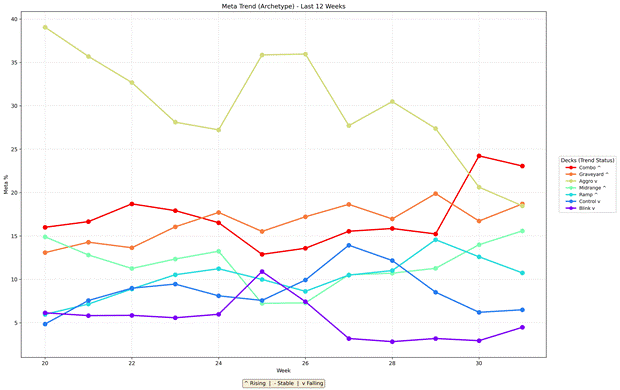
u/No-Bet7157 — 30 days ago
▲ 6 r/Pauper

Chosing right deck

Hi everybody, I'm new here. I try to go into a Pauper and try to find my deck. I was searching foor something that gives me a feel of a Zoo deck (I know that there is no Zoo in Pauper), and I was pointed to the Gruul deck and did some games yesterday with a more Ponza list and found it quite suited for me, but also noticed that there are more versions of those. I'm not a fan of changing decks. I would rather focus on one construction and learn how to play it.

I will test all that list by myself, but also want to ask you about your opinion about those archetype, how it performs in the metagame, and any other toughs :)

Thanks!

reddit.com
u/No-Bet7157 — 1 month ago

MTGO Modern Breakdown: Prowess proves it's for real, Boros gets its trophies back, Eldrazi Tron is unavoidable again, and Amulet Titan still can't close

I'm back after two weeks of vacation, and a lot has happened since the last Meta Breakdown. Prowess seems to improve, Boros gets back to the throne with really good results, and Amulet tries to take his T0 place back ;)

For everyone who wants to see a video analysis or just misses my voice or a face, here is a link to the YT Video. Also, I had my Substack if you want the text with charts.

Also, please remember that I'm not a data analyst. I do it for fun and for the community, as always, any CC is welcome. If you like it and have some spare time, subscribe to my YT channel, leave a comment there, or subscribe to my Substack. It helps me a lot.

And as always, here you got a short TL;DR, and after that, you have a much longer text ;)

TL;DR

>

Quick definitions

Top32 presence is how often a deck appeared in the Top32 of a Challenge. Top8 presence is the same idea for Top8. Conversion is how often a Top32 appearance turns into a Top8 appearance. Win/Top32 is how often a Top32 appearance turns into a win. Delta is Top32 event frequency minus metagame share, so a high delta means a deck appears in Challenge results more often than its raw popularity would predict.

Every win rate is reported with its 95% Wilson confidence interval and the number of games behind it. A 50% win rate on n=939 and a 56% win rate on n=92 are not the same claim, and the interval is the honest way to show that. Win rate is context. Challenge results, delta, and conversion are the primary signals.

For this window, the field median delta was +69pp, and the median Top8-to-Top32 conversion was 24%. Both thresholds come from this window’s data, not from a fixed rulebook.

Key observations

Prowess

Prowess sits at 7% metagame share, rising, and it took 4 of the 14 trophies. That is a 29% winner event frequency, the highest of any deck in the field, on top of 93% Top32 presence and 57% Top8 presence.

The part I keep coming back to is the pilot spread. Those four wins belong to four different players. Ruby Storm also won twice this window, but both trophies came from one pilot. Same for Goryo’s Vengeance. Prowess is the only deck whose trophy count is spread across the field rather than concentrated in one pair of hands, and that is usually what a genuinely strong deck looks like rather than one person on a heater.

Win-rate context: 52% (95% CI 48-56, n=581). Nothing dramatic, and it does not need to be. The Challenge results carry the argument on their own.

Boros Energy

Boros is at 12% metagame share with a falling trend, and it is still the deck you are most likely to sit across from at 46% encounter probability. The Challenge line: 100% Top32, 79% Top8, 30% conversion, 2 wins, delta +88pp.

The interesting part is that both the delta and the conversion are above the field median this window. The “Boros floods the Top32 but cannot close” read that held in earlier weeks simply does not apply here. It got there, and it finished. Win rate is 50% (95% CI 47-53, n=939) overall, the largest sample in the field, and a near-perfect coinflip. Popular, even, and effective this week as well.

Amulet Titan

Amulet is the frustrating one. 71% Top32 presence, 43% Top8 presence, and a 41% Top8-to-Top32 conversion that is the best of any volume deck in the window. Its win rate is also the strongest in that group: 58% (95% CI 51-64, n=221), an interval that sits fully above even. And it won nothing.

A deck that converts into Top8 at that rate with that win rate and still ends the window without a trophy is either running into a specific wall in the elimination rounds or simply on the wrong side of variance in a 14-event sample. I lean toward variance for now, but it is the second archetype-defining zero of the window next to Living End, and it is worth watching whether the pattern holds.

Eldrazi Tron

The encounter chart mover. Eldrazi Tron was under 2% of the field around week 20. It is now at 10% metagame share, second only to Boros by encounter probability at 40%, and this time the results came with the popularity: 100% Top32, 64% Top8, 2 wins, delta +90pp.

Its conversion is mediocre at 18%, below the field median, so the profile is “present everywhere, finishes sometimes” rather than elite efficiency. Win rate 48% (95% CI 45-52, n=782). But a deck at 40% encounter probability that also wins events is a deck you need an actual plan for, not a footnote.

Goryo’s Vengeance and the graveyard picture

Goryo’s posted the highest delta in the entire field at +94pp. 6% metagame share, 100% Top32 presence, 50% Top8 presence, 2 wins. Its conversion is modest at 17%, so this is a presence machine more than a closing machine, and both trophies came from a single pilot (Rvng, who tops the pilot table this window). Win rate 48% (95% CI 44-52, n=519), an interval sitting just under even.

The wider graveyard story finally improved. The archetype had spent weeks reaching Top8s and winning almost nothing; this window, it took 3 trophies (Goryo’s 2, Grixis Reanimator 1) on 100% Top32 and 93% Top8 presence.

The exception is Living End. 71% Top32, 43% Top8, a genuinely good 32% conversion, and zero wins. Again. Win rate 47% (95% CI 42-52, n=420). The deck has no trouble reaching the elimination rounds. It has trouble once it is there, and at this point, it is a multi-week pattern rather than a single bad fortnight.

Ruby Storm

Ruby Storm rose to 7% metagame share and won 2 events, with 93% Top32 and 50% Top8 presence. Its win rate is the highest among the top volume decks at 55% (95% CI 51-59, n=530), and the interval clears even, so that edge looks real rather than a rounding artifact.

The caveat is the same as with Goryo’s: both trophies came from one pilot (YungDingo). The deck is good. The trophy count is concentrated.

Belcher, briefly

Belcher will show up in some tables with an 86% conversion rate, and I want to defuse that number before anyone gets excited. It comes from a handful of Top32 entries at 1% metagame share, where a single deep run can swing the ratio violently. The deck did win an event, and its 59% win rate (95% CI 50-68, n=110) is the best point estimate in the field, but the interval is wide, and the trend is falling. Real deck, unreliable headline number.

Archetype breakdown

Aggro is the format at the moment: 31% metagame share, 85% encounter probability over a five-round event, Top32 in every Challenge, Top8 in 93% of them, and 9 wins. Its delta of +69pp is the lowest of any archetype, which is what always happens to the most popular thing in the room, and it does not matter. Nine trophies are the sentence that counts.

Graveyard sits at 16%, stable, with 100% Top32 and 93% Top8 presence and, for once, actual trophies: 3 wins. Goryo’s leads on presence, Grixis Reanimator chipped in a win, Living End keeps converting, and keeps not closing.

Combo is at 15% and reached the Top8 of every single event, the only archetype to do so, with the best archetype conversion in the field at 30% and 4 wins. Ruby Storm and Amulet carry the presence; Ruby Storm and Broodscale carry the trophies, plus the Belcher one-off.

Control is the presence-without-payoff story. 100% Top32, 86% Top8, 30% conversion, and exactly one win in fourteen events, which came from Land Destruction. Jeskai Control quietly earned a Challenge Overperformer tag with an above-median delta and conversion, but no trophy yet. The archetype delta of +88pp says control players keep getting deep. The winner column says the last two rounds keep going to someone else.

Ramp is essentially the Eldrazi Tron paragraph again, since Tron is nearly all of it. Highest archetype delta at +89pp, 2 wins.

Midrange had 100% Top32 and 64% Top8 presence with 2 wins. Dimir Midrange is rising at 2% share but converting poorly so far. Yawgmoth at 53% (95% CI 46-60, n=182) and Mono-Black at 56% (95% CI 46-66, n=92) both have attractive point estimates, but their confidence intervals are too wide to lean on.

Blink is the collapse. 3% metagame share, down from over 8% earlier in the window, the only archetype that missed some Top32s, 29% Top8 presence, zero wins. Esper Blink at 43% (95% CI 35-52, n=125) is the weakest win-rate profile in the eligible field.

Meta trends

The short version: Aggro rebounded to the top after its dip, Eldrazi Tron went from fringe to second-most-faced deck in about eight weeks, Boros and Affinity are both coming down from their peaks, Control keeps grinding upward, and Blink fell off a cliff. Goryo’s and Ruby Storm are the rising decks inside their archetypes.

On the Radar

>

My prep order for the next event: Boros first because of sheer volume, Eldrazi Tron second because of the trajectory and the sub-event point estimate, then the Ruby Storm and Grixis Reanimator matchups. Graveyard hate still earns its slots, since the cluster is 16% of the field and finally winning again, but I would take the Blink-specific cards out.

Best pilots this window

The pilot table explains a lot of the deck-level reads. Rvng took both Goryo’s trophies (2 wins, 3 Top8s across 6 events), YungDingo took both Ruby Storm trophies (2 wins, 3 Top8s in 6 events), and yolad won twice with Grixis Reanimator from just two entries, an average place of 1.0 that will be hard to top. Meanwhile, the four Prowess wins are spread across JPA93, lilianna1989, and two pilots further down the sheet, which is exactly why I read Prowess as a deck signal and the other two as pilot signals.

Data note: win-rate intervals use Wilson 95% confidence intervals. Challenge conversion and delta remain the primary performance signals.

By Karol Małota

aka WarLord1986pl / TribalFlamesInYourFace
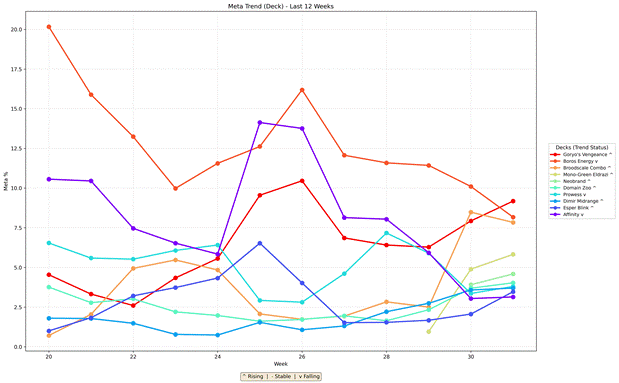
u/No-Bet7157 — 1 month ago

MTGO Modern Breakdown: Affinity is now #1, Boros is still here, Goryo’s keeps winning, and Tron still has a trophy problem

As usual, here is this week's modern metagame breakdown :) For everybody who wants to see a presentation, you can find it on my channel. If you want a version with tables, etc., here is my Substack.

Remember, treat this data as a signal, not as an oracle. I'm not a pro data analyst; I mostly do it to gather as much data as I can and show you some signals that might be helpful in preparing for an event. I also just like to do it. As always, any CC and ideas on how to improve those summaries are more than welcome. I do it for the community, so discussion is always great because it gives me and all of you another point of view for that data and what is happening in the modern metagame.

TL;DR

·         Affinity is the story of the week. It is now the single most-played deck in the format at 14.1% metagame share, reached the Top32 of every event, posted 61.5% Top8 event frequency, and tied for the most wins in the aggregate Challenge table with 3 trophies. Its win rate is 54% (95% CI: 50-58) on n=580, making it one of the few win-rate signals in this window with real weight behind it.

·         The event-size split matters. The headline winners did not all come from the same bracket. Affinity and Amulet Titan did their trophy work in the 32-player Challenges, while Boros Energy, Goryo's Vengeance, and Prowess won in the 64-player bracket. There were also important one-trophy results from Esper Blink, Broodscale Combo, Domain Zoo, Land Destruction, Azorius Blink and The Rock. That split is one of the most useful structural reads of this window.

·         Graveyard is still everywhere in the Top 8, but it rarely closes. As an archetype, it posted 100% Top32 presence and 84.6% Top8 presence, but only 15.4% winner event frequency. The decks get deep. The problem is turning those Top8s into trophies.

·         Eldrazi Tron and Living End are the clearest presence-without-trophy cases. Eldrazi Tron made the Top 32 of every event and the Top 8 in 61.5% of them, but finished with zero wins. Living End had the strongest real-volume Top8-to-Top32 conversion in the field at 50.0% and also finished with zero wins.

·         Domain Zoo had its strongest tracked week. Zoo posted a 67% overall win rate with a 95% CI of 55-77 on n=66, and it took one Challenge with Pleyboy. The sample is still small, but this was the first window where the deck did more than merely look playable.

Quick definitions

Top32 presence is how often a deck appeared in the Top32 of a Challenge. Top8 presence is the same idea for Top8. Conversion is how often a Top32 appearance turns into a Top8 appearance. Win/Top32 is how often a Top32 appearance turns into a win. Delta is Top32 event frequency minus metagame share, so a high delta means a deck appears in Challenge results more often than its raw popularity would predict.

I am no longer using a binary reliability tag for win rate. Every win rate is reported with its 95% Wilson confidence interval and the number of games behind it. That matters because a 54% win rate on n=580 and a 54% win rate on n=43 are not the same claim. Win rate is context. Challenge results, delta, and conversion are still the primary signals.

One technical note: the 32-player and 64-player Challenge sheets are best read as separate bracket signals. I use them to understand where decks are converting, not as a simple additive replacement for the aggregate table.

Key observations

Affinity

Affinity is the cleanest positive story in the data. It reached the Top32 of every event, made Top8 in 61.5% of them, and won 3 trophies in the aggregate Challenge table. It also became the most-played deck in the format at 14.1% metagame share, which means this is not a hidden deck anymore. It is both popular and successful.

The win-rate context is also stronger than usual: 54% (95% CI 50-58, n=580). That is the largest sample in the field, so I would take it more seriously than most of the smaller win-rate numbers.

The important caveat is the bracket split. All three Affinity wins came in the 32-player Challenges, where it had 71.4% Top8 event frequency and 42.9% winner frequency. In the 64-player bracket, it still appeared constantly, but it had 0 wins and only 27.3% Top8 event frequency. So the headline is not simply 'Affinity is the best deck.' The cleaner read is: Affinity is now the most important deck to prepare for, but its wins this window came from the smaller bracket.

Goryo's Vengeance and the Graveyard Problem

Goryo's Vengeance is now the clear graveyard pillar. It is the third-largest deck overall and the largest graveyard deck at 9.6% metagame share. It had 100% Top32 presence, 61.5% Top8 event frequency, and 2 wins, both from the 64-player bracket. Its win rate is 47% (95% CI 42-52, n=392), which is a solid sample sitting just under even.

The deck also had one of the highest deltas in the field at +90.5pp. That means it showed up in Challenge results much more often than raw metagame share alone would predict. Even if the win rate does not scream dominance, the Challenge data says you cannot treat Goryo's as just another graveyard deck.

Living End is the contrast. It is falling in the metagame trend, but it still posted 76.9% Top32 presence, 53.9% Top8 presence, and a 50.0% Top8-to-Top32 conversion rate. Its win rate is 56% (95% CI 47-64, n=126), but the sample is much smaller, and the trophy count is empty. That is the broader graveyard story this week: the archetype reaches elimination rounds all the time, but it still has a trophy problem.

Eldrazi Tron

Eldrazi Tron is the biggest gap between presence and trophies. It made the Top 32 of every event and the Top 8 in 61.5% of them. Among high-presence decks, its 34.7% Top8-to-Top32 conversion is excellent. And yet it won nothing.

The win rate is 54% (95% CI 48-60, n=274), so the deck does not look weak in the general data. The problem is specifically the finish. This is a deck you should expect to face, and probably face often, but the current Challenge window still does not show it closing events.

That distinction matters for preparation. Eldrazi Tron is not a deck you can ignore just because it has 0 wins. A deck with 100% Top32 presence and 61.5% Top8 event frequency is part of the format. The question is not whether it exists. The question is why it keeps getting close and not winning.

Amulet Titan

Amulet Titan is the quiet winner of the week. It won 3 events from only 5.0% metagame share, which gives it the best Win/Top32 ratio among established decks at 10.3%. Its win rate is 54% (95% CI 47-61, n=207).

Like Affinity, all of Amulet's wins came in the 32-player bracket. In those events, it posted 71.4% Top8 event frequency and 42.9% winner frequency. In the 64-player bracket, it had 0 wins and a Top8 event frequency of only 9.1%.

There is also a pilot-concentration angle here: reidq7 was responsible for two of the Amulet wins. So I would not read this as automatic format-wide dominance. I would read it as a strong warning that experienced Amulet pilots are still very capable of winning, especially in smaller Challenge fields.

Boros Energy

Boros Energy is no longer the single most-played deck, but it is still very much part of the format. It sits at 12.6% metagame share, behind Affinity, with a stable trend. The Challenge results are solid: 92.3% Top32 presence, 53.9% Top8 presence, and 2 wins.

The win rate is 49% (95% CI 45-53, n=518), which is essentially a coin flip on a large sample. That is not a dominance signal, but it is not a collapse signal either.

Both Boros wins came in the 64-player bracket, where the Top8 event frequency was 63.6% and the winner frequency was 18.2%. Boros is not alone at the top anymore. But if your testing plan does not respect Boros, it is still wrong.

Prowess

Prowess finally broke the no-trophy pattern this window. It won 2 events, both in the 64-player bracket. The deck still looks strange in the data: 92.3% Top32 presence, 38.5% Top8 presence, high delta at +89.4pp, but only 15.6% Top8-to-Top32 conversion.

The win rate is 47% (95% CI 38-56, n=120), so I would not make too much of the sub-50 number. The interval is wide enough that a few points either way are not meaningful.

The useful read is simpler: Prowess is still reaching Challenge results at a rate far above its raw metagame share. It is falling in popularity, but it is not disappearing from the top tables.

Archetype breakdown

Aggro is the largest archetype at 35.1% metagame share and the one you are most likely to face, with 88.5% encounter probability over a five-round event. It reached the Top32 of every event, the Top8 in 84.6% of them, and posted the highest winner frequency in the field at 46.2%. Affinity is the main story, Boros remains the baseline, and Jeskai Energy is rising in the background.

Graveyard sits at 15.5% and is the most obvious presence-heavy, trophy-light archetype. It had 100% Top32 presence, 84.6% Top8 presence, 15.4% winner frequency, and 29.8% conversion. Goryo's leads the archetype; Grixis Reanimator had a strong delta/conversion profile, but no wins; Living End converted extremely well into Top8 and still finished trophyless.

The combo is down to 12.5% meta share but still produced 30.8% winner event frequency. This was mostly Amulet Titan plus one Broodscale Combo win, not Belcher. Belcher is much less convincing this week: 46.2% Top32 presence, 7.7% Top8 presence, 0 wins, and a 36% (95% CI 26-47, n=80) win rate.

Control is rising, and the Challenge data support paying attention. The archetype reached the Top8 in 76.9% of events, but had only a 7.7% win rate. Azorius Control had 92.3% Top32 and 46.2% Top8 presence with 0 wins, while Land Destruction supplied the control trophy.

Ramp is basically the Eldrazi Tron story: strong presence, strong conversion, zero wins. The archetype had 100% Top32 presence, 69.2% Top8 presence, 30.7% Top8-to-Top32 conversion, and no trophies.

Blink is quietly impressive. It has 10.9% meta share, 100% Top32 presence, 53.9% Top8 event frequency, and the best archetype-level Top8-to-Top32 conversion in the field at 32.4%. Esper Blink and Azorius Blink both won once, and the archetype is rising.

Meta trends

The short version: Affinity has spiked sharply, Boros rebounded after the drop, Goryo's Vengeance is rising, and Control is not just a one-week curiosity anymore. The archetype view still shows Aggro as the format's baseline, but the rest of the field is pulling in several directions at once.

Figure 7. Deck-level metagame trend over the last 18 weeks.

Figure 8. Archetype-level metagame trend over the last 18 weeks.

On the Radar

·         The Rock won a Challenge from sub-5% encounter share. That is the cleanest underplayed-winner signal of the week, even if the sample is tiny.

·         URG posted 38.5% Top32 event frequency and 15.4% Top8 event frequency without a win. It is not a major metagame player yet, but it is showing up often enough to notice.

·         Jeskai Blink has fallen below the eligible encounter threshold, but it still reached Top8 in 15.4% of events. That is not enough to call it back, but it is enough to keep it on the radar.

·         Jeskai Control had 46.2% Top32 event frequency and 7.7% Top8 event frequency with 0 wins. That fits the broader control story: presence is improving before trophy conversion fully catches up.

Domain Zoo perspective

This was the strongest week tracked by Domain Zoo. The deck posted a 67% overall win rate with a 95% CI of 55-77 on n=66 and took one Challenge with Pleyboy as the pilot. The sample is small and the interval is wide, so I am not going to claim the deck suddenly solved the format. But this is no longer just 'Zoo might be playable.' This window shows real results.

The metagame-share problem is still there. The zoo is only 1.6% of the field and is still falling by trend. But when it entered Challenge results, it played deep: 61.5% Top32 presence, 23.1% Top8 presence, 33.3% Top8-to-Top32 conversion, and 8.3% Win/Top32.

The most important matchup is now Affinity. It is the deck you are most likely to face at 53.3% encounter probability, and Zoo's matchup data is positive: 56% (95% CI 48-64, n=143).

Boros Energy remains the largest matchup sample: 49% (95% CI 43-55, n=249). That reads like a real coin flip, which is about where the matchup has felt in practice.

Living End is less common, but it matters because of how well it converts to Top8. Zoo's data: 50% (95% CI 39-61, n=78).

My prep order for the next event would be Affinity first, then Boros and Goryo's, then the bracket-specific question. If you are entering a 32-player Challenge, the decks that actually won this window were Affinity, Amulet Titan, and The Rock. If you are entering a 64-player Challenge, the winning pressure came more from Boros, Goryo's, Prowess, and the one-trophy decks. Build the post-board plan for the bracket you are playing, not for an average that hides the split.

Best pilots this window

The top of the pilot table also explains some of the deck-level reads. Amulet's result is partly concentrated in reidq7, while Goryo's had multiple pilots near the top of the sheet.

Rank Pilot Deck Wins Top8 Top16
1 reidq7 Amulet Titan 2 2 3
2 Aced5 Goryo's Vengeance 1 3 3
3 jussupinator Goryo's Vengeance 1 2 3
4 WanderingOnes Affinity 1 2 2
5 UninspiredMehjagic Esper Blink 1 1 2
6 MJ_23 Boros Energy 1 1 2
7 Pleyboy Domain Zoo 1 1 1
8 AChord4Five Amulet Titan 1 1 1
9 Dioferreira Affinity 1 1 1
10 RiceTackler The Rock 1 1 1


Data note: win-rate intervals use Wilson 95% confidence intervals. Challenge conversion and delta remain the primary performance signals.


By Karol Małota


aka WarLord1986pl / TribalFlamesInYourFace
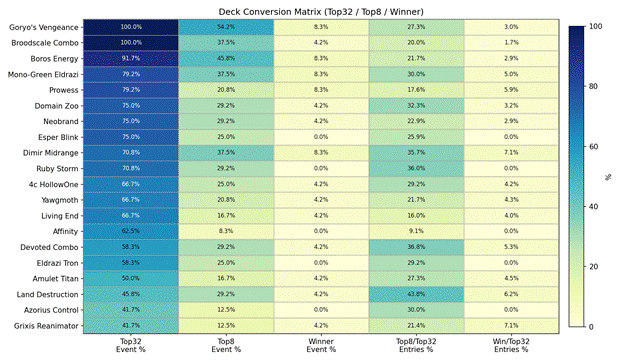
u/No-Bet7157 — 2 months ago

MTGO Modern Breakdown: Goryo’s is Clean, Living End is Struggling, Boros is King

Here is a traditional weekly metagame breakdown. You can find it in video version, or if you want some charts, I also have a free Substack page.

So, this week we will probably start to see some stabilization in the format after the ban. It looks like we have quite a diverse metagame, but is it a healthy one? From my point of view, it looks ok, not perfect, but it will probably never be like that. I still think that Boros should get some bans, because it is clearly as powerful as it was, and maybe fewer free spells, but I still enjoy playing the format a lot ;)

As always, appreciate any CC and comments. I know that I made mistakes and missed some data here and there, but I tried to answer any of your questions.

TL;DR
- Boros Energy is still the first deck to prepare for: 11% meta share, 46% encounter probability, 71% Top8 event frequency, and 43% winner event frequency.

- Goryo's Vengeance is the cleanest graveyard performer of the window: 100% Top32 event frequency, 64% Top8 event frequency, and 21% winner event frequency from only 6% metagame share.

- Living End is popular and still converts into Top8s, but 0 wins and 40% at n=268 (95% CI 34-46%) make it harder to call it the best graveyard deck right now.

- Eldrazi Tron is the widest presence-to-trophy gap: 93% Top32 event frequency, 36% Top8 event frequency, and 0 wins.

- Prowess broke the no-win story in this sample. It posted 14% winner event frequency and remains a real prep deck.

- Domain Zoo is playable but not a headline deck this week: 2.0% meta, 9.6% encounter probability, 21% Top8 event frequency, and 0 wins.

Quick definitions Top32 presence means in how many Challenges a deck appeared in the Top32. Top8 presence means in how many Challenges a deck appeared in the Top8. Conversion means how often Top32 appearances become Top8 appearances. Win/Top32 means how often a Top32 appearance turns into a Challenge win. Delta is the difference between metagame share and Challenge-result presence. A high delta suggests that a deck shows up in results more often than its raw metagame share would imply. Win rate is shown with n and Wilson 95% CI, but it is not the primary signal in this article.

Key observations

Boros Energy

Boros Energy remains the default deck of the format. It is 11.6% of the league metagame and has 46.1% encounter probability in a 5-round sample. That alone would make it important, but the Challenge line is also strong: 92.9% Top32 event frequency, 71.4% Top8 event frequency, and 42.9% winner event frequency.

The win rate is 54% at n=451 (95% CI 49-59%). That is a real enough sample to use as context, but I would not make the whole argument from the win rate. The real story is that Boros is still both popular and capable of closing events. This is the matchup I would check first before making any sideboard decision.

Goryo's Vengeance

Goryo's Vengeance is the cleanest positive signal of the window. It is only 5.6% of the metagame, but it posted 100% Top32 event frequency, 64.3% Top8 event frequency, and 21.4% winner event frequency. Its Top32 delta is 94.4pp, the highest in the deck field.

This is exactly the kind of deck that can be underrated if you only look at raw league share. You may not face it as often as Living End, but when it shows up in Challenges, it performs. The win rate is 52% at n=217 (95% CI 45-59%), which supports the idea that the deck is real, but the Challenge finish is the stronger argument.

Living End

Living End is more complicated. It has 6.9% metagame share and 30.1% encounter probability, so it is one of the decks you are most likely to face. It also converts Top32 entries into Top8s at 39.3%, which is a strong number.

The problem is the finish. Living End posted 0 wins, and the league win rate is 40% at n=268 (95% CI 34-46%). That does not mean the deck is bad. It means the deck is popular, present, and still reaching deep rounds, but it did not have the cleanest graveyard week. If I had to choose the graveyard deck that impressed me most in this window, I would pick Goryo's Vengeance over Living End.

Prowess

Prowess deserves a different read from the previous few weeks. The old story was that Prowess could reach Top8 but could not close events. This time, it posted 14.3% winner event frequency. The deck is 6.4% of the field, has 28.2% encounter probability, and a win rate of 54% at n=250 (95% CI 48-60%).

The Top8 conversion is 19.6%, so it is not the best-converting deck in the data. Still, the deck is too present and too successful to ignore. From my perspective, this is one of the matchups where I do not want to oversideboard. You need respect, but you also need to keep your own clock.

Eldrazi Tron

Eldrazi Tron is the clearest presence-to-trophy gap. It has 6.3% metagame share, 27.8% encounter probability, and 92.9% Top32 event frequency. At the same time, it finished with 0 wins.

This is why I would call it a preparation priority but not a deck that is currently dominating. The deck is everywhere. It makes Top32s. It reaches Top8 sometimes. But it is not closing. For sideboarding, that still matters: you need a plan, but you do not need to build your entire tournament around beating only Eldrazi Tron.

Affinity

Affinity is somewhat similar, but with a different texture. It has 5.8% metagame share and 25.9% encounter probability. It appeared in the Top32 of every Challenge and reached Top8 in 42.9% of events, but it did not win.

The league win rate is 52% at n=228 (95% CI 46-58%). I would still be cautious. Affinity punishes unprepared lists very quickly, and 100% Top32 event frequency means the deck is constantly present in real results.

Azorius Control

Azorius Control is one of the main decks I would watch. It has 5.3% meta share, 23.9% encounter probability, 92.9% Top32 event frequency, and 42.9% Top8 event frequency. It finished with 0 wins, but the Challenge Overperformer label is justified by the combination of delta and conversion.

The win rate is 50% at n=206 (95% CI 43-57%). That looks like a real deck, but not a deck I would overreact to yet. If this continues for another window, Control becomes a bigger part of the sideboard conversation.

Archetype breakdown

Aggro - 27.2% meta

Aggro is still the largest archetype in the format. It has 79.6% encounter probability and, at the Challenge level, 85.7% Top8 event frequency and 57.1% winner event frequency. That is the strongest trophy signal among the major archetypes.

Boros Energy is the clear number one deck in the archetype. Prowess won this window and should not be dismissed. Affinity did not win, but its constant Top32 presence makes it a real deck to prepare for.

Graveyard - 17.7% meta

Graveyard is the second-largest archetype and probably the biggest sideboard tax. It has 62.3% encounter probability, 78.6% Top8 event frequency, and 28.6% winner event frequency.

The important part is that the archetype is not one deck. Living End is the most encountered graveyard deck. Goryo's Vengeance had the best Challenge finish. Grixis Reanimator sits in the middle with 50.0% Top8 event frequency and 7.1% winner event frequency. I would prepare for graveyard decks broadly, not only for cascade.

Combo - 16.5% meta

Combo is 16.5% of the metagame and has 59.5% encounter probability. Broodscale Combo is the largest deck in the archetype at 4.8%, but it did not win this window. Amulet Titan is smaller at 3.0%, yet posted 14.3% winner event frequency.

Ruby Storm has a strong league win rate at 58% at n=157 (95% CI 50-65%), but no wins. Belcher is lower in share and lower in this window's trophy signal than in previous weeks. I would still keep stack interaction and fast-combo respect in the sideboard, but this is not a week where one combo deck owns the whole section.

Midrange - 13.0% meta

Midrange is a mixed bucket this week. Domain Zoo, Yawgmoth, Mono-Black Midrange, Mardu Energy, Grixis Midrange, The Rock, and other smaller decks all live here. The archetype has 64.3% Top8 event frequency but only 7.1% winner event frequency.

Domain Zoo is the most relevant deck for this article. It has 2.0% meta share, 9.6% encounter probability, 42.9% Top32 event frequency, and 21.4% Top8 event frequency. The win rate is 48% at n=77 (95% CI 37-59%). I would describe Zoo as playable and underrepresented, not as secretly dominant.

Ramp - 11.2% meta

Ramp is mostly an Eldrazi Tron story. The archetype has 44.9% encounter probability, 50.0% Top8 event frequency, and 0 winner event frequency. That is a classic warning sign: you must prepare because the deck appears often, but the trophy count does not justify panic.

Eldrazi Tron itself has 92.9% Top32 event frequency and 35.7% Top8 event frequency. Its win rate is 46% at n=247 (95% CI 40-52%). I would keep targeted hate and a clear game plan, but I would not sacrifice too many slots only for Tron.

Control - 8.4% meta

Control is smaller than the top archetypes, but it matters. The archetype has 57.1% Top8 event frequency and 0 wins. Azorius Control is the main representative, and Land Destruction also appears in the eligible field.

Control is always a list-construction question. If you overload for aggro and graveyard, the Control matchup can get worse. If you overload for Control, Boros and Prowess punish you. This is one of the reasons I prefer flexible sideboard cards when possible.

Blink - 6.0% meta

Blink is lower than it used to be, but it is not gone. Esper Blink has 4.3% meta share, 19.8% encounter probability, 35.7% Top8 event frequency, and 7.1% winner event frequency. The league win rate is 45% at n=169 (95% CI 38-53%), so I would not treat it as a top deck, but the Challenge win means it still deserves respect.

On the Radar - Universe B

These decks sit below the safe encounter-probability threshold, but they appeared in Challenge results and should not be completely ignored: WUR (it Is Prowess 😊): Top32 35.7%, Top8 14.3%, Wins 0.0%;

Dimir Mill: Top32 35.7%, Top8 7.1%, Wins 0.0%;

 Jeskai Blink: Top32 28.6%, Top8 7.1%, Wins 0.0%;

 Jeskai Control: Top32 28.6%, Top8 7.1%, Wins 0.0%;

 Dimir Midrange: Top32 21.4%, Top8 7.1%, Wins 0.0%;

 Jeskai Energy: Top32 14.3%, Top8 7.1%, Wins 0.0%;

 Rakdos Aggro: Top32 14.3%, Top8 7.1%, Wins 0.0%;

 Simic Midrange: Top32 14.3%, Top8 7.1%, Wins 0.0%.

The important distinction is that these decks are not the same as Boros, Goryo's, Living End, or Eldrazi Tron. They are not first-layer sideboard pressures. They are warning lights. If a radar deck has Top8 presence or a win, I want to know it exists, but I will not rebuild the entire 75 for it.

Best pilots this window

The aggregate BestPilots sheet matters because it shows how much of the trophy share can come from repeated strong finishes. The top names this window are

reidq7 (Amulet Titan, 2W/4T8),

RNicoF (Boros Energy, 2W/3T8),

ashame (Azorius Blink, 2W/2T8),

Denisevich (Grixis Reanimator, 2W/2T8),

rastaf (Boros Energy, 2W/2T8), PieGonti (Boros Energy, 2W/2T8),

MayoDominaria (Boros Energy, 2W/2T8),

McWinSauce (Esper Blink, 2W/2T8).

This is useful context when reading deck performance. A deck can be good and still have its results concentrated in the hands of a few excellent pilots. I do not want to erase that. For weekly metagame analysis, it is better to treat pilot concentration as a separate layer of interpretation.

Preparation priorities

My first preparation layer is Boros Energy, Goryo's Vengeance, Living End, Prowess, Affinity, Eldrazi Tron, Grixis Reanimator, and Azorius Control. These are the decks that combine league presence and Challenge presence in a way that actually changes how I would register a 75.

The second layer is Broodscale Combo, Amulet Titan, Ruby Storm, Esper Blink, Belcher, Land Destruction, Yawgmoth, and Domain Zoo. These decks can absolutely beat you, but they are not all equal in priority. I would rather have flexible cards that cover multiple decks here than narrow cards for only one of them.

Overall, this window looks like a format with several strong pressures rather than one single deck to beat. Boros sets the fair baseline. Graveyard decks demand sideboard space. Eldrazi Tron is everywhere but not closing. Prowess is back to winning. Control is relevant but not dominant. Zoo can compete, but it needs to be tuned for the actual room rather than for last month's metagame.

u/No-Bet7157 — 2 months ago

Abzan in Pioner?

Im quite new to format, playing Modern (only zoo) but I play one league with this Golgari deck and I really like it. It looks like one of my 2017(?) Std deck with sylvan advocate and black gearhulk deck. I have all the mana base (exept shock lands) but have all man lands in those colors etc. Is any sense to add white? I like those grindy decks with lot of remuval and white had a really nice options. Also why nobody playing Morderus Cut? It looks like a solid remuval option.

reddit.com
u/No-Bet7157 — 2 months ago

Week 22 MTGO Modern: Control is back, Belcher overperforms, and graveyard decks keep reaching Top 8 without trophies

After a one-week break, I’m back with the Modern metagame analysis.

I took some community feedback and tried to clean up the format a bit. As usual, the post starts with a short TL;DR, then the main observations, and only after that goes into the full archetype breakdown for anyone who wants the deeper data.

The plan from now on is pretty simple: Monday will be the YouTube metagame video, and Tuesday will be the more polished written version with the full numbers.

TL;DR

Belcher is the main story of the week: 3 Challenge wins from only 4.2% metagame share and a 36.0% Top32 to Top8 conversion rate.

Prowess reached Top8 consistently for the third week in a row, but still did not win an event. This is starting to look more like a structural closing problem than simple variance.

Eldrazi Tron appeared in the Top32 of every single one of the 14 events, but finished with 0 wins and weak conversion. The deck is coming back, but for now it is not closing tournaments.

Azorius Control is the biggest positive surprise: a rising trend, excellent conversion, and the best Win/Top32 ratio in the field.

Graveyard decks are still present, but they have a trophy problem. As an archetype, they posted 100% Top32 presence and 78.6% Top8 presence, but only one win across 14 events.

The post-ban format is still settling. Boros and Amulet lost metagame share, but their results do not suggest that they were killed. At the same time, there is clearly more room for control decks.

Quick definitions

Top32 presence - in how many Challenges a deck appeared in the Top32.

Top8 presence - in how many Challenges a deck appeared in the Top8.

Conversion - how often Top32 appearances become Top8 appearances.

Win/Top32 - how often a Top32 appearance turns into an actual Challenge win.

Delta - the difference between metagame share and Challenge-result presence. A high delta suggests that a deck shows up in results more often than its raw metagame share would imply.

Key observations:

Belcher

Belcher is the cleanest story of the week. The deck won 3 Challenges from only 4.2% metagame share, and it did so in the hands of two different pilots. On top of that, it posted a 36.0% Top32 to Top8 conversion rate, one of the best results in the entire data set.

This looks like a deck that is still flying somewhat under the radar of sideboards. For comparison, Boros Energy has 13.2% metagame share and also won 3 events, meaning Belcher reached the same final result with more than three times less representation in the field.

Prowess

Prowess is in a strange place. On one hand, it has solid Top32 and Top8 presence. On the other hand, it has now gone three weeks in a row without a win. With 57.1% Top8 presence and 0 trophies, this is starting to look less like pure bad luck and more like a real problem with closing events.

This is not a deck that looks weak. Quite the opposite: both delta and conversion are above the median. The issue is that good entries into the elimination rounds are not becoming wins.

Eldrazi Tron

Eldrazi Tron had 100% Top32 presence - it appeared in the results of every single one of the 14 Challenges. At the same time, it finished with 0 wins and only 12.5% conversion, one of the weakest numbers among decks with a real sample.

This is the biggest gap of the week between presence and performance. The deck is clearly returning to the format and should be kept in mind, but the results show that, for now, it is more often present everywhere than actually finishing tournaments.

Azorius Control

Azorius Control looks like one of the biggest winners of the current window. It has 7.3% metagame share, a rising trend, 37.0% conversion, 7.4% Win/Top32, and a win rate around 54% at n=555.

This is already the fourth week of growth in a row. If this trend continues for another week or two, the deck will quickly move from "watch this" to "must prepare."

Living End

Living End posted a very clear decline. The deck still has 5.0% metagame share, but only 7.1% Top8 presence, 5.0% conversion, and 0 wins. Its win rate fell to around 46% at n=384.

Not long ago, Living End looked like one of the main beneficiaries of the return of cascade. Now the data suggests that the format is adapting. Some of the hate prepared for cascade and graveyard decks may be hitting it directly, while the rise of control also makes life harder.

Graveyard decks as a whole

The Graveyard archetype is still highly present: 100% Top32 presence and 78.6% Top8 presence. The problem is that the entire archetype converted all of that into only one win across 14 events.

This is a pattern that has repeated for several weeks now: graveyard decks regularly reach Top8, but they rarely close the tournament. Grixis Reanimator looks like the best deck in this space, Living End is falling sharply, and Goryo's Vengeance still shows strong entries without trophies.

Archetype breakdown

Aggro - 32.7% meta

Aggro remains the largest archetype in the format. It appeared in the Top32 and Top8 of every one of the 14 events. As a whole, it has 35.7% winner event frequency and 25.1% Top32 to Top8 conversion.

What is interesting is that the whole archetype is losing popularity. This is not only the result of Boros Energy declining; the other aggro decks are also moving down. One possible reason is pressure from cascade decks and a higher amount of sideboard cards that indirectly make life harder for fast strategies.

Boros Energy

Boros Energy currently has 13.2% metagame share and a downward trend, but the results are still very solid. The deck appeared in 92.9% of Top32s, 85.7% of Top8s, and won 3 events, which equals 21.4% of all Challenges in this window.

Its win rate is around 51% at n=1010, so the sample is already fairly solid. It is possible that after the bans some less experienced pilots left the deck, while the players still posting results are more likely to know the archetype well. The high delta suggests that Boros still appears in results much more often than its raw metagame share would imply.

Affinity

Affinity has 7.5% metagame share and is also declining, which is somewhat surprising. The deck has access to good tools against cascade, is fast, and in theory should be able to fight both control and parts of the ramp field reasonably well.

Despite the lower metagame share, the results are strong: 92.9% Top32, 64.3% Top8, and 2 wins, or 14.3% winner event frequency. The win rate is around 54%, but on a smaller sample than Boros (n=569), so I would not base the entire evaluation only on that number. Delta +85.4pp still shows a deck with a very strong presence in results.

Prowess

Prowess has 5.5% metagame share and is still declining. That does not stop it from appearing regularly in results: 85.7% Top32 and 57.1% Top8. The problem is the lack of wins.

A win rate around 53% at n=421 looks solid, but the sample is not huge. The more important signal is different: once again, Prowess looks like a deck that goes deep into tournaments but cannot turn Top8 appearances into trophies.

Combo - 19.0% meta

Combo is the second-largest archetype in the metagame. It appeared in 100% of Top32s and 85.7% of Top8s. More importantly, it won almost 43% of events, more than Aggro despite having a much smaller share of the field.

This is where the most important story of the week lives: Belcher.

Broodscale Combo

Broodscale Combo has a 4.9% metagame share and is on the rise. The deck posted 71.4% Top32, 35.7% Top8, and 1 win, for a 7.1% win rate in the event.

Its win rate is around 50% at n=377, so the raw win rate isn't the most impressive part. The more important pieces are the delta, the Challenge Overperformer flag, and the fact that this is the fastest-growing Combo deck for the third week in a row. This is not a deck I would ignore.

Belcher

Belcher has only 4.2% metagame share, yet it appeared in 78.6% of Top32s, 64.3% of Top8s, and won 3 events. That gives it 21.4% winner event frequency, the same final result as Boros Energy with much lower metagame share.

Its 36.0% conversion and roughly 12.0% Win/Top32 put it near the top of the entire field. The win rate is around 54%, although on a small sample (n=323). Combined with delta +74.3pp, that gives it a deserved Challenge Overperformer flag.

In my view, this is the main story of the week.

Amulet Titan

Amulet Titan has 2.8% metagame share and a downward trend, most likely as an after-effect of the bans. Even so, the deck is still putting up excellent tournament results: 64.3% Top32, 21.4% Top8, and 2 wins, or 14.3% of events.

Conversion is 25.0%, and Win/Top32 is 12.5%, both of which are among the best in the format. The win rate sits around 52%, but on a small sample (n=217). The conclusion is simple: metagame share is going down, but experienced pilots can still win with Amulet without Lotus Field.

Ruby Storm

Ruby Storm has a 2.2% metagame share and is in a downward trend. Even so, the deck appeared in 71.4% of Top32s and 21.4% of Top8s, but finished the period without a win.

Its win rate is only around 45% at n=168, so this needs to be treated carefully, but the signal doesn't look strong. It is possible that hate prepared for Cascade is also hitting Storm as splash damage. Many sideboard cards that are good against cascade are also very reasonable against Storm.

Crashing Footfalls

The unbanning of Violent Outburst brought Crashing Footfalls back into the metagame. The deck currently has 2.4% metagame share and is slowly growing.

The results, however, are mixed: 64.3% Top32, but only 7.1% Top8, 0 wins, and 11.1% conversion. The win rate is around 44% at n=185. The deck's metagame share is indeed rising, but the Challenge results do not yet confirm its strength. Maybe the format is already well prepared for cascade, or maybe two vanilla 4/4 creatures are less scary in today's Modern than they used to be.

Graveyard - 13.6% meta

Graveyard as an archetype looks very stable in terms of presence but weak in terms of winning events. It has 100% Top32, 78.6% Top8, but only 7.1% winner event frequency, which means one win in 14 Challenges.

This is an archetype that regularly reaches the elimination rounds, but struggles to finish the job.

Grixis Reanimator

Grixis Reanimator has a 5.7% metagame share and is on the rise. The results are very good: 92.9% Top32, 57.1% Top8, and one win.

Conversion is 33.3%, the win rate is around 53% at n=436, and delta +87.1pp gives it a strong Challenge Overperformer flag. Right now, it looks like the strongest graveyard deck in Challenges and beats Living End in almost every important metric.

Living End

Living End has 5.0% metagame share, but its results dropped hard. The deck posted 71.4% Top32, only 7.1% Top8, 0 wins, and just 5.0% conversion.

The win rate fell to around 46% at n=384. This is still not a gigantic sample, but the trend is clear. Not long ago, Living End had very high Top8 presence. Now it has fallen to a level that suggests strong format adaptation. Cascade hate, graveyard hate, and a better position for control may together explain the drop.

Goryo's Vengeance

Goryo's Vengeance has 2.6% metagame share and also a downward trend. The deck posted 85.7% Top32, 35.7% Top8, but 0 wins.

Conversion at 31.2% and a win rate around 50% at n=198 show a deck that can still enter the top tables regularly, but does not close events. This is another example of the broader graveyard pattern: strong presence, weak trophy count.

Midrange - 11.2% meta

Midrange as an archetype has 100% Top32, 85.7% Top8, and 14.3% winner event frequency, meaning 2 wins. Conversion is 23.1%.

The whole archetype is clearly gaining. This is interesting because Phlage was a very midrange card, and some builds definitely suffered from its ban. On the other hand, midrange usually has many tools and can adapt more easily to a new field.

Domain Zoo

Domain Zoo currently has 3.0% metagame share. The deck dropped after the Phlage ban, but the new versions look playable and effective. Zoo probably has one of the widest ranges of builds in the format: from more aggressive Nacatl versions, through grindy midrange with Quantum Riddler, to more exotic shells.

The results are better than the metagame share alone would suggest: 71.4% Top32, 42.9% Top8, 0 wins, and a very good 35.3% conversion. That is the third-best conversion result in the field. The win rate is around 51% at n=230.

With a conversion that high, the lack of a win looks more like small-sample and finals-variance issues than proof of a real weakness. In other words: Zoo is not dead. The deck has a metagame-share problem, but when it does break into Top8, the numbers suggest that it can fight close to the end of the event.

Yawgmoth

Yawgmoth has 2.3% metagame share and looks stable. The deck posted 64.3% Top32, 28.6% Top8, but like Zoo, it finished without a win.

Conversion is 23.5%, and the win rate is around 53% at n=177. The sample is small, so I would not draw overly sharp conclusions, but the deck looks solid. The heavy presence of graveyard hate may be somewhat hostile to it right now, but this is still a deck worth watching.

Ramp - 8.9% meta

Ramp appeared in 100% of Top32s across all 14 events. The archetype has 57.1% Top8 presence, 7.1% winner event frequency, and 20.4% conversion. Delta at +91.1pp is the highest among archetypes.

Eldrazi Tron

Eldrazi Tron has 5.8% metagame share and a rising trend. It appeared in 100% of Top32s, but only 28.6% of Top8s, and it did not win an event.

Conversion at 12.5% is very weak for a deck with such regular presence. The win rate is around 50% at n=442, and delta +94.2pp is the highest in the entire field. This deserves a Needs Attention label: the deck is present in every Challenge, but for now it cannot turn that presence into trophies.

The main takeaway: Tron is coming back. Even if it is not winning yet, a Top32 finish in a Challenge is still a meaningful result, and 100% Top32 presence means you cannot ignore this deck when preparing for the format.

Control - 8.7% meta

Control is one of the bigger surprises of this period. The archetype has 85.7% Top32, 42.9% Top8, and 14.3% winner event frequency. Conversion is 33.3%, the second-highest value among archetypes.

The most important point is that Control has a rising trend and looks like a real part of the new metagame, not a one-week spike.

Azorius Control

Azorius Control is the main representative of the archetype and, alongside Dimir Control, looks like one of the most serious control decks in the format. It has 7.3% metagame share and a rising trend.

The results are very strong: 85.7% Top32, 42.9% Top8, 2 wins, 37.0% conversion, and 7.4% Win/Top32. On top of that, it has a win rate around 54% at n=555 and delta +78.4pp.

This is a deserved Challenge Overperformer flag. Four straight weeks of growth, a good sample, and excellent conversion suggest that Azorius Control may be one of the most important decks of the next few weeks.

Blink - 5.8% meta

Blink, recently one of the top archetypes, dropped hard after the bans. Even so, it still has solid results: 92.9% Top32, 50.0% Top8, 7.1% winner event frequency, and 31.0% conversion.

The trend is rising, so I would not write this archetype off. It looks more like a deck that has been heavily rebuilt after the bans and may still return to a larger role.

Esper Blink

Esper Blink has 3.2% metagame share and posted 64.3% Top32, 28.6% Top8, and 0 wins. Conversion is 28.6%.

The win rate looks weaker: around 45% at n=245. The sample is not huge, but for now the win rate does not support the deck's rising popularity. Still, Blink is an archetype you should respect, especially if the upward trend continues next week.

On the Radar - Universe B

Below are decks that sit below the safe league encounter threshold, but still show up repeatedly on the Challenge results radar.

Eldrazi Ramp - 0.8% meta

42.9% Top32, 7.1% Top8, 0 wins. For such a low metagame share, the Top32 presence is definitely worth noting.

Sultai Ritual - 1.0% meta

28.6% Top32, 14.3% Top8, and 1 win. A win at around 1% metagame share is a strong signal that the deck may be more than a one-off curiosity.

Jeskai Blink - 0.3% meta

Jeskai Blink, until recently one of the more important decks in the format, has fallen below 1% metagame share. It has 21.4% Top32, 14.3% Top8, and 0 wins. This is one of the clearest examples of a deck that was genuinely weakened by the bans.

BRG - 0.7% meta

21.4% Top32, 7.1% Top8, and 1 win. Aldreen won an event with this build. It may be the result of one very strong pilot, but a win at sub-1% metagame share definitely deserves a place on the radar.

Mono-Black Midrange - 0.8% meta

35.7% Top32, 7.1% Top8, 0 wins.

The win rate is around 44%, but without a clear sample size I would treat this number cautiously.

Overall, the post-ban format does not look completely reset. Instead, the emphasis has shifted. Boros and Amulet can still win, Combo had a very strong week thanks to Belcher, Control is coming back, and Zoo - despite the drop in popularity - still has numbers suggesting real potential.

I hope you like this writing style more and it is more friendly, still I'm open to any CC and suggestions that helps me improve :)

u/No-Bet7157 — 3 months ago

The Last Jeskai: Pre-Ban Modern Data + What It Tells Us About the Post-Ban Format

The title says The Last Jeskai because today's bans effectively end the deck in its current form. Phlage and Lotus Field are out, Violent Outburst and Jitte are back.

This write-up and breakdown video were prepared before the announcement, but instead of scrapping it, I'm publishing the data with ban context integrated throughout. This is the cleanest snapshot of the format that just ended, which makes it directly useful for predicting what's coming next.

TL;DR:


  • BANS TODAY: Phlage and Lotus Field banned, Violent Outburst and Jitte unbanned. Directly affected decks marked POST-BAN below.
  • Biggest winner I'm watching: Prowess. 61.5% Top 8 frequency, zero wins across two consecutive windows. Jitte solves the exact problem the data shows.
  • Boros Energy rebounds to 20.2% after its recent dip, but its conversion rate in Challenges is below the metagame share data.
  • Affinity (10.6%, Rising) is the best Challenge Overperformer of the week: 2 wins, 31.5% Top 8/Top 32 conversion.
  • Jeskai Blink is back, winning 2 events despite currently holding only a 4.5% meta share, boasting the best deck-level conversion rate in the entire format (57.1%). I expect its return to a higher metagame share.
  • Prowess reached the Top 8 in 61.5% of Challenges but failed to win any. This situation is repeating itself for the second time in a row.
  • Amulet Titan and Boros lead ex aequo with 3 wins each.
  • Yawgmoth won 2 events with a 2.5% meta share (ShikiXYZ, two 1st-place finishes). Due to such a strong performance, this deck might start capturing a larger meta share, and you will likely encounter it more frequently in upcoming Leagues and Challenges.

Boros Energy

Rebounded to 20% after several weeks of decline. A "Rising Deck" in trends, with a 48% WR from a large sample size (N = 1622). On the Challenge level: 100% Top 32 event frequency, 77% Top 8 event frequency, 3 wins across 13 Challenges, resulting in a 23% winner event frequency and a 20% Top 8/Top 32 conversion. The latter is below expectations, similar to last time.

In short: Boros is everywhere; its meta share spiked, but it still converts presence into wins less frequently than other decks with comparable reach. The Challenge vs. Meta Share delta is +79.8pp, high, but not the highest.

The encounter probability is 67.7%, meaning that in a 5-round event, you will statistically face Boros in at least one match. This means that regardless of whether Boros delivers event wins or not, it is a deck you absolutely must be prepared for, both in terms of your sideboard and your gameplay lines.

POST-BAN: Phlage banned. The 20.2% share and 3 wins above are the high water mark of pre-ban Boros, not predictive.

Affinity

Something more interesting is happening here. Sitting at nearly an 11% meta share with a steadily rising presence, it maintains a 52% WR from a large sample ($N = 849$). In Challenges, Affinity is performing incredibly well: 100% Top 32, 70(!)% Top 8, 2 wins, and a 31.5% Top 8/Top 32 conversion rate. This conversion is the second-best in the entire format, trailing only Jeskai Blink. Its delta of +89.4pp is the third-highest in the format. According to both metrics (delta and conversion), Affinity is above the median, earning it the Challenge Overperformer label. These data suggest that Affinity is probably the best aggro deck in the format, and only the deck's price tag prevents it from overtaking Boros's position.

Encounter probability is 43.0%, so you definitely need to be prepared for it, know its gameplay lines, and pack appropriate sideboard answers; otherwise, it can be a rough matchup.

Prowess

This deck struggled for a while but is now making a comeback thanks to new cards and good adaptation to the current meta. Its presence is slowly growing, currently sitting at a 6.5% meta share with a 49% WR from a fair sample size (N = 526). When it comes to Challenges, it shows 100% Top 32, 61.5% Top 8, and a +93.5pp delta, which is the best in the entire dataset. However, it struggles to close out events, with zero wins across thirteen Challenges despite over 60% presence in the Top 8. Something must be happening here; it is highly possible that the decks reaching the very top are ones that Prowess cannot fully handle. Interestingly, this is the second time we are observing this exact pattern. Still, I am glad to see this deck return, as it is a fun, fast, yet highly skill-intensive archetype.

POST-BAN: Jitte unbanned. This deck hit 61.5% Top 8 frequency with zero wins across two windows. Jitte solves the finisher problem. My pick for biggest winner of these bans.

Jeskai Blink

This is definitely the biggest surprise of the week regarding Challenge data. Having previously dropped from the second-most-played deck in the format down to a 4.5% meta share, its downward trend is stable while its win rate hovers at 50%, though this sample comes from a relatively small dataset (N = 362). Its Challenge performance stands at 85% Top 32, 54% Top 8, and 2 wins. The conversion rate from Top 32 to Top 8 is 57%, the best single-deck performance in this entire dataset. As I mentioned last time, Jeskai didn't suddenly become a bad deck; for some reason, people just temporarily stopped playing it, but it remains a great deck.

In other words: Jeskai Blink doesn't have a large meta share, but more than half of its Top 32 appearances turn into Top 8 finishes, and it regularly walks away with the trophy. The encounter probability is 20%, meaning you will face it in one out of every five events. Even so, it's worth being prepared, because when someone pilots Jeskai, they usually know exactly what they are doing. Additionally, I predict an increase in its metagame share, as these excellent results will cause grinders to pick it back up.

POST-BAN: Phlage banned, the value engine of this deck. Esper Blink, which doesn't play Phlage, is the natural heir to the blink niche. Moreover, I’m happy that this deck just before the ban made such a great result. Cudos.

Graveyard Archetypes

The general trend for graveyard-based strategies is a decline in metagame share. Living End is at 6.6% and falling, but its Challenge data look solid: 100% Top 32, 54% Top 8, and 1 win. A healthy 55% WR calculated from a fair sample size (N = 532) shows that this is a truly great and consistent deck.

Goryo's Vengeance sits at a 4.5% meta share and is declining. However, a 77% appearance rate in Top 32 and 39% in Top 8 yields a very respectable 31% conversion rate. Still, the lack of wins is somewhat puzzling. Despite missing a trophy, Goryo's qualifies as a Challenge Overperformer by both metrics, showing good Challenge results relative to its meta share, even without a first-place finish.

Combined, the Graveyard archetype boasts 100% Top 32 and a 77% Top 8 appearance rate, yet secured only 1 win across 13 events. The presence is there, but the wins are missing. Do not let this fool you, though these are powerful strategies. An encounter probability of nearly 30% for Living End and 21% for Goryo's makes graveyard hate in the sideboard an absolute necessity, alongside a strong understanding of both decks' gameplay lines. Remember, they can execute their Plan B quite effectively.

POST-BAN: Violent Outburst unbanned. Instant-speed cascade in the opponent's end step that changes Living End in Instant Speed Wrath effect...

Amulet Titan

A deck that is the terror of paper events boasts a massive WR of 58%, though the sample size is not huge, so treat it with caution (N = 329). Challenge data show an 85% presence in Top 32 and 39% in Top 8. Most impressive are its 3 wins, 25.0% conversion rate, and 23% winner event frequency. To put things into perspective: three wins from a 4% meta share is exactly the same number as Boros Energy achieved with 20%. This comparison should tell you more than any win rate in the world ever could. However, this doesn't mean Boros is weak and should be disrespected or hated on. Rather, it highlights that Titan players are usually specialists who stick to a single deck.

This is a powerful argument for focusing on and mastering a single deck instead of constantly jumping between top meta choices.

The encounter probability is only 19%, so you won't see it in every event. But when you do, you had better focus, because it won't be an easy match. Furthermore, Titan is a prime example of a low-meta-share deck that completely justifies dedicated sideboard hate. If you go 4-1 in a League simply because you ignored Titan and don't know how to play against it because it's a niche deck, only to face it in the final round, you can only blame yourself. With three titles won in this window, this is a matchup you need to have figured out beforehand rather than improvising in the Top 8.

POST-BAN: Lotus Field banned. Loses a key go-fast ramp piece, but I think it is still a good deck. Expect conversion to drop, but Amulet as a deck is still dangerous. Analyst line is still a thing, even without Lotus Field.

Yawgmoth

This is another highly potent deck that we haven't seen as much lately. It has only a 2.5% meta share, but its presence is growing. It holds a solid 54% WR, though it is unfortunately calculated from a small dataset, so treat it with a healthy dose of skepticism (N = 197). Nonetheless, it is performing beautifully in Challenges: 61% Top 32, 23% Top 8, and 2 wins, yielding a 33.3% conversion rate. Both winning events belong to ShikiXYZ, the same pilot, two 1st-place finishes. With such a small meta share, two wins is a disproportionate result. The pilot clearly knows what they are doing, but is the deck truly answering the meta well, or is this just a fluke? We will find out in the coming weeks, as I expect its popularity to rise following these spectacular results. So, make sure to brush up on how to play this matchup. Fortunately, we are already preparing graveyard hate for two other powerful decks, so the tools to handle Yawgmoth are there, you just have to use them correctly.

Mono-Black Midrange

A major surprise here: another deck hovering around a 2.0% meta share whose popularity is rising, sporting a surprising 57% WR from a small sample (N = 164). Despite this, it secured 1 win. This demonstrates that even off-meta strategies have a real shot at taking home a trophy in a Challenge. It doesn't appear on the encounter probability chart because it falls below the 5% threshold, making it background noise for most players, but the upward trend is clear, and the numbers are solid. Keep an eye on this deck and what it does; it's worth knowing, as people will likely want to pick it up after seeing it perform in a Challenge.

Domain Zoo

And finally, my pet deck. It put up 77% Top 32, 23% Top 8, and unfortunately, no wins in this window. With a +73.2pp delta, its overrepresentation in the Top 8 relative to its meta share is distinct. Its Top 8/Top 32 conversion rate sits at 20.0%, which is below the field's median (28.6%). The overall WR hovers around 50% from a modest sample size (N = 302). A standard week, right at the median in terms of efficiency, with no outliers in either direction. Nothing flashy, but consistent.

POST-BAN: Phlage forced this deck into a midrange shape. With Phlage gone, original tempo Zoo with one-mana threats becomes viable again. Jitte is also a testing candidate. Expect a sharp rebound, with Crashing Footfalls Zoo returning as a separate archetype.

Predictions for the post-ban format

Affinity takes the top slot as the strongest untouched aggro deck with existing meta share and conversion data to back it up.

Prowess is my contrarian pick because Jitte fixes the closing problem, as this data clearly shows.

Esper Blink fills the Jeskai Blink vacuum.

Living End rebounds hard with Violent Outburst, and the possibility of Crashing Footfalls Zoo returns as a separate archetype. Burn and small-creature aggro get room to operate because Phlage was actively suppressing them. Graveyard hate stays critical because Goryo's, Yawgmoth, and a stronger Living End are all still here.


Boros, Jeskai Blink, and Amulet Titan data above reads as "what was," not "what is." Everything else retains predictive value going into the new format.

The upcoming weeks are going to be extremely interesting in terms of new decks emerging, and the format will gradually build up a new homeostasis. I expect aggressive builds to take over the meta for the first weeks, then counterstrategies will emerge, and maybe in 3 to 4 weeks we'll be able to say that the metagame is starting to stabilize.

Be careful with influencers and card speculators. We are only predicting and thinking about what might happen. Don't rush to buy or sell cards, test new builds, but now is the time to observe, not react with haste. I think it's going to be interesting 😉


Challenge Data Summary

Eight different decks won during this window:

  • Boros Energy and Amulet Titan with 3 wins each- both hitted by Ban
  • Affinity, Jeskai Blink, and Yawgmoth with 2 wins each- only Jeskai suffer from ban
  • Living End, Mono-Black Midrange, and Ruby Storm with 1 win each.
  • Ruby Storm, which had an 84.6% Top 32, 53.9% Top 8, and zero wins in the previous window, managed to close one out this time, though still less than its Top 8 presence would suggest.

Drop your post-ban predictions in the comments, I want to see what the community thinks before the first Challenge data comes in...

Appendix: How to Read Win Rate? (Margin of Error)

^(The presented results are point values heavily influenced by variance (the randomness of matchups and card draw). To evaluate whether a deck is actually good/weak or simply "got lucky," we must apply a statistical margin of error (95% confidence level relative to a baseline 50% WR):)

  • ^(N = 150 (Small Sample) Margin of Error: approx. 8%)
    • ^(What it means:) ^(A deck's WR must be above 58% (or below 42%) to ensure it is not a fluke. Results like 53% within this sample size mean very little.)
  • ^(N = 300 (Solid Sample) Margin of Error: approx. 6%)
    • ^(What it means:) ^(The safe threshold of certainty is 56% for strong decks and 44% for weak ones. Variance is beginning to smooth out.)
  • ^(N = 600 (Optimal Sample) Margin of Error: approx. 4%)
    • ^(What it means:) ^(The statistical tipping point. Any result above 54% (or below 46%) is hard evidence that the deck genuinely deviates from the metagame average.)
  • ^(N = 1200+ (Large Sample / Concrete Data) Margin of Error: approx. 2.8%)
    • ^(What it means:) ^(Complete stabilization. If a deck maintains a 48% WR at this sample size, we know with 95% certainty that it is a weak strategy ("trap deck"), as the high volume of games has completely smoothed out variance.)

^(TL;DR:) ^(The smaller the number of matches (N), the more you should ignore minor deviations from 50%. A deck's true strength or weakness only becomes clear as the sample size approaches 600+ games.)

Methodology: Why Use a Rolling Window?

^(In these reports, tournament data (e.g., Challenges) and metagame breakdowns are analyzed using a rolling time window. This means that data from consecutive weeks partially overlap. This is a deliberate methodological choice that provides specific benefits:)

  • ^(Maximizing Sample Size (N)****:) ^(Combining data from overlapping periods drastically increases the number of analyzed matches. A larger N results in narrower confidence intervals and a smaller statistical margin of error.)
  • ^(Smoothing Anomalies (Smooth Trend)****:) ^(The metagame can be fickle. A single "good run" by a niche deck over a weekend can create a false spike on a chart. A rolling window dampens this noise, showing a stable direction of change rather than weekend anomalies.)
  • ^(Metagame Inertia:) ^(Players do not react to changes instantly – deck adaptation, acquiring cards, and testing take time. A rolling window perfectly separates temporary hype from real, long-term trends in the format.)
  • ^(Reducing Recency Bias:) ^(This prevents drawing hasty conclusions based solely on the results of the most recent Sunday. It provides broader context, allowing for a cool-headed assessment of whether an archetype is genuinely growing in power or just had a single successful tournament.)

^(The Deck Delta Ranking chart shows the difference between an archetype's share in Challenge Top 32 finishes and its overall popularity in the field (Metagame Share %). A higher value indicates that a deck is performing better than expected based on its metagame percentage (overperformance), while a lower delta highlights a deck that, despite its high popularity, reaches the top cuts less frequently (underperformance).)

u/No-Bet7157 — 3 months ago

Traditionally I’ve been doing these Monday metagame dumps with charts and conversion matrices in video form, but here’s the raw Week 18 data for people who just want the picture without the noise.

Boros Energy (15.6% meta, 47% WR)
Third week in a row of decline (22.1% → 15.6%). Still shows up everywhere, still hits Top8 in ~83% of challenges, but doesn't win a lot.

At this point, it’s hard to say what happened. Deck is really good, but still flagged as Popular Trap, and maybe it's time for a new format king?

You’re going to play against it constantly (57.3% encounter rate) and slightly underperform against it over time. Nothing about that has changed except the win column getting emptier.

The real story: Broodscale Combo (1.15% meta, 64% WR, n=86)
This is the part that stands out this week.

64% winrate (small sample, but not meaningless anymore at this output)

Yes, the sample is still small. But you don’t usually see a deck at ~1% just and wining challanges.

Even if you regress it heavily, the ceiling interaction is clearly there.

Belcher quietly doing Belcher things
Also 2 event wins this week.

~87.5% Top32 conversion

~16.7% win rate per Top32 entry

Nobody ever respects it until it shows up and just win.

Graveyard (19.4% combined)
This is starting to look less like “an axis in the format” and more like “the format itself”.

Living End: 10.5%, 100% Top32 presence, ~44% Top8 conversion

Goryo’s Vengeance: 5.6%, 91.7% Top32, 50% Top8, 0 wins

Both sit around ~56% WR independently.

The uncomfortable question is no longer “is graveyard good?”
It’s “at what point does this become the thing you have to beat first?”

Ruby Storm continues its identity crisis

100% Top32 presence

66.7% Top8 rate

0 wins over the tracked period

~52% WR overall

It’s clearly strong enough to get into every room… and then just refuses to close.

Domain Zoo (45% WR, stable)
Still the reference point for midrange positioning.

Slightly positive vs Boros (51%)

Roughly even vs Affinity (54%)

Negative into Living End (49%) and Goryo’s (44%)

Graveyard axis is still the prep priority, no real shift there.

Big picture takeaways

Boros is still everywhere, still “fine” on paper, still underperforming in actual results

Broodscale is the outlier spike of the week at tiny meta share

Belcher keeps quietly over-converting

Graveyard (19.4%) is now large enough that calling it “a matchup package” feels increasingly dishonest

Ruby Storm is the most consistent non-closing deck in the format

At what point does 19.4% graveyard with two separate 56% WR decks stop being a trend and start being the thing you have to target first in deckbuilding?

And more importantly:

are people still sideboarding like Boros is the problem, when it might just be the distraction?

u/No-Bet7157 — 4 months ago