
▲ 105 r/Starlink
Starlink Terminal and Routers Models Chart - July 2026
Fresh update to the Starlink hardware breakdown. Terminals and routers.
P.S. Looks like Reddit messed up the quality.
Here are the full-res originals:
terminals: https://olegkutkov.me/wp-content/uploads/2026/07/starlink_models_july_2026.jpg
routers: https://olegkutkov.me/wp-content/uploads/2026/07/starlink_router_models_july_2026.jpg
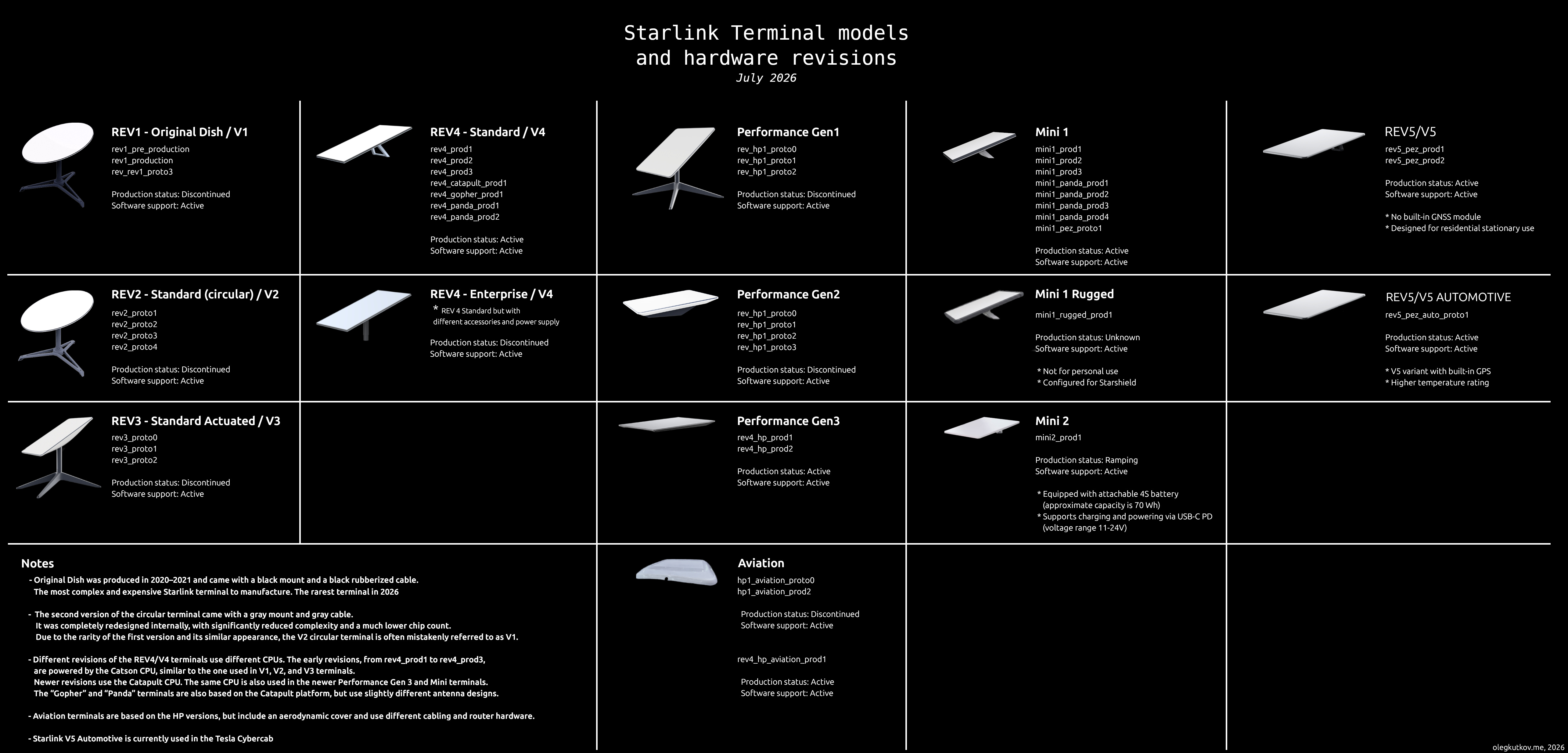
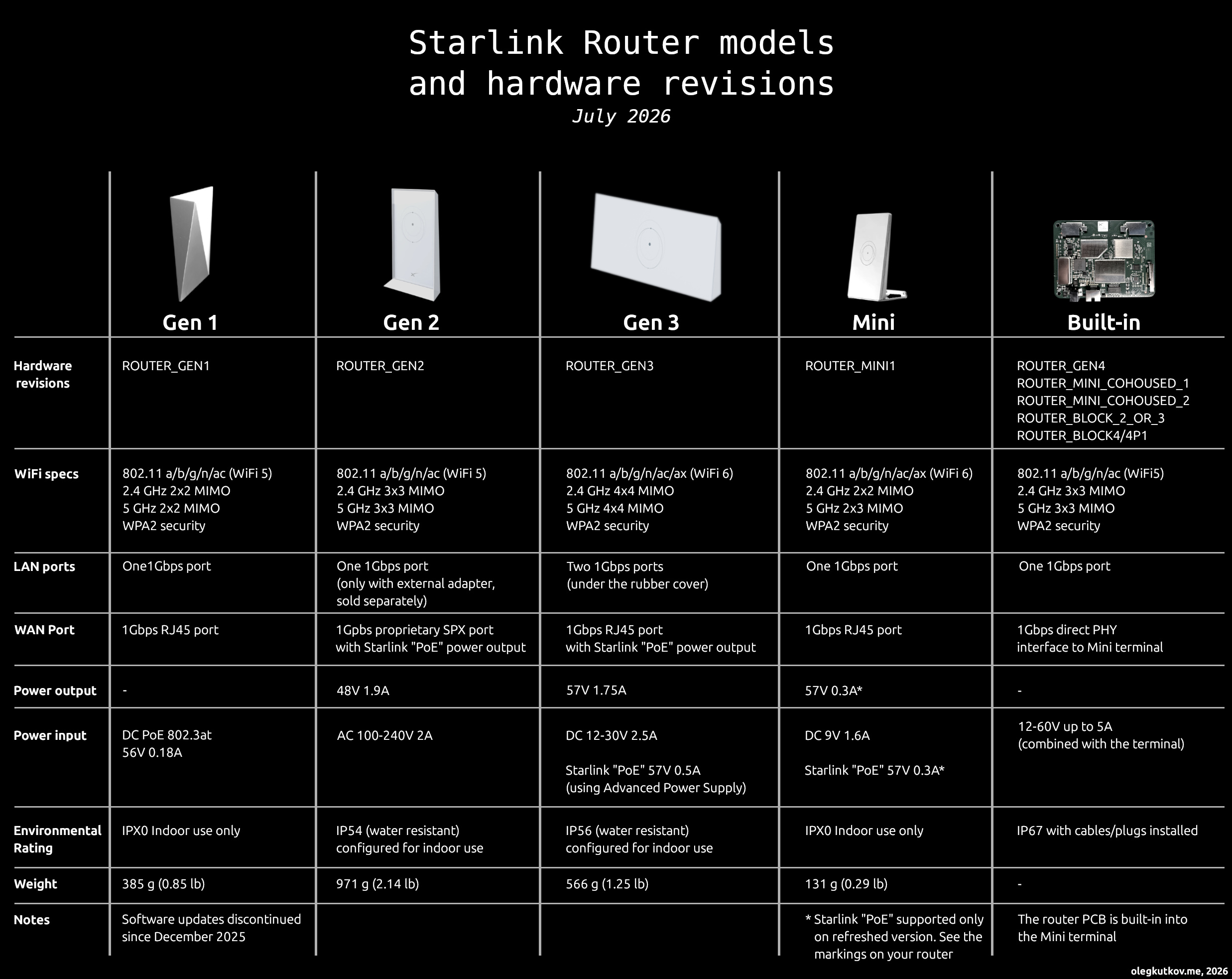
u/OlegKutkov — 28 days ago
▲ 169 r/Starlink
Starlink Mini 2 is finally entering production, with a built-in battery now confirmed.

The current hardware revision is mini2_prod1.
The new terminal is slightly smaller than the original Starlink Mini. Its panel PCB measures 225 × 273 mm, compared with 236 × 276 mm for Mini 1.

Average EIRP is also slightly lower: 27.4 dBW, compared with 27.57 dBW. The transmit duty cycle has been reduced significantly, from 75% to 11%, resulting in lower uplink speeds.
This limitation is most likely driven by the terminal’s power budget.
The terminal includes a built-in 4S lithium battery managed by a BQ40Z-series BMS. Battery capacity is currently unknown.
Charging is provided via a USB-C Power Delivery port, supporting an input range of 11–24 V.
The MAC thermal thresholds have been increased to 95°C and 99°C, compared with 79°C and 83°C on Mini 1. The battery thermal shutdown threshold is set to 80°C.
GPS - present. Explicitly configured for in-motion use. The SoC is the same "Catapult".
u/OlegKutkov — 1 month ago
▲ 156 r/Starlink
First view of the new Starlink V5 dish
UPD: official specs: https://starlink.com/specifications/10
Please read my post here if you wonder why it's V5, but not V4: https://www.reddit.com/r/Starlink/comments/1ttc5rm/starlink_terminal_models_chart_may_2026/
Technical details + internal layout are here: https://www.reddit.com/r/Starlink/comments/1txhxqw/the_new_starlink_terminal_rev5/
As you can see, the kickstand was moved to the edge per the new internal layout.
Four visible notches are most likely for additional mounting options.
Cable attachment and powering options are similar to the Standard V4.
u/OlegKutkov — 1 month ago
▲ 37 r/Starlink
Starlink Mini Versions
Let's talk about Starlink Mini versions, since a lot of people are asking about the current versions and are waiting for the release of the new one.
Please note that some of the information below is highly technical and may be of interest to those who dive deeply into Starlink.
From the user's perspective, all revisions (except the rugged version) are quite similar in terms of Starlink performance, WiFi coverage, and power consumption. All variations are negligible.
Currently, there is only one Starlink Mini generation: Mini 1.
It has eight known production revisions:
mini1_prod1
mini1_prod2
mini1_prod3
mini1_panda_prod1
mini1_panda_prod2
mini1_panda_prod3
mini1_panda_prod4
mini1_rugged_prod1
(You can always find a revision of your Starlink in the Star Debug app or the official Starlink app's debug data section)
***
There are several internal and external differences between these revisions.
The mini1_prodX and mini1_panda_prodX revisions use different FEM chips in the antenna array: Bamboo and Panda, respectively. As a result, these versions are not compatible at the SoC/eMMC replacement level. A SoC/eMMC pair from a Bamboo board can only be installed on another Bamboo board, and the same applies to Panda boards. If they are mixed, the terminal will constantly report low SNR and will never detect a satellite signal.
Take this into account if doing Starlink Mini repairs.
The Panda revisions have higher EIRP on some channels, while the Bamboo power graph is much flatter, with nearly the same output power across all TX channels.
All Mini 1 versions use the same Catapult CPU.
The built-in router board also has its own compatibility matrix. Router boards from mini1_prod1, mini1_prod2, mini1_prod3, mini1_panda_prod1, and mini1_panda_prod4 are interchangeable, but they are not compatible with mini1_panda_prod2 or mini1_panda_prod3.
Likewise, router boards from mini1_panda_prod2 and mini1_panda_prod3 are incompatible with any other revisions.
The reason is that mini1_panda_prod2 and mini1_panda_prod3 use a direct SGMII connection between the Starlink SoC and the router SoC. All other versions use Ethernet PHYs for the interconnect.
Somewhere around the mini1_panda_prod1 revision, SpaceX switched to a single type of plastic for the whole housing.

The more fragile gray plastic on the front panel was replaced with thin ABS plastic, similar to the material used on the rear panel. As a result, the white vinyl sticker is no longer needed either.

The new housing is way easier to disassemble due to the soft plastic. It's not cracking like a gray one.
Interestingly, the mini1_panda_prod3 revision has a slightly higher temperature rating. Its thermal trip point is set to 105 °C, whereas the other versions are set to 85 °C.
***
What About “Mini 2”?
There are currently no signs of an upcoming Mini 2. This version appears to be stuck at the internal _proto2 revision and hasn't progressed for a long time. I will continue to monitor and keep you updated.
***
What About the Rumored Battery-Powered Mini Terminal?
Starlink gRPC telemetry has included a battery and charger monitoring section for quite a long time, and it does not appear to be tied to any specific hardware revision.
Most likely, we will eventually see an additional accessory similar to the Advanced Power Supply, but with battery-charging support. Alternatively, this functionality may be added to Mini 2 someday.
***
What is the mini1_rugged_prod1 revision?
This is a special revision designed for Starshield. It also uses the Panda FEM and is somewhat close to the early Panda production revisions, but it is still quite different.
This version has a newer and better next-gen GNSS receiver. (Sorry, I do not want to share the specific part number here)
It also includes several hardware improvements to achieve higher signal levels and phase-coherent beamforming. Also, no further details here.
***
Packaging and Accessories
Later versions of the Mini terminal come in updated packaging with less cardboard and paper.
The pole adapter has also been redesigned. It is now deeper and uses an allen key, which is included in the box.


Power supply and cable are unchanged.
***
What is Mini X?
It's the same Mini terminal from one of the revisions, with an additional Mini router in the box to extend WiFi coverage.
For the moment, this KIT is only available in several markets.
u/OlegKutkov — 2 months ago
▲ 152 r/Starlink
The new Starlink terminal REV5
SpaceX is preparing the new Starlink user terminal - rev5
(I guess everyone gonna call it Gen4).
The current revision is rev5_pez_prod2, meaning the terminal should already be in production and likely to hit the market pretty soon. But I can't guarantee this, of course.
I prepared a picture comparing the current rev4 (a.k.a. Gen3) and Mini terminals.
The new terminal lies somewhere between the current rev4 and the Mini terminal. It is much smaller than the rev4 and slightly larger than the Mini. The panel size is approximately 274 x 350 mm. It uses new FEM chips (codename is "Pez", previous was "Panda").
Only 2 beamformers (similar to Mini) and 820 antenna elements. In comparison, rev4 has 1536 elements, and the latest Mini is 571. The CPU/Modem is the same - Catapult.
Also, the new board has quite an unusual layout. It seems that most components (such as the CPU, memory, and so on) have moved to the center of the board. You can see these empty spaces in the antenna array.
In all previous models, these components are placed on the edge of the PCB.
The max EIRP is about 24.63 dBm (rev4 is 26.85 dBm), and the new device seems to have better EIRP stability across a wider temperature range.
The software configuration of the rev5 board suggests there is no external GPS receiver. It means that the terminal is fully reliant on its own constellation.
The input voltage is 54V with a maximum power of 111W. No information about battery power, I guess not in this version.

u/OlegKutkov — 3 months ago
▲ 53 r/Starlink
Starlink Terminal Models Chart - May 2026
Hello. Some of you might remember my Starlink version chart. It’s time for an update — May 2026 version.
The new version has a new design and might be slightly controversial 🙂
Since many people asked for a router chart as well, I made one too.


u/OlegKutkov — 3 months ago