
Jalin Hyatt - The One Gear Wonder
Welcome to the Draft Prospect Autopsy series where I break down the final year of a player’s college tape to see what grade I’d give them, as well as what lessons can be learned in the process. The goal is to keep this as objective as possible - sticking solely to a tape grade while not factoring in any other factors. If you would like to see all the accompanying clips that go with each part, click the substack link below. With this in mind, let’s talk Jalin Hyatt!
https://birach.substack.com/p/jalin-hyatt-the-one-gear-wonder
Jalin Hyatt was the star of the 2022 college season. The performances he put on week after week - particularly the Alabama upset - took college football by storm. By the end of the year, Hyatt not only received a unanimous First Team All-American honors, Hyatt also won the Biletnikoff award as the top WR in college football for 2022. It's only natural he would then go on to be a dominant name in the 2023 draft process, finishing as the 42nd rated player.
Athleticism
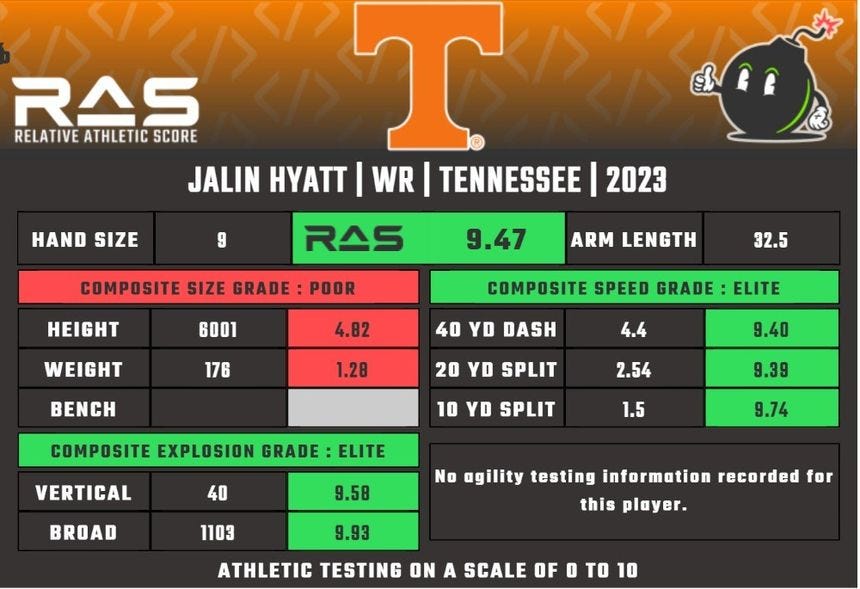
RAS
Even though combine data doesn’t correlate with actual athleticism, it’s still worthwhile to analyze. For instance, it will come as no shock to those following this autopsy series that the lack of agility testing is telling in it of itself. But first, lets focus on that 40 time. On tape, Hyatt is actually faster than this time suggests.
Legit 4.3 Speed
Hyatt has true burner speed. In a foot race, he'd have the ability to go toe-to-toe with most players in the NFL, which is a high bar to clear. This is a trait that a player could utilize to carve out a role for themselves. The pure threat of a true 4.3 athlete stretching the field can be tantalizing for any NFL signal callers.
Stiff Hips
Although Hyatt has game-breaking speed, his ability to use that speed is severely hampered by his hip fluidity. There are a plethora of routes he ran where the perfect footwork was required just to even attempt to turn. Stiffness limits his range of movement options, so the footwork required for what he’s capable of becomes much more rigid, leaving more tells for defensive backs to trigger on. Wasted time during the route-running process will relegate a player to the bench and out of the league very quickly.
The Limitations of Stiffness
Can’t Turn Up Field
Stiffness affects every aspect of play, regardless of position. Take Hyatt’s YAC ability as the first example. The ability to catch the ball and then turn up field comes down to how quickly one can flip their hips. The level of stiffness Hyatt has severely limits his YAC ability to running solely in a straight line. Hyatt's hips are so stiff that he can't change direction without coming to a full stop. Again, wasted time and movement allows defenders to close space and make plays.
Can’t Adjust to the Ball
Now we look at adjusting for the ball. This is another area that fluidity helps tremendously. Think about it. The ability to manipulate your body to allow your hands to take the force of the football requires the ability to get your body around. Hyatt is simply too stiff to make these adjustments.
Can’t Turn with Speed
Here's the crux of why stiffness matters so much at wide receiver. Stiffness forces wider turns in order to maintain speed. Hyatt can only generate speed in the direction his hips are facing, so attempting a sharp cut would require him to lose most his speed, flip his hips, and then reaccelerate. That’s why you really don't see any of his cuts being sharp - he physically can't. It's not something you can coach out of him. It's the limits of his biomechanics.
Crossing Routes - Speed
This speed shows up on his crossers as well. Hyatt’s speed allows him to flash across the formation so fast that defenders don't have a chance to drop back into their zones. This is a matchup skill that can stress defenses into respecting Hyatt's speed, opening up areas of the run and pass games. The issue is that in the NFL, you will deal with contact downfield that slows you down. In the condensed formations the NFL runs, Hyatt is left at a massive disadvantage, since he can’t adjust around the contact due to his lack of fluidity.
Curl Routes
Even withs good footwork, the human body always has limitations. Take Hyatt’s ability to run curls routes as an example. Watch where he starts each curl and where he ends. Every single time Hyatt starts the curl at five yards and floats to eight. This is a coached movement designed to fit the route to his movement abilities. So why did this work in college and won’t work in the pros? Tennessee runs the “super spreader” offense - designed to stretch horizontally, while defensive backs have to respect Hyatt’s speed. These combine to create conditions where floating three yards on a curl is feasible. This doesn't hold up in the NFL, where condensed looks dominate and there is far less space to work with.
YAC Ability
The only real YAC threat Hyatt provides is pure speed. Every single play with significant run-after-catch yardage was just a straight line path created by good blocking and the offensive scheme. Again, the formations Hyatt ran in college gave him a lot of space and kept defenders away from him. That's not a luxury he’ll get in the NFL - not by a long shot.
Nuance
There is none
Hyatt's stiffness really hurts his game, but for most prospects it’s usually salvageable with some nuance. Unfortunately, there was no nuance to his game. There's no anticipation. There's no maximizing of his traits through footwork. There was no stacking defensive backs. It's just "Run the curl, go or crosser and make speed your whole game."
The reason this "speed or bust" profile doesn't work is the difference in college and pro hash marks. In college, the hash marks are wider by almost 22 feet. This spreads out formations horizontally, while the pros condense their formations to maximize the space on each side. There's a lot more contact in the NFL that wide receivers have to contend with, which an extremely stiff player can't survive.
Conclusion
I would have given Jalin Hyatt a Priority Free Agent grade (PFA). There's true 4.3 speed to work with, so it's always worth a try in training camp. Given the amount of contact Hyatt would have to endure at the next level, I really don't see a salvageable player here. His stiffness hurts his ability to handle contact and his ability to turn and avoid it. That's a profile that doesn't survive the NFL. I believe his hype came from a high-statistical season combined with an offense that only works at the collegiate level.
Collegiate production should be looked at, but never used as the reason for a grade. I don't believe it should even be used to cluster bust a set of prospects. The demands of the college game are so drastically different than those of the NFL game, that to compare them brings some major concerns. It's why you look for athletic ability, feel/instincts, and refinement. Do they have the athletic ability to play at the next level? Were they able to show feel and anticipation at the college level? How much refinement do they have out the gate? Raw stats can't show you this information. There may be a level of correlation, but collegiate production doesn’t equate to NFL success.
That being said, higher level data and aggregated data could have some reliability. The issue is that type of information is never available to the public - only agencies and NFL teams. Base, raw data at the college level is very misleading. Even pass-rush win rate heavily biased towards fast players who beat up on slower college competition. Data has to be analyzed to be useful, ESPECIALLY when projecting a player to the next level.
Alright my rant about stats and their place in NFL scouting is over. Stats and their use case in NFL scouting is a hot button topic and the ability to utilize them to benefit teams will always be up for debate. Let me know your thoughts on the role of stats in collegiate scouting! I appreciate you sticking around till the end and hope you join for the next installment!
