Etruscan wolf's head helmet. 2500 years old.
u/minaminotenmangu — 1 day ago
Lets see it, and state why.
*REDBAD: the legendary king’* sheds new light on King Redbad (c. 670–719), a legendary yet elusive ruler whose influence on the North Sea world may have been far greater than previously assumed.
Thanks to new Dutch-German research, his world is being re-examined as part of a dynamic North Sea region. Through a strategic form of kingship, in which diplomacy and warfare went hand in hand, Redbad succeeded in binding regional rulers to his sphere of influence. At its height, this united kingdom Frisia possibly stretched along the North Sea coast from the Dutch-Belgian border to the German-Danish border, extending inland towards the river region around Utrecht.
For the exhibition project, Dutch and German researchers are collaborating on a large-scale research program into the early medieval coastal regions of Northwestern Europe. Never before has this period been studied on such a scale.
The REDBAD exhibition project has yielded a remarkable discovery: an eighth-century song recounts how the Frisian king dreamed of Valhalla—the mythical afterlife previously associated primarily with the Vikings, with the earliest known mention dating back to the ninth century. Redbad’s dream may thus represent the earliest known reference to Valhalla, predating previous estimates by about a century. The scholarly analysis underpinning this discovery is presented in the chapter "Sacral Kingship: A Song of Redbad and Woden"—authored by Han Nijdam, Ewoud van Aalst, Petter Jensen, Arjan Sterken, and Hilbert Vinkenoog—which will appear in the academic volume accompanying the REDBAD project in February 2027.
The exhibition, featuring archaeological masterpieces from Northern Europe such as the Wijnaldum fibula and the Odin of Lejre, will be on display at the Fries Museum in the autumn of 2026.
Indentity is just fascinating, you can't get around its importance in late antiquity. Even if we compare it to modern times, it might suprise many but the idea of being Scouse goes back only to the late 19th century. A new identity formed out of the industrial revolution. Now in some dusty corners they see it eclipsing being english. That is almost certainly a recent mythology built of Maggie's managed decline, The beetles, liverpool football club, Hilsborough, not buying the sun... You have to admit, for some corner of England they have managed to build up symbols of identification. Liverpool also had migration from ireland, wales and scandinava during the industrial revolution, which many suggest explains its accent.
Does this sound familiar? a new identity formed from economic upheaval... We can probably apply it to many northern towns that are frankly 'new'. We should all know York and Lincoln are the key historic bigger towns of the north.
So lets come back to Kent, the reason Kent is so interesting is that it holds the vast majority of "interesting" evidence for the earliest Anglo-Saxon times. Something like 90% of the swords in burials are found in Kent (nearly all of the rest are found towards Wessex). Alot of select evidence is from here. Also, some of the earliest written evidence, both germanic and latin, comes from Kent. So we have more information here than anywhere else for the earliest period.
Kent was very important during late roman times. The soldiers there had equipment made from elsewhere in the Roman world. Their material was found to be made outside Britian compared to roman soldiers elsewhere in Britian. Britian and Gaul were also heavily linked in Roman times. It was part of the same roman prefecture, so evidence in Gauls has looked nearly the same as evidence from England, especially the south east. England was like a little Africa in that it fed the roman armies along the rhine. England made spelt, which was a campaigning crop, as it didn't spoil easily so it could be transported. This all changes around 400AD. The western romans lost a civil war, no coins were minted north of the alps, new barbarian threats and usurpers were about to cause more problemes. But it doesn't workout, Britain is sort of left to nominally still be part of the Roman Empire and the whole roman prefecture in the area (britian and northern gaul) transforms in almost the same way.
The way that the south east and gaul transform in the same way is important. They were the same country for centuries and kent connected them together. Guy Halsall tells us we should really look at continental evidence as well as British evidence to understand the period between 400-600 A.D. The archarology is near identical, and in the past, that is why Kent's evidence has been called 'Frankish'. But is there anything Frankish about Kent's evidence?
The Franks are interesting because when we say Frankish, what we really mean are the merovingian Franks of Childeric and Clovis. As with the Saxons, the Franks weren't all the same either. The Franks of Clovis were the Salians, and they were a group probably formed somewhere in the 300s probably by Emperor Julian and settled inside the Roman Empire. They were a roman army units listed in the Notitia Dignitatum and their famous lawcode gives us detail on what it means to be Frankish. In short its a elite identity, not even young franks get to be franks, its earned through service to the king.
As suggested, by 400 A.D. the roman economy has fallen, so we have 100 years of the army in Gaul transforming. They still exist in the late 5th century as Majorian is able to send Aegidius there to become Magester Militum of Gaul. He takes over from Childeric and Geregory of Tours remembers Aegidius as a Frankish King. Its possible Aegidius was a Frankish King, but like the romano-british names of Saxon kings, i think its just writers looking back and suggesting these generals were kings as that was what their position became in their day. With well known recruitment problems across the roman empire its no suprise the army in gaul recruited from the franks, and with the imperial power gone, the army would have been the natural successors. So that is how the world changed in gaul, its unlikely any of the people would have thought of themselves as suddenly frankish, or that frankish influence was being applied in kent. Did their jewlelry suddenly become frankish in a sense that it was from the armies of gaul? No, we are still in a post roman world and gaul and britian nominally part of the same prefecture. The local Roman Army might have become frankish, but has been true atleast in part for over a century.
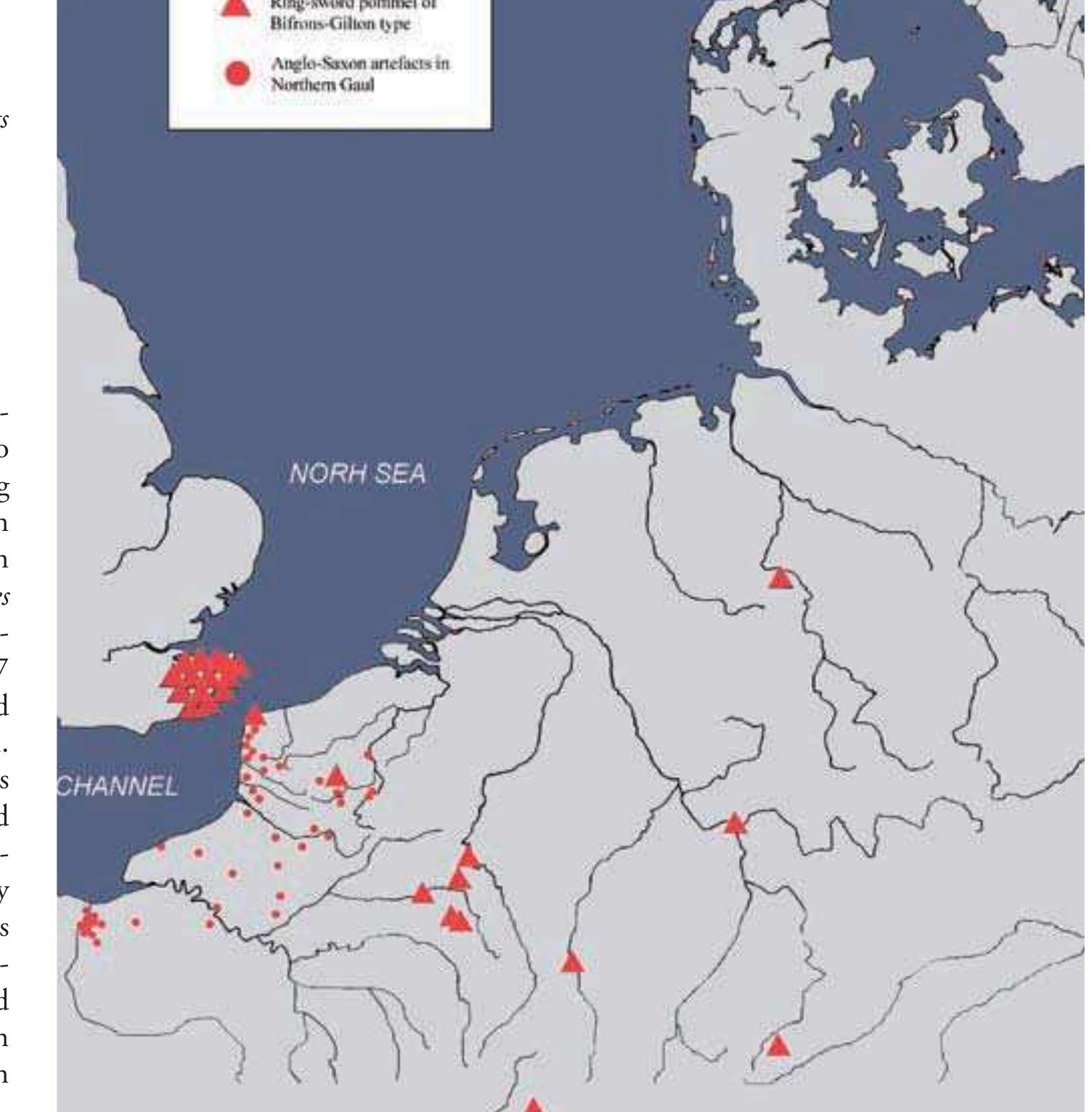
The general evidence becomes post-roman but both the south east and northern gaul gets the same germanic wash of evidence. Have a look at the identical Anglo-Saxon evidence in Normandy. Or the runic sword pommel distribition or the 'saxon' claw beakers. All the interresting evidence is not from the royal armies of the merovongians in paris or along the Loire, but on the merovongian periphery, where the Roman Limes were. The Quoit Brooch style in the post image was once named 'Jutish Style' as it was a style found mostly in Kent, but as you can see the style of buckle is clearly from the Roman Army broadly. The runic sword pommels I think are the most interesting as their distribution was also once called frankish. But they are mostly found outside toxandria where most of the salian franks were settled. Its kind of extraordinary how outside it is in the above plot. Toxandria is to the right of the 'toes' in the netherlands.
So what we are seeing is a transformation of the roman world proper. Placename evidence suggests alot of northern gaul also became germanic speaking this is true all the way up to brittany in pockets. But can we see a specifically jutish identity in kent?
Its going to be impossible to disprove, in terms of archaeology, it should atleast be clear there is nothing special about Kent once you look outside of Britain., i wanted to show its a highly connected place to the wider post roman world. The germanising of the entire northern gaul perhaps shown by the rune swords does start to suggest north sea peoples. We have written evidence for northern gaul, the franks did not experience an invasion from saxons, but very clearly north sea peoples migrated to northern gaul as they did to britain. There is written evidence of saxons living in normandy during the merovingian period who were used as mercineries just as we see in the earliest writings in Britian. Fredegars cronicle also records the ascendancy of a Saxon duke, a sign that the saxons can become prominent in Gaul as they do in Britian.
So as suggested by Robin Flemming in her more recent book. The germanic peoples in Britian and gaul are a peripheral group that slowly become more prominent with time.
The problem with the Jutes specifically is now how prominent their ethnicity is in the many migrating groups. With Kent much more closely following post roman trends it becones much more difficult to suggest a group of prominent Jutes as the leaders. If such an important ethnicity existed, it should become prominent somewhere else in the written record nearer the time. There is no provision for ethnicity in Aethelbherts lawcode. In the many letters between Augustine and Gregory, the ethnicity given is Angle. The Pope thinks he is converting the Angles, he proclaims Aethelbhert Rex Angolorum. I think its safe to say they didn't cosider being an Angle that important locally for they continued the Romano-British identity of Kentish. For me the nail in the coffin for the Jutes is that clearly the people of Kent didn't change their ethincity, they have been Cantii since the time of Caesar. We then have to fit Jutish within the Kentish ethnicity, it is possible, but it gets even more difficult. The genetic data, the paeleoenvironmental evidence of the food they ate, the isotopes all suggest a heavily mixed population that formed in kent. So we have to assune the Jutes entered kent, formed a people of mixed origin under their name but that dissapeared behind the original kentish inhabitants and their enthnicity. Its just too much, that they were always Kentish is surely more plausible. With lincolnshire the people were Lindisfaran, the Derians were Derian and Bernicians were bernician The Germanic peoples are absorbed first into the eastern romano british polities. Jutes and Angles must more plausibly be placed in the politics of our venerable friend... who lied to is btw. The letters bede conveniently left out show some of the kentish people to be heretical christians. It doesn't fit the narrative bit it hints at how mixed kent is.
Numismatics are also interesting. The first struk coins in kent are generic to the Roman Civitas by a monier or a medallion of liudhard, the frankish priest of bertha, this does hint we aren't yet seeing overlordship of a king or people.
The last important evidence on this post that really closes the Jutish chapter for me is the most recent genetic evidence. Kent was heavy on the inhumations so we can get a picture of where the people derive their origins. For Britain during 400-600 A.D. the many 'germanic' newcomers almost entirely cannot be modelled as having iron age scandinavian ancestry. Their origins is a bit of a mystery, but kinship models and material evidence suggest Frisia. That does not mean that they weren't iron age scandinavian elites there, they could be mostly using cremation, as is expected for scandinavian pagans, and this type of signiture does appear after 600 A.D. But again Kent is almost entirely inhumations, so they should surely be more present in the many inhunations of eastern kent. The small curiosities build up.
For me Kent becones quite easy to explain. Like Clovis and Childeric, the army raised in Kent gradually recruited many germanic peoples probably from within britain. All we need is a politcal change, or a vaccume of power for the soldiers raised in kent to be independent successors. When that becomes known it probably becomes more important that they are christian. For them to have been Jutes we will need the soldiers to be mostly cremating their dead in kent while also closely following post roman politics. For them to have been Franks is just not inline at all with what we know about Clovis and Childeric. The obstacles are many.
I do wonder how useful it is, my data is nice and neat without many repeates. Reranking with an llm also feels expensive, I wonder what models others are using that can show real improvement. I don't think I can find a single test where reranking was able to reorder the very important docs after retrieval. hybrid search almost always got it right.
Obviously frescos are just so great, so nice to have. But so many are religeous. They obviously don't represent contemporary society much.
Attached is one of my favourite 'byzantine' frescos in the West. It would probably be better represented as Carolingian, but its from northern Italy where 'Lombards' held power over many Romans who remained after the Gothic wars.
This fresco would have been within the diocese of Chur. The man depicted is the patron of this small church. I hope we all agree how he looks rather Roman, whatever that means in the 8th century. But the important difference we see when compared to the past is the prominance of his sword. The direction of scholarship is not to see this as a representation of 'Germanic' culture, but rather the natural change of early medieval society where service to the king provided the highest status. So you could say, prominently showing your sword suggested you were one of the kings men and of high status. I don't think that is unique to the western christendom in general, its just a more martial form of administration, you see similar things all over history where martial displays were the focus of elites. It reminds me of this [coin](https://fayezthezealot.wordpress.com/wp-content/uploads/2014/12/isl827a.jpg) from early islam.
Can anyone think of great depictions of ordinaty first millenium eastern Romans? I remember this image of bulgarian generals but its probably not quite the right thing.
and why is it this?
I have noticed through a number of anecdotes that Northern Ireland seems to be predisposed to rioting. In recent years this seens to be outside the sphere of its usual politics (nationalist vs loyalist).
Is there a connection here? I want to say a history of violence might have made it more... volatile and prone to rioting elsewhete. But that is of course nothing more than a guess.
I've only really used postgres behind wrappers (like django). i've edited the config and have improved performance with tools like pghero and pgtune and that has got me so far.
Now i want to design a bespoke database, but i want a book or resource on how to do that properly. Something that will tell me what constraints i should use and correct use of indecies. i guess maintenance and vacuming will also be needed eventually.
Any suggestions are welcome, i don't mind a proper text to buy if needed.
And how early can we find an attestation to this?
There is incredible longevity in Kamillie as a character in any show beyond Gundam or Anime. Many on here have so many interesting things to say about him. His abuse, his emotions, Interpretations about autism, lgbt+ interpretations. Its all part of the many ways we associate with him.
I'm fairly confident i'm not autistic, and pretty straight, but I feel like I can understand why Kamillie is popular and why so many can associate with him in different ways.
Kamillie's story is so raw, blandly terrible parents like his aren't depicted in many shows, sensitivity about his girl's name, violent outbursts, neither do we see his awkwardness often in protagonists. I might be wrong, but I find it difficult to imagine many younger audiences will like Kamillie. I forgive him because I can sympathise with his actions and emotions as an adult. I remember being close in my teenage years to reacting as he has, or atleast, can imagine doing so. Forgiving Kamillie is like forgiving yourself. "is this youth" is what char thinks when met with kamillie's outburst (in the image above). Tomino is talking to the audience here, the tears we see in char is for us collectively about Kamillie's behaviour, the behavour we recognise in youths.
There are so many things written into the show on how he is treated, emma's subtle condecending comments. Char and his hands off mentoring, vs Bright who is so much tougher. Its shows the different ways he is treated by elders. Kamillie also falls in love like a teenager, and cares so much for the people around him. Like I did I guess, he cares more than others about things he perhaps shouldn't. We see his care for others change, when he is forced to confront needing to kill his enemies. He thinks this out loud with Haman and Sirocco, being forced to confront his own ideals.
Tomino could not have forseen these modern interpretations we have of him. Its because Kamillie is so real, and its a depiction not seen in many other shows. His depiction must be a far more broad life experience that fit many issues that go further than what Tomino initially expected. I suspect alot of himself is in Kamillie. Off the success of the original Gundam, he must have been given some freedom. Its reported that he made Kamillie the strongest newtype, so the evidence is there for who his favourite is.
For me, forgiving Kamillie is forgiving myself. I was a young kid, it was ok to care, to not always be how i wanted to be, and react poorly to things sometimes. Given kamillie's power, I too would have fought for what is right, and not always behaved properly, and that's ok. That's why writing such a charrecter is a love letter to things you were as a youth. That is what I believe Char and Tomino were telling us in that scene. The depths of his character is why i think so many on here find him so compelling as I do.
So I have to give credit to u/Gudmund_ , I disagree with him but he has clearly done his reading. There are very few out there doing press or even give details about the debates in ancestral DNA research. Its near impossible to find any kind of consensus yet and I entirely rely on friends closer to this field and my own interest.
But there does seem to be a scalp detectable in the recent Crick institute papers (Silva et al, and Speidel et al) against certain methods found in McColl that I think are becoming accepted. A quick search on Google Scholar and we see many new papers using Twigstats as a method. The IBD methods used in McColl may already be out of favour. Let me highlight the McColl methods for you all, its hard to understand but you will see a clear pattern.
> We explored the genomic affinities between all individuals in the dataset using the identity-by-descent (IBD) hierarchical clustering method (Supplementary Note S5.2) and mixture modelling (Supplementary Note S5.3) to discern the closely related genomic ancestries28. Here, clusters form on the basis of the long shared genomic segments between all pairs of individuals within the dataset, rather than by proportions of the deeply diverging ancestries they carry. As discrete clustering does not display the complexities of admixture, potentially giving false impressions of continuity, we applied IBD mixture modelling to assess the genetic structure within the clusters. In brief, we created a ‘palette’ for every individual, based on the total length of IBD segments shared between that individual and all 386 clusters in the dataset. We then define sets of individuals from specific clusters as ‘sources’, and modelled the palettes of ‘target’ individuals as a mixture of all possible source palettes, using an non-negative least squares approach, similar to chromosome painting.
That might not mean much for anyone yet. But I want to highlight the last sentence, as it seems Speidel et al suggests this method is biased.
> We demonstrate that a widely used ‘chromosome painting’ approach, and any conceptually similar modelling based on identity by descent, that finds the nearest neighbours between chromosomal segments in a sample and model groups using a non-negative least squares of genome-wide painting profiles2 is also prone to bias, when source groups have undergone strong drift since the admixture event (Fig. 1b and Extended Data Fig. 3b).
Silva et al, also stresses caution with IBD methods...
I don't think I have misinterpreted this, but I cannot find a response or defence from the McColl researchers. All I have is this claim of bias in the crick papers, and the many citations and popularity of twigstats in the most recently released papers.
So I think the methods of McColl might now already be out of favour. Only time will tell, but I don't think it looks good for them. What that means for their results is difficult to say, but I think the Crick papers now have better methods, and therefore better results.
Grüezi my alemannic brothers and sisters. Since
aDNA does not lie and its all confirmed by science and irrefutable. We must now re-orient anglo-saxon history to the rhine.
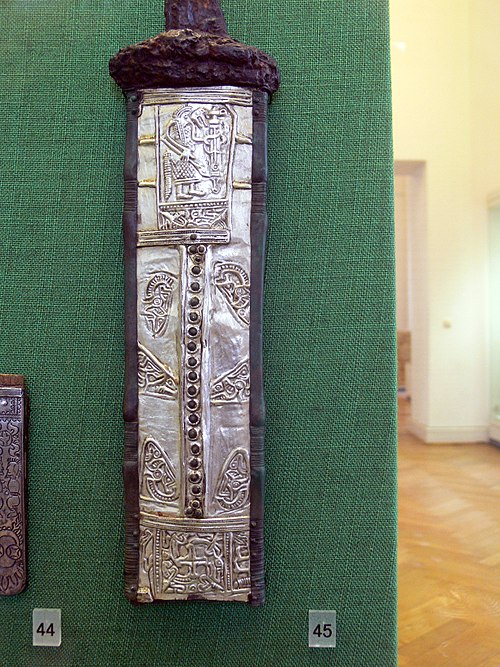
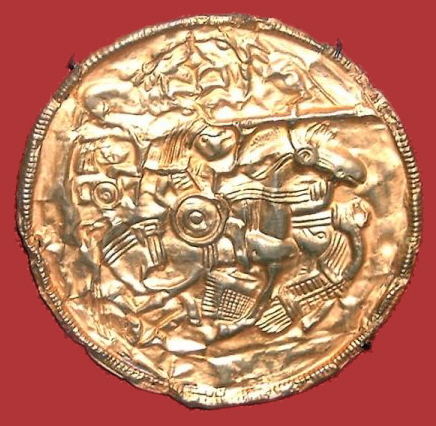
All is not lost, the material culture is actually very very similar. I would even go so far and argue the archaeological footprint is closer along the rhine than the wider north sea. Seriously! Now hopefully some new sites and evidence can become 'anglo-saxon' and generally more compelling. Here is the wolf head motif found on a scabbard from gutenheim. The bracteate with the sutton hoo rider. A Gold hilt spatha with "raven" mounts. All the greatest hits are here along the rhine too.
Obviously, germanising the dna is biased. But that's the thing about 'Central European' aDNA. Its everywhere from after the Roman period. It even makes up around half of the Danish viking aDNA. The debate from when Speidel's paper released around 18 months ago is who the Central Europeans are. McColl considers this group to have 'replaced' the Danes after the roman period. Its a split between gauls, and the wider western mediterranean, against a possibly archaeologically hidden population in free germany and anywhere inbetween. Silva highlights this debate, and just shows how difficukt these results are.
What is more clear is this population group probably represents the La Tene Celts from 500 B.C. So all those memes about the celts being eaten by the anglo-saxons who are then eaten by the norse. Genetically you can swap it around. It is the Celts who have become both the Danes and the Anglo-Saxons!
In all seriousness, it just shows how we need to be very careful with aDNA conclusions. They aren't better evidence by default and the results will change and still need interpretation as the field advances.
Using modern high-resolution methods. aDNA studies are getting much more complex and honestly difficult to read. Graves from this town in france from the 4th century has the closest match for the most common late period Anglo-Saxons. The mysterious Central Europeans strike again. Its all smoke and mirrors, lots of uncertainty of how accurate this is.
This genetic profile appears prominently around the 7th century after a earlier groups from the north sea shore areas arrived in the 5th and 6th Century. The earlier groups don't show any ancestry from Iron age scandinavia, which is very curious.
Image 2 shows this change. Going from Romano-British at the top, washing towards the north sea migrants in the 6th and 7th, then to our central europeans in the later saxon period and beyond.
As always, and if its not yet clear, aDNA brings more questions than answers.
https://www.biorxiv.org/content/10.64898/2026.04.28.721361v1
When I read claims of "definitive", "formal" or "final" split of the Roman Empire in 395 I just can't help but comment how there is no evidence for such a thing.
One benefit of reddit when discussing history is we are free from having to adhere to dated but popular ideas, so we can challenge them. Historians often habe to patronize their readers with these ideas in their books, they are "so called" splits or perhaps a "traditional" split date, often quoted to highlight the problems wkth these ideas. But we don't have to patronize old positions, especially flawed ones like the 395 split.
When Theodosius dies its his court who have split. Stilicho is a bit stuck in the west as that is where he is when Theodosius dies, he probably would have had a home and properties around Constantinople. He would have considered it his home and his base that he can't return to due to intense court politics with the other court rivals that didn't go west with Theodosius. So he claims he is the real guardian of Theodosius' children, which he would, but could very well have been true. As far as Stilicho is concerned, he is the power behind the Throne of the entire Empire, east and west as seperate entity does not come into his mind.
Does anyone in the West think differently? probably not, even magnus maximus ends up trying to take the east from a western base as Constantine did. Gildo, who was made ruler in north africa by Theodosius, clearly did not get this new western roman consciousness. He started a rebellion against Stilicho to support factions from the East. Again rather than east and west, it is court rivals that demarcate political seperation.
A decade later have east and west crystalized perhaps? There seems to be no indication of it. Arcadius' death overrides any trouble Stilicho has in the west with Constantine III, the Rhine barbarians or Alaric. He plans to go to Constantinople and take control. He of course does not abandon the west, his plan is to put Alaric in charge to take out Constantine III, Honorius has to agree, but Stilicho dies so we can't see this play out. If a western conciousness even exists at this time, giving Alaric control of Honorius would be extraordinary. RIP western Roman Empire 395-408. Its much easier to view the relationship as it was, just provinces in the orbit of the Capital of a unsplit Empire.
As Honorius looks to more western generals to deal with western problems, we might see a real western court emerge? But when Honorius dies the East has to take control again of the west with an Army. Theodosius did it this twice in life, then Aspar did it for the east, then Anthemius, then Nepos, Technically Theoderic does it too, then Justinian(belisarius) does it, Germanus was about to do the same and become Western Emperor before his death, so it fell to Narses to do it instead. I can only think of Valentinian I as the last "peaceful" claim of the west from Constantinople but I'll have to look into that. To make Theodosius' second invasion of western provinces as "the split" again feels way off the mark.
After Valentinian III is ruling we have the unified laws of Theodosius spread across the Empire, and again the western provinces controlled by different generals both eastern and western.
I guess I could go on. But overall I see no real changes in 395 other than a court civil war and perhaps a change in supply routes? That is not splitting the Empire in any profound way that suggests there are large changes before or after 395.
i know how to do "~$ rm -rf /" . but why is this in competition with llm tools and MCP?
The Viking Age is generally agreed to have ended, as far as England was concerned, on 25 September 1066, when Harald Harðráði, or ‘Hardline Harald’, was killed and his army all but annihilated at Stamford Bridge. This put an end to the steady progress of the Vikings from raiders to settlers to would-be conquerors: an attempted invasion by King Sweyn of Denmark three years later was abortive, and though Norwegians continued for many years to control the Scottish islands in the far North, their effect on the British mainland was negligible.
But if you take a more romantic view, the First Viking Age was succeeded within three weeks by the start of a Second Age, with the victory of William of Normandy at Hastings. By 1100, Norman princes ruled not only England and most of Wales, with much of Scotland and Ireland soon to follow, but also Apulia and Calabria in southern Italy, and Sicily. They had started the process of picking off parts of the Byzantine Empire, and a Norman prince was ruler of Antioch in the Levant. They were to play a significant part in the reconquest of Spain and Portugal from the Muslims, and had ambitions even in North Africa. Who were the Normans, after all, but the men of the North, descended from pagan pirates?
Historians have long taken a different view, summed up almost fifty years ago by Ralph Davis in The Normans and Their Myth. The story of a Norman diaspora with a shared Viking ancestry, he suggests, is a fairly late creation of the 12th century, when ‘Normanness’ was beginning to fade and needed something of a boost. It can be seen, for instance, in Ailred of Rievaulx’s account from the 1150s about the Battle of the Standard (fought against the Scots in 1138). Ailred gives Walter Espec, the high sheriff of Yorkshire, an unlikely pre-battle speech. ‘Why should we despair of victory, when victory has been given to our race, as if in fee, by the Almighty?’ Our ancestors, he continues, conquered Normandy, beat the French of Maine, Anjou, Aquitaine, conquered Britain and Apulia and Calabria and Sicily, and put to flight the emperors of both East and West on the same day. What have we to fear from King David and ‘his half-naked natives’?
If Walter Espec did say anything of this sort, his words wouldn’t have meant much to his English levies. Some of it is simply false, such as the same-day defeat of both emperors (the events were in fact two years apart, in 1081 and 1083). But in an account of an Anglo-Norman expedition against Lisbon, in 1147, a similar speech is credited to Hervey de Glanville: ‘Recalling the virtues of our ancestors, we ought to strive to increase the honour and glory of our race ... For who does not know that the race of the Normans declines no labour in the continual practice of valour?’ This is also no doubt invented, but both chroniclers must have thought it was the kind of speech, and the kind of appeal to race-pride, that their rulers desired.
The Normans’ name and origin myth date back to 911, when – according to Norman historians – Charles the Simple of France ceded the land between the river Epte and the sea to a Viking leader called Rollo or Rou (or, according to his own deeply unreliable saga, Hrolfr, known as Göngu-Hrolfr, or ‘Hrolf the Walker’, because he was so big that no horse could carry him). There is no doubt that what is now Normandy did receive a large number of Scandinavian settlers: as many as a hundred place names derive from Norse personal names, including La Hastinguerie, Havardière, La Quetterie and Le Mesnil-Opac, from Hasteinn, Havarthr, Ketill and Ospakr. The Scandinavian connection was kept up for a while, and remained a point of pride, but ethnicity was inevitably diluted and the incomers adopted French and Christian culture with surprising speed, as is clear from the accounts of 1066 in The Anglo-Saxon Chronicle. To the chronicler, the Normanni are Harald’s Norwegians, while William of Normandy’s men are the Frencyscan, the French.
This seems to have happened all over. Modern historians write, or used to write, of the ‘Norman’ invasion of Ireland: to the Irish, however, the intruders were either Gaill, ‘foreigners’, or Sagsannaich, ‘Saxons’. In the Byzantine world, Normans were ‘Franks’, and to the Scots they were English. Like the Vikings, the Normans didn’t maintain an empire but were assimilated where they invaded. What then remains of their myth of multiple conquests?
Two recent books take different views. As Levi Roach’s subtitle suggests, he follows what one might call the triumphal line – for which there is a great deal of evidence. Take family names, for example. The two contenders for the Scottish throne in the 12th century were the families of de Brus and de Bailleul (Bruces and Balliols). The kings of Sicily and rulers of southern Italy were the de Hautevilles, and the names de Lacy, de Warenne, de Montgomery and de Clare recur in accounts of conquest.
Roach considers one area at a time: first England, then Italy, then Byzantine involvement and the First Crusade, then the conquests of Wales, Scotland and Ireland. Other chapters take us to Iberia and North Africa (a step too far). The height of Norman power, in Roach’s view, was the accession in 1212 of Frederick II as king of the Germans, to add to his title of king of Sicily, with king of Italy and Holy Roman Emperor to come and, to cap it all, king of Jerusalem from 1225: a far cry from the village of Hauteville in the Cotentin and a (possible) Viking ancestor called Hjalti.
For Anglophone readers, the least familiar parts of this are the activities in the eastern Mediterranean (though they form the subject of Alfred Duggan’s Norman trilogy of novels). Roach writes that, some time before the year 1000, a group of Norman pilgrims found Salerno besieged by Saracens, borrowed horses and armour, drove them off, and decided to strike out for themselves. In an area divided between Lombard princes obedient to the pope, Byzantine governors obeying the emperor and Muslim amirs fighting for their own hand, the Normans saw an opportunity. They took advantage of it, eventually unifying themselves under William de Hauteville. At the battle of Civitate in 1053 – ‘a victory every bit as complete as that at Hastings’ – the Normans defeated the Lombards and papal forces, and captured the pope himself.
In the years after Civitate, they benefited from both the wealth and the weakness of the Byzantine Empire. A sequence of Norman adventurers entered imperial service, first as mercenaries, for pay, and then as rebels, for land: Hervé (full name not known), Robert Crispin (or ‘Curly’) and Roussel (‘Ginger’) de Bailleul. Roussel – the hero of Duggan’s Lady for Ransom – took part in the Byzantine campaign of 1071 against the invading Turks, which ended in disastrous defeat at Manzikert, but got away with his men and used the collapse of Byzantine power to set up an independent kingdom in what is now Anatolia. The Byzantines got the better of him, mostly by bribery, but the Byzantine historian Bryennios says his rule was so popular that when he was eventually captured, the future Emperor Alexios had to only pretend to blind him to escape the fury of the ‘rescued’ provincials. Among several reasons for the popularity of Norman rulers in the East were their relatively low taxes – no expensive imperial court to maintain – and their reliability as protectors, unlike the professional Byzantine soldiers, who might be transferred at any moment to some far frontier.
The dream of a Norman kingdom in Asia was revived at the end of the century with the First Crusade. One of the major figures was Bohemond de Hauteville, son of the conqueror of Sicily, Robert ‘Guiscard’ de Hauteville (‘Guiscard’ might mean ‘the Wily’ or perhaps ‘the Twister’). ‘Bohemond’ is another nickname, borrowed from a giant, because Bohemond was very tall: in her Alexiad, Anna Comnena, the daughter of Alexios, writes that Bohemond was nearly a cubit taller than the tallest of other men. A cubit is around a foot and a half, which would make him at least seven feet tall: rather unlikely, but this is at least first-hand evidence from an eyewitness, even if she was only fourteen when they met. Like his predecessors, Bohemond gained experience fighting for and against the Byzantines in the Balkans, but when Pope Urban II launched the First Crusade in 1095, the Normans of the south were among those most enthusiastic to join up. Indeed, the whole idea of a Crusade to conquer Jerusalem probably had its origin in the Norman success in Muslim Sicily. Bohemond achieved his goal three years later by becoming, after a long siege, prince of Antioch, and his descendants and namesakes continued to rule for almost two hundred years.
The story of Norman conquest in the British Isles outside England is even more of a tangle, but it’s clear that Norman barons, especially the ‘marcher lords’ of the north and west, were adept at exploiting the chronic disunity of the Celtic lands, siding with one faction or another before moving in and taking over, while Norman kings in Westminster were quite happy for them to turn their energies away from England.
This is the story told by Roach, but it leaves important questions unanswered. If the Normans continued to be Normans, what was distinctive about them? What explains their success and how long did it last? These issues are more in focus in Judith Green’s book, which has a narrower chronological range. Her 220 pages of text are followed by sixty pages of endnotes and a forty-page bibliography. If you want to know the state of scholarly opinion, this is the place to start. It comes with a certain guardedness, however. For every academic opinion there is a counter-opinion: place-name studies need ‘careful handling’; rules of inheritance were probably ‘kept flexible’. When it comes to interactions between Norman lords and the populations they ruled, ‘there are no simple conclusions’. She finally arrives at the more difficult matters in a number of analytic chapters, beginning with ‘Power’.
The Normans, Green writes, had charismatic leaders such as William and Bohemond. They were good at logistics: William’s ‘greatest achievement’ in 1066 (as Roach acknowledges) was provisioning his fleet and army during the long weeks of waiting for a fair wind to Hastings. They were violent and sometimes cruel: when peasants in Normandy sent envoys to Duke Richard II to ask for the continuation of their customary rights to wood and water, his response was to send the envoys back without their hands and feet. The practice may have been inherited from Richard’s Viking forebears, who had a special word for such unfortunates: heimnar, ‘home-corpse’. But it isn’t clear that the Normans were more barbarous than anyone else in the early Middle Ages, and if they were, we can’t be sure that this was the reason for their success.
Green’s general conclusions are that the Normans were dynamic, opportunistic, well-led and ‘brutally efficient’. One might add, more impressionistically, but taking the impressions from Green’s account, that the Normans were very good at handing out the smack of firm government. The Old English state was well organised, unusually literate, good at coinage and taxes, but bumbling. Orders were disobeyed, there was internal friction and it was sometimes unclear who was in charge. The Anglo-Saxon Chronicle for 892 reports that when the Vikings arrived at the mouth of the river Lympne, they landed without difficulty because the fort meant to guard it – part of King Alfred’s defence programme – was only half-built and feebly garrisoned. By contrast, the Normans got on with things. In England and Wales they built something like six hundred castles within forty years of the Conquest. It wouldn’t have been pleasant to have to report construction delays to a Norman marcher lord.
Green continues with chapters on ‘The Church’ and on ‘Buildings’, for both of which there is a great deal of evidence – documentary, in the shape of lavish endowments to churches and abbeys, and physical, in the shape of buildings such as the White Tower in London, made from stone imported from Caen, or Westminster Hall, finished in 1097 and for a century the largest in Western Europe. Once again it seems that while the Normans may not have been innovative themselves, they backed innovation, whether it was ecclesiastical reform, monastic constitutions, new religious orders such as the Cistercians and Augustinians or different styles of church-building borrowed from Byzantium and Rome. In a chapter on ‘Encounters’, Green comments on Norman attitudes to intermarriage, religious difference, law and literature, music and medicine, and women’s rights, concluding that Norman rulers adapted themselves to different situations and different subject populations in whatever way they thought best, without any ruling ideology.
It’s hard to see the Normans as ‘conquerors of Asia’, as Roach would have it. The Crusades may have been inspired by Norman conquests, and Normans did make conquests in Asia, but neither lasted. Outremer in the Holy Land was extinguished in 1291. It’s true that a de Villehardouin was for a while duke of Athens and Thebes (in Old French, Satines and Estives), while a de Bruyère ruled Sparta (Lacedaimon, or La Cremonie) and Frankish Achaea lasted almost until the Ottoman Conquest of 1460. But no trace after that of the principality of Lamorie, once and now again the Morea.
As for ‘makers of Europe’, one can perhaps say that Norman conquests had the effect of bringing outlying areas of Europe, such as Ireland and the British Isles, Sicily, southern Italy and Spain, into the mainstream of European civilisation. It’s sometimes suggested that the Normans popularised the cults of chivalry and courtesy, though Green is unconvinced. It is certainly hard to see the Normans, with their habit of penal mutilation, blinding and castration, as agents of a mission civilisatrice. And, looking back to their identity problem, in the end they had no identity left.
The last word of Davis’s book of 1976 is ‘disappeared’, of Roach’s book of 2022, ‘forgotten’. Roach says the Normans were ‘victims of their own success’, so much ‘part of the fabric of European society that they scarcely occasioned note’. Green sees them as opportunists who got lucky, several times. Reverting to a romantic view, one might say that the Normans entrenched what has been called ‘the Western way of war’ – the decisive head-on clash with no concern for manoeuvre. Anna Comnena, the admirer of Bohemond, remarked that a mounted and armoured Frankish lancer ‘would even make a hole in the walls of Babylon’. By Franks, Anna probably meant Normans specifically – she had observed Bohemond’s men training – but not excluding West Europeans generally. She notes, moreover, that while their charge was irresistible, they were vulnerable to what we would now call ‘asymmetric warfare’. This has been a feature of Euro-American culture ever since.