July 24, 1908: In the first Olympic marathon run at the modern 26.2 mile (42.195 kilometer) distance, Italian Dorando Pietri enters the stadium for the final 352 meters with a big lead. He collapses several times and is helped across the finish line by Olympic officials. He is later disqualified.

July 24, 1908: In the first Olympic marathon run at the modern 26.2 mile (42.195 kilometer) distance, Italian Dorando Pietri enters the stadium for the final 352 meters with a big lead. He collapses several times and is helped across the finish line by Olympic officials. He is later disqualified.

The marathon originated in 490 B.C. when a Greek messenger ran from Marathon to Athens to bring news of victory over the Persians. Running the entire way without stopping, he burst into the assembly hall, shouted "We have won!", and died.

While the Ancient Greeks did have foot races at their Olympics, they didn't have a long-course race like a marathon; it was invented as a way to honor the Ancient Greeks at the first modern Olympics in 1896. The first Olympic marathon was run in 1896 from Marathon to Athens, a distance of about 40 kilometers (25 miles), and was won by, appropriately enough, a Greek named Spyridon Louis.

At the second Olympics, the marathon course was through the streets of Paris and was a length of 40.26 kilometers. The third Olympics was a distance of 40 kilometers in St. Louis.

Preparing for the fourth Olympics, organizers agreed on a route of 40 kilometers again. That's about how far Windsor Castle is from White City Stadium in London, and a course was laid out along that route. But it turned out to be slightly longer... 26 miles and 385 yards, or the modern 26.2 miles / 42.195 kilometers. This later became the agreed-upon standard for marathons.

Those extra 2.195 kilometers made a big difference. At first, British runner Thomas Jack was in the lead, then he fell behind his countryman, Frederick Lord. at around the 15-mile mark, South African Charles Hefferon took over and led until he had about two miles to go. Hefferon later said he made a mistake by accepting an offer of champagne from a fan along the the route. The champagne gave him cramps, slowing his pace enough that Dorando Pietri, a 22-year-old baker's apprentice from Italy, was able to pass him at about the 39 kilometer mark.

At around the 40 kilometer mark -- where the race would have ended it had been held at the original distance -- Pietri began to feel the effects of fatigue and dehydration. He entered the stadium for the final 350 meters and became confused about what to do next. Olympic officials redirected him and he collapsed. They helped him to his feet and he staggered along the track inside the stadium, but collapsed four more times. Each time, the Olympic officials helped him to his feet. It took Pietri 10 minutes to run those final 350 meters, and when he finally crossed the finish line at 2 hours 54 minutes and 46 seconds, it was with Olympic officials on either side of him, one supporting him by his right arm.

Crossing just 32 seconds after him was an American, Johnny Hayes. After Hayes crossed the finish line, the Americans immediately filed a protest that Pietri had been assisted. With 75,000 witnesses, it was hard to deny it. Pietri was disqualified and Hayes made the winner, with Hefferon getting the silver and American Joseph Forshaw the bronze.

The British public was solidly behind the Italian. (Or maybe they were solidly against the Americans... the American flag-bearer had refused to dip the American flag to King Edward VII at the opening ceremonies, as U.S. flag code states the flag is not to be dipped to any person or thing. Martin Sheridan, an Irish-born track-and-field star on the U.S. team, allegedly declared: "This flag dips to no earthly king.")

Queen Alexandra gave him an ornate cup that was said to contain more gold than the first-place medal, and Sir Arthur Conan Doyle, covering the Olympics for the Daily Mail, led a campaign to raise money for Pietri.

After the Olympics, he ran in exhibitions, including two races against Hayes in the United States. (Pietri won both.) He used his winnings to open a hotel with his brother, though it went bankrupt.

Pietri became a big fan of Mussolini. He died of a heart attack in 1942 at the age of 56 and was buried wearing a black shirt as a symbol of fascism.

u/sonofabutch — 10 hours ago

No game today, so let's remember a forgotten Yankee: Mark Hutton

> "The Yankees and New York City. It was a place that nothing could really prepare you for." -- Mark Hutton

The first Australian-born Yankee, and the first Australian to start a major league baseball game, Mark Hutton thrilled Yankees fans when he made his debut at Yankee Stadium on July 23, 1993, throwing eight three-hit innings in a 5-2 win over the California Angels. The New York Daily News declared it was "AUS SOME".

The rest of his career wasn't as impressive, but for a brief time the 6'6" righthander enjoyed being the "Crocodile Dundee of Baseball."

Mark Steven Hutton was born February 6, 1970, in South Adelaide, Australia. Pitching for the Australian national team as a 15-year-old, he drew the interest of scouts from a number of teams, including the Yankees and Blue Jays. Three years later, as an 18-year-old at Scotch College in Melbourne, he signed with the Yankees for $15,000. (The Yankees not only had to outbid three other major league teams, but also lure Hutton away from an offer to go professional in Australian rules football.) The deal made national news in Australia.

Pitching for the Oneonta Yankees at age 19 in 1989, Hutton went 6-2 with a 4.07 ERA and 1.417 WHIP in 12 starts, with 62 strikeouts in 66 1/3 innings. Given his age and the quality of the competition -- future major leaguers in it included 22-year-old Kenny Lofton, 21-year-old Jeff Kent, and 17-year-old Carlos Delgado -- the Yankees were pleased, and Baseball America had him as the ninth-best prospect in the Yankees system.

But the following year with Greensboro Hornets in A-ball was a disaster, with Hutton going 1-10 with a 6.31 ERA in 81 1/3 innings. Hutton blamed a coach in the Fall Instructional League who had tinkered with his mechanics.

In 1991, the Yankees kept him in A-ball with Fort Lauderdale, where he went 5-8 but with an impressive 2.45 ERA and 1.109 WHIP in 147 innings, including a one-hitter, and was named to the Florida State League's All-Star team. The Yankees jumped him two levels to give him a start in Triple A, where he gave up two runs (one earned) on three hits in six innings to get the win.

Hutton was with the Yankees in spring training in 1992 and in the mix for the Yankees' starting rotation after Pascual Perez was handed a one-year suspension after testing positive for cocaine. Instead he started the 1992 season in Double A, and was ranked #4, and #83 in all of baseball, by Baseball America, with his fastball rated best in the Eastern League.

After going 13-7 with a 3.59 ERA in 165 1/3 innings, he again got a one-game promotion to Columbus, where he gave up four runs (three earned) in five innings. The following year he returned to Columbus, where he was 7-4 with a 3.40 ERA in 95 1/3 innings when on July 23 he was called up to make the start against the California Angels. He took the rotation spot of previously forgotten Yankee Bob Wickman, who after starting his sophomore season 8-0 with a 3.76 ERA had been bombed for 19 runs on 29 hits, five home runs, and 12 walks in 22 innings in his previous four starts. Wickman was moved to the bullpen, returned briefly to the rotation, and then became a reliever for pretty much the rest of his career.

To make room for Hutton, the Yankees sent down to the minors a name familiar to Yankees fans of a certain age... Kevin Maas, at the time hitting .204/.318/.408 in 173 plate appearances. Maas would return briefly in September, going 1-for-4, and then was released after the following spring training.

Hutton pitched eight innings, allowing two runs (one earned) on three hits and four walks while striking out five. Steve Farr got the final three outs for the save. Veteran Mark Langston took the loss, giving up five runs on six hits, including a solo home run to Mike Stanley. (Ten days earlier, Langston had started for the American League in the All-Star Game.) The Angels starting lineup Hutton faced included five former and future Yankees: Luis Polonia (1989-1990, 1994-1995), Chad Curtis (1997-1999), Chili Davis (1998-1999), Torey Lovullo (1991), and J.T. Snow (1992). And in the top of the eighth he faced another former Yankee, pinch-hitter Stan Javier (1984).

It was California's seventh straight loss and the Yankees' sixth win in eight games.

During the press conference after the game, Hutton asked for a beer, saying he was thirsty. Reporters laughed, but the Angels' J.T. Snow -- Hutton's teammate in the minors -- said he was serious. "He told us that in Australia they drink beer like it's water," Snow said.

Crocodile Dundee had been released seven years earlier, followed in 1988 by its underwhelming sequel, but it was still the only Australian reference familiar to most Americans, and that -- along with "g'day, mate!" -- figured prominently in newspaper stories about Hutton's debut. He quickly acquired the nickname "Mate."

Hutton was briefly the talk of the town but the hype started to fade after he gave up five runs on seven hits and three walks in just 3 2/3 innings in his next start, July 28 at the Detroit Tigers. The Yankees held on to win the game, 12-7, with Don Mattingly 3-for-4 with a two-run home run and Pat Kelly 2-for-5 with a two-run home run and a two-run single. Hutton got another start on August 3, giving up two runs on five hits and four walks in four innings, blowing a 3-0 lead in an 8-6 loss to the Blue Jays.

Hutton was then sent down to Columbus, replaced on the major league roster by outfielder Gerald Williams and into the rotation by rookie Domingo Jean. He was recalled from Columbus when rosters expanded on September 1, and in four appearances he gave up eight runs (six earned) on nine hits and six walks in 6 1/3 innings.

He was in the mix for the rotation in 1994, but a groin injury had him starting the season back in Columbus. He came up in May, got two relief appearances -- giving up three runs (two earned) on four hits in 3 1/2 innings -- and was sent back down again. Overall, he went 2-5 with a 3.64 ERA and 1.240 WHIP in five starts and 17 relief appearances.

Hutton, now 25, opened the '95 season back in Columbus and was bombed, going 2-6 with an 8.43 ERA and 1.682 WHIP, until finally going down with a sore arm that ended his season in August with arthroscopic surgery. He returned in spring training in 1996, and because he was out of options, the Yankees either had to keep him on the major league roster or risk losing him. He looked like a candidate for the bullpen, but another groin injury put him on the shelf again. After pitching in 12 games (two starts) and giving up 19 runs (17 earned) on 32 hits and 18 walks in 30 1/3 innings, the Yankees dealt him to the Marlins for David Weathers, Ryan's father.

Hutton, in 104 innings with Florida, had a 3.72 ERA and 1.288 WHIP, then was traded to the Rockies, where he had a 7.11 ERA in 12 2/3 innings while battling a sore arm again. His final season came in 1998, giving up 14 runs on 24 hits and 17 walks in 17 innings for the Reds, while again troubled by a sore groin.

He signed as a free agent with the Rays in 1999, but was released without appearing with them, and then went to the independent league Newark Bears, but they also released him without throwing a pitch in a game. He returned in the minors with the Astros in 2000, and went 4-2 with a 3.90 ERA and 1.407 WHIP in 64 2/3 innings across two levels. He retired after the season to return to Australia and pitch for Team Australia in the Olympics. He was later a pitching coach in the Australian Baseball League.

When E.F. Mark Hutton Talks, People Listen

  • Hutton was the first Yankee to be born in Australia; the second, three years later, was Graeme Lloyd. Lloyd and Hutton just missed being teammates on the '96 Yankees; Hutton was traded to the Florida Marlins on July 31, and Lloyd was acquired from the Milwaukee Brewers on August 23.

  • While Hutton was the first Australian to start a major league game, Lloyd was the first to pitch in one by three months. He made his debut in the seventh inning on April 11, 1993, for the Milwaukee Brewers against the Oakland A's. Lloyd also got the first major league win by an Australian (April 30, 1993) and the first save (April 16, 1994). The second Australian to pitch in a major league game was Mark Ettles, who pitched the ninth inning of a 3-1 loss for the San Diego Padres against the San Diego Padres. Hutton was the third.

  • However, the first Australian to play in a major league baseball game goes all the way back to the 19th century! Joe Quinn was born in Ipswich, Queensland, but at age 11 moved to Iowa. He played from 1884 to 1901, including a stint as the player/manager of the woefully inept 1899 Cleveland Spiders. Quinn was the only Australian in baseball history for 102 years, until Craig Shipley made his debut as an infielder with the Dodgers in 1986.

  • Hutton's calling card was his fastball, which sat between 95 and 96 mph at a time when a league-average MLB fastball was between 89 and 90. He also threw a slider and a forkball.

  • Hutton visited the United States in 1987 as a teenager, and went to a game at Yankee Stadium. Two years later, he was with the Yankees in spring training. "I just remember sitting in Yankee Stadium with a Yankees jersey I bought at the concession stand, and now it's the real one," he told Newsday in 1989.

  • Greg Cadaret said he knew Hutton had a chance to make it in the majors after seeing him pitch in an exhibition game during in spring training in 1992. Cadaret said home plate umpire Ken Kaiser was squeezing him, but Hutton kept his cool and worked to Kaiser's zone. After the inning, Cadaret heard Kaiser telling Yankees manager Buck Showalter that he was impressed with Hutton's composure.

  • Like most Yankees prospects, Hutton's name frequently came up in trade discussions. Some of the rumored deals he was named in were to the Angels for Jim Abbott (who the Yankees eventually got for J.T. Snow, Russ Springer, and Jerry Nielsen) or Mark Langston (who didn't get traded), to the Padres for Andy Benes (later traded to the Mariners), to the Blue Jays for David Wells (an acquisition the Yankees were reportedly talked out of by former Blue Jay Jimmy Key), to the Expos for Dennis Martinez (who wasn't traded after all), to the Astros for Xavier Hernandez (the Yankees eventually got him for Domingo Jean and Andy Stankiewicz), or to the Reds for Jose Rijo (a former Yankees prospect who wound up sticking with the Reds) or Tim Belcher (traded to the White Sox for Johnny Ruffin and Jeff Pierce). There also was speculation that he would be taken by the Rockies or Marlins in the 1992 expansion draft, but the Yankees protected him, instead losing Charlie Hayes, Carl Everett, and Brad Ausmus.

  • Hutton wore #53 his first season with the Yankees, taking it from veteran reliever Neal Heaton, who was designated for assignment before Hutton was called up. #53 is currently worn by David Bednar; it also was worn by Zack Britton (2018-2022), Austin Romine (2013-2015), Cory Wade (2011-2012), Bobby Abreu (2006-2008), Bob Geren (1988-1991), and previously forgotten Yankee Johnny Kucks.

  • Hutton wore #52 in 1994 and 1996, which will be retired for C.C. Sabathia on September 26. Hutton was traded to the Marlins for David Weathers, who took #52 when he arrived in New York. Other #52's include Jose Contreras (2003-2004), Dave Eiland (1988), and Doyle Alexander (1976, 1982-1983).

  • Hutton's dad, David, was an important figure in Australian baseball history. He played for the Sturt Baseball Club for 14 years and was a board member of the South Australia Baseball League. Father and son were inducted into the South Australia Baseball Hall of Fame together in 2023.

  • Hutton's son, Jack Hutton, pitched for Australia's national under 12 team in 2017 and then in the South Australia Baseball League.

  • In 2023, the Advertiser of Adelaide, Australia, named Hutton one of the best athletes in the history of the state of South Australia.

> "When you performed in New York you had to be ready to talk to about 20 different microphones." -- Mark Hutton

In 1992, the Yankees were loaded with pitching prospects, with Baseball America listing Brien Taylor, Russ Springer, Hutton, Ed Martel, Bobby Munoz, and Sam Militello all in the organization's top 10.

Alas, TINSTAAPP ("there is no such thing as a pitching prospect"). Of those six, only Militello had positive bWAR with the Yankees, and that was all in his rookie season; he went 3-3 in nine starts with a 3.45 ERA for 1.4 bWAR, then the following year 1-1 with a 6.75 ERA (-0.2) and never pitched in the majors again. Taylor, after destroying his shoulder in a bar fight, didn't make it to the Show. Springer had a -0.2 bWAR with the Yankees before getting traded to the Angels for Jim Abbott. Hutton had -0.1 with the Yankees before getting traded to the Marlins. Martel never made it to the majors. Munoz, -0.2 and then traded to the Phillies for Terry Mulholland.

As sad as that was, let's also remember that in 1993, the top 10 prospects on the team included Mariano Rivera (#9), joined by Andy Pettitte (#7) in 1994. Occasionally prospects do make it!

u/sonofabutch — 1 day ago

WW2: What’s the earliest date D-Day could have happened and still been successful? What’s the latest it could have happened and still mattered?

Operation Sledgehammer was the proposed Allied invasion of France in Fall 1942. Instead the Allies invaded North Africa. There also were plans for invading France in 1943 (Operation Roundup and Operation Roundhammer) that were shelved and ultimately the Allies invaded with Operation Overlord on June 6, 1944.

The British believed and most historians agree that a 1942 landing would have been a disaster as the American forces benefited from the experience of fighting in North Africa and Italy. The Allies also learned a lot about amphibious assaults from the Dieppe raid and the landings at Morocco, Algeria, Sicily, Salerno, and Anzio.

But at what point had they learned enough? Could the invasion have happened before June 6, 1944?

What if the Allies attempted to land in Normandy instead of Sicily (July 1943) or Salerno (September 1943) or Anzio (January 1944)?

Then there’s the other possibility: Operation Overlord happens after June 6. Churchill wanted to continue operations in the Mediterranean, possibly even a landing in Greece. There also is the possibility that had the Allies advanced faster in Italy, overrunning the Germans before they could form up at the Gothic Line, that D-Day could be delayed to focus on attacking Germany via Austria. Or maybe the Allies decide to invade Norway before France.

Whatever the reason, if the Allies had waited three months… six months… a year to land in France, at what point is the Red Army occupying all of Germany, or even waiting for them in Paris?

reddit.com
u/sonofabutch — 6 days ago

No game today, so let's remember a forgotten Yankee: Art Schallock

> “I had a great career. I can’t complain. I played with some of the best that ever played and I have three World Series rings.” -- Art Schallock

Seventy-five years ago today, on July 16, 1951, pitcher Art Schallock made his major league debut with the New York Yankees. What's more interesting is who was sent down to make room for Schallock: a 19-year-old switch-hitting outfielder from Oklahoma.

Mickey Mantle joked about it for years afterward, that he had been sent down to make room for... Art Schallock.

It was no laughing matter when it happened, though. Mantle came up for spring training in 1951, and to say Yankees manager Casey Stengel had been impressed by him is an understatement.

> “He has more speed than any slugger I’ve ever seen, and more slug than any other speedster – and nobody has ever had more of both of ’em together. This kid ain’t logical. He’s too good. It’s very confusing.” -- Casey Stengel

Then, on March 1, Joe DiMaggio announced that 1951 would be his final season. Stengel immediately told the press he had anointed Mantle as DiMaggio's successor in center field... even though he had yet to play in a major league game!

Mantle got off to a slow start, hitting just .222/.286/.289 in April, but rebounded with a promising May, .303/.372/.486. But between May 28 and July 13 he hit just .208/.304/.376. After playing in 61 of the Yankees' first 62 games, Mantle was used as a pinch-hitter and defensive replacement for the next 12 games, losing playing time to previously forgotten Yankee Jackie Jensen, who had been heralded as "the next Joe DiMaggio" before Mantle came along.

Mickey finally got back into the lineup on July 12, going 1-for-3 with a double; the day after he was 1-for-5, but with three strikeouts. He was back on the bench the next day and the day after that, a doubleheader.

Meanwhile, the Yankees were having a pitching shortage. A few weeks after the end of the 1950 season, Whitey Ford -- who had gone 9-1 with a 2.81 ERA (153 ERA+) in 112 innings as a rookie -- was drafted into the Army for a two-year stint. Then, 31-year-old Tommy Byrne, an All-Star coming off back-to-back 15-win seasons, was bombed in his first three starts (11 runs on eight hits and 17 walks in nine innings) and moved to the bullpen, where he wasn't much better (seven runs on eight hits and 19 walks in 12 innings), and finally shipped off to the St. Louis Browns for the delightfully named Stubby Overmire. But Stubby lasted just two turns in the rotation after giving up 11 runs on 11 hits and five walks in 6 1/3 innings.

The Yankees needed a fresh arm, and wanted Schallock, who was 11-5 with a 3.40 ERA in the high-offense Pacific Coast League. (The league-average team ERA in the PCL was 4.57, compared to 4.18 in the A.L. that season.) Schallock was pitching for the Hollywood Stars but he belonged to the Brooklyn Dodgers, and to get him the Yankees gave up two minor leaguers and cash.

But now the Yankees needed to make room on the major league roster. Somebody had to go, and the Yankees decided to kill two birds with one stone by sending the slumping Mantle to the minors to regain his confidence. Following a doubleheader on July 15, with Mantle watching both games from the bench, Stengel told him he was going to the Kansas City Blues to play every day and regain his confidence.

Mantle was crushed. "I was always one of those guys who took all the bad luck doubly hard, who saw disaster when there was just everyday trouble, and who took every slump as if it were a downhill slide to oblivion," Mantle later recalled.

And after he started 3-for-18 for the Blues, he called his dad and said he wanted to quit. Mutt Mantle hung up on him, got in the car, and drove the 166 miles from Commerce to Kansas City to tell his son to his face: "I thought I raised a man, not a coward!"

As a shocked Mantle watched, Mutt packed up his clothes, saying if he was going to quit he might as well do it right now. "It was as though Mutt had leveled a double-barreled shotgun at my head," Mickey later wrote in The Mick: An American Hero. He finally told his dad to stop packing and that he'd give it another chance. He then went on a tear. In 40 games, Mantle hit .361 with 11 home runs and 60 RBIs, and the Yankees called him up again. He hit .284/.370/.495 the rest of the way.

In fact, Schallock's arrival on the Yankees poses some intriguing what-if's:

  • What if Ford hadn't been drafted?

  • What if Byrne hadn't faltered and been traded for Overmire?

  • What if Overmire hadn't faltered and been replaced by Schallock?

  • What if Schallock hadn't been acquired, leaving Mantle on the Yankees roster all season?

  • What if Mantle couldn't bust out of his slump and remained a part-time player?

  • What if Mantle had been on the bench in Game Two of the World Series, instead of writhing in pain after getting his spikes caught on a drain cover in right-center field?

And: What if we remembered Mickey Mantle not as #7, but as #6? Mantle had been given #6 when he first came up, with the Yankees very conscious of the order -- #3 for Babe Ruth, #4 for Lou Gehrig, #5 for Joe DiMaggio, and #6 for who everyone thought was going to be the next great star. But when Mantle went to the minors, #6 was returned to third baseman Bobby Brown, who had been in military service when Mantle was first called up. And so when Mantle came back on August 24, he was wearing his iconic #7.

But back to Arthur Lawrence Schallock, who was born April 25, 1924, in Mill Valley, California. He attended Tamalpais High School, throwing a 1-0 no-hitter in 1941. He also was on the school's tennis and golf teams.

That summer and the following summer he played for the San Mateo Blues, one of the top semi-pro teams in Northern California. A high school student competing against grown men, he averaged 14 strikeouts a game.

After high school, he was drafted into the U.S. Navy. As a 19-year-old with no professional baseball experience, he wasn't assigned to a military base and told to play baseball, as many major and minor leaguers were, as a way to raise morale and money for the war effort. Schallock, instead, was assigned to an aircraft carrier.

> “I was two weeks out of high school when they drafted me. I went in the Navy and I didn’t see a baseball for three years.” -- Art Schallock

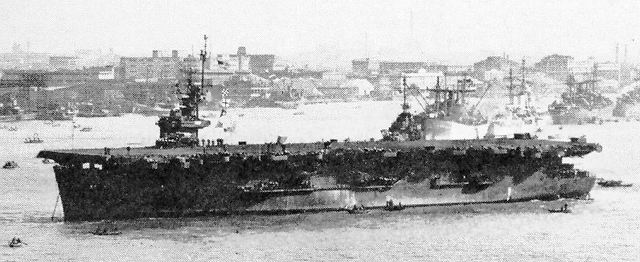
As a radio operator aboard the U.S.S. Coral Sea, later renamed the U.S.S. Anzio, Schallock earned 11 battle stars between 1943 and 1945, including for the Gilbert and Marshall Islands campaign, Operation Cartwheel, the Mariana and Palau Islands campaign, and the Battle of Okinawa. Two of Anzio's sister ships -- U.S.S. Liscome Bay and U.S.S. Bismarck Sea -- were sunk in engagements she participated in. Schallock said it was just luck that his ship survived while those two didn't.

Discharged in 1946, Schallock attended Marin Junior College, playing baseball for the Marin Mariners and then semi-pro in the summer and fall. On September 7, 1946, he struck out 19 batters in a seven-inning game; later that month, he threw a three-hit shutout in game one of the three-game championship series.

After that season, the Brooklyn Dodgers signed Schallock and assigned him first to the Pueblo Dodgers, where he led the team in ERA (3.61). The following year he was with the Montreal Royals, where he was teammates with Don Newcombe, Duke Snider, Sam Jethroe, and Chuck Connors, who would find fame not on the baseball diamond but on TV screens as The Rifleman. The Royals won the International League pennant that year, but Schallock was given just 50 innings and just one start. The following year he was sent to the Hollywood Stars of the Pacific Coast League. Back in the rotation, Schallock went 12-9 with a 4.20 ERA in 1949 and 5-7 with a 4.01 ERA in 1950. After starting 1951 with an 11-5 record and a 3.40 ERA in 127 innings, the Yankees traded minor leaguers Bob Landeck and Eddie Malone and cash to get him.

Schallock reported to the Yankees and was immediately thrown into the fire, making the start against the Detroit Tigers on July 16, 1951. The Yankees staked him to an early lead courtesy of a two-run first inning, but it didn't last long. The first four batters Schallock faced all reached -- walk, double, single, walk -- followed by a sac fly and another walk before he finally got the last two outs with the score tied 2-2.

In the top of the second, the Yankees scored another four runs, including a two-run home run from Yogi Berra, but Schallock gave one back in the bottom of the inning after giving up a pair of singles. In the third, three consecutive singles plated another run to make it 6-3, and Schallock was pulled for Spec Shea, who pitched 4 2/3 innings, allowing two more runs on seven hits to get the win; Joe Ostrowski got the final five outs for the save.

The Yankees won, 8-6, but Schallock's line was ugly: 2.2 IP, 7 H, 4 ER, 3 BB, 0 K. Over the rest of the season he was used as a swingman, going 3-1 with a 3.88 ERA (100 ERA+) and 1.511 WHIP in 46 1/3 innings (six starts, five relief appearances). He was on the roster for the 1951 World Series against the Giants, but wasn't used.

The following year he was on the Yankees' Opening Day roster, but after just two appearances mopping up in the final inning of blowout losses he was optioned to the Blues, where he spent the rest of the season. He went 8-6, but with an ugly 5.49 ERA and 1.533 WHIP in 105 innings (13 starts, 13 relief appearances). The Blues won the American Association championship that season.

Schallock was back in Kansas City and went 9-3 with a 3.15 ERA, finally getting called back to the Yankees in mid July after the release of Ewell Blackwell. He got one start, only giving up one run despite three hits and five walks in 4 1/3 innings. He made six more appearances over the rest of the season, all in relief; his final line was a deceptively low 2.95 ERA despite 30 hits and 15 walks in 21 1/3 innings, a 2.109 WHIP.

He was on the World Series roster and got into Game Four as a reliever, giving up a run on two hits and a walk in two innings. The Yankees lost that game, 7-3, to tie the series at two games each, but then won the next two.

Schallock opened the 1954 season with the Yankees, was sent to the Oakland Oaks of the Pacific Coast League in May, and then back to the Yankees in July. Overall, he was 12-4 with a 4.09 ERA in 99 innings with Oakland, and 0-1 with a 4.15 ERA in 17 1/3 innings with New York.

After just two appearances with the Yankees in 1955, Schallock was traded to the Baltimore Orioles, in their second season after being the St. Louis Browns, and he finally got some regular usage. In 80 1/3 innings, he had a 4.15 ERA and 1.668 WHIP. He went to spring training with Baltimore in 1956, but they traded him back to the Pacific Coast League on April 2. He went 11-9 with a 3.42 ERA in 163 innings with the Seattle Rainiers, then retired at age 32. After baseball, he did public relations for a real estate company and won a number of amateur golf championships.

Following the death of the 101-year-old (and aptly named) George Elder on July 7, 2022, the 98-year-old Schallock became the oldest living major leaguer, a title he retained until his death on March 6, 2025, six weeks before his 101st birthday. The oldest living major leaguer right now is Bill Greason, born on September 3, 1924; the oldest living Yankee is Bobby Shantz, born September 26, 1925.

You Schallock Pass!

  • Schallock was the prototypical junkballing lefty, throwing a little bit of everything, including a screwball. “Schallock doesn’t have overpowering stuff, but he is a master in keeping hitters off stride. He mixes his pitches into a master blend. His fastball is an effective weapon, not because of its speed but because of the surprise element involved,” the Kansas City Star wrote in 1953.

  • Schallock described himself as "a runt-sized southpaw." He was listed at 5'9", 160, but reporters doubted he was that big; one said he was 5'7" and 144. Words like "diminutive," "slight," and even "frail" were often used in stories about him, and sometimes he was "Little Art." Despite Schallock's success in high school, college, semi-pro, and even minor league baseball, scouts doubted a man of his size had the strength or stamina to succeed in the majors.

  • During spring training in 1949, Schallock was with the Hollywood Stars and apparently on the roster bubble. Prior to pitching in an exhibition game, Schallock discovered someone had broken into his car and stolen everything -- his luggage, golf clubs, and a baby's crib. "The sneak even stole a cardboard box filled with infant's rattles," a newspaper reported. Schallock pitched in the game and took it out on the opposition, striking out six. After the game, Stars manager Fred Haney told Schallock he had made the team. "We're going to keep you, kid," he said. "I wanted to see what you could do under pressure. This was it."

  • Whitey Ford getting drafted into the U.S. Army during the 1950-1951 off-season was the first domino that led to the pitching dearth that ultimately led to the Yankees acquiring Schallock in 1951 and making room by optioning rookie Mickey Mantle to the minors. Like many major leaguers in the service, Ford's primary job was to play baseball against teams from other military bases. "Army life was rough," Ford later recalled. "Would you believe it, they actually wanted me to pitch three times a week!"

  • Schallock said he and Mantle would joke for years afterward about how Schallock was the reason Mantle got sent to the minors. It wasn't Schallock's fault, but even so, maybe Mantle bore a little grudge against him. On August 15, 1955, Schallock was pitching for the Orioles and gave up a home run to Mantle. He said the Mick grinned at him the whole way around the bases, no doubt recalling how Schallock had replaced him on the Yankees' roster four years earlier. It was the last home run Schallock allowed in the major leagues.

  • Schallock is one of three major leaguers to have attended the College of Marin. The others are Jerry Goff, a backup catcher with the Expos, Pirates, and Astros between 1990 and 1996, and reliever Jim Neidlinger, who pitched for the Dodgers in 1990. Schallock said he had scholarship offers from USC and UC-Santa Clara, but he chose Marin because he had high school friends there.

  • In addition to playing with all those Hall of Famers on the great Yankees teams of the 1950s -- Joe DiMaggio, Mickey Mantle, Yogi Berra, Whitey Ford, Phil Rizzuto, Johnny Mize, and Enos Slaughter -- Schallock also played in the minors with Duke Snider and in spring training with Jackie Robinson and Roy Campanella. In his last season, with the Baltimore Orioles, he was teammates with 18-year-old Brooks Robinson.

  • Schallock said the best player he ever saw was Joe DiMaggio, followed by Mickey Mantle and then Willie Mays. He said the best pitcher was Allie Reynolds.

  • Schallock said his first roommate in the majors was Yogi Berra, who would send him to the corner store for comic books or to the hotel lobby for the newspaper funny pages. Schallock said Berra played up his image as a lovable dope. "He was sharp as a tack and a wonderful guy," Schallock said. He said Berra could talk for hours about the strengths and weaknesses of every notable hitter in baseball.

  • He wore #20 for his first three seasons in pinstripes, then switched to #38 in 1953. In 1954 he wore #19 and #38, and in 1955, back to #38. Schallock went back to #20 when he was on the Orioles in his final season.

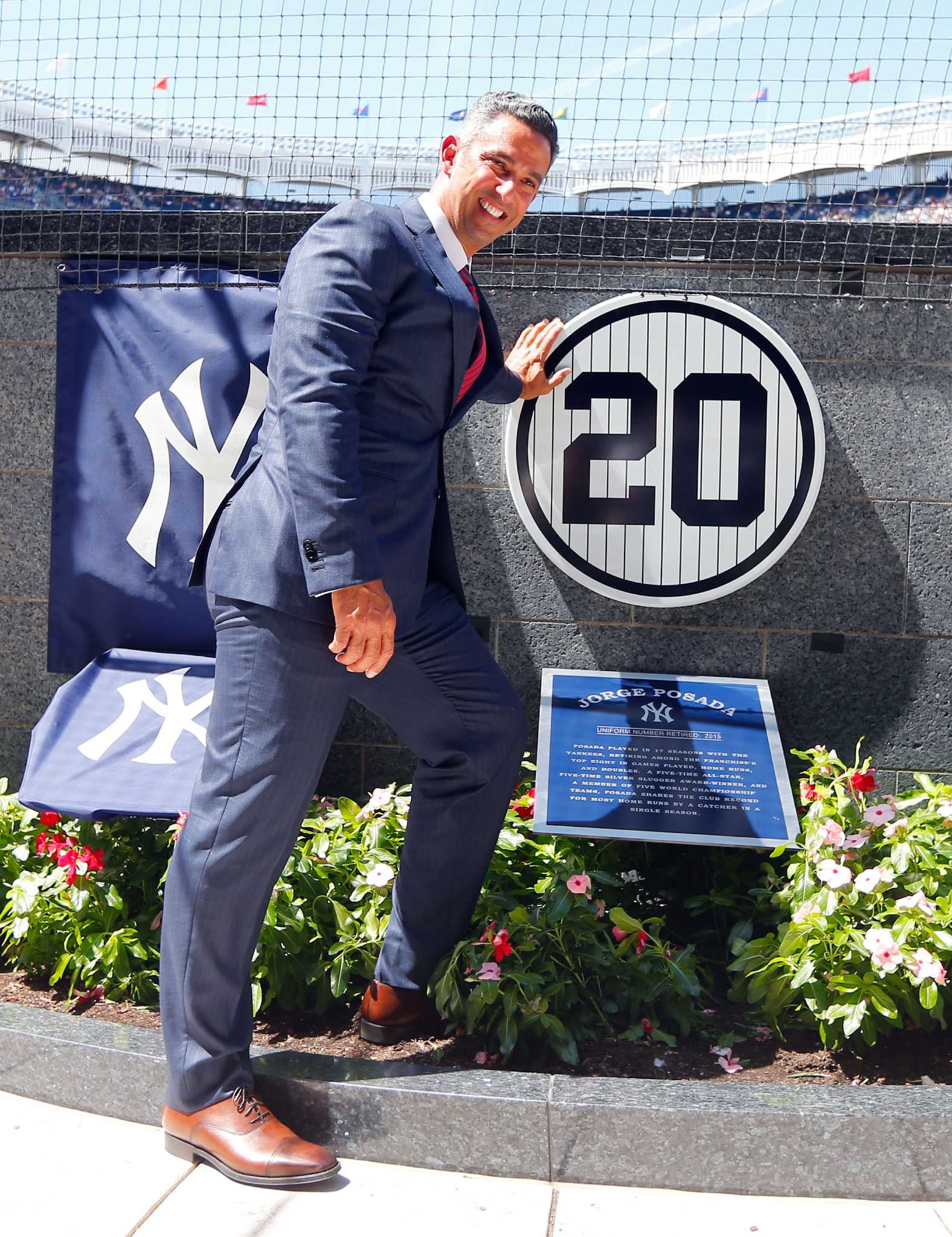
  • #20 was worn by previously forgotten Yankees Tiny Bonham, Bobby Meacham, and Mike Stanley, as well as Horace Clarke, Bucky Dent, and Alvaro Espinoza, but of course it's best known as the number worn by (and retired for) Jorge Posada.

  • #19, currently worn by Ryan McMahon, has a distinguished history as the number worn by Masahiro Tanaka, Luis Sojo, Dave Righetti, Dick Tidrow, Fritz Peterson, and Bob Turley, as well as previously forgotten Yankees Johnny Murphy and Jumbo Brown.

  • And #38 has been a cursed number as of late, last worn by Devin Williams, and before that, Mark Leiter Jr., and before that, J.D. Davis, and before that, Ben Rortvedt, and before that, Andrew Heaney. It also was worn by Johnny Blanchard, Steve Kline, and Matt Nokes.

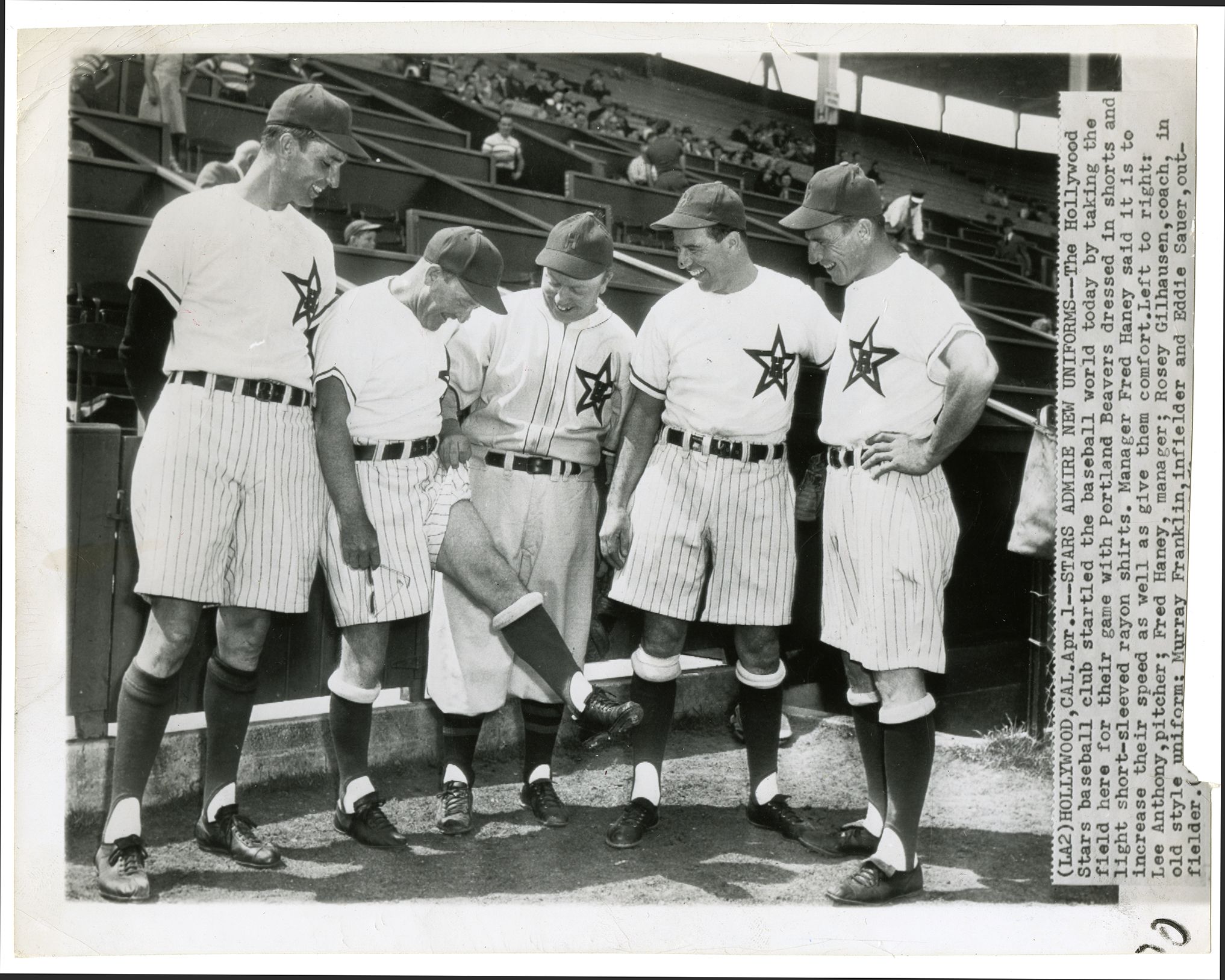
  • Schallock was on the Hollywood Stars in 1950 when they debuted new uniforms: with shorts! The Stars did it a quarter-century before the Chicago White Sox did. Stars manager Fred Haney, who said he got the idea from watching soccer, thought the shorts would be more comfortable as well as allow his players to run faster. The jersey also was new, made of a lightweight synthetic fiber and made as a pullover. Players said it was more like a football jersey than a baseball jersey. The real innovation was the socks: They were extra long and then had a ring of extra material at the top that was supposed to absorb the blow from sliding. Apparently it didn't work, because players frequently complained about "raspberries" on their legs. While the batters didn't like them because of that, Schallock told Pacific Coast League historian Dennis Snelling that he and other pitchers liked the shorts -- they were lighter and more comfortable than the baggy woolen baseball pants they had been wearing.

  • Schallock's nephew is guitarist and bassist Dave Schallock, who joined Big Brother and the Holding Company after Janis Joplin left to start a solo career. He also played for Sons of Champlin, who hit #47 on the Billboard Hot 100 in 1976 with Hold On.

  • Aaron Judge, Gerrit Cole, Anthony Rizzo, and other Yankees recorded video messages for Schallock on his 100th birthday in 2024. Two months later, when the Yankees were in San Francisco to play the Giants, they greeted Schallock in the dugout. Schallock said he hadn't been to a major league game in decades, but he decided to come out and meet the current Yankees because he was so touched by their birthday greetings.

> "As a former player, it’s hard to sit there and watch the game, because I figure I should be in the dugout or out there playing." -- Art Schallock, at age 81, on why he didn't like watching baseball games from the stands

R.I.P. Art Schallock, a colorful character and a Yankee we should remember!

u/sonofabutch — 9 days ago

The New York Times, July 8, 1874: "A Curious Case of Unintentional Homicide"

A CURIOUS CASE OF UNINTENTIONAL HOMICIDE.

>Coronor Woltman was called to Bellevue Hospital yesterday to investigate the case of Peter Beck, a native of this City, twenty-three years of age, who died at the hospital from a stab-wound of the abdomen, received under very peculiar circumstances. It appears from the affidavit of Charles Brown, of No. 272 Seventh Street, taken before the Coronor, that on the 2d inst., Beck, with a number of other men, were in the liquor-store of Robert Delacey, at the corner of Stanton and Sheriff streets. A stranger, who had been drinking in the place, complained that he had been robbed of $19, and commenced to make a great deal of noise about his loss. Peter Ort, the barkeeper, told the stranger to make less noise, when the latter abused Ort, accusing him of harboring thieves in his place. Ort, who was behind the bar, picked up a screw-driver, the blade of which had been made out of an old file, and struck the stranger on the arm with it. As Ort raised the screw-driver to strike the stranger a second time, the blade flew out of the handle and struck Beck, who was standing close by, on the left side of the abdomen, and rebounding flew out into the street through the open door. Beck was taken to Bellevue Hospital by his friends and lingered there until Monday evening, when death ensued. Deputy-Coroner Shine made a post-mortem examination of the remains of deceased yesterday, and found that death was caused by peritonitis, resulting from a stab wound of the abdomen, penetrating the abdominal cavity. By direction of Coronor Woltman, Capt. Murphy, of the Eleventh Precinct, arrested Ort last evening, and he will be arraigned at the Coroner's Office to-day, when the inquest will be held.

A follow-up story on July 22, 1874, reported: "The jury returned a verdict of accidental death and exonerated Peter Ort from all blame."

u/sonofabutch — 9 days ago

In historic shift, struggling Kentucky newspaper gets tax approval to become a nonprofit • Kentucky Lantern

The Woodford Sun, a Central Kentucky newspaper with about 2,300 subscribers, has won approval to become Kentucky’s first “legacy newspaper” (founded pre-Internet) to become a nonprofit.

kentuckylantern.com
u/sonofabutch — 22 days ago

No game today, so let's remember a forgotten Highlander: Walter Clarkson

> "Walter Clarkson, once the mainstay of the Harvard baseball team, is regarded as one of the coming pitching sensations in major league circles. Now with the New York Americans, he is being coached by 'Happy Jack' Chesbro, who says that, with a little more professional experience, Clarkson will become the talk of the country." Topeka State Journal, September 8, 1904.

The first "can't miss" prospect -- and bust -- in Yankees history, Harvard phenom Walter Clarkson made his major league debut as a member of the New York Highlanders on July 2, 1904. He went the distance, as most starters did in those days, and allowed three runs (two earned) on eight hits and one walk. Alas, it wasn't good enough as Happy Townsend of the Washington Senators allowed just two runs to get the win.

After three and a half mediocre seasons, he was shipped off to Cleveland. A year after that, at age 29, Clarkson quit baseball to focus on his real ambition -- to own a business.

Walter Hamilton Clarkson was born November 3, 1878, in Cambridge, Massachusetts. (His city birth record says it was 1879.) He came from a baseball-playing family, as two older brothers and two older cousins had been major leaguers. His father was a well-to-do jeweler.

Clarkson was a standout pitcher for Cambridge High School, striking out 19 batters and throwing a shutout to win the Interscholastic Association league championship in the spring of 1899, and in another game struck out 24 of the 27 batters he faced.

That fall, he attended Harvard University, and pitched for the baseball team. As a freshman, he beat Yale twice. The following year, he threw a one-hitter to beat them again.

During the summers, Clarkson went north to New Hampshire and Maine, playing in a highly competitive league run by hotels and resorts for the entertainment of guests. College players could play in these summer leagues and keep their amateur status as long as they didn't do it for money... but most did, either paid under the table or by "working" no-show jobs. When Clarkson returned to Harvard for the 1902 baseball season, Yale filed a complaint that he had been paid to play, but couldn't prove it. That spring he again beat Yale twice.

The following winter, two New York Highlanders and future Hall of Famers -- Wee Willie Keeler and Happy Jack Chesbro -- went to Harvard to help the players prepare for the upcoming season. Chesbro worked with Clarkson on developing what he called an "in drop" pitch. (Chesbro, an impressive 28-6 with the Pittsburgh Pirates in 1902, had yet to master the spitball he would unleash on the American League in 1904, when he went an astounding 41-12. Wee Willie Keeler, 5'4", was already a star when he was on the inaugural New York Highlanders of 1903. In 1904, he slapped, chopped, bunted, and sprayed his way to a .343 batting average. He is most famous for his batting advice: "Hit 'em where they ain't.")

Clarkson was not only dominating college batters, but he also came from a Hall of Fame bloodline. His elder brother by 17 years, John Clarkson, was regarded by many at the time as the best pitcher of the 19th century. In 1885, John Clarkson was an astounding 53-16 with a 1.85 ERA (163 ERA+) in a ridiculous 623 innings, and in 1889 he went 49-19 with a 2.73 ERA (150 ERA+) in 620 innings. He retired in 1894 at age 33 and still won more than 300 games; he was elected to the Hall of Fame in 1963.

During the winter of 1903-1904, with Clarkson still in college on the "five-year plan," Chesbro helped out at Harvard again. No doubt he told Highlanders manager Clark Griffith to hurry up and sign this phenom before he was picked up by his hometown Boston Red Sox, who also were interested. Griffith blew away Clarkson with an offer of $4,000, the equivalent of about $150,000 today, and a $500 signing bonus. For context, "Iron Man" Joe McGinnity was reportedly the highest paid player in baseball that year and he made only $5,000.

Clarkson, however, wanted to pitch his final season for Harvard. Having nearly lost his amateur status a couple years earlier, he didn't want to risk it again. So rather than signing the contract, he made a secret deal with the Highlanders to take the $500 bonus in exchange for a promise that he would sign the contract as soon as the college season was over.

Newspapers somehow got wind of it and reported it. This was a gray area -- Clarkson had taken money, but he hadn't signed a contract and certainly hadn't played for the Highlanders. Was he still an amateur, or a professional? (This was before the NCAA; each school was allowed to follow its own judgment when it came to amateur status.) Harvard ultimately ruled that Clarkson was ineligible for his final season.

So he went to the Highlanders, and 122 years ago today, on July 2, 1904, he made his debut. In his debut against the Washington Senators, he gave up three runs (two earned) on eight hits, a walk, and two hit batters in nine innings. Sportswriters were already comparing him to Christy Mathewson, who had pitched at Bucknell before becoming a star with the New York Giants.

Alas, the rest of his career didn't go as well. The righthander's fastball and "unusual curves" were good enough to dominate the Ivy League, but American League batters weren't as impressed. He was bombed for seven runs (six earned) on seven hits and four walks in four innings by the Cleveland Indians on July 13, then eight runs (seven earned) on nine hits and four walks by the Detroit Tigers on July 16. Facing those same Tigers four days later, he gave up three runs on five hits and a walk in four innings. (Ty Cobb would make his debut the following season; the Tigers' star player in 1904 was Wahoo Sam Crawford, who went 2-for-5 with a triple and two RBIs in the first game and 2-for-5 with a home run and four RBIs in the second.)

After that terrible start, Clarkson bounced back with eight solid appearances, allowing 14 runs (13 earned) on 26 hits and 13 walks in 38 1/3 innings, a 3.05 ERA and 1.017 WHIP. Clarkson's turn-around helped the Highlanders, five games behind the first-place Red Sox on July 15, to creep to within a half-game after an 8-1 win over the Browns on October 5.

The Highlanders and Red Sox had five games remaining -- all against each other. Three were in New York, and two in Boston. Whoever won the series would win the pennant.

Chesbro pitched against the Red Sox at home on Friday night, and won, 3-2. That night the Highlanders and Red Sox traveled to Boston for a Saturday doubleheader. Griffith told his spitballing star to rest up because he was going to start on Monday. Instead, Chesbro hopped a train to Boston and talked his way into starting the first game. Griffith relented, and Chesbro was rocked for six runs (five earned) on four hits and two walks in just four innings. Down 6-1 and knowing Monday might be a must-win game, Griffith pulled Chesbro and went to the rookie Clarkson. He was even worse, giving up eight runs (seven earned) on eight hits, two walks, and two hit batters in four innings as the Red Sox romped, 13-2.

That was Clarkson's last appearance of the season. The Highlanders lost the second game of the doubleheader, 1-0, with the great Cy Young pitching for Boston.

Now it was back to New York for the final two games of the season, with the Highlanders needing to sweep. Big Bill Dinneen was on the mound for Boston and Chesbro, making his eighth start in 15 days, for New York. Tied 2-2 in the ninth, Boston had a runner on third with two outs, and Chesbro threw a wild pitch (his widow, for years afterward, said it should have been called a passed ball) that allowed the winning run to score. The Highlanders then won the meaningless final game of the season.

Griffith invited Clarkson, reportedly even smaller than his listed 5'10", 150 pounds, to come to his Montana ranch that off-season to build up his strength. Then he went to West Point to coach the U.S. Military Academy's baseball team before leaving for Highlanders' spring training in Alabama.

Apparently all this off-season activity didn't help as his 1905 season got off to a terrible start. Clarkson gave up 18 runs in 22 2/3 innings and was sent to the minors, where he went 17-12. He pitched in Montreal on July 22, then hopped a train to Boston to get married on July 24, then went to Jersey City to pitch again on July 26. So much for a honeymoon!

Called back up at the end of the season, Clarkson gave up seven runs on 22 hits and four walks in 23 2/3 innings, redeeming himself enough that he again figured into the Highlanders' future plans.

Clarkson returned for the 1906 season and was used as a swingman, with 16 starts and 16 relief appearances for 151 innings. He had a 2.32 ERA (128 ERA+) and finally looked a little like the star pitcher the Highlanders thought they were getting when he was pitching for Harvard.

But the 1907 season got off to another disastrous start -- 1-1 with a 6.23 ERA and 1.558 WHIP in 17 1/3 innings -- and the Highlanders finally had enough. He was shipped off to the Cleveland Indians (with outfielder Frank Delahanty) for pitcher Earl Moore, who had been an impressive 80-66 with a 2.52 ERA (120 ERA+) over the first five years of his career, but suffered a career-altering injury on August 1, 1905, ironically against the Highlanders, when a line drive went off his foot. Moore was 13-7 at the time, but 2-8 the rest of the season, and 1-1 in just five games the following year as the foot injury continued to nag him.

The Highlanders apparently thought they could fix Moore, but he went 2-6 with a 71 ERA+ in 64 innings, then they sold him to the minors. (Moore eventually returned to the majors in the National League and had a few good seasons with the Phillies.)

Clarkson went 4-6 but with a 1.99 ERA (128 ERA+) in 90 2/3 innings with Cleveland over the rest of the 1907 season. The following year he pitched in just two games and then abruptly quit baseball at age 29. The Harvard-educated Clarkson had always viewed baseball as a means to an end. All along he had said his goal in baseball was to earn enough money to open his own business.

> “I am through with base ball and do not intend even to pitch semi-professional ball. I will devote my entire time to business here after.”

In his major league career, Clarkson was 18-16 with a 3.17 ERA (89 ERA+) in 374 2/3 innings overall; with the Highlanders, 14-10 with a 3.46 ERA (84 ERA+) in 280 2/3 innings. It was a bitter disappointment for a pitcher once heralded as the next Christy Mathewson.

Clarkson eventually moved to Lowell, where he owned and operated a shoe store called Walk-Over Boots. (Walk-Over is a shoe brand founded in 1874, still in business today!) Apparently he did quite well for himself, living in the city's wealthy Belvidere Hill Historic District. He died October 10, 1946, in Cambridge, and is buried in the Cambridge City Cemetery, as is Hall of Fame pitcher Tim Keefe and outfielder Eddie Waitkus, whose shooting in a hotel room by an obsessed female fan in 1949 may have inspired The Natural.

For years afterward, Clarkson was a cautionary tale, with newspapers advising college athletes to avoid "Clarkson's fate" and not take any money before graduation lest they lose their amateur status.

Clarkson, Clarksoff

  • While at Harvard, Clarkson played center field when not pitching, and was described as "a heavy hitter and a ground covering fielder of exceptional ability." He could do it all! In the majors, however, he hit a not-very-heavy .152/.158/.227 in 139 plate appearances and never played anywhere but pitcher.

  • Clarkson lost just five games during his four years at Harvard... and none to Yale.

  • He is one of 35 major leaguers to have attended Harvard. The most notable is probably Eddie Grant -- aptly nicknamed "Harvard Eddie" -- who played in the majors from 1905 to 1915 and hit .249/.300/.295 (78 OPS+) as a middle infielder. He was killed in France while serving as a captain in the U.S. Army during World War I. There are two currently Harvard Crimson players in the majors: Brent Suter, a reliever with the Angels, and Hunter Bigge, a reliever with the Rays.

  • Clarkson's two older brothers were John Clarkson, inducted into the Hall of Fame in 1963, was 328-178 with a 2.81 ERA (133 ERA+) and Dad Clarkson went 39-39 with a 4.90 ERA (99 ERA+) in 704 2/3 innings.

  • With Walter's 18 career wins, that's a total of 385 wins, which was the all-time record for major league brothers until Jim (215 wins) and Gaylord Perry (314 wins) came along.

  • Two other brothers, Fred and Henry, played baseball as well. Fred was said to be a good amateur pitcher, but he didn't want to play professionally. Henry was an outfielder for Harvard who went on to be a golf and billiards champion.

  • He also had two cousins who played in the majors in the 19th century: Mert Hackett was a catcher and Walter Hackett was an infielder.

  • The player Clarkson was traded with from the Highlanders to the Indians, Frank Delahanty, also came from a baseball family. He had four brothers in the major leagues: Ed, Jim, Joe, and Tom. Big Ed Delahanty is in the Hall of Fame; he played 16 years, hit .346/.411/.505 (152 OPS+), and died under mysterious circumstances at age 35 while on a train from Detroit to New York City. After drinking heavily, breaking a window, threatening passengers with a straight razor, attempting to enter an occupied sleeping berth, and getting into a fight with three men, the conductor ordered Delahanty off the train while it was at a station in Ontario. Delahanty then tried to walk across the 3,600-foot-long International Railway Bridge over the Niagara River, where he scuffled with a watchman, then either jumped or fell off the bridge. His body was found seven days later at the base of Niagara Falls.

  • As noted above, in 1904, Clarkson signed a secret deal with the Highlanders, taking $500 in exchange for an agreement to sign with them as soon as the college season was over so he could play one last year for Harvard. Somehow the newspapers got ahold of the story and Clarkson was ruled ineligible. Who leaked it to the press? The suspects include Yale, which had been trying to get him declared ineligible for two years; the Red Sox, who had also been trying to sign him; or maybe even Clarkson himself, who might have believed he could take money as long as he didn't play in any games. (This was before the NCAA and there were no defined rules.) Another possibility: The Highlanders, who didn't want to risk Clarkson getting hurt playing in collegiate games!

> "Walter Clarkson is the ablest pitcher produced in a college for many a year. Through his efforts Harvard defeated Yale three successive seasons, and the young man is the idol of every feminine as well as every masculine heart in Cambridge and Boston." -- Topeka State Journal, June 25, 1904

"The Harvard phenom" proved to be a bust. Sportswriters of the day said he lacked stamina, faltering in the late innings at a time when starters were expected to go the distance almost every time. Others, including St. Louis Browns manager Jimmy McAleer, cited Clarkson as proof that major league hitters could hit even the most dominant collegiate pitcher. Or maybe Clarkson's heart just wasn't in it -- he had always said he was only playing baseball to build up enough money to pursue his real dream, to own a business.

Whatever the reason, Clarkson was the franchise's first can't-miss prospect... and he missed.

u/sonofabutch — 23 days ago

June 30, 1988: In response to Mexico using four overage players in the 1988 U-20 tournament, FIFA bans Mexico from international competition for two years... which includes the 1988 Olympics and 1990 World Cup. Some believe the "Cachirules Scandal" has cursed the Mexican national team.

In April 1988, Mexico finished second in the 1988 CONCACAF U-20 Tournament, held in Guatemala. Their second-place finish gave them a berth in the following year's FIFA World Youth Championship, to be held in Saudi Arabia.

A Mexican journalist, Antonio Moreno, discovered a discrepancy between the players' ages submitted to CONCACAF and what he had found in the previous year's Mexican Football Federation yearbook. He published an article, which was then picked up by the television show La Misma Hora.

The Mexican Football Federation initially denied the accusations and chastised the reporter, but other journalists began to investigate. Soon it was revealed that Gerardo Jimenez, who had scored the winning goal in the final game, and Jose de la Feunte were two years over the age limit; Jose Luis Mata was three years over; and team captain Aurelio Rivera was four years over. (Rivera later said every player on the team was over age.)

The United States, which had finished third in the tournament, filed an official complaint to CONCACAF, demanding an investigation into the ages of the players for Team Mexico. An independent investigator confirmed the journalists' findings.

Earlier that year, FIFA had issued a warning to all teams that age limits would be strictly enforced. In light of these findings, FIFA made an example of Mexico. On June 30, 1988, they announced that not only was the youth team was banned from the World Youth Championship, but all Mexican teams were banned from international competition for two years. This not only prohibited Team Mexico from participating in the 1988 Olympics, but the 1990 World Cup. (In previous years, teams that had violated age restrictions were banned at junior levels, but not the entire program.)

A week later, it was announced the United States would be hosting the 1994 World Cup. Conspiracy theorists believed that FIFA had barred Team Mexico -- which had reached the quarter-finals as the host team in 1986 -- from international competition in order to give the United States an easier path to qualifying for the World Cup in 1990 as a prelude to being the host in 1994. (The U.S. did qualify in 1990, for the first time in 40 years, but were eliminated in the group stage after losing all three games.)

Mexico returned to the World Cup in 1994 and has advanced to the knockout stage each time except for 2022.

But Mexico has been eliminated in its fourth game of the World Cup each time, often losing in heartbreaking ways or upset by underdogs.

In Mexico, it is known as the Curse of the Fifth Game -- "Quinto Partido."

Mexico, once again, has qualified for the Round of 16, and will play Ecuador tonight. Mexico won all three group stage games and is considered the favorite, but will "Quinto Partido" curse them again?

Those who fear the curse can take comfort in knowing that the last two times Mexico reached the quarter-finals -- 1970 and 1986 -- the fourth game was played in Mexico. Tonight's game will be played in Mexico City.

reddit.com
u/sonofabutch — 25 days ago

USAA has a commercial that says: "A hundred years ago, no one would insure cars for military members." Is this true, and if so, why wouldn't insurance companies cover cars for people in the military?

reddit.com
u/sonofabutch — 25 days ago

June 23, 1986: Oakland A's slugger Dave Kingman, who had been harassing sportswriter Susan Fornoff since she began covering the team the previous year, sends her a pink box containing a live rat. She names the rat Kong (Kingman's nickname) because "I want everybody to recognize who the real rat is."

Dave Kingman had a long history of feuding with the press -- in 1980, he dumped a bucket of ice water on the head of Don Friske of the Arlington Heights Daily Herald, and on another occasion he dumped a beer down the back of a female member of a TV crew -- but he had a particular obsession when it came to Susan Fornoff, one of the first women assigned to cover a baseball team. She fought for, and won, the right to interview players in the locker room as male reporters had long been permitted to do.

Previously a sportswriter for the Baltimore News-American and USA Today, Fornoff was hired by the Sacramento Bee in 1985 and assigned to cover the Oakland A's. Almost immediately, Kingman launched a vendetta against her. In interviews he would use obscene language, hoping to shock her; he would speak rudely about her to other reporters when she wasn't present; and he once asked a reporter to "dig up some dirt on her."

When Kingman hit his 400th home run on August 10, 1985, reporters gathered around him after the game for a quote about the milestone. Kingman said he wouldn't answer questions until Fornoff left. Knowing her fellow writers were on deadline, Fornoff walked away, and only then Kingman started talking.

But Kingman's most despicable act came on June 23, 1986, when he sent a pink box to the press box addressed to Fornoff.

Knowing it likely came from Kingman, and that it likely would contain an unwelcome surprise, Fornoff was careful with it. Sure enough, as she removed the lid, she saw a live rat inside.

"She opened it slowly, removed some paper that covered the rodent and pushed the box aside," wrote Kit Stier, the A's reporter for the Oakland Tribune. He added: "There was a note attached to the rodent's tail that said: 'My name is Susan.'"

Kingman undoubtedly hoped the 6-inch long rat, which he said he purchased from a pet store for $2, would make Fornoff scream or cry. But her reaction was priceless. "It won't hurt you," she coolly told the male reporter sitting beside her. A security guard said his friend's 5-year-old son would love it as a pet. Fornoff said the boy could have it, as long as he named it Kong -- Kingman's nickname. She said she wanted everyone to know who was "the real rat."

Kingman wasn't satisfied, however. After the game, a 6-3 Oakland loss to the Kansas City Royals in which Kingman had a solo home run, Fornoff went into the locker room with other reporters to interview the players. As she walked in, Kingman -- thinking she'd been upset by the rat -- threw a box of tissues at her.

> "Kleenex! Anybody? Kleenex! Tears. Don't cry. Tears. Don't cry. Men's clubhouse." -- Dave Kingman

His theatrics were met by silence from the reporters and his teammates.

"The only person who was laughing was Kingman," Stier wrote.

After the incident, Stier continued, Kingman refused to speak to reporters for 50 minutes, "then stood at his locker with a strange grin."

Finally, he tried to explain himself.

"I'm a practical joker, and I've done it since day one. And I'll continue to do it. If she can't take a practical joke, she shouldn't be part of it. All I want to do is blow it off as a practical joke," Kingman said.

"I had a lot of fun with that little guy in the clubhouse before the game. I furthered the joke by sending it to a dear friend. I play a lot of jokes, and the guys don't object. I do bizarre things, and she's a bizarre person."

The A's fined Kingman $3,500 and gave him a formal warning that if he were to harass Fornoff again, he would be "released immediately without further compensation." The A's also apologized to Fornoff.

Fornoff said the fine was meaningless to Kingman, who made $730,000 that season, as was the A's apology on Kingman's behalf.

"All I want is for the harassment to stop," she said. "There is nothing they can give me on a piece of paper that would satisfy me." She said A's GM Sandy Alderson led her to believe Kingman would personally apologize, but it's unclear if he ever did.

Fornoff became widely known as "the Rat Lady," a nickname she embraced "as long as everybody recognizes who was the real rat."

The A's didn't offer Kingman a new contract at the end of the year, and no one else did, either. In July, he signed a minor league contract with the San Francisco Giants, but retired after hitting .203 with two home runs in 73 plate appearances with Triple-A Phoenix. His 35 home runs in 1986 were the record for most home runs hit by a player in his final season, later surpassed by David Ortiz's 38 in 2016.

He later became the first player with at least 400 home runs to not be enshrined in Cooperstown. In fact, he dropped off the ballot in his first year of eligibility after receiving just three Hall of Fame votes from the Baseball Writers' Association of America.

Fornoff continued to cover the A's until 1989. In 1990, she became just the second woman in baseball history to be the official scorer of a major league baseball game when she was hired to score A's and Giants home games. (The first was Elisa Green Williams, who was the official scorer of Chicago Cubs home games from 1882 to 1891, but signed her scorecards "E.G. Green" and mailed them to the league office; no one knew her identity or gender until years later.) Fornoff later became the press officer for the World Cup and launched a golf website for women, GottaGoGolf.com.

As for the rat, Kingman tried to buy it back from the 5-year-old son of the security guard's friend.

"I want my mouse back," Kingman said. "I want to give it to my wife. She's a great pet lover."

The 5-year-old said no!

reddit.com
u/sonofabutch — 1 month ago

1963: After going 4-10 the previous season, San Diego Chargers coach Sid Gillman institutes a tough summer workout program: weightlifting, two-a-days, and... steroids. Players who refused to take them were fined $50. They won the AFL Championship that season.

Frustrated by the team's 4-10 record in 1962, San Diego Chargers Coach Sid Gillman instituted a tough five-week off-season summer camp at a dusty ranch called Rough Acres about 70 miles east of San Diego.

Under the blazing sun, the players worked out twice a day, scrimmaged, ate five high-protein meals a day, and lifted weights.

And three times a day they were given a little pink pill, called Dianabol (methandrostenolone). It's an androgen and anabolic steroid originally developed by Ciba Pharmaceuticals in 1955. At the time it wasn't a banned substance.

> "It was like the Wild, Wild West. Everything went. There was speed, painkillers, steroids." -- Chargers guard Walt Sweeney

Individual players from other teams have admitted they also experimented with steroids at the time. But no one did it like the Chargers in 1963.

Alvin Roy, the team's strength coach, told the players he had learned about the pills from "those Rooskies" when he was a trainer for the U.S. Olympics. (Soviet weightlifters won five out of seven gold medals during the 1960 Olympics.) He told the players it would help them "assimilate protein."

Quarterback John Hadl said within a month the linemen "started looking like Popeye."

Some of the players, including Hadl and wide receiver Lance Alworth, said they didn't take the pills because they worried bulking up would be counterproductive. Hadl said the team looked the other way when it came to lean-build skill-position players. But not linemen or tight ends. Walt Sweeney, a rookie lineman, said he was told if he didn't take the pills he'd be fined $50 a day.

Players said at first they didn't think the pills were doing anything. But as the summer went on, the effect on their bodies was noticeable.

> "It was probably at the end of the camp, people were talking: 'Have you noticed anything?' Yeah, I noticed. The strength was there." -- Chargers lineman Pat Shea

But the pills were having other effects as well. Shea's wife told him he was "a different person," irritable and impatient.

Tight end Dave Kocourek went to his doctor and told him he was taking Dianabol. His doctor was shocked, telling Kocourek that the pills could lead to permanent bone damage, liver damage, heart damage, and testicle shrinkage. Kocourek told Ron Mix -- an offensive tackle who was a team captain and later inducted into the Pro Football Hall of Fame -- about what his doctor said.

> "Now comes the obligatory joke. The other three we could live with. But the last -- no!" -- Lineman Ron Mix

Mix went to the coaches and expressed his concerns, handing them some literature about the possible side effects.

Sweeney said Gillman looked at the papers, then dismissively threw them away, saying: "What do these guys know? They don't know anything about football. They're doctors."

But the players were worried. When the regular season was about to begin, Mix again objected to the pills. The team finally relented, saying if they didn't want to take them, they didn't have to. Most, but not all, stopped taking them, according to Mix.

Did the steroids work? Experts are divided. Some say the dosage (5 mg per pill) was too low to provide much benefit, and that the regime ended too soon for it to have a lasting effect. Others believe the added strength and stamina helped the players well into the regular season. And of course, some of the players did continue taking the team-supplied steroids all season long.

In any event, the Chargers went from 4-10 in 1962 to 11-3 in 1963, and won the AFL Championship, 51-10.

Jim Van Deusen, who was hired as San Diego's athletic trainer after the 1963 season, said the pills were again distributed in 1964 and, while not mandatory this time, were strongly encouraged by the coaches. At the end of the 1964 season, Van Deusen told Gillman they should stop encouraging the players to take the pills. Gillman agreed, but steroids and amphetamines continued to be available to whoever wanted them.

In 1969, a Chargers defensive lineman named Houston Ridge had a career-ending injury and sued the team, claiming the steroids and amphetamines had given him a propensity for injuries. The team settled for $265,000.

Steroids were banned by the NFL beginning with the 1987 season.

According to an ESPN Outside the Lines story, of the 38 men who were on the Chargers in 1963, 10 were dead by 2009, at an average age of 53.5. Don Norton, who said he added 25 pounds of muscle in a month, had a heart attack at 39 and died at 59 from complications during open-heart surgery.

Roy, the mastermind behind the Chargers' steroid regime, died in 1979 at age 59. He is in the USA Strength & Conditioning Coaches Hall of Fame, and the National Strength and Conditioning Association gives out the NSCA Alvin Roy Award for Career Excellence.

u/sonofabutch — 1 month ago

No game today, so let's remember a forgotten Yankee: Norm Siebern

> "Siebern is one of those players that if you could clone him and run his career over again, he might well be a Hall of Famer." -- Bill James

Seventy years ago today, on June 15, 1956, Norm Siebern made his major league debut as a member of the New York Yankees, hitting a single up the middle off Cleveland's Mike Garcia, then scoring on a two-run home run by Mickey Mantle!

Siebern is best remembered, if at all, as one of the players the Yankees traded for Roger Maris. But he has three unusual firsts:

  • In 1956, he was the winner of the inaugural James P. Dawson Award, which is given out to the best Yankee rookie in spring training. (Carlos Lagrange won it this season; it went to J.C. Escarra last year, and Spencer Jones in 2024.)

  • In 1958, Norm was the first Yankees position player to win a Gold Glove. Pitcher Bobby Shantz had won it in 1957, the first year Gold Gloves were awarded. The voters might have gotten it right; not that they knew it at the time, but Siebern that year ranked first in the majors in total zone runs saved as a left fielder (12).

  • In 1962, as a member of the Kansas City A's, Siebern was the first player in baseball history to play 162 games in a season at first base. After all, the league had just gone to a 162-game schedule the year before. Still, this is rarer than you might think; it's only happened 23 times in major league history, and never by a Yankee. (Though future Yankees broadcaster Bill White did it as a member of the Cardinals in 1963.) Don Mattingly has the Yankees record for most games played in a season at first base, with 160 in 1986.

Norman Leroy Siebern was born July 26, 1933, in Wellston, Missouri, a city outside of St. Louis. A Yankees scout signed the baseball and basketball star as soon as he graduated high school, and at just 17 years old, Siebern was assigned to the McAlester Rockets in the Sooner State League, where he hit .331 with a .520 SLG in 175 at-bats in 1951.

The following year, with the Joplin Miners in the Western Association, he hit .324/.483(!)/.505 in 614 plate appearances, with 139 walks in 137 games. The year after that, the 19-year-old was moved up to the Birmingham Barons in the Southern Association, and he hit .281/.387/.464 in 633 plate appearances, with 21 home runs and 97 RBIs.

While not playing baseball, Siebern was a journalism major (he had been managing editor of his high school newspaper) at Southwest Missouri State Teachers College, now Missouri State University. At the time, minor-league baseball players were allowed to play college basketball, and the 6'2" Siebern led the Bears to back-to-back NAIA National Championship Tournament titles in '52 and '53. (After the '53 season, minor league athletes were barred from college athletics, and Siebern dropped out to focus on baseball.)

But then came the Army. Siebern missed the 1954 and 1955 seasons during his military service. He returned in 1956 and had an outstanding spring training, winning the first-ever James P. Dawson Award. The Yankees sent him to the Denver Bears, then their top farm team, where he hit .300/.453/.640 in 128 plate appearances. After two months, the Yankees finally saw enough and promoted him to the Show. And so on June 15, he made his debut, going 2-for-5 with two runs scored. He hit his first home run two days later, on June 17, a two-run shot in the first inning off future Hall of Famer Early Wynn.

Siebern was hitting .293/.326/.561 after 11 games in the majors, but cooled off considerably after that. Between June 26 and July 26 he hit just .206 in 68 at-bats. Siebern later admitted he was still dealing with the effects of knee and shoulder injuries he had sustained in spring training after he crashed into a concrete outfield wall while chasing a fly ball.

The Yankees benched him for a few games, then used him sporadically over the final two months of the season. Overall, he hit .204/.286/.333 in 184 plate appearances. He got into the World Series as a pinch hitter in Game 2, but flew out.

He was still just 23 years old, and maybe needed more seasoning. The Yankees sent him back to Denver, and he hit a ridiculous .349/.443/.617 (1.059 OPS) in 654 plate appearances, with 45 doubles, 15 triples, and 24 home runs. He led the league in batting average, runs, hits, doubles, triples, and total bases, and was named The Sporting News Minor League Player of the Year.

He'd never play in the minors again. The Yankees made him the starting left fielder in 1958, and he hit .300/.388/.454 (136 OPS+) with 14 home runs, and he won a Gold Glove. It appears the voters made the right call -- they didn't know it then, but Siebern led the majors in total zone runs as a left fielder (12).

The Yankees returned to the World Series in 1958 for a fourth straight season, and a second straight rematch against the Milwaukee Braves. The Braves had beaten the Yankees in seven games the previous season, and the Bronx Bombers wanted revenge. Siebern wasn't used in the Game 1 loss and also started Game 2 on the bench, but after the Yankees fell behind 7-1 in the first inning, he took over in left field as part of a double switch as the Yankees went to their third pitcher before three outs could be recorded. He went 1-for-3 in the 13-5 loss. Starting in left field for Game 3, he went 0-for-2 with two walks and a run scored in the 4-0 win.

Siebern started in left field again for Game 4, and had such a disastrous day in the field it altered the path of his career. In the sixth inning of the scoreless game, Siebern lost a ball in the sun and it fell for a triple. In the seventh, a blooper dropped in front of him, allowing a run to score. And finally, in the eighth, a fly ball eluded him and bounced into the stands for a ground rule double.

Siebern was blamed for the loss, which put the Yankees in a seemingly insurmountable three games to one hole. The Yankees came back to win the next three in a row -- just the second team in World Series history to do that -- but Siebern was on the bench for all three.

Manager Casey Stengel defended Siebern in the press, but the following year he gave the 25-year-old Siebern just 380 at-bats. He hit .271/.341/.403. At one point, the Yankees had him fitted for glasses. The Yankees had so many options -- 13 different outfielders in 1959! -- that playing time was hard to find. He even played first base a few times.

After the 1959 season, the Yankees made yet another trade with the Kansas City A's. The two teams made more than a dozen trades in a six-year period, and one of the most consequential came on December 11, 1959. The Yankees traded away Norm Siebern, Hank Bauer, Marv Throneberry, and Don Larsen, and got back Kent Hadley, Joe DeMaestri... and Roger Maris.

Hadley had 70 plate appearances for the Yankees in 1960, then went to the minors, then to Japan. DeMaestri retired after 77 plate appearances for the Bronx Bombers. But you know who won the trade anyway. Roger Maris won back-to-back MVPs in 1960 and 1961 and was worth 26.4 bWAR in seven seasons in New York.

As for who the A's got back... Bauer was a good player, but at 37 at the end of his very good career; he only played two more seasons as a part-time player. Larsen, too, had his best years behind him; he went 2-10 with a 5.20 ERA for the A's before getting traded to the White Sox. Throneberry also was soon flipped, traded to the Baltimore Orioles after hitting .246/.323/.423 in 410 plate appearances with the A's; he would later find some fame, if not fortune, as a member of the 1962 Mets.

That left just Siebern, who had four very good seasons for the A's -- .289/.381/.463 (126 OPS+) in 2,616 plate appearances, mostly as a first baseman. He was named an All-Star twice in 1962 (they played two All-Star Games that year) and again in 1963.

After the 1963 season, the A's traded him to the Orioles, managed by Bauer, his former teammate on the Yankees and A's, and he was an All-Star for a third straight year.

After the 1965 season, the Orioles traded him to the Angels, and then a year later, the Angels traded him to the Giants. During the 1967 season, the Boston Red Sox claimed the 33-year-old Siebern off waivers as they won the A.L. pennant for the first time since 1946. Joining former teammate Elston Howard as well as Jose Tartabull, Danny's father, Siebern just .205 as a first baseman, outfielder, and pinch hitter; he went 1-for-3 in the seven-game loss in the World Series to the Cardinals. Maris, the man he was traded for, hit .385/.433/.538 with a home run and seven RBIs in the Series.

Siebern went 2-for-30 (.067) as a little-used pinch-hitter in 1968 and the Red Sox released him in August. He retired.

Siebern worked as a scout for a few years, first for the Braves then the Royals, then opened an insurance company in Florida. He appeared at a few Yankees Old Timers' Games and played with some of his former teammates at the Roger Maris Memorial Golf Tournament. He died in 2015 at the age of 82.

NORM!

  • The James P. Dawson Award, which Siebern won in 1956, was named in honor of the New York Times sportswriter who died at age 57 of a heart attack. Hired by the Times as an office boy in the sports department at age 13, within a couple years Dawson became a full-time sportswriter. Dawson was at spring training with the Yankees on March 6, 1953, when he told the Yankees' team doctor he was having chest pains. He was immediately taken to a hospital but died 15 minutes after arrival. "I have known Jim Dawson many years," Yankees manager Casey Stengel said after his passing. "He was one of the finest newspaper men I ever knew, respected and admired by players and managers alike. All I can say is that his death has shocked our club. Jim was like one of us. We feel we have lost a loved member of the Yankees."

  • I mentioned that Siebern set the major league record by playing in 162 games at first base in 1962; the record has been tied 22 times but never broken. It has been done 23 times by 15 players, as Matt Olson has done it five times (and counting), Steve Garvey four times, and Pete Rose twice.

  • Could it be broken? It is theoretically possible for a player to get into 163 (or more) games in a season, and in fact it has happened 34 times, most recently by Rafael Devers last year. Devers played in all 73 games for the Red Sox, then was traded to the Giants, who had only played 72 games at that point. He played in all 90 games the Giants had left, giving him 163 games on the season. (There's also the possibility of a player playing in a day game for one team, getting traded, and then playing for his new team in the night game; Danny Jansen did it last year.) Another was, under the old rules, if a game ends in a tie due to darkness, weather, or some other reason; the stats counted for the record book but the game had to be replayed if the result could impact the pennant race. (Now, the game would be suspended and resumed.) Under the rules in 1915, all tie games had to be replayed. The Cincinnati Reds had a 154-game schedule that year, but six tie games that were played a second time, giving them 160 games played. The equivalent today would be 168 regular season games! Ties resulted in the Yankees playing two extra games for a 164-game schedule in 1964 and 1968. Lou Gehrig played in three extra games in 1937 and in 1938, and in two extra games in 1932, due to replayed ties. The third way for a player to be in 163 or more games, which also became extinct after rule changes in 2022, is if two teams are tied for first place at the end of the year, requiring a tiebreaker series that is considered tacked onto the regular season. The Yankees and Red Sox played in 163 games in 1978; do you remember what happened? A tiebreaker series is what led to the all-time major league record for most games played in a single season, an astonishing 165 by Dodgers shortstop Maury Wills in 1962. The Dodgers and Giants had finished the year tied for first, and rules at the time required a three-game tiebreaker series to determine the league winner. Wills had played in all 162 regular season games and then in all three games of the tiebreaker series. The Giants won the series, two games to one, then lost to the Yankees in seven games in the World Series.

  • Siebern played with Hall of Famers Mickey Mantle, Yogi Berra, Whitey Ford, Phil Rizzuto, Enos Slaughter, Brooks Robinson, Luis Aparicio, Robin Roberts, Jim Palmer, Willie Mays, Willie McCovey, Gaylord Perry, Juan Marichal, and Carl Yastrzemski. And he played for Hall of Fame manager Casey Stengel with the Yankees and Hall of Fame second baseman Joe Gordon while with the Kansas City A's.

  • He also was teammates with a number of future Hall of Fame managers: Billy Martin, Dick Williams, Whitey Herzog, Tony La Russa, and, in the minors, Tommy Lasorda... plus some pretty good future managers in Dick Howser, Lou Piniella, Jim Fregosi, Buck Rodgers, and Mets manager Davey Johnson.

  • Casey Stengel derisively referred to Siebern, along with Bobby Richardson, Tony Kubek, and Bobby Shantz, as the "ice cream and popcorn set" because they didn't drink, smoke, or swear.

  • Other major leaguers who attended MO State include Drake Baldwin, Jake Burger, Ryan Howard, Pierce Johnson, and Luke Voit.

  • When Norm first came up in 1956, he wore #36, a number I associate most with David Cone (1995-2000). It also was worn by Johnny Mize (1949-1953), Nick Johnson (2002-2003, 2010), Tom Gordon (2004-2005), Carlos Beltran (2014-2016), Mike Ford (2019-2021), and currently, Clarke Schmidt (since 2023).

  • He then switched to #25, which had been worn by the Yankees' previous everyday left fielder, Irv Noren (1952-1956). Other long-time wearers of #25 are Joe Pepitone (1962-1969), Tommy John (1979-1982, 1986-1989), Greg Cadaret (1989-1992), Jim Abbott (1993-1994), Joe Girardi (1996-1999), Jason Giambi (2002-2008), Mark Teixeira (2009-2016), Gleyber Torres (2018-2024), and since last year, J.C. Escarra.

  • After he left the Yankees, Siebern wore #7 with the A's, #4 with the Orioles, #16 with the Angels, #29 with the Giants, and back to #4 with the Red Sox.

  • Despite his being a left-handed batter, Yankee Stadium wasn't kind to him; he was a .259/.342/.383 hitter at the Stadium, compared to a .272/.369/.423 line overall.

> "If the Yankees hadn't traded me to Kansas City after the 1959 season, I just might have been the starting left fielder from 1960 to 1965, when they won five consecutive pennants... I often think of what might have happened if I had stayed around during that period." -- Norm Siebern

Siebern's career is full of what-if's. What if he hadn't been required to serve in the military during his minor league ascent? What if he hadn't gotten hurt in spring training during his rookie year? What if he hadn't dropped those balls in the World Series?

Or what if he had been traded a few years earlier, and had his entire career with the Kansas City A's? He would have played everyday, and at Kansas City's Municipal Stadium he hit .293/.392/.467 (126 OPS+) in 1,450 plate appearances during his career, compared to .272/.369/.423 (118 OPS+) overall. Who knows how his career might have ended up.

On the other hand, what if the Yankees hadn't traded Siebern? After dealing him away, left field became a revolving door, often using out-of-position players -- Yogi Berra, Johnny Blanchard, Elston Howard, Hector Lopez, et. al. With Siebern as the everyday left fielder, would the Yankees have won more than two of the five World Series they played in between 1960 and 1964?

But the bottom line is, the deal that was essentially Norm Siebern for Roger Maris worked out great... at least for the Yankees!

u/sonofabutch — 1 month ago

No game today, so let's remember a forgotten Yankee: Rick Rhoden

> " 'Disbelief' is the word that comes to mind." -- Rick Rhoden when asked what he thought when he saw his name on the lineup card as the DH

On this date, June 11, 1988, Rick Rhoden is Shohei Ohtani before Shohei Ohtani: He becomes the first pitcher in baseball history to start a game as a designated hitter! He didn't pitch in the game; he was purely a DH.

Batting seventh against Baltimore Orioles lefty Jeff Ballard, Rhoden grounds out in the second inning and has a sac fly in the fourth inning. Ballard was pulled in the fifth inning for right-hander Doug Sisk, and when Rhoden was due up to face him, he was pulled for pinch hitter Jose Cruz Sr., who grounded out.

Why on earth was Rhoden the designated hitter? Didn't the Yankees have a better option?

It wasn't totally crazy. As a former National League pitcher, Rhoden did have a lot of experience batting. In fact, he was a career .238 hitter and had won three Silver Slugger awards! Four years earlier, as a pitcher in the National League, he had a 10-game hitting streak... hitting an even .500 (14-for-28) with four doubles, six runs, and two RBIs.

On the other hand, he hadn't had an at-bat since the end of the 1986 season... and hadn't even taken batting practice since spring training.

> "If I thought this was going to happen, I would have practiced more." -- Rick Rhoden

It was yet another example of manager Billy Martin being Billy Martin. "With the injuries I have, and my other available hitters not very good at hitting slow, breaking pitches, I didn't have much else to do," Martin told reporters.

The injuries were to Don Mattingly, Rickey Henderson, Willie Randolph, and Don Slaught. With those four out, Martin had moved Jack Clark, who had been the DH, to first base. Gary Ward, Bobby Meacham, and Joel Skinner, normally his right-handed bench players, had to be in the lineup to replace the other three.

That left Martin with an all-lefty bench: Jose Cruz Sr., Mike Pagliarulo, and Claudell Washington. (Right-handed catcher Bob Geren was on the bench as well, but like most managers, Martin didn't want both catchers in the lineup in case of injury. )

Pagiarulo was probably better off left on the bench against Ballard. He had 117 plate appearances against lefties that year, but he hit .170/.224/.358 against them, and .217/.289/.335 in his career.

Cruz, in the final season of his 19-year major league career, was a reasonable .265/.313/.373 lifetime vs LHP, but had done most of the damage in his youth. He had only five plate appearances against lefties in 1988 (he had three hits, though), and the previous season was an ugly .227/.270/.359 against them in 137 plate appearances.

Washington was probably the best option. He had limited at-bats against lefties, but he had been successful: In 1988, he hit .313/.333/.458 in 58 plate appearances vs LHP that season, and in 1987, .361/.435/.475 vs LHP in 69 plate appearances. In his career, he hit a not-hopeless .263/.316/.351 vs LHP in 1,640 plate appearances.

So why Rhoden? The behind the scenes story: Bob Quinn had been named Yankees general manager a month earlier, and this was one in a series of provocations from Martin to show him who was in charge. Earlier in the month, Martin announced without notifying Quinn that he was switching to a seven-man rotation, leaving Quinn stammering in front of reporters when asked about it. And a couple weeks after the Rhoden situation, they'd have another public fight when Martin questioned why Quinn had activated Don Slaught from the Disabled List. (Martin was right on this one -- Slaught had told Martin he was still unable to run the bases.) Quinn finally had the last laugh when he convinced George Steinbrenner to fire Martin on June 23, after a 2-7 road trip... though Quinn himself would be fired that off-season as well.

Rhoden said when he saw the lineup card, he thought it was a joke. Pitching coach Art Fowler saw Rhoden's questioning look and simply said, "No, really." Fowler then told Rhoden to get a good pair of cleats because he expected him to get on base!

Rhoden recalled:

> Art told me that I was DHing. I thought he was kidding. Obviously, I was very surprised. Once the surprise wore off, I had to start thinking about not embarrassing myself. If I thought this was going to happen, I would have practiced all along. > > It was real strange. I just had to try to tell myself to calm down. When you're pitching and you get up to bat, you're in the game. But this was entirely different. I had to keep myself in the game. I don't think this is going to happen very often.

Baltimore manager Frank Robinson thought Martin was trying some kind of gimmick. In fact it was one of Robinson's predecessors in Baltimore, Earl Weaver, who invented the "Phantom DH." Weaver would write in the lineup the name of the previous day's starting pitcher at DH, knowing he wasn't actually going to use him. When it was the pitcher's turn to bat, Weaver would pick whatever batter was best suited to the situation -- a leadoff hitter if there was nobody on and nobody out, a slugger if there were men on base, or a platoon bat if the starting pitcher had already been knocked out and replaced by a pitcher throwing with the other hand. (The American League then outlawed such antics by requiring the starting designated hitter to get at least one plate appearance.)

It worked out for the Yankees, who won 8-6. Yankees rookie Jay Buhner had a grand slam. (He's also got a rocket for an arm.)

Richard Alan Rhoden was born May 16, 1953, in Boynton Beach, Florida. As an 8-year-old, he was sliding down a grass hill on a rubber mat and cut his knee on a pair of rusty scissors half-buried in the ground. The injury led to an infection, and the infection led to a bone disease, osteomyelitis, that nearly required amputation of his right leg. Several operations followed, and he wore a leg brace until age 12. That led to a nickname that fortunately didn't stick: The Gimp.

Rhoden became a star pitcher at Seacrest High School (now known as Atlantic Community High School) in Delray Beach, Florida, including a game where he struck out 20 batters in eight innings and 19 batters in seven innings. He was selected in the first round (#20 overall) by the Dodgers in 1971. That season, just 18 years old, he went 4-6 with a 3.98 ERA in 11 starts (and 67 strikeouts in 61 innings) for the Daytona Beach Dodgers in the Florida State League. The next year he established himself as a top pitching prospect after going 7-1 with a 3.83 ERA in the high-scoring Pacific Coast League. Just three years later, he was in the Show, making his debut as a reliever in the fourth inning of a game against the Montreal Expos. Entering the game in relief of previously forgotten Yankee Al Downing, Rhoden allowed two inherited runners to score while getting the final two outs of the inning, then was pulled for a pinch hitter. That was his only appearance until returning in September after rosters were expanded. He made three appearances, allowing two runs on four hits and three walks in 8.1 innings.

The next year Rhoden was a swingman, then became a starter. He had an All-Star season in 1976, going 12-3 with a 2.98 ERA in 181 innings. He pitched against the Yankees in the 1977 World Series, giving up two runs on four hits in two appearances. (He also hit a ground-rule double off Ron Guidry!) Early in the 1979 season, the Dodgers traded Rhoden to the Pirates for veteran lefty Jerry Reuss, but after just one start he went on the Disabled List and missed the rest of the season with a shoulder injury.

After the injury, Rhoden transitioned from a power pitcher to a finesse pitcher... and maybe a little trickery as well. "We think he's scuffing some balls but we have no proof because we haven't caught him in the act," American League President (and former Yankee) Bobby Brown said. Don Sutton, notorious for his use of sandpaper to doctor the ball, later said he taught Rhoden how to do it. Pitching for the Pirates against the Mets in 1986, Gary Carter picked up a ball during his at-bat and showed the home plate umpire that it was scuffed. The umpire threw out the ball and searched Rhoden, but couldn't find any contraband, so the at-bat continued; Rhoden struck him out. As Rhoden was leaving the mound, he got into an argument with the Mets' first base coach, who had been Rhoden's teammate on the Pirates a few years earlier. Soon punches were being thrown and the benches emptied.

After the season, Rhoden asked to be traded to a contender, and the Pirates obliged, trading him with Cecilio Guante and Pat Clements to the Yankees for Doug Drabek, Brian Fisher, and Logan Easley. Yet another 1980s trade the Yankees wish they could do-over: Rhoden was worth 4.2 bWAR as a Yankee, Guante 1.6, and Clements -0.2; Drabek was worth 21.2 bWAR for the Pirates.

Rhoden went into the 1987 season in the rotation with Dennis Rasmussen, Tommy John, Bob Tewksbury, and Joe Niekro, with Ron Guidry waiting in the wings. (After refusing to sign with the Yankees when they refused to increase their offer by $50,000, Guidry sat out spring training and finally returned on May 1.) He went 16-10 with a 3.86 ERA and 1.349 WHIP in 181.2 innings in 1987. The following year he was the Opening Day starter in 1988 and threw a three-hit shutout over the defending World Series champion Minnesota Twins, but the rest of the year wasn't as impressive; overall, he was 12-12 with a 4.29 ERA and 1.330 WHIP in 197 innings.

After the 1988 season, Rhoden was traded to the Astros for minor leaguers Pedro DeLeon, Mike Hook, and John Fishel; none of them ever made it to the Show as Yankees. Rhoden went 2-6 with a 4.28 ERA and 1.541 WHIP in 96.2 innings, missing 12 weeks in the middle of the season with a rib injury. The Astros released him after the season was over and he retired at age 36.

Rhoden then embarked on a career as a professional golfer, earning over a million dollars in prize money in celebrity tournaments as well as on the Senior PGA Tour, now known as the Champions Tour. He holds the record for most career wins (eight) at the American Century Championship, an annual celebrity golf event held since 1990 at Edgewood Tahoe Resort.

Rhoden Ramblings

  • Rhoden was taken with the 20th pick in the first round of the 1971 draft; the Yankees had the 19th pick, but took high school outfielder Terry Whitfield instead. Whitfield bounced between the Yankees and the minors for a few years before getting traded to the Giants for veteran infielder Marty Perez, who had just four plate appearances in New York before getting flipped to the A's (with Reddit favorite Dock Ellis) for pitcher Mike Torrez. He's best remembered as the guy who gave up Bucky Dent's home run in 1978, but Torrez was a key contributor to the '77 championship, getting two complete game wins against the Dodgers in the World Series. But if the Yankees could re-do the '71 draft, they would be better off taking one of the players taken back-to-back in the second round: George Brett (#29) or Mike Schmidt (#30)!

  • Atlantic Community High School in Delray Beach has produced three major leaguers -- Rhoden, current Nationals pitcher Jake Eder, and 1990s pitcher Ricardo Jordan -- but is more famous for its football program. Atlantic Eagles who went on to the NFL include Bobby Butler, David Clowney, Brandon Flowers, Orlando Franklin, Jayron Hosley, Omar Jacobs, Keni-H Lovely, Preston Parker, and Mike Rumph.

  • Rhoden's battle with osteomyelitis destroyed some of the bone in his right leg, leaving it shorter than his left leg. He had to walk with a cane and wore a brace. Doctors removed some bone from his left knee so his legs would be about the same length. Even so, he was 6'3"!

  • Mickey Mantle also developed osteomyelitis, from an ankle injury suffered in a high school football practice. His leg swelled to three times its normal size and he had a 104 degree fever. Doctors recommended amputation, but his parents took him to another hospital, where his leg was saved thanks to a new wonder drug... penicillin.

  • On April 15, 1982, Rhoden's older brother Bill was killed in a car accident. Hours later, Rhoden took the mound and gave up three runs (two earned) in six innings; the Pirates won the game with two in the eighth and another in the ninth. “It’s the most difficult thing I’ve experienced in my life,” Rhoden said. “It puts things in a different perspective. A lot of things you think are important, then something like this happens and suddenly they’re not so important anymore.”

  • Rhoden went to Japan as part of an all-star team of major leaguers for the 1986 MLB Japan All-Star Series. The two teams played seven games; the U.S. won six and lost one. There were no current Yankees on the roster, but future Yankees included Mike Witt, Jesse Barfield, and Jose Canseco, and the pitching coach was former Yankee Mel Stottlemyre.

  • The Pirates were shopping Rhoden and All-Star catcher Tony Peña as a package during the 1986-1987 off-season, but couldn't find a buyer. ("He's asking for the store," one general manager said; "they want too much," said another.) The Yankees were in the market for a catcher; they had started the 1986 season with Ron Hassey and Butch Wynegar, but had traded Hassey to the White Sox and Wynegar had sat out the last two months of the season and was traded to the Angels. In one of the rare examples of restraint when it came to trading prospects for veterans, the Yankees declined to pursue Peña and instead went with Joel Skinner, who had been acquired for Hassey, and brought back Rick Cerone, who had been with the Brewers, as a free agent. The Pirates eventually traded Peña to the Cardinals for Andy Van Slyke, top pitching prospect Mike Dunne, and catcher Mike LaValliere. We can only imagine which Yankee prized prospect(s) would have been shipped to Pittsburgh for Peña, who at age 29 was already a four-time All-Star and three-time Gold Glove winner, with a career .286/.327/.411 line for 22.4 bWAR. But Peña fell off hard, hitting .239/.295/.326 (2.3 bWAR) over the rest of his career.

  • If the Yankees hadn't acquired Rhoden, there was another deal supposedly in the works: Dave Winfield for Orel Hershiser. But nothing came of it.

  • Ron Guidry got into a well-publicized spat with the Yankees front office after Rhoden asked for, and received, a $1.35 million one-year contract extension in order to waive his rights to veto the trade from the Pirates, while the Yankees were haggling with Guidry a $50,000 difference between what he was offered and what he had asked for. He hit the open market, but to his surprise, no one was interested. After sitting out all of spring training, Guidry returned to the Yankees on a two-year, $1.56 million contract to return to the Yankees. Guidry later was one of the players awarded compensation as it was determined the owners had engaged in collusion when it came to veteran free agents.

  • Yankees to have thrown a complete-game shutout in the home opener: Slow Joe Doyle (1908), Red Ruffing (1934, 1938, 1939), Tiny Bonham (1942), Vic Raschi (1951), Tom Morgan (1954), Mel Stottlemyre (1968), Steve Kline (1972), and Rick Rhoden (1988). More recently, they've been combined shutouts: Andy Pettitte with Steve Karsay and Randy Choate in 2002; Hiroki Kuroda with David Robertson in 2012; and Gerrit Cole with Wandy Peralta, Jonathan Loáisiga, and Ron Marinaccio in 2023.

  • After getting traded to the Yankees, Rhoden joked that the only way he'd get to hit a ball now was on the golf course. Little did he know he'd be a DH!

  • Rhoden was the first pitcher to start a game as a designated hitter without pitching in the game. Fergie Jenkins, Ken Holtzman, and Ken Brett all had batted for themselves as pitchers in lieu of a designated hitter.

  • In addition to being a good hitter for a pitcher, Rhoden was a good fielder. When he retired, his .989 fielding percentage was third-best all-time among pitchers with at least 1,500 innings.

"(Rhoden) puts us in a position to win every time he goes out there." -- Mike Pagliarulo

Rick Rhoden wasn't a star pitcher, but he gave the Yankees something they desperately needed in the late 1980s: durability. In 1987, he was tied for second on the team in starts (29) and innings (181.2), and led the team in strikeouts (107); in 1988, he was second in starts (30) and strikeouts (94) and led the team in innings (197.0). Overall as a Yankee, he went 28-22 with a 4.09 ERA (102 ERA+) and 1.339 WHIP in 378.2 innings (4.2 bWAR). And of course, he was 0-for-1 with an RBI and a sac fly as a designated hitter! For that, he should be remembered.

u/sonofabutch — 1 month ago

No game today, so let's remember a forgotten Yankee: Bud Metheny

Happy birthday to Bud Metheny, a "War Years" Yankee who went on to a legendary career as a college baseball coach.

Although some online sources say Metheny was the last Yankee to wear #3, that's not correct; one Yankee wore it before him and six more after him before it was retired for Babe Ruth in 1948.

Given that the Yankees didn't start wearing jersey numbers until 1929, and that Babe Ruth's #3 was the second number retired (after Lou Gehrig's #4), you might think the Babe was the only one to wear it. While that is the case for Gehrig, it's not for Ruth. After Ruth went to the Boston Braves in 1935, #3 was given to George "Twinkletoes" Selkirk, who had been wearing #1. After Selkirk was told he would be replacing Ruth as the Yankees right fielder in 1935, he asked for #3, saying if he was taking Ruth's place, he should get his number, too. (Retiring numbers wasn't a thing yet.) Selkirk, who hit a respectable .290/.400./483 (127 OPS+) in nine seasons as a Yankee, kept the number until he enlisted in the U.S. Navy in 1942.

The number then went to Metheny, who kept it until he left the Yankees early in the 1946 season. But he wasn't the last to wear it. In 1946 it was first worn by Roy Weatherly, until he was traded to the Boston Braves in June; Hal Peck, who suited up in it but never actually got into a game with the Yankees; and then September call-up Eddie Bockman. The following year it was worn by Frank Colman, then Allie Clark. (Joe Medwick, signed by the Yankees that off-season, wore it in spring training but was released before the season started.) At the start of the 1948 season it was worn by previously forgotten Yankee Cliff Mapes, who switched to #13 when the Yankees retired Ruth's number on June 13, 1948. (The following year, Mapes switched to #7, and kept it until he was traded away during the 1951 season. Since Mapes was wearing #7, when Mickey Mantle first came up, he got #6. Mantle then went back to the minors and when he was called up again was given #7!)

Arthur Beauregard Metheny was born June 1, 1915, into a family steeped in American history. Through his mother's side he was said to be related to both Confederate General P.G.T. Beauregard and Pocahontas!

Born in St. Louis, Metheny's family moved to Virginia when he was a boy. He was a pitcher in high school until elbow trouble moved him to the outfield. He also played basketball and football.

He was a student at the College of William & Mary when discovered by Yankees scout Gene McCann, who also is credited with signing previously forgotten Yankees Vic Raschi and George McQuinn as well as Charlie "King Kong" Keller. Metheny had been working his way through college by working in the dining hall and as the circulation manager for the school newspaper. As part of his deal with the Yankees, they would pay his tuition.

Metheny worked his way up through the Yankees farm system, first with the Norfolk Tars, then the Kansas City Blues, and finally reaching the Newark Bears in 1942, where he hit .296/.363/.460 in 609 plate appearances as the team's clean-up hitter. The Bears, loaded with future major leaguers including Tommy Byrne, Billy Johnson, Hank Majeski, Mel Queen, Joe Page, and Snuffy Stirnweiss, won a league-best 92 games that year, and Metheny ranked in the top three on the team in hits, doubles, RBIs, and total bases. He also had a gun in the outfield, throwing out 16 baserunners.

But Metheny's best number? 4-F. He had been rejected by the draft board because of a bad knee. (He initially hurt it playing football in high school, then re-injured it during the 1939 season, requiring surgery.) After the 1942 season, the Yankees lost Joe DiMaggio, Tommy Henrich, Phil Rizzuto, Red Ruffing, and previously forgotten Yankee Buddy Hassett. The New York Daily News described Metheny as "draft insurance" as the Yankees knew he wouldn't be called into the service. That's not to say Metheny didn't contribute to the war effort, as he worked as a crane operator at a naval base during the off-season.

Seldom used early in the season -- he had just 13 plate appearances in the team's first 47 games -- a mid-season injury to Charlie Keller gave him an opening, and over the rest of the season he played almost every day. Overall he hit .261/.333/.397 (112 OPS+), with a promising .295/.357/.505 line in September.

The next year the Yankees lost even more talent as Bill Dickey, Joe Gordon, Charlie Keller, Billy Johnson, and Roy Weatherly were all called to service along with pitchers Spud Chandler, Marius Russo, Tommy Byrne, and Johnny Murphy. (Another future star lost, though at the time he was still in the minors, was 19-year-old Yogi Berra.)

Metheny held onto the job as the starting right fielder. His season got off to a terrible 1-for-22 start, but he recovered thanks to a .301/.363/.437 mark in 117 plate appearances in May.

The Yankees were in first place with two weeks left in the 1944 season, then went 7-10 to finish in third, six games out. Metheny blamed himself, as he went a dismal 9-for-57 with just one extra base hit (.158/.200/.175) and three errors during that stretch. Overall, he hit a disappointing .239/.316/.355 (89 OPS+) in 592 plate appearances.

Metheny returned to a fourth outfielder role to start the 1945 season and went just 3-for-18 in the team's first 20 games. He took over as the starting right fielder on May 19 and pretty much held the job the rest of the season, hitting .248/.325/.338 (another 89 OPS+) in 580 plate appearances.

Heading in the 1946 season, all the stars were coming back from the war, and guys like Metheny were suddenly out of work. His .247/.323/.359 (95 OPS+) in three seasons against diminished war-time pitching staffs wasn't good enough to stick on a major league roster. After just three pinch-hit appearances to start the 1946 season, the Yankees sent the almost 31-year-old outfielder back to the minors. He hit .251/.326/.365 for the Kansas City Blues over the rest of the season, and the next year .264/.365/.454 between the Newark Bears and the Birmingham Barons.

Between 1948 and 1950 he was a player/manager for the Baxley Red Sox, the Portsmouth Cubs, and Newport News Dodgers. He also was a baseball coach, basketball coach, and a professor at Old Dominion University. He would stay there for 32 years! He was named the NCAA's Eastern Regional Coach of the Year in 1963 and 1964, the National Coach of the Year in 1964, and the Small College Baseball Coach of the Year in 1965. His career record was 423-363-6. He also went 198-163 as the head basketball coach.

In 1980, Metheny was the first recipient of the "Yankee Family Award." Ryne Duren won it in 1983. I haven't seen any other recipients of it.

Bud married Frances Davis, a teacher and librarian, on Valentine's Day, February 14, 1942. They died on the same day, six weeks shy of their 61st wedding anniversary, on January 2, 2003. Frances, 82, died in the morning and Bud, 87, died in the afternoon. Newspapers did not report on whether this was the result of some sort of accident, or a coincidence.

This Bud's For You

  • Metheny said his childhood nickname was actually "Buddy," but when he reached the minors, it was shortened to Bud. His tombstone has Arthur B., neither Bud nor Buddy. Newspapers sometimes called him Art Metheny.

  • Bud's family was all about the nicknames. His father was James "Art" Metheny and his mother's father was Beauregard "Dink" Godfrey. He also had an Aunt D.D. (Doris Davis Godfrey), an Uncle H.B. (Henry Beauregard Godfrey), an Uncle Dolly (Adolphus Godrey), and an Uncle Bugs (Henry Smith Godfrey).

  • Supposedly his mother's father got the nickname "Dink" because, at the end of the Civil War, Union soldiers showed up at the Godfrey plantation and one asked the toddler his name. Before little Beauregard could respond, and reveal the family's connection to the Confederate general, his mother blurted out "Dink!" The name stuck.

  • Owing to his family history of being descended from Pocahontas, Metheny is one of several Yankees with Native American ancestry, along with Joba Chamberlain, Jacoby Ellsbury, Roy Johnson, Allie Reynolds, and Roy Weatherly.

  • Metheny was listed at 5'11" and 190 pounds, but I suspect he may have been heavier than that. Newspaper accounts described him as "husky." After the 1940 season, the Yankees enrolled him in a weight-loss program at Johns Hopkins University. He lost 20 pounds, but also lost a lot of power, his slugging percentage nosediving from .451 to .307. He bulked up again after the 1941 season and his slugging percentage in '42 bounced back up to .460!

  • With the Norfolk Tars in 1938, Metheny was playing left field when a fan came out of the stands and started wandering around the outfield. Metheny ran over and told him to get back into the stands. As this was going on, the batter hit a fly ball to left field and it landed exactly where Metheny had been standing. By the time Metheny picked it up, the batter had reached third base. The umpires talked it over and finally declared it a do-over.

  • On August 29, 1943, the Yankees were playing a doubleheader against the Red Sox at Yankee Stadium. Boston's Pete Fox hit a blooper to shallow right-center that Metheny and center fielder Roy Weatherly raced in to grab. Metheny caught it as Weatherly crashed into him, but he held onto the ball. According to the New York Times, "the accident merely jarred Weatherly out of a moderate batting slump." He had been 0-for-9, but after the collision, homered in the bottom of the 10th to win the game. Then, in game two, he went 3-for-4 with a triple and a home run as the Yankees won, 5-1. (Metheny went 1-for-3 with a run scored, an RBI, and a walk.) "It was suggested that Weatherly and Metheny go into a daily pre-game routine of crashes and tumbles, but Manager McCarthy vetoed the idea," the Times added.

  • On June 12, 1944, Metheny had a "two round" bench-clearing brawl. The trouble with the Washington Senators began when he got tangled up with second baseman George Myatt while trying to break up a double play. The benches emptied and Metheny and Myatt were both ejected. As they were leaving the field, they got into a second scuffle, and once again everyone came out of the dugouts!

  • In Game Two of the 1943 World Series, Metheny was playing right field in the top of the fourth inning when Ray Sanders of the St. Louis Cardinals hit a ball that just reached the right-field bleachers for a two-run home run. Metheny leaped at the wall to catch it and the ball glanced off the tip of his glove. He fell to the ground and was "stunned momentarily after landing on the base of his spine," according to the Washington Evening Star. Metheny came so close to catching it that Sanders thought it was in Metheny's glove, and sportswriters believed the one-inch-taller Tommy Henrich, lost to the Coast Guard, would have caught it. The Cardinals won the game, 4-3, but it was their only win in the Series.

  • Two years later, on July 14, 1945, the New York Times said Metheny went over that same right-field wall to make "a spectacular twisting, leaping, gloved-hand catch" of a would-be game-tying home run in the ninth inning, hit by Frankie Hayes of the Cleveland Indians.

  • Metheny had his biggest game in baseball in the first game of a doubleheader on June 24, 1945. He went 3-for-4 with two home runs and a double, knocking in six. (In Game 2, he was 1-for-4 with two RBIs.) He twice had four-hit games, once on July 21, 1943, and again on May 6, 1944.

  • Umpire Red Jones told a story about umping a game with Metheny at the plate and the colorful Bobo Newsom on the mound. Newsom was one of those eccentric characters who you either loved or hated. Prior to the game, veteran umpire Cal Hubbard told Jones that he thought Newsom's goofy antics were detrimental to baseball. Jones said he thought Newsom was funny. Metheny took a 3-2 pitch that Jones later admitted he had "lost completely." So he announced: "Strike-ball!" Maybe he was hoping Metheny would make the decision for him by either slinking back to the dugout or trotting to first. Instead Metheny turned around in confusion. "What did you say?" Jones paused a moment, then said, "It's what I finished with. Ball." Metheny ran to first and the enraged Newsom came storming off the mound, screaming in Jones's face. When Newsom finally departed, Hubbard walked over and asked calmly, "Do you still think Bobo is funny?"

  • Metheny had a couple monster seasons in the minors. In 1938, playing for the Norfolk Tars, he hit .338/.408/.618 with 21 home runs and 67 RBIs in just 89 games. A decade later, playing for the Portsmouth Cubs, he hit .336/.451/.454 in 544 plate appearances. In addition to winning a World Series with the Yankees in 1943, he was on three league championship teams in the minors including the 1940 Newark Bears, who went on to win the "Junior World Series" that year. (The Junior World Series was played between the champions of the International League and the American Association.)

  • Metheny was there on June 13, 1948, to see #3 retired for the Babe, playing in that day's Old Timers Game prior to the scheduled game between the Yankees and Cleveland Indians. In fact, of the nine Yankees who wore #3, six were there: Ruth, Metheny, and Selkirk; Mapes as a current member of the Yankees; and, as members of the Indians, Hal Peck and Allie Clark. The three missing were Eddie Bockman (with the Pittsburgh Pirates), Roy Weatherly (with Pittsburgh's Triple A team in Indianapolis), and Frank Colman (with the Yankees' Triple A team in Newark). Other notable Old Timers Games that Metheny played in were 1951, when his old manager Joe McCarthy was presented with a plaque, and in 1957, with the 70-year-old Ty Cobb in attendance.

  • In 1964, with Metheny as head coach, Old Dominion went 22-3 and won the NCAA Eastern Regional championship. The title game was played at Yankee Stadium, which must have been extra special for Metheny!

  • In 1984, Old Dominion honored Metheny and his Yankees career by adding pinstripes to their home uniforms.

  • Ryan Yarbrough went to Old Dominion, though long after Metheny was gone. The university in Norfolk, Virginia, also produced Vinnie Pasquantino, Daniel Hudson, and Justin Verlander.

  • Metheny is in the Virginia Sports Hall of Fame, the Tidewater Baseball Shrine, the American Association of College Baseball Coaches Hall of Fame, the William & Mary Hall of Fame, and the Old Dominion University Hall of Fame. The baseball stadium at Old Dominion is named in his honor and the university gives out an annual Bud Metheny Award. The Society for American Baseball Research has a regional chapter in Virginia named in his honor.

In a four-year major league career spent entirely with the Yankees, Metheny hit .247/.323/.359 (95 OPS+) in 1,584 plate appearances. But his impact on baseball went far beyond what he did on the diamond thanks to his many years of coaching college baseball. A Yankee worth remembering!

reddit.com
u/sonofabutch — 2 months ago

What if Robert doesn’t marry Cersei?

The events prior to the first book / episode unfold as they do until Robert sides with Ned instead of Jon Arryn. He orders Tywin arrested for the sacking of King’s Landing and has Clegor Clegane executed for the murder of Elia Martell and her children. Naturally this means no marriage to Cersei.

What happens next?

reddit.com
u/sonofabutch — 2 months ago

May 29, 1993: Jose Canseco gets three outs but gives up three runs on three walks and two singles to close out a blowout loss. After the game, Canseco says he can't wait to do it again, but it will be his only chance: on June 24, he goes on the D.L. with a sore elbow, then has Tommy John surgery.

Jose Canseco had well-known defensive shortcomings as an outfielder, but he had a rocket for an arm. In fact, while in the minor leagues, he was rated as having the best throwing arm of any outfielder in the Pacific Coast League.

Yet after playing 870 games in the outfield and 149 games at designated hitter during his first nine years, that was reversed in his final eight: 141 games in the outfield, 698 games at designated hitter.

What changed? May 29, 1993.

Three days earlier, on May 26, Canseco had one of the most famous bloopers in baseball history when he drifted back to the warning track on a long fly ball, raised his glove to catch it... but it somehow went past his glove, bounced off his head, and over the fence for a home run.

Perhaps hoping to redeem himself, on May 29, Canseco volunteered to pitch in a blowout loss against the Boston Red Sox in Fenway Park. Already down 12-1 in the bottom of the eighth, Canseco -- who had started the game as the designated hitter -- asked manager Kevin Kennedy if he could pitch in the game.

Canseco, who had pitched in high school, had been asking for years for a chance to pitch in a major league game. He said he had a 90 mph fastball (right around league average at the time) coupled with a knuckleball. Kennedy had allowed him to pitch in an exhibition game at the end of spring training.

Position players pitching wasn't as common then as it became starting about 10 years ago; in fact, it typically only happened a few times a season back then. (In 2023, new rules were put in limiting position players only to blowouts or extra-inning games.) But Kennedy, wanting to save his bullpen, told Canseco he'd give him a shot.

Canseco grounded out to end the top of the seventh, then went to the bullpen to warm up.

For the bottom of the eighth, Canseco took the mound. This video only shows the highlights: the three fly outs he got.

But Canseco had a lot of lowlights, too. He walked the first batter, Ivan Calderon, on four pitches, and the next batter, Bob Zupcic, on five. The next batter was John Valentin, who flew out to right. Then another four-pitch walk, to Tony Pena, to load the bases.

Utility infielder Luis Rivera, who pinch hit for second baseman Scott Fletcher in the top of the seventh, beat out an infield single to score one run. Billy Hatcher flew out to knock in another. Mo Vaughn singled up the middle for a third run.

Canseco finally got future Hall of Famer Andre Dawson to fly out to center to end the inning. He had thrown 33 pitches (12 strikes), faced eight batters, and gave up two singles, three walks, and three runs. The Rangers went down in order in the top of the ninth to end the game, with Canseco in the hole... if two batters had reached in the top of the ninth, he would have had an at-bat as a pitcher!

Canseco did not leave the mound clutching his elbow in pain. After the game, he was joking around, telling reporters he had "left his good shit in the bullpen" and wanted another chance.

Kennedy, who said he used Canseco because he was annoyed that his three actual pitchers had walked eight batters in seven innings, said after the game it was a possibility that Canseco would pitch again.

But the next day, Canseco's elbow hurt. The Rangers' team doctor, John Conway, examined him and said he didn't think anything was torn, but Canseco should rest it. He sat out until June 10, but after he returned he hit just .209/.255/.372 in 12 games and his elbow continued to bother him.

Kennedy said he now regretted the decision to use him and that Canseco's pitching days were over.

> "I'll take any heat you want to throw my way. I truly felt at the time that we were doing the right thing. I did it for a reason. I did it to save the bullpen." -- Kevin Kennedy

On June 24, Canseco went on the Disabled List and consulted with Dr. Frank Jobe, then got a second opinion from Dr. James Andrews. They told him he needed Tommy John Surgery. He missed the rest of the season.

Canseco blamed himself. "If you're going to point a finger, you point it at me. I take full responsibility for it," he said. "You don't blame Kevin Kennedy for that."

But Rangers GM Tom Grieve said the fault ultimately resided with the manager.

"Jose is a player who wanted to pitch," Grieve said. "But he doesn't write the lineup card out. Kevin Kennedy does."

Rangers owner George W. Bush flip-flopped, first blamed Kennedy for allowing Canseco to pitch, then saying "it's easy to second-guess the manager, Kevin has our full support and confidence."

Canseco returned in time for Opening Day the following year. Grieve and Kennedy were both fired after the 1994 season.

u/sonofabutch — 2 months ago

No game today, so let's remember a forgotten Yankee: Bob Kuzava

> "That was the year Kuzava beat us. Jesus. Jimmy Christmas. I wanted to throw up." Carl Erskine of the Brooklyn Dodgers on the 1952 World Series

Long before Matt Blake and the Pitching Lab, the Yankees of the 1950s were famous for reclamation projects when it came to turning used-up starters into useful relievers. Pitchers like Johnny Sain, Jim Konstanty, Sal Maglie, and Virgil Trucks all found new life once they put on the pinstripes.

Bob Kuzava was another, a journeyman lefty with an unusual claim to fame. He made just one appearance in the 1951 World Series... and got the final three outs to save the deciding game. A year later, he did it again, not appearing until the final game and then getting the last eight outs for another save!

He is, to date, the only pitcher to not appear until getting the save in the final game in back-to-back World Series.

Maybe you never heard of Kuzava, but you have heard of someone who got his nickname because of his supposed resemblance to him.

Pitching in a game against the Red Sox, Kuzava fooled Johnny Pesky with a pitch, inducing a weak grounder back to the mound. As Kuzava easily fielded it and threw him out, a frustrated Pesky howled at the blond-haired, fair-skinned Kuzava: "you white rat!"

There are a couple stories as to how the nickname was then transferred to a teenage Yankees outfield prospect. According to one version, broadcaster Bill Speith thought the kid with a blond flat-top haircut was a dead-ringer for Kuzava; in another version, it was Pesky himself who saw the resemblance. In any event, the young player was dubbed another White Rat, and from there, Whitey, as in... Whitey Herzog, the Hall of Fame manager of the St. Louis Cardinals.

Happy birthday to Robert Leroy Kuzava, born May 28, 1923, in Wyandotte, Michigan.

Kuzava was signed by the Cleveland Indians out of high school and assigned to the Mansfield Braves for the 1941 season, where the 18-year-old went 5-7. The next season he moved up a rung and went an impressive 21-6 with a 1.72 ERA. Then, World War II. Kuzava spent the next three years as a military policeman in Burma, India, and China with the U.S. Army, attaining the rank of sergeant.

When he got out, the Indians sent him to the competitive Eastern League, where he picked up where he left off -- 14-6 with a 2.36 ERA while setting the league record for strikeouts with 207, earning a call-up at the end of the season.

Kuzava's major league debut, on September 21, 1946, was against the Detroit Tigers in the Indians' last game at League Park, which had opened in 1891 as the home stadium of the Cleveland Spiders. (The original structure had been rebuilt in 1910.) Kuzava gave up three runs, one earned, on four hits and seven walks in eight innings, but the Indians lost, 5-3, in 11 innings. Opposing him that day was Dizzy Trout -- not the father of Mike Trout, but Steve Trout, one of the many infamous Steinbrenner trade busts of the 1980s. The Yankees gave up previously forgotten Yankee Bob Tewksbury (20.8 career bWAR) for Trout's -0.5 bWAR in 46.1 innings.

Kuzava faced those same Tigers six days later, this time in Detroit, and got his first major league win despite allowing four runs (all unearned) on five hits and four walks in four innings.

The Indians sent him back to the minors for 1947, assigning him to the Baltimore Orioles of the International League. (It would be another seven years before the St. Louis Browns moved to Baltimore and took the name.) The Orioles in their heyday had been a premier minor league team, with players like Babe Ruth and Lefty Grove, and Kuzava was drawing comparisons to the latter. "Kuzava is the best left-handed prospect I've seen since Mose Grove pitched for Jack Dunn's Baltimore champs," Orioles manager Tommy Thomas said. "This Kuzava has the speed and, unlike Grove in the beginning, has the control."

Despite that hype, control proved to be Kuzava's biggest issue. After another September call-up, going 1-1 with a 4.15 ERA in 21 2/3 innings, he was returned to the Orioles for the 1948 season and was an ugly 9-16 with a 4.83 ERA, with 113 walks in 192 innings. But he did finish strong, with a one-hit shutout and a 15-strikeout win in back-to-back starts in August.

After the 1948 season, the Indians traded him and another minor league pitcher, Ernest Groth, to the Chicago White Sox for veteran Frank Papish. In a season and a half with Chicago, Kuzava was 11-9 with a 4.39 ERA in 201 innings. During the 1950 season they traded him to the Washington Senators as part of a six-player deal.

A year later, after going 11-10 with a 4.34 ERA in 207 1/3 innings in Washington, the Senators traded him to the Yankees for Tom Ferrick, Fred Sanford, and previously forgotten Yankee Bob Porterfield. (The Senators had reportedly wanted Billy Martin in the deal, but the Yankees refused.) Sportswriter Ed Burns said the Yankees had "swindled" Washington with the deal; the Washington Star said Kuzava had been dealt for "three Yank has-beens." On the other hand, Kuzava was injured at the time of the deal, and was on crutches when he reported to the Yankees, to the great shock of Yankees GM George Weiss. The Senators hadn't disclosed his injury! Kuzava thought the trade would be rescinded, but he recovered quickly enough that he was able to take the mound a week later.

Kuzava flourished with the Yankees, going 8-4 with a 2.40 ERA and 1.251 WHIP in 82 1/3 innings as a swingman (eight starts, 15 relief appearances).

He went to his first World Series that year but wasn't used... until called on to get the final three outs of the final game.

The Yankees were winning 4-1 in the top of the ninth when previously forgotten Yankee Johnny Sain loaded the bases with nobody out on three straight singles, and the formidable Monte Irvin and Bobby Thomson coming to the plate. Casey Stengel called on the left-handed Kuzava, a move the New York Times called “perhaps as deep and mystifying a piece of managerial strategy as any world series has seen,” as both batters due up were right-handed.

But the crafty Stengel had purposefully saved Kuzava for this moment. In the days before interleague play and video of opposing pitchers, the Giants hitters had never seen Kuzava before, but Kuzava had been carefully watching them from the bullpen all Series long.

Stengel told Kuzava to throw the ball over the plate. "Make 'em hit it in the air," Stengel said. "We'll get 'em out."

Kuzava did just that, getting Irvin and Thomson -- seven days after his dramatic "The Giants win the pennant! The Giants win the pennant!" home run at the Polo Grounds -- to fly out to deep left field. Each time a run scored, but now it was 4-3 with two out and a runner on second.

The Giants sent up Sal Yvars, a right-handed backup catcher who like Kuzava was making his World Series debut, to pinch-hit for the left-handed Hank Thompson. Yvars hit a line drive to right field that Hank Bauer lost in the afternoon shadows but recovered and ran down, tumbling as he made the game-saving, and ending, catch.

Kuzava returned to the swing-man role in 1952, going 8-8 with a 3.45 ERA and 1.338 WHIP in 12 starts and 16 relief appearances. The Yankees went back to the World Series, this time facing the Brooklyn Dodgers. Once again Stengel left Kuzava in the bullpen the whole Series until the very end, and once again used him in an unconventional way.

The Yankees had a 4-2 lead heading into the seventh inning of Game 7, but starter Allie Reynolds had been lifted for a pinch hitter in the top of the inning. Previously forgotten Yankee Vic Raschi then loaded the bases on a walk, a single, and another walk. There was only one out and Duke Snider was coming up to bat, with Jackie Robinson on deck.

It wasn't a surprise when Stengel went to the mound to take out Raschi, but his choice of a reliever shocked everyone: Kuzava, who just like last year hadn't been used at all to this point in the World Series. Once again Stengel waited until the very end to unveil him to the Dodgers.

Kuzava and Snider battled to a 3-2 count, with the Duke of Flatbush fouling off multiple pitches. Finally he got him to pop up for the second out of the inning.

But that brought up the dangerous Robinson, a career .316/.405/.495 hitter vs left-handed pitching. With Johnny Sain warmed up in the bullpen, Stengel started to come out of the dugout -- no three-batter minimum in those days -- but then stopped and turned around, no doubt remembering Kuzava's success in the previous year's World Series. He decided to leave the lefty in against the right-handed Robinson.

(Sportswriter Fred Lieb said the reaction in the press box was: "Has Stengel gone mad?")

Robinson fought off pitch after pitch in a six-pitch at-bat that included a long drive down the left-field line that went foul. The final pitch was a hard curve that broke in on Robinson's hands, and he popped it up. But it was perfectly placed, a soft fly to no-man's land behind the mound. The result was one of the most famous plays in World Series history. Kuzava watched from the mound as third baseman Gil McDougald and shortstop Phil Rizzuto started for the ball, then stopped as the wind took it, pushing it in and to the right, toward first baseman Joe Collins. But he had lost the ball in the sun as it was setting behind the third base grandstand. Suddenly Billy Martin -- who was playing deep at second base -- came streaking in and caught it just above his knee. With two outs, the baserunners were all off with the crack of the bat; it's possible the pop up would have scored the tying runs if it had fallen untouched.

> "Those were the kinds of things that happened against the Yankees. Honest to God. Unexplainable. Un-ex-plain-able." -- Brooklyn Dodgers pitcher Carl Erskine

Kuzava had shockingly escaped the bases loaded jam... and then Stengel left him in for another inning, even though that meant the lefty was facing formidable right-handers Roy Campanella and Gil Hodges. He struck out Campy, then Hodges reached on an error by Gil McDougald. The Dodgers sent up yet another right-hander, pinch-hitter Andy Pafko, but Stengel stuck with Kuzava. He struck out Pafko and then got yet another right-handed batter, Carl Furillo, to fly out.

Kuzava was then allowed to bat for himself in the top of the ninth -- he grounded out -- and came out to get the last three outs. He did just that, retiring Bobby Morgan, Billy Cox, and Pee Wee Reese. All right-handed batters.

Sportswriters thought Stengel was crazy to use the left-handed Kuzava against right-handed batters, but now we know he actually had reverse splits: .707 OPS vs RHB and .743 OPS vs LHB. Stengel might not have had those stats at his fingertips, but he knew his pitchers!

In 2008, Kuzava told an interviewer that his greatest honor in baseball was recording the save in the final game of back-to-back World Series. (With the caveat that the save didn't exist as an official statistic until 1969; it was retroactively awarded for games we have complete boxscores for.) Kuzava was the first to do it, and he said he thought he might be the last: “I am the only guy to have a save in the [deciding game of the] World Series, back-to-back,” he said. “It's quite an honor. To have a save in back-to-back World Series, I don't know if it will ever be done again.” However, at the time of the interview, it already had been done twice since he did it in '51-'52: Cincinnati's Will McEnaney got the save in the final game of the 1975 and 1976 World Series, and Mariano Rivera saved the final game in three consecutive World Series, 1998, 1999, and 2000. (And of course came within an out of doing it for a fourth straight year, but we're not going to talk about that.) Sometimes it's reported that Kuzava is the only man to save Game 7 in back-to-back World Series, but that's not right either; the '51 World Series only went six games.

Kuzava is, however, the only reliever to have his only appearance in the Series to be the save in the deciding game of back-to-back World Series.

He appeared in the World Series for a third straight year, in a rematch against those same Dodgers. With the '53 Series tied, two games each, Kuzava was called on in the eighth inning of Game 5. The Yankees had been cruising with a 10-2 lead, but Jim McDonald gave up an RBI single to Furillo and a three-run home run to Cox to make it 10-6. Kuzava was brought in to face the left-handed George Shuba, but the Dodgers pinch-hit with right-handed Dick Williams. Kuzava struck him out, then returned for the bottom of the ninth. He gave up a home run to Jim Gilliam to make it 11-7, then retired Reese. A single by Snider brought up Robinson, and Stengel didn't want to tempt fate again. He brought in Allie Reynolds, who got Robinson to ground into a game-ending 4-6-3 double play. The Yankees then won Game 6 behind seven one-run innings from Whitey Ford and a two-inning save from Reynolds.

Kuzava got off to a rough start in 1954, going 1-3 with a 5.45 ERA in three starts and 17 relief appearances. The Yankees put him on waivers and he was claimed by the Baltimore Orioles, in their first season after 52 years as the St. Louis Browns. The Orioles made him a starter, and he went 1-3 with a 4.18 ERA. The next year he went 1-1 with a 6.25 ERA between the Orioles and Phillies, then spent 1956 in the minors with the Kansas City Athletics. He spent most of 1957 in the minors, but got into a handful of major league games with the Pirates and Cardinals.

(Signed by the Cardinals at the end of the 1957 season, St. Louis made room for Kuzava by releasing the 35-year-old Hoyt Wilhelm... who went on to pitch another 14 seasons in the majors, finally hanging 'em up two weeks before his 50th birthday!)

Kuzava hung around in the minors for three more seasons, one year with the Cardinals and two with the White Sox. Playing for the Rochester Red Wings in 1958, he was teammates with the 22-year-old Bob Gibson. In 1960, he was a player/manager with the Charleston White Sox. Joe Horlen, who later pitched 12 years in the majors, credited Kuzava with teaching him how to pitch. "Until Bob worked with me, I never had a plan for pitching to hitters. He got me to throw strikes and keep the ball low in the strike zone," Horlen said years later.

Kuzava later became a scout for the Braves, then the A's, While with the A's, Kuzava discovered a 6'6" right-handed pitcher, but Charley O. Finley was too cheap to sign him. Dave DeBusschere instead signed with the White Sox, pitching two seasons for them before embarking on a Hall of Fame career as a basketball player.

After baseball, he drove a beer truck. He died on May 15, 2017, 13 days shy of his 94th birthday.

Rat Droppings

  • Kuzava's nickname during his playing days wasn't White Rat or Whitey, but Sarge. He served three years in the U.S. Army during World War II, earning the rank of sergeant. Unlike many ball players, Kuzava wasn't assigned to a baseball team in the states to raise money and morale by playing exhibition games, but to a military police unit in South Asia. He said it was too hot there to play baseball.

  • Whitey Herzog embraced the "White Rat" nickname, and even had a wooden statue of a giant white rat on the front lawn in front of his house. He titled his autobiography White Rat: A Life In Baseball.

  • As a prospect, Kuzava was sometimes called "Bullet Bob." He had a blazing fastball with good movement. He also threw a hard-breaking curveball, which is how he retired Jackie Robinson in the 1952 World Series. "Nobody told me he could break it off that good," Robinson later said.

  • Before reporters asked Casey Stengel why he allowed the left-handed Kuzava to face the right-handed Robinson, he answered it himself: “Now, you are gonna ask me why I left in the left-hand fella to face the right-hand fella, who makes speeches, with bases full. Don’t I know percentages and et cetera? The reason I left him in is the other man has not seen hard-throwing left-hand pitchers much and could have trouble with the break of a left-hander’s hard curve, which is what happened.”

  • Kuzava pitched for the Pittsburgh Pirates' Triple-A team, the Columbus Jets, in 1957. On July 20, he had a perfect game for six innings until the top of the seventh, when he gave up a one-hit single. Kuzava finished the game with a one-hitter. In an odd coincidence, the hit against Kuzava was by a guy named Kutyna!

  • Wyandotte, Michigan, also is the birthplace of Lee Majors, The Six Million Dollar Man.

  • Kuzava's greatest performance in the regular season came on August 8, 1953, in the second game of a doubleheader. The Yankees won the first game, 1-0, behind Whitey Ford, and Kuzava pitched the second game and came within two outs of a no-hitter. It was spoiled with one out in the ninth inning by Bob Boyd, a former Negro Leaguer who got the start at first base because of an injury to Ferris Fain. The New York Times reported Boyd's hit as a "clean two-bagger into right center." You may not have heard of Bob Boyd, but you do know his nephew: Oil Can Boyd.

  • In 2003, Kuzava was inducted into the National Polish-American Sports Hall of Fame. The baseball field at Pulaski Park in Wyandotte is named in his honor.

Kuzava lasted 10 years in the majors, going 49-44 with a 4.05 ERA (98 ERA+) and 1.466 WHIP in 862 innings. With the Yankees, he was 23-20 with a 3.39 ERA (105 ERA+) and 13 saves in 347 1/3 innings. And when it counted most, in three World Series appearances, he had two saves, a 2.08 ERA, and a microscopic 0.462 WHIP. For that, he's a Yankee worth remembering!

u/sonofabutch — 2 months ago

May 18, 1924: The New York Times reports that British lawmakers are pondering whether a golf club can be considered a firearm.

"Is a Golf Club a Firearm? Britons Await the Answer" was published in The New York Times on May 18, 1924:

> A breath-stopping, hair-raising question has arisen in the British courts: Is a golf club, legally speaking, a firearm, and is a golf ball a missile fired by that firearm? > > The question has been referred to Mr. Wheatley, Minister of Health in the British Labor Cabinet, some one having ascertained that in the mysterious processes of his Majesty's Government the task of pronouncing upon golf balls is the proper business of the Health Minister. Mr. Wheatley is probably the only person in London not fully appreciative of the humor of the situation. > > It was this way: New golf links had been laid out in the parish of Cowley to meet the Oxford undergraduate demand for the game, for which there is not adequate provision in the university town. Those designing the course intended that players should drive from a certain green toward another green across a public footpath. At this point the parish of Cowley rose up in alarmed protest. The proper authorities brought the matter to the attention of the Ministry of Health and remonstrated vigorously, pointing out the danger to public health of driving golf balls across a right of way. The Ministry, to its relief, discovered that there existed no statute in the law books of England empowering a local authority to forbid the propulsion of golf balls across public paths, and so informed the embattled parish of Cowley. > > But the parish of Cowley, not to be bilked of justice in that lofty manner, undertook a little legal research of its own and learned that the Firearms Act made it unlawful for any person to "drive or propel any missile across highway." And the Cowleyites accordingly invoked the Firearms act in protection of their rights as Britons. > > Nor were they satisfied with that onslaught on the new golf course. They went still further into the archives and dragged out from the dusty cobwebs an ancient ordinance, enacted about the time of Robin Hood, prohibiting Oxford undergraduates from "carrying bows and arrows." > > Back to the Minister of Health the question comes again, and that much bothered Secretary must now decide whether or not a golf club is a weapon in the meaning of the Firearms Act, whether or not the sacred bow-and-arrow law will be violated by the Oxonian pill pounders, and, incidentally, whether or not a footpath is a "highway." And the Cowleyites say they don't care a copper ha'-pence how uncomfortable these vexing problems make him.

Alas, I could find no record of the Minister of Health's determination, but the Oxford Golf Course is in Cowley so they must have resolved the situation somehow!

reddit.com
u/sonofabutch — 2 months ago

May 18, 1924: The New York Times reports that British lawmakers are pondering whether a golf club can be considered a firearm.

"Is a Golf Club a Firearm? Britons Await the Answer" was published in The New York Times on May 18, 1924:

> A breath-stopping, hair-raising question has arisen in the British courts: Is a golf club, legally speaking, a firearm, and is a golf ball a missile fired by that firearm? > > The question has been referred to Mr. Wheatley, Minister of Health in the British Labor Cabinet, some one having ascertained that in the mysterious processes of his Majesty's Government the task of pronouncing upon golf balls is the proper business of the Health Minister. Mr. Wheatley is probably the only person in London not fully appreciative of the humor of the situation. > > It was this way: New golf links had been laid out in the parish of Cowley to meet the Oxford undergraduate demand for the game, for which there is not adequate provision in the university town. Those designing the course intended that players should drive from a certain green toward another green across a public footpath. At this point the parish of Cowley rose up in alarmed protest. The proper authorities brought the matter to the attention of the Ministry of Health and remonstrated vigorously, pointing out the danger to public health of driving golf balls across a right of way. The Ministry, to its relief, discovered that there existed no statute in the law books of England empowering a local authority to forbid the propulsion of golf balls across public paths, and so informed the embattled parish of Cowley. > > But the parish of Cowley, not to be bilked of justice in that lofty manner, undertook a little legal research of its own and learned that the Firearms Act made it unlawful for any person to "drive or propel any missile across highway." And the Cowleyites accordingly invoked the Firearms act in protection of their rights as Britons. > > Nor were they satisfied with that onslaught on the new golf course. They went still further into the archives and dragged out from the dusty cobwebs an ancient ordinance, enacted about the time of Robin Hood, prohibiting Oxford undergraduates from "carrying bows and arrows." > > Back to the Minister of Health the question comes again, and that much bothered Secretary must now decide whether or not a golf club is a weapon in the meaning of the Firearms Act, whether or not the sacred bow-and-arrow law will be violated by the Oxonian pill pounders, and, incidentally, whether or not a footpath is a "highway." And the Cowleyites say they don't care a copper ha'-pence how uncomfortable these vexing problems make him.

Alas, I could find no record of the Minister of Health's determination, but the Oxford Golf Course is in Cowley so they must have resolved the situation somehow!

reddit.com
u/sonofabutch — 2 months ago

May 15, 1963: Gene "Big Daddy" Lipscomb, 31-year-old All-Pro defensive lineman of the Pittsburgh Steelers, is buried after dying of a heroin overdose. "Big Daddy did three things: He drank, he screwed, and he dominated football games," teammate Brady Keys said.

Defensive lineman Eugene Lipscomb got the nickname "Big Daddy" from his habit of calling everybody else "Little Daddy." A forerunner of today's Relative Athletic Score phenoms, Lipscomb was a massive man who was somehow as fast as a running back. "I know how a mouse feels when a big cat is after him," running back Billy Wade said.

NFL legend Jim Brown called Lipscomb "the Empire State Building with a mustache."

> "He had the strength of an elephant and was so fast he frequently ran down backfield men from behind. He was the one player in the league who could practically control a play. What gave me pause was the known fact that Daddy could stop a ball carrier in his tracks with a giant bearhug, then straighten him up like a board, then bend him every way imaginable. There was nothing illegal or dirty 'bout this sort of thing. But just thinking about it, you could feel your spine tingle. You knew it wouldn't take much to give Daddy an excuse for twisting you into a piece of abstract sculpture." -- Jim Brown

Ebony magazine wrote in 1960 that Lipscomb was the biggest man in the NFL that season. Teams tried everything to stop him, even quadruple teams. But despite his success on the field, Lipscomb was a troubled man plagued by a traumatic childhood.

At the age of 11, his mother was stabbed to death by her boyfriend, and Eugene carried photos of the crime scene with him for the rest of his life. He moved in with his grandfather, a harsh man who charged the middle school student room and board to live with him. Lipscomb took odd jobs to come up with the money. He joined the U.S. Marine Corps after high school.

Not surprisingly given his rough upbringing, Lipscomb was a troubled young man. A friend described him as "Dr. Jekyll and Mr. Hyde" -- a gentle giant who loved kids and joked around with teammates, but also was prone to violent outbursts and binge drinking. He would go to bed with a gun under his pillow and would sometimes cry himself to sleep. In hotels, he would sometimes drag the bed and push it against the door to block it closed.

Jim Brown said Lipscomb would pick up a 230-pound player, smash him into the ground, and then gently help him up after. He was a violent, angry man with "the sensitive soul of an artist," Brown said.

He was signed by the Los Angeles Rams as an undrafted free agent without ever playing in college. The Rams waived him after three injury-plagued seasons and he signed with the Baltimore Colts, where he blossomed into a terrifying defender, helping the Colts to back-to-back championships in 1958 and 1959. When he got angry, no matter what the defensive assignments were supposed to be, Lipscomb would growl to his teammates: "Just leave 'em to Big Daddy."

During the off-seasons, Lipscomb toured as a professional wrestler across the United States and Canada!

Big Daddy was traded to the Steelers prior to the 1961 season, and in 1962 he was named to the Pro Bowl for the third time. He was voted lineman of the game after recording 11 tackles, a blocked punt, a forced fumble, and a fumble recovery. Despite the late start to his career, he was blossoming into a star.

Four months later, on May 10, 1963, Big Daddy and his friend Tim Black partied with women until 3 a.m., then shot up with heroin. Black said when he couldn't wake Lipscomb up, he took him to a hospital. He was pronounced dead on arrival. His autopsy showed five times the "safe" amount of heroin in his bloodstream.

Thousands went to a public viewing in Baltimore, and a thousand more went to the funeral in Detroit. In attendance were NFL players Erich Barnes, John Henry Johnson, Dick (Night Train) Lane, Lenny Moore, Luke Owens, Jim Parker, Sherman Plunkett, and Johnny Sample. Also at the funeral were three women, each claiming to be his fiancée.

u/sonofabutch — 2 months ago