▲ 4 r/lanoire
My dream sequel location: Las Vegas in the early 1970s.
u/BricksHaveBeenShat — 6 days ago
>O Distrito de Entre Rios, composto por cinco colônias: Vitória, Jordãozinho, Cachoeira, Socorro e Samambaia, surgiu com a vinda de 500 famílias que buscavam um novo recomeço no período da 2ª Guerra Mundial. Após 70 anos, os descendentes dos pioneiros, em Entre Rios mantêm vivas a cultura, a língua e as tradições suábias.
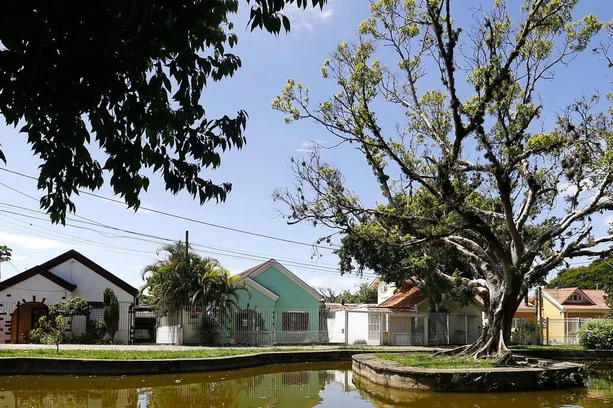
Volta e meia vejo vídeos nas redes sociais dessas colônias do distrito de Entre Rios, sempre mostrando as casas bonitas cercadas de gramados, árvores, praças bem cuidadas, avenidas com ciclovias. Parecia uma versão perfeita do que toda cidade pequena no Brasil poderia ser.
Mas fiquei surpreso ao ver pelo Google Maps que a maior delas, a Colônia Vitória, é bem desigual. Quase um terço da colônia tem um aspecto de abandono e princípio de favelização, onde imagino vivam os trabalhadores das indústrias locais. Até uns dois anos atrás nem asfaltadas essas ruas eram. Ali não tem só casas, mas todo tipo de comércio, até igreja. É como se a ideia fosse essa mesmo, de que as pessoas vivam segregadas do restante da colônia.
A Cooperativa Agrária que atua em Entre Rios teve um faturamento de R$ 7,5 bilhões em 2024. Em seu site, é dito que "diante do seu compromisso com o futuro, a Agrária investe ainda em educação, na preservação da cultura e na saúde e bem-estar de toda a comunidade." Mas pelo visto a moradia dos funcionários não foi uma grande preocupação deles.
Ao invés de criar uma situação de uma colônia minúscula dividida ao meio, poderiam ter construído alguns conjuntos de prédios inspirados na arquitura local, com áreas verdes, jardins floridos, praças. Se duvidar se tornaria um ponto turístico como é o Fuggerei na Alemanha, o conjunto habitacional público mais antigo do mundo.
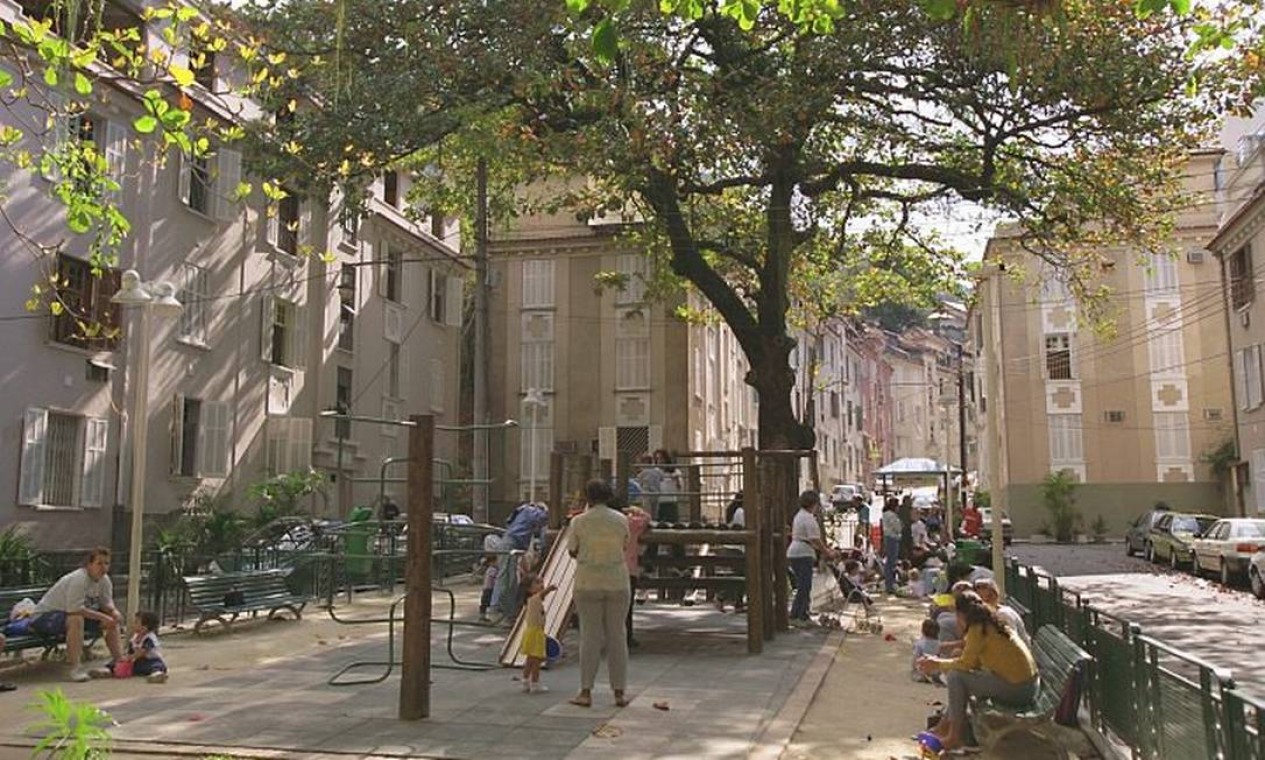
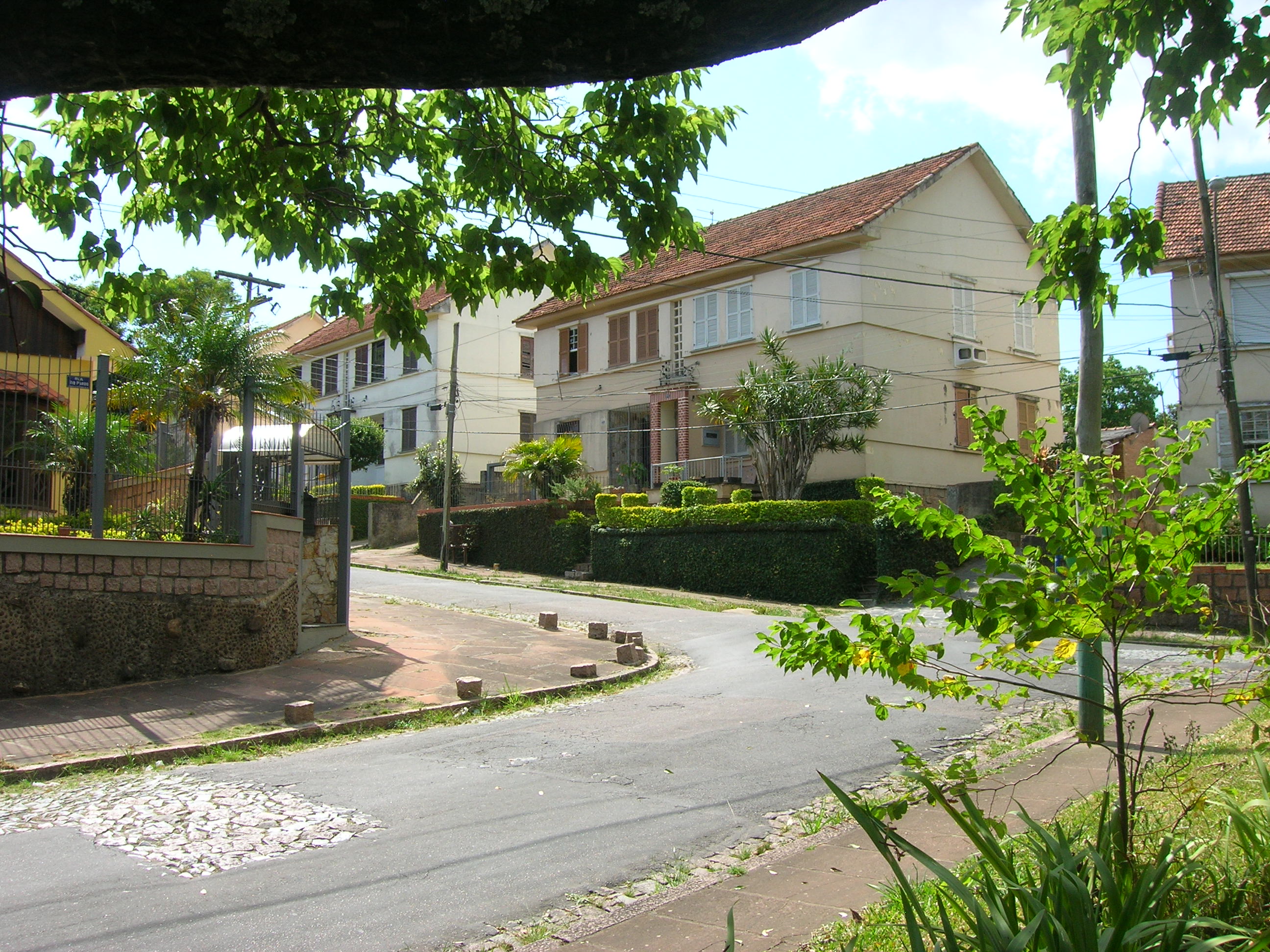
Temos exemplos aqui no Brasil, como a Rua Pires de Almeida em Laranjeiras no Rio de Janeiro. Começou nos anos 1920 como uma vila para os funcionários da Companhia de Seguros Sul América, e hoje é considerada uma das ruas mais bonitas da cidade. Tem a Vila do IAPI em Porto Alegre, inaugurada nos anos 50 e onde Elis Regina cresceu. Hoje está um tanto abandonada, mas continua charmosa com seus conjuntos de casas, sobrados e prédinhos. Inclui no post alguns exemplos da Europa também. Não estou falando que tudo no passado era maravilhoso, mas que podemos aprender com que deu certo ao invés de insistir em modelos fadados ao fracasso.
O meu questionamento é que se nem em uma pequena colônia próspera, de fundação recente e um bom senso de identidade própria tem o mínimo interesse em manter o mesmo padrão de qualidade de vida e urbanismo em sua pequena extensão, qual é a esperança pras cidades médias e grandes brasileiras?
>My blood boils and I don’t know what to do. Clever people think nobody in the world is as happy as I am, but they’re wrong. I’m unhappy because I make myself unhappy. I should have been born a century sooner, as these days all my dearest ideas seem ridiculous and I’m more frightened of being laughed at than dying. I love and hate violently, and I don’t know which is better, my love or my hatred. I have an awful mixture of passions inside me, all wild; I fight them, but I always lose, and my life is going to end miserably, in a whirl of passions, virtues and follies.
Excerpt from a letter written by a teenaged Eugénie to the Duke of Alba, her sister's fiancé whom she was in love with.
-
From the choice of fabric, a Chiné à la branche (or possibly its 19th century counterpart Chiné á la chaîne*)* to the shape of the neckline and sleeves of the day bodice, there's a clear inspiration in the fashions of the 18th century. Empress Eugénie's love for the era and her almost obsession with Marie Antoinette are well documented:
>The last woman to reign over France (and the only one to reign over the Paris we know today), she personified the allure of the Second Empire that one glimpses in Winterhalter’s portraits and the music of Jacques Offenbach. ‘Eighteen years of self-indulgence, folly and wild gaiety, of love affairs and unbelievable elegance’, a survivor recalled wistfully. ‘For a short time, too short a time, it seemed as if we were glittering ghosts from the spendours of the eighteenth century.’ In many ways the Second Empire was a final flicker of the ancien régime.
-
>A painting of Eugénie’s private salon by Giuseppe Castiglione shows a drawing-room and study joined by a curtained arch, with long windows looking out onto the Tuileries gardens. The furniture includes a buttoned sofa, a Chinese screen of crystal and a Louis XVI cabinet on which there is a bust of Marie-Antoinette, while the carpet is a red Savonnerie. Through the arch, flanked by two tall red vases on gilt stands, what may have been Marie-Antoinette’s writing table can be glimpsed in the study.
-
>Her style was a blend of the ancien régime with comfort. Nostalgia for the days before 1789 was already widespread, and inspired by her heroine Marie-Antoinette she pioneered a revival of interest in eighteenth-century furniture – acquiring as much of the queen’s as she could, made by such ébénistes as Weisweiler, Riesner, Oeben and Carlin, besides commissioning copies.
-
>She wore day dresses of wool or poplin, of silk, velvet or plush, in every colour of the rainbow, plain or patterned. [...] She was fond of pastel shades such as dove grey, cream or buttercup yellow, because they had been favourites of Marie-Antoinette.
-
>Republicans and even royalists claimed, wrongly, that Eugénie’s expenditure on clothes during her reign rivalled Marie-Antoinette’s, that she was a symbol of unbridled luxury, ignoring the prestige she gave to French fashion.
-
>In 1854, Winterhalter painted the empress in a garden at Versailles, in an eighteenth-century dress of pale gold taffeta and with powdered hair. Only the year before Hübner had watched the ninety-year-old Isabey picking up her fan – if Isabey, who had painted Marie-Antoinette, saw Eugénie dressed like this, he may well have thought that he was seeing a ghost. Princesse Mathilde told the Goncourt brothers it was ridiculous for the empress to compare herself with the queen, yet the two women had much in common. Disliked as foreigners, criticised for their clothes, jewels and parties, both were on insecure thrones and had a vulnerable child.
>
When Napoleon III asked Eugénie to marry him, he warned of the dangers and reminded her of Marie-Antoinette’s fate, which frightened even Doña Maria Manuela. During her honeymoon the empress visited the Petit Trianon, and later installed a copy of the dairy in a small country house near Saint-Cloud. In future years she would warmly encourage the Petit Trianon’s restoration, visiting it regularly – as if hoping to commune with the spirit of her predecessor. Sometimes the great antiquary Count Nieuwerkerker expounded learnedly on how the little palace must have looked in Marie-Antoinette’s day, the empress listening with rapt attention.
>As early as 9 May 1853, when Eugénie was pregnant for the first time, she wrote to Paca, ‘I am thinking with terror of the poor dauphin Louis XVII, of Charles I, of Mary Stuart and of Marie-Antoinette. What is going to be my poor child’s destiny? I would a thousand times rather that my son had a less glittering but safer crown.’ In her far from infrequent moods of depression, Eugénie began increasingly to fear that her husband would be overthrown like Louis XVI, and that she too would die a terrifying death. Above all, she worried about the Prince Imperial. Would he end as horribly as the little Dauphin had in the Temple, sixty-three years before?
>Viel Castel had noticed the empress’s obvious emotion when shortly after her marriage she went to the Conciergerie to see the cell where Marie-Antoinette had been imprisoned during her trial, and from where she was taken to be guillotined. She also visited the National Archives to read the letter written by the queen on the night before her execution. One night she returned unexpectedly to the Archives, asking the keeper to show her the queen’s last letter again, while she chose Maundy Thursday 1860 (when she was probably fasting) to revisit the cell at the Conciergerie.
>Baron Hübner thought that her obsession bordered on the morbid. Staying at Saint-Cloud in April 1855 he was shown the imperial couple’s private apartments, and observed, ‘The empress’s almost superstitious cult for Queen Marie-Antoinette may be seen in her own rooms (these were the rooms that had once been occupied by Marie-Antoinette):
>In the bedroom that she shares with the emperor, only one picture hangs on the walls. It is an old print that depicts Louis XVI’s unlucky consort. Clearly, ‘Doña Eugenia’ is convinced that she is going to die on the scaffold. She has said to me more than once, and when I smiled she went red. She mentioned, as absolute proof that a tragic fate awaited her, how when preparing her trousseau for her marriage she had been offered a lace veil that the queen had worn. It was really most tempting, but Mlle de Montijo simply did not have enough money to buy it. She was therefore overwhelmed – both elated and depressed – when opening her wedding presents she found sitting on top of them the same veil, the very same, that had once belonged to Marie-Antoinette.
>In October the following year (only a few months after the demoralising ordeal when she had so painfully given birth to the Prince Imperial), the empress and Hübner had another conversation while he was staying at Compiègne, during which they discussed the queen and her execution. ‘I would much rather be assassinated in the streets’, Eugénie confided in the ambassador. ‘I have lost all my sang-froid. Since my lying-in, I have had a deeply disturbed imagination.’ Hübner comments condescendingly, ‘Poor woman. It is no bed of roses being on a throne, even an imitation one.’ Obviously an element of terror contributed to Eugénie’s not infrequent bursts of ill-temper.
>Understandably, the birth of the Prince Imperial made the empress think still more of Queen Marie-Antoinette and the dauphin. In London The Times reflected that since Louis XIV no French monarch had been succeeded by his son although almost none of them had been childless, gloomily prophesying, ‘The Napoleon born last Sunday morning may be crowned the last of his line; or may add one more to the Pretenders of France.’ During the weeks that followed the Orsini plot Cowley reported that ‘The poor empress is tormented to death by anonymous letters telling her that the little Prince is to be carried off and the poor child is now never let out of sight of the house.’
>Eugénie bought everything she could find that had belonged to the martyred queen, or might have belonged, as if it were a sacred relic. Horace de Viel Castel presented her with a ring worn by Louis XVI, together with Gravelot’s sketch for the invitation to the ball for Marie-Antoinette’s wedding (but, sadly, they did not earn him an invitation to Compiègne). Eventually her collection included furniture, jewellery, paintings, tapestries, bronzes, porcelain and letters – and books whose bindings bore Marie-Antoinette’s coat of arms, particularly prayer-books. Among the most prized items were the queen’s ivory and ebony mandolin, her jewel casket decorated in Sèvres and some exquisite chairs by J.B.B. Demay with the monogram ‘M.A.’. In addition, a bust, a portrait or a print was prominently displayed in the empress’s apartments at each of the imperial palaces.
>In 1861 the British foreign secretary Lord Clarendon compared her vendetta with Plon-Plon to the feud between the queen and Philippe Egalité. After his embarrassing refusal to fight a duel with the Duc d’Aumale – one of the Orleanists pretender’s uncles – she had expressed her contempt for Plon-Plon during a dinner at the Tuileries. ‘He will never forgive the empress any more than Egalité did Marie-Antoinette, who was always abusing his lâcheté, and this chimes in curiously with her belief that she is in all things like Marie-Antoinette and that the same fate is reserved for her.’
>Rumours of her cult circulated widely, revealing how frightened she was of a revolution and delighting the régime’s opponents, republican or royalist. At the costume ball for the carnival of 1866, on 8 February, she received the guests in a dress of crimson velvet trimmed with sable and a matching toque with red and white plumes – modelled on what the queen had worn in one of Mme Vigée-Lebrun’s portraits. A masked man sidled up through the crowd, to hiss in her ear, ‘Some day you’re going to die just like her, and your son is going to die in the Temple just like the dauphin.’
>‘Until 1860, so far as I can make out, most people thought that the empress’s time was entirely taken up with dress and frippery’, said Augustin Filon, the Prince Imperial’s tutor. ‘It was when Italian unity had begun to be very much the question of the day and when this unity, already half-achieved, had started to threaten the pope’s temporal power, that whispers began to circulate about the empress’s political influence.’ This alteration in her public image was not unlike that undergone by Marie-Antoinette seventy years before. As early as 1862 Viel Castel noticed how the resemblance to the queen was being used to damage the empress’s reputation during M. Thouvenel’s sudden replacement as foreign minister by the pro-Austrian Drouyn de Lhuys. Eugénie was blamed by Thouvenel’s enraged friends. ‘I was told this morning that Marie-Antoinette perished because of her Austrian name, and that the Spaniard had better take care of herself’, recorded the diarist. ‘For some days now the unhappy empress has been considered capable of almost any crime – she is even said to be hoping for her husband’s death so that she can become Regent.’
>Just as the queen had been accused of plotting against the Revolution, so the empress was blamed for all the Second Empire’s more unpopular policies at home as well as abroad. Filon heard that she was supposed to have her own political party, but never saw any trace of one during his three years at court. What is beyond dispute is that the hostility towards Eugénie noted by Viel Castel was growing stronger every day. There were rumours that she was responsible for the emperor’s failing health, even for France’s loss of standing as a world power after Prussia’s victory at Königgrätz. However half-baked, such rumours may have been, they did her no good.
>‘It really is quite extraordinary how much our empress resembles poor Marie-Antoinette’, wrote the loyal if not uncritical Filon, two years later when Eugénie’s unpopularity had soared to alarming heights. This was after he had read the memoirs of Mme Campan, the queen’s woman of the bedchamber during the Revolution. Filon noticed in Eugénie the same love of domesticity as the queen’s, while he thought that he could see certain resemblances in their temperaments – the same mixture of haughtiness and affection, the same vivacity interrupted by moods of melancholy and bitterness. Yet Filon was shrewd enough to recognise at the same time the more sterling qualities that marked the two women – the same morality and decency, together with an honest, unaffected desire not only to please but to serve the French people.
>By the end of the 1860s the Second Empire was losing impetus and obviously nearing a crisis. Eugénie’s comparison of herself with Marie-Antoinette, which had begun in 1853 as little more than an affectation, partly romantic and partly superstitious, now seemed only too convincing. It looked as if she had good reason to fear that she might share the queen’s fate.
Excerpts from Eugenie: The Empress and Her Empire by Desmond Seward.
A obra vai reformular calçadas, com acessibilidade plena, novo pavimento em paralelepípedo, travessias elevadas e ampliação dos espaços para pedestres na quadra entre as ruas Cruz Machado e Cândido Lopes.
Conforme a prefeitura, a obra integra o programa Curitiba de Volta ao Centro e deve ficar pronta até o fim de julho, poucas semanas antes de o novo Cine Lido, casa de shows instalada na mesma via, abrir as portas ao público em agosto.
O modelo adotado segue o mesmo conceito aplicado nas revitalizações das ruas Voluntários da Pátria e Prudente de Moraes, onde o pedestre passou a ocupar posição central no planejamento urbano.
Publicado primeiro em Banda B » Das calçadas ao pavimento: rua do novo Cine Lido vai passar por transformação histórica e “mudar a cara”