
misa77: ridiculously fast decompression at good ratios
Hello, I'd like to share misa77, a codec I've been working on for some time now.
Source Code: https://github.com/welcome-to-the-sunny-side/misa77
misa77 is a LZ-based codec that targets the write-once, read-many niche. In particular, it aims to satisfy the following criteria:
- Extremely high decompression throughput (single-threaded).
- Modest compression ratios (it has no entropy backend, so one can obviously not compare it to something like zstd, but LZ4 at high effort levels is a good reference point).
- Constant memory use, regardless of input size (<= 5 MB across all compression modes, and 0 MB for decompression).
Slow compression is the obvious tradeoff that one makes to achieve the above.
In addition, misa77 has a somewhat synergizing tendency to decompress highly compressed files faster, leading to the following results:
- It offers particularly high decompression throughput on highly compressible files.
- Even for moderately compressible files, spending more effort during compression to get a more compressed result leads to better decompression throughput (alongside the natural advantage of better ratios).
This makes high-effort compression particularly attractive for misa77, and inspires some experimental compression modes that aim to spend more effort at compression time to produce a compressed stream that is friendlier to the microarchitectures of most CPUs when decompressing said streams. As of v0.1.0, there are two experimental compressors:
misa77::experimental::adaptive_compressfor homogeneous data.misa77::experimental::yolo_compress, which is more general-purpose and has lesser overhead than (1).
Benchmarks
Detailed results are listed ahead, but here's a terse summary:
- misa77 lies on the pareto frontier for decompression throughput vs compression ratio on most shapes of data.
- It very frequently decompresses faster even when competitors have a significantly worse ratio.
- It is quite slow at compression (although this isn't fundamental, I just haven't spent that much time optimizing compression as of now).
All benchmarks were run using https://github.com/welcome-to-the-sunny-side/lzbench (fork of lzbench) and can be reproduced easily. For the codecs below, I've used flags that yield a similar compression ratio to misa77.
x86-64 (Intel)
Details:
- CPU: Intel(R) Core(TM) i7-14650HX (@2.2 GHz) (Intel Turbo disabled).
- Single threaded, pinned to a single performance core.
- CPU governor set to
performance.
| Compressor name | Compression | Decompress. | Ratio | Filename |
|---|---|---|---|---|
| misa77 0.1.0 | 43.9 MB/s | 4285 MB/s | 39.62 | silesia.tar |
| misa77 0.1.0 yolo | 7.68 MB/s | 5513 MB/s | 42.75 | silesia.tar |
| lz4 1.10.0 | 370 MB/s | 2512 MB/s | 47.59 | silesia.tar |
| lz4hc 1.10.0 -12 | 7.31 MB/s | 2534 MB/s | 36.45 | silesia.tar |
| lizard 2.1 -10 | 323 MB/s | 2452 MB/s | 48.79 | silesia.tar |
| lzsse4fast 2019-04-18 | 186 MB/s | 2538 MB/s | 45.26 | silesia.tar |
| lzsse8fast 2019-04-18 | 183 MB/s | 2668 MB/s | 44.80 | silesia.tar |
| zxc 0.12.0 -3 | 115 MB/s | 2839 MB/s | 45.46 | silesia.tar |
| zxc 0.12.0 -4 | 81.0 MB/s | 2727 MB/s | 42.63 | silesia.tar |
| zxc 0.12.0 -5 | 48.7 MB/s | 2599 MB/s | 40.25 | silesia.tar |
| zstd 1.5.7 -1 | 297 MB/s | 902 MB/s | 34.54 | silesia.tar |
| snappy 1.2.2 | 376 MB/s | 857 MB/s | 47.89 | silesia.tar |
x86-64 (AMD)
Details:
- CPU: AMD Ryzen 7 260 (@3.8 GHz) (Frequency boost disabled).
| Compressor name | Compression | Decompress. | Ratio | Filename |
|---|---|---|---|---|
| misa77 0.1.0 | 71.3 MB/s | 6220 MB/s | 39.62 | silesia.tar |
| misa77 0.1.0 yolo | 13.7 MB/s | 7832 MB/s | 42.75 | silesia.tar |
| lz4 1.10.0 | 693 MB/s | 4455 MB/s | 47.59 | silesia.tar |
| lz4hc 1.10.0 -12 | 12.8 MB/s | 4326 MB/s | 36.45 | silesia.tar |
| lizard 2.1 -10 | 573 MB/s | 2887 MB/s | 48.78 | silesia.tar |
| lzsse4fast 2019-04-18 | 323 MB/s | 4195 MB/s | 45.26 | silesia.tar |
| lzsse8fast 2019-04-18 | 311 MB/s | 4416 MB/s | 44.80 | silesia.tar |
| zxc 0.12.0 -3 | 213 MB/s | 4935 MB/s | 45.99 | silesia.tar |
| zxc 0.12.0 -4 | 151 MB/s | 4776 MB/s | 43.04 | silesia.tar |
| zxc 0.12.0 -5 | 87.3 MB/s | 4570 MB/s | 40.29 | silesia.tar |
| zstd 1.5.7 -1 | 491 MB/s | 1598 MB/s | 34.55 | silesia.tar |
| snappy 1.2.2 | 691 MB/s | 1355 MB/s | 47.85 | silesia.tar |
ARM64 (Apple Silicon)
Details:
- CPU: Apple M3
| Compressor name | Compression | Decompress. | Ratio | Filename |
|---|---|---|---|---|
| misa77 0.1.0 | 94.3 MB/s | 10007 MB/s | 39.62 | silesia.tar |
| misa77 0.1.0 yolo | 17.1 MB/s | 13088 MB/s | 42.75 | silesia.tar |
| lz4 1.10.0 | 881 MB/s | 5173 MB/s | 47.59 | silesia.tar |
| lz4hc 1.10.0 -12 | 17.0 MB/s | 4874 MB/s | 36.45 | silesia.tar |
| zxc 0.12.0 -3 | 276 MB/s | 8010 MB/s | 45.77 | silesia.tar |
| zxc 0.12.0 -4 | 192 MB/s | 7628 MB/s | 43.20 | silesia.tar |
| zxc 0.12.0 -5 | 114 MB/s | 7126 MB/s | 40.30 | silesia.tar |
| snappy 1.2.2 | 966 MB/s | 3438 MB/s | 47.91 | silesia.tar |
| zstd 1.5.7 -1 | 714 MB/s | 1614 MB/s | 34.54 | silesia.tar |
| lizard 2.1 -10 | 830 MB/s | 6530 MB/s | 48.78 | silesia.tar |
Per-File on x86-64 (Intel)
As misa77's performance is quite "spiky" (depending on the shape of the data being compressed), a file-level breakdown for the silesia corpus yields some interesting insights into its performance.
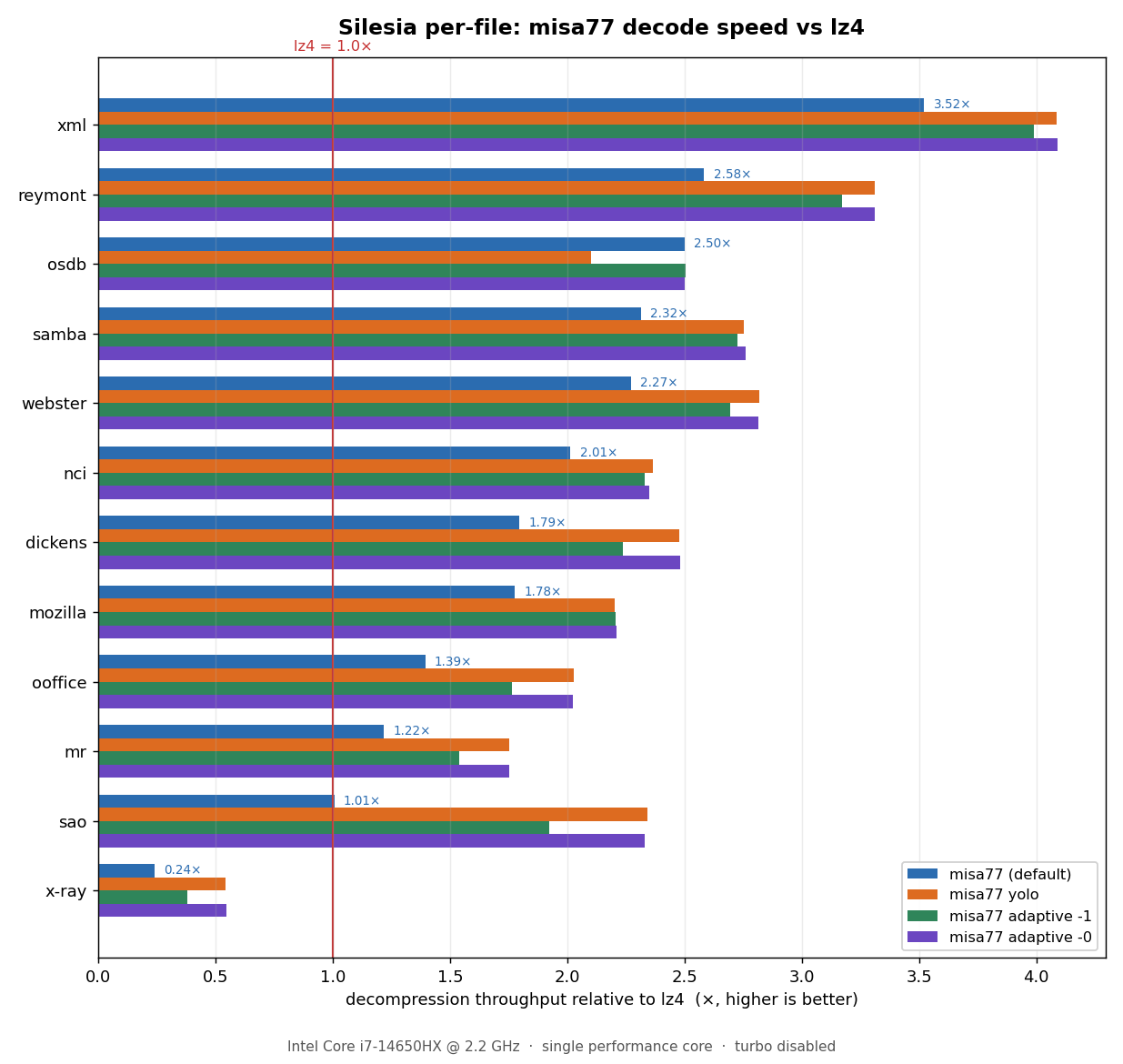
Decode speed relative to lz4
Every misa77 mode decodes faster than lz4 on 11 of the 12 files (some by huge margins). The exception is x-ray, which is highly incompressible (lz4 has a ratio of nearly 1.0 on this file and essentially devolves to a memcpy).
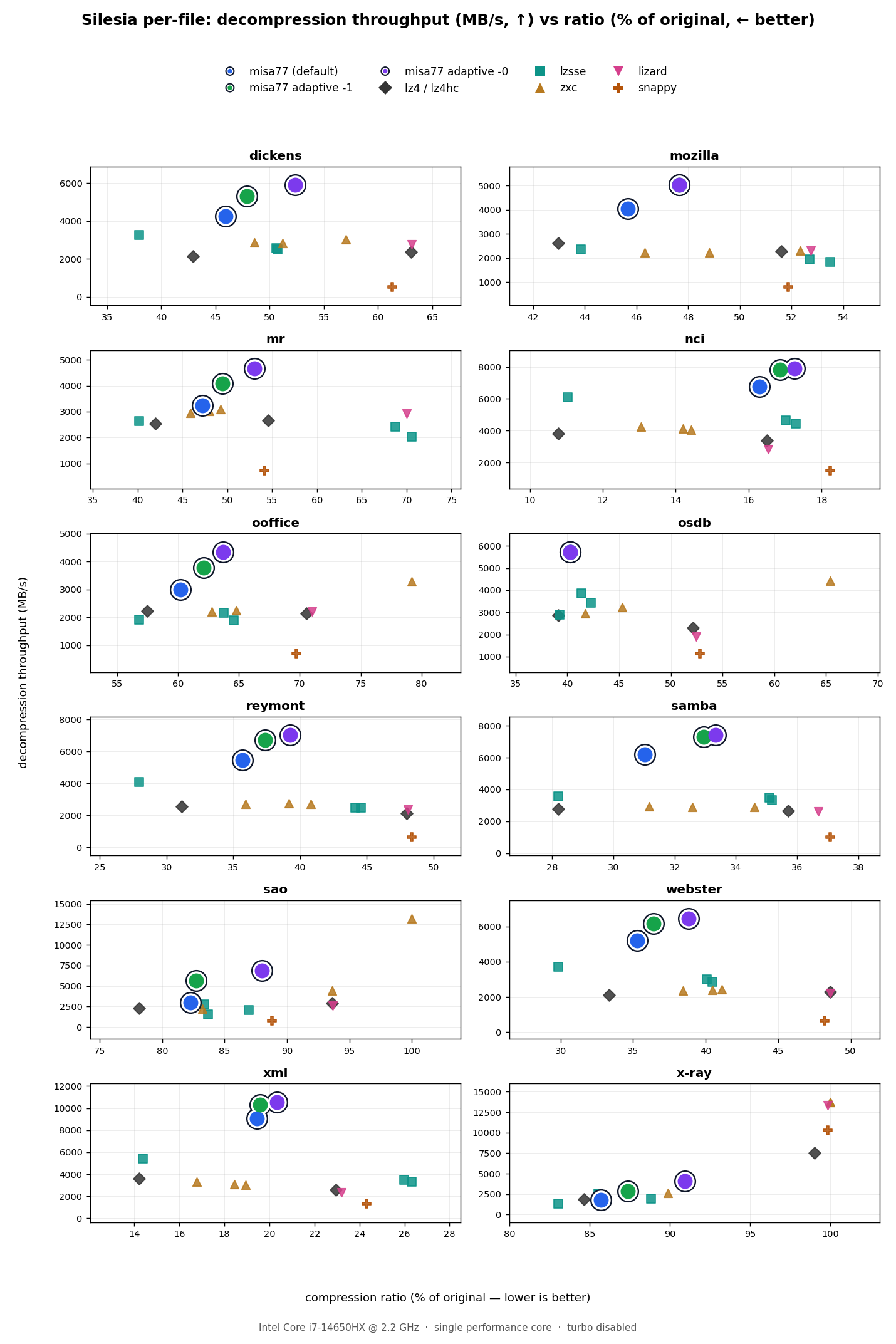
Throughput vs ratio, against popular fast-decode codecs
On the compressible files, misa77 sits on the decode-throughput/ratio Pareto frontier: it decodes fastest while ~matching or beating the ratio of the other fast-LZ codecs. sao and x-ray are exceptions due to the reasons stated before (incompressibility).
I'd be happy to receive feedback/answer queries about misa77 :)
Also I will pre-emptively note that I'm aware of how slow compression is right now, and I don't think it's going to be that hard to speed up (I just need to spend some time on it).