[FREE CODES] Check out "Welcome To the Deep Estate" a Surreal Backrooms comedy. The sequel is now available for pre-order.

This is a series that can only be described as insane.

  • 4/5 on Goodreads with 100+ ratings.
  • It's Dungeon Crawler Carl meets the Backrooms and SCP Foundation.
  • A flying No. 2 pencil is a major character. You WILL get deeply emotionally invested in her well-being.
  • The main love interest is a kinda-sorta vampire that killed Hitler TWICE.
  • By the end of Book 2, you will know who killed Jeffrey Epstein, what happened to Amelia Earhart, and how secret lizard people reproduce. Spoiler alert: >!It involves a "detachable penis missile."!<
  • The Sequel is available to pre-order and is dropping July 23rd.

WELCOME TO THE DEEP ESTATE

Length: ~11 hours
Narrator: Christopher Harbour (he absolutely sells the madness)
Tone: absurd, fast, occasionally unhinged, surprisingly coherent.

Unfortunately, while I have a stack of UK Audible codes burning a hole in my digital pocket, I only have a few US codes to spare. BUT Welcome to The Deep Estate is available FOR FREE as part of Audible Plus. (which I think everyone should have access to. Don't quote me on that.)

Feel free to leave a comment and I'll DM you a code.

AUDIBLE LINK

The Synopsis:

Here’s a little secret: Reality is insane.

A death cult led by a box of Kraft mac and cheese. The Bermuda Triangle. Lizard people walking among us. When every conspiracy theory, urban legend, and fever-dream headline is true, someone has to keep it all cataloged, contained, and out of sight. That someone is the Bureau of the Bizarre.

John Doe always thought his paranoid father was crazy, then the crazy showed up on his doorstep with a job offer. Now, he’s a Collector for the Bureau, partnered with Edith Sinner, a metanatural vampire with a murder glare and a past that refuses to stay buried. Their office is The Deep Estate, a liminal space carved out of The Backrooms, where nightmares take shape and reality bends to the collective unconscious. Their coworkers are anything but normal. Carrie is a stab-happy flying pencil. Marybeth is a Victorian doll with serious Devil Daddy issues. And then there is the Murder Clown...

But when John and Edie bump into a conspiracy the Bureau was never meant to see, reality itself is rewritten to frame them for murder. Hunted by their own and pursued through impossible corridors, they have to expose the truth before the Deep Estate’s secrets swallow them whole.

Equal parts cosmic horror and comic absurdity, Welcome to the Deep Estate is what happens when Men in Black stumbles into the Backrooms carrying a copy of Hitchhiker’s Guide.

Thanks for tolerating my extremely dignified marketing.

u/KevinKaneAuthor — 3 months ago

Dead Audience Theory: Malcolm Gladwell says it takes ten thousand hours to become an expert. It takes about ten seconds to accuse someone of being a fraud.

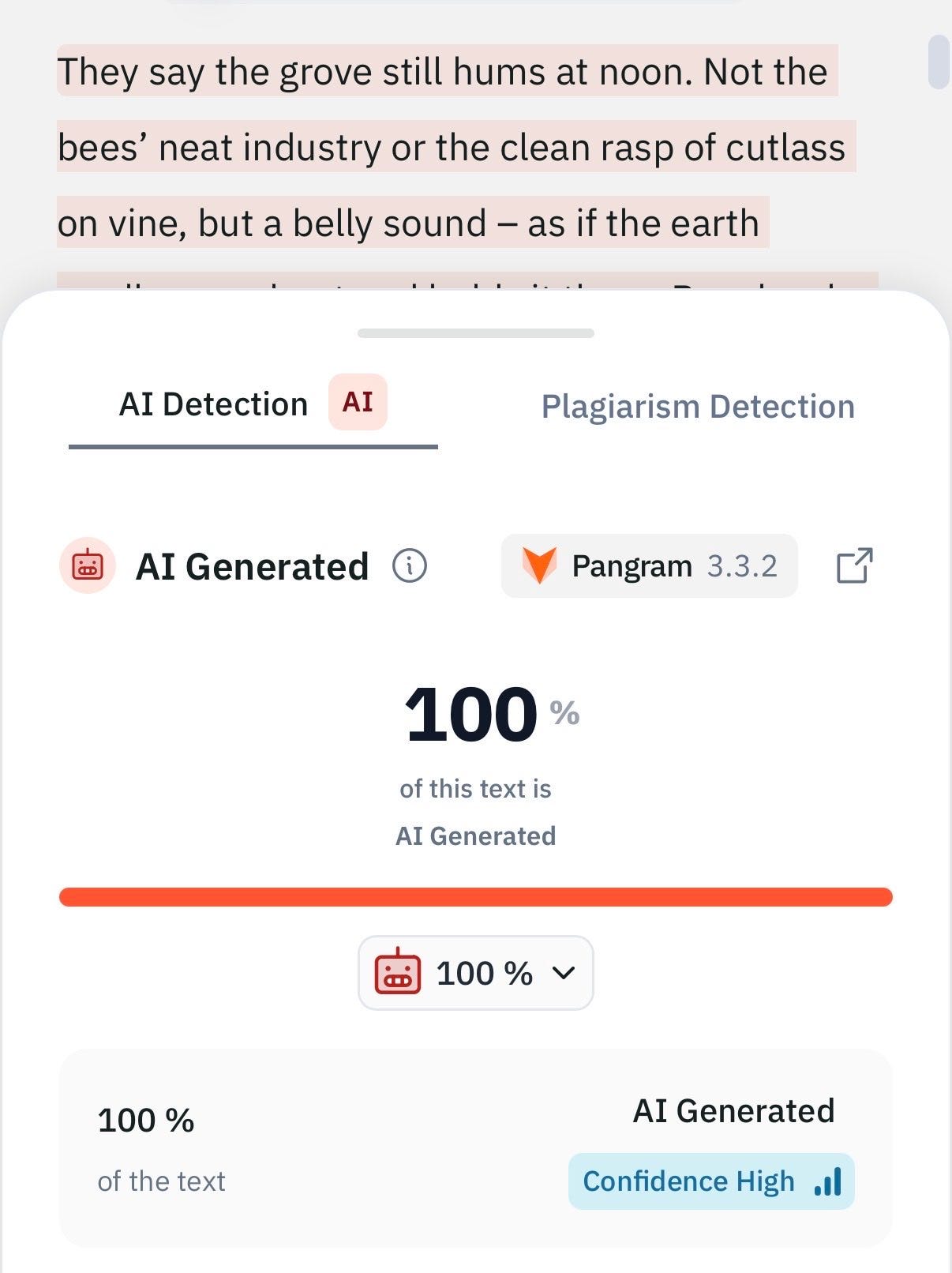
Pangram AI detector Results

TL;DR: When we believe we’re surrounded by frauds pushing fake content, we stop engaging with the new and unfamiliar. Accusing human creators of using AI-generated content is actually more corrosive than the AI content itself.

kevinkane.net
u/KevinKaneAuthor — 3 months ago
▲ 12 r/aiwars

Dead Audience Theory: Malcolm Gladwell says it takes ten thousand hours to become an expert. It takes about ten seconds to accuse someone of being a fraud.

Taken from my Substack. Pangram AI detector Results

TL;DR: When we believe we’re surrounded by frauds pushing fake content, we stop engaging with the new and unfamiliar. Accusing human creators of using AI-generated content is actually more corrosive than the AI content itself.

You must feel it too. That little uncertain hitch as you take something in. A subconscious check we now all have, stopping you before you engage with anything new and asking, “Is this AI?” It’s become stranger danger’s second cousin, only instead of warning you about a van with no windows, it pipes up whenever you see a short story, an image, a song, comment, product review, news article, or weirdly sincere Facebook post from an uncle who usually types like he’s being hunted.

The most disturbing thing about the question “Is this AI?” is that it’s become almost interchangeable with “Is this real?”

On a certain level, that’s insane. There is no other way to describe it. AI has us walking around the internet like Russell Crowe in A Beautiful Mind, staring at everything and mumbling, “Is this real?” Yet the paranoia is justified. The fakery exists. The hallucinations and delusions are real. They’re just coming from the machines, not a chemical imbalance. I wouldn’t blame you for reading this far and deciding this piece is just three prompts in a trench coat. That’s the internet we’re swimming in.

As counterintuitive as it sounds, AI may be the reason behind the paranoia, but it’s not the problem we now have to face. The problem is what happens to us after we accept that realness is no longer guaranteed. Once you know someone in the room might be an impostor, you start side-eyeing everyone. Innocent or not, everyone becomes suspect.

It’s what I call the Dead Audience Theory.

In 2026, Trinidad and Tobago author Jamir Nazir’s short story “The Serpent in the Grove” won the Caribbean regional award for the Commonwealth Short Story Prize. Almost immediately, the internet began accusing the story of being AI-generated. People pointed to the usual tells. The story loves the rule of three. It has several “deep until you think about it” lines like “She had the kind of walking that made benches become men”, “the girl smiled like sunrise over a sink,” and a third example I’m not going to give out of fear of being accused of the same crime.

Worse, the more people looked into it, the more it appeared that other regional winners might also be laundering slop. The AI cancer had clearly metastasized.

Except, not really.

After a month-long inquiry involving early drafts, timestamps, notes, and author interviews, the Commonwealth Foundation announced on June 22 that it was satisfied AI had not been used in the winning stories. Unfortunately, by then, most people had already moved on. Like most internet drama, the crowd wandered away without piecing it all together, absolutely convinced they understood the full picture because it was right there on the front of the puzzle box.

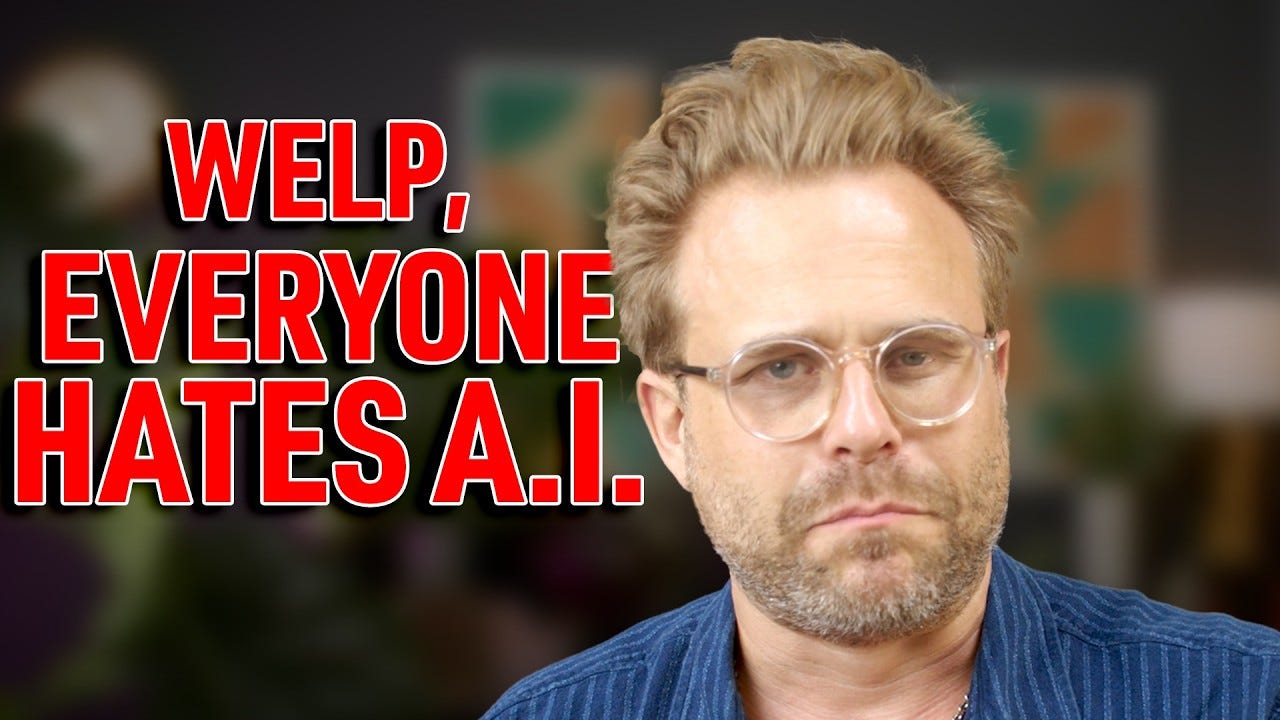
Adam Conover, a man who can only be described as what you’d get if a Reddit comment was a fursona, used Nazir’s controversy as Exhibit A in why AI is terrible and why people who use it are terrible in a YouTube video posted five days after the Commonwealth Foundation announcement. He did not mention that the author’s name had been cleared five days earlier, at least in the Foundation’s eyes. Instead, he and his guests used Nazir as a segue into the Dead Internet Theory, a popular dystopian idea suggesting that most of the internet has been overtaken by bots, algorithms, and AI slop. What we think of as the internet’s bustling town square is actually a ghost town full of Westworld hosts, still performing their programmed routines long after the guests have gone home.

But I think something else is happening.

What if the internet isn’t dead? What if we just can’t tell the humans and hosts apart anymore, and that uncertainty has convinced us none of it is real? The perception that the internet is being overtaken by AI-generated content may end up being more corrosive than the AI content itself. When we believe we’re surrounded by fake art, fake opinions, fake essays, fake comments, fake images, fake reviews, fake everything, we stop engaging with the new and unfamiliar. We start behaving like paranoid misanthropes. Authentic human interaction disappears not because every human has been replaced, but because we no longer trust that anyone is human in the first place.

The Dead Internet Theory becomes a self-fulfilling prophecy because we labeled the humans as AI and then congratulated ourselves for spotting the fraud.

It’s hard to precisely explain why something being AI-generated feels so disqualifying. AI content is treated almost like online leprosy. No one really wants to spend time consuming something AI-generated unless they were the one who generated it. They’re certainly not going to spend money on it. People rarely ask if AI is good. For most audiences, it can only be bad, suspicious, cheap, exploitative, embarrassing, or an automatic disqualification from consideration. The artificial taint also spreads to anyone who uses it. People who want to have their AI content displayed on the fridge are often treated with derision, while anyone trying to pass AI content off as their own is quickly labeled a fraud.

And if there’s one thing the internet loves, it’s identifying frauds.

Whether or not Jamir Nazir’s story was AI-generated matters, but the accusation did not need proof to do its job. No matter who won a Commonwealth Prize this year, the internet was probably going to come away shouting that some of it was AI. Partly, that’s just the social media environment we’re in. Outrage travels faster than nuance because nuance doesn’t make people feel like a little detective solving crimes from the toilet. “There’s AI slop afoot!” was always going to gain more traction than “This is a fine short story from a marginalized author.”

But the deeper issue is that we don’t always know what’s real anymore, and it’s only going to get harder to tell. Nazir’s story is actually something more unsettling than the usual low-effort machine garbage we call AI slop. It’s mystery meat. You can hold whatever opinion you want about who or what actually wrote “The Serpent in the Grove,” but we cannot definitively know. If it was AI, then it was slop good enough to fool a room of literary experts and win a prize. If it wasn’t AI, then a real writer’s career moment was dragged through the mud because his work happened to trip the alarm.

That second possibility should bother us more than it does.

We run into mystery meat all the time now. This essay, for example, is mystery meat. Maybe it’s AI-generated. Maybe it isn’t. Maybe it’s some depressing mixture of the two. What makes it mystery meat is not what it is. It’s what you don’t know. You didn’t see me sit down and type this. If I swear this is 100% USDA-certified human thought, you have no particular reason to believe me. In fact, you’re probably predisposed to believe I’m a liar.

We all understand that anyone can now be a fraud. We all have the means to access these models and the opportunity to pretend a thirty-second generation took hours of human effort. As for motive, you’re reading this. I clearly want your attention, and you’re giving it to me.

Not knowing the truth behind mystery meat should eat at us. We don’t have a reliable way to prove or disprove AI use. Not every generated image comes stamped with SynthID, and an AI detector like Pangram is just one machine squinting at text and making a confident guess about whether another machine wrote it. That isn’t proof. So much of Nazir’s problem came from Twitter pointing out that Pangram’s machine thought “The Serpent in the Grove” was 100% AI.

The reason the question “Is this AI?” doesn’t eat at us for very long is because it’s almost always followed by an answer. We don’t have the energy, time, or patience to do due diligence on every piece of content that crosses our screen. Every second we’re online, we’re bombarded by an endless torrent of stimulation. Most of it gets only a few seconds to win our interest before we move on. The question “Is this AI?” probably eats up one or two of those seconds by itself. Sometimes the answer is backed by clear evidence, but if we can’t spot something obvious, like a mangled hand with six fingers, we end up settling for a gut check.

What matters is that for all the reasons people don’t engage with AI, they also don’t engage with any work they think might be AI. Sometimes defaulting to “This is AI” feels like the safest answer. For anyone who describes themselves as anti-AI, the last thing they want is to be the idiot who argued “AI art isn’t art” and then got caught enjoying AI art. No one wants to be the Facebook Boomer saying through a full mouth of mystery meat, “This is a tasty burger,” only for someone to inform them it’s fake. I’ve felt like an idiot sharing a video with a friend showing a baby reacting to a rainbow bath bomb and telling him he needed to buy this thing and blow his baby’s mind, only for him to respond, “Dude, that’s AI.”

The worst thing we can do is try to answer “Is this AI?” by reading the room and deferring to everyone else’s gut checks. There’s always confirmation bias in the mix. Most people who read “The Serpent in the Grove” only picked it up after the accusation, meaning they didn’t go in blind. They were primed to think it was written by AI, so what they read screamed, “This was obviously written by AI.”

Some of the loudest slop accusers also have the shakiest understanding of the technology. They don’t use AI themselves. Why would they? They’re not hypocrites. But that kind of moral consistency can lead to ignorance. They don’t really know how the enemy works or what the enemy looks like, yet they want to fight this war and go in guns blazing, and the humans they’re trying to defend end up getting caught in the crossfire.

You see this everywhere now. A skilled photographer is using Midjourney because the lighting is too crisp. An aspiring model is too beautiful to be real, and not in the usual creepy online-guy way. People literally judge a self-published book by its potentially AI-generated cover and call the entire text a con job.

Sometimes all it takes is one person suggesting something is slop, and suddenly everyone starts collectively hallucinating fraud. Authors on Reddit watch in dismay as someone shows up to proudly announce they won’t read what they wrote because it’s AI slop. The accusation leaks through the thread like ethylene gas from a rotten apple, souring everyone around it.

The accusers often speak with the confidence of someone holding a master’s degree in digital forensics, pointing out “obvious tells” that don’t exist. The books on a bookshelf are facing the wrong way in a mirror selfie. A lifelong iPhone user is confident the Android phone someone is holding is wrong.

Sometimes they just squint and say something “seems off” because an unknown writer is too metaphorical, too grounded, too lyrical, too blunt, too normal, too weird, too anything. Really, the unknown writer just doesn’t write like them. Or the author can write and the accuser can’t. If the accuser tried to create what the author created, they would need to use ChatGPT, so it goes to reason the author must be using ChatGPT too.

The net result is that people don’t read the self-published book because they don’t know the author. They don’t give the new musician a shot because the song might be a Suno prompt. They ignore actual artists making actual art because the artists didn’t bring enough receipts. Even if an artist does show their work, someone will point out that “slop artists” can generate fake receipts too. The paranoia never ends.

And people stop engaging with genuine organic human content.

A false accusation doesn’t just hurt someone’s feelings. It suppresses discovery, preventing an unknown from becoming known. Every established creator today was once an unknown creator asking strangers for the benefit of the doubt. The fear of AI severs those tiny chains of engagement, where one stranger takes a chance, telling another stranger, who tells another, until eventually a career exists where nothing existed before.

Kane Parsons went from posting creepy Backrooms videos on YouTube to landing a major Hollywood adaptation before he was old enough to rent a car. It’s easy to imagine a world where those same Blender videos are immediately dismissed as AI slop and never get the momentum to go viral. Matt Dinniman became one of indie publishing’s biggest success stories before the internet was flooded with AI-generated novels. How are we supposed to discover the next Dungeon Crawler Carl if every unknown author gets thrown onto the slop pile before anyone bothers to read Chapter One?

We love the idea of discovering unknown creators. The internet was supposed to be a place where a nobody could upload something strange, brilliant, stupid, deranged, hilarious, beautiful, and find an audience without asking permission from the old gatekeepers. That was the dream. Now, the old gatekeepers are the only ones holding a stamp of authenticity and everything else is regarded with suspicion. Now, before a stranger can become a fan, they have to decide whether the creator is even real. That might be the single worst environment for creativity.

There’s no easy fix to the irony that people are attacking human creativity in defense of human creativity. There are only personal suggestions that work at an individual level. The first is that before we shout “This is AI,” we should ask the opposite question: “Is this human?” AI content is easy to dismiss because we assume no effort went into its creation. Before making the accusation, we should consider the potential blood, sweat, tears, hopes and dreams that poured into whatever we’re examining. We need to fully understand the stakes of the second question: “What if I’m wrong?”

Malcolm Gladwell says it takes ten thousand hours to become an expert. It takes about ten seconds to accuse someone of being a fraud.

AI art supposedly deserves no praise because it creates the appearance of skill without the struggle, but when real human work gets mislabeled, the accusation does exactly what people fear AI will do. It replaces the human with a machine and erases the labor behind the work. It turns skill into an illusion, effort into a lie, and the artist into some idiot standing next to a generative slot machine, pretending a jackpot was craftsmanship. The hours vanish. The drafts vanish. The practice vanishes. Their humanity vanishes. All that remains is suspicion, and the suspicion is enough to scare off the audience who might have helped the work survive.

Jamir Nazir is a real person. He’s not some prompt monkey trying to hack his way into literature. He’s a 62-year-old writer who says diabetes-related health problems have made conventional typing difficult. His writing process often involved using Android speech-to-text on his phone. Becoming a Commonwealth Short Story finalist should have been a major step toward recognition for a marginalized author. Instead, it may become a career-ending pitfall, forever tying his name in search results to the words “AI,” “controversy,” and “fraud.”

That’s the thing people miss when they treat AI accusations like harmless skepticism. They are not harmless. The internet is very good at starting fires and very bad at reading the arson report, and it’s easy for an audience to walks away remembering only the accusation. I’ve been lucky that whenever someone accuses me of using AI, they usually denounce my work and then immediately leave without reading another word. They haven’t stuck around long enough to do real damage, like bombing my reviews with one-star accusations or permanently poisoning the well for future readers.

This is probably going to sound like the worst possible take to a lot of you, but bear with me: AI isn’t going away anytime soon. While it may be the reason behind our paranoia, it isn’t the problem behind Dead Audience Theory. We are. We’re the audience. We’re the ones who need to change, consciously or not.

We’re trapped in the Uncanny Valley, and I doubt we’ll ever find our way back out. As the technology improves, there will probably be less obvious AI slop and far more mystery meat.

My hope is not that everyone learns to love AI, but that the backlash becomes less visceral and more precise. We can learn to live with uncertainty instead of trying to excise it. We need to stop treating suspicion as proof and remember that a human being can look artificial because artificial things were trained to look like us.

If you made it this far into this particular piece of mystery meat, then you’re already doing exactly that. Maybe I’m a writer. Maybe I’m a fraud who hit “generate” and let a machine argue for me. Even if you’ve read my entire bibliography, you still really don’t know. I could show you my revision history and argue that I spent roughly 23 to 28 hours over nine days researching and writing this. If getting distracted on Reddit and Threads for hours at a time counts as research, it might even be true. I could point to an AI detector score on this piece, even though I just argued those scores shouldn’t be treated as gospel.

If I’m putting all my cards on the table, I would also need to admit that I fed this article into ChatGPT and Claude. I use LLMs to fact-check, find typos, critique arguments, and poke holes in my logic all the time. Sometimes I even listen to them and tone down the Adam Conover insults. They seem to think I have some major grievance against the guy.

But the “I smoked but didn’t inhale” defense only opens the door to more doubt. Maybe I don’t have Gladwell’s ten thousand hours. Maybe I only have five thousand, and I’m using ChatGPT to make up the difference. Maybe I wrote this entire article at a fourth-grade reading level before telling an AI, “Fix this and make it gud.”

You don’t know. And you know what? Maybe it doesn’t matter.

You can eat a Big Mac without knowing exactly what’s in it. Later, you may hate yourself and decide it was artificial, overprocessed garbage. What matters is that you gave the mystery meat a chance, and you didn’t starve.

Human creativity needs human engagement to survive. Musicians need fans. Artists need snooty patrons. You read what I wrote, and that encourages me to keep writing. Small moments like that are what keep the internet we actually want alive.

u/KevinKaneAuthor — 3 months ago
▲ 465 r/ACX+1 crossposts

Article: Amazon is stuffing Audible full of slop, turning human narration into a luxury, and betting you won’t do the math. Well, I did the math.

TL;DR: (heavy emphasis on the TL part) The title basically sums it up. Amazon is being Amazon. Jeff Bezos' cock rocket is powered by human suffering. What else is new?

Edit: If you want to do something about this, I'd start by signing this petition.

Edit 2: Added TL;DR and some clarification on my use of AI for this article: Claude and ChatGPT were used for research and fact-checking purposes only. I wrote this mess in its entirety. Yes, people still do that.

Taken from my free Substack. (audio version available there)

------------------------------------------------------

I logged into the Kindle publishing dashboard to futz with my new sequel, Take Back the Deep Estate. The ebook was live, the paperback was live, and right in between the two was a new slot: “Add audiobook with virtual voice.”

Not “hire a narrator.”

Not “Use AI and help Amazon trade out a creative industry for slop.”

Just “Add audiobook virtual voice,” positioned as a natural next step, just above that hardcover edition I should probably get around to setting up.

That button bothered me more than I expected, and then I started connecting dots. My God, things got so much worse. Even with ChatGPT and Claude operating in galaxy-brain mode, [PURELY FOR RESEARCH AND FACT CHECKING] I quickly became tangled in the red string. I’m still sitting here scratching my head, but I can say this much with confidence:

Three things are happening at the same time. Audible is forcing creators into a new royalty system and pushing “All You Can Listen,” while Amazon has introduced the Virtual Voice option directly into the Kindle publishing dashboard.

They’re connected.

In short: Fuckery is afoot, and everyone except Amazon is going to suffer.

Consumers will find Audible filled with AI slop. Authors and narrators will be paid far less until human narration is eventually squeezed out of the equation entirely.

First off, narration is not just reading a book.

I care about voice actors, and I don’t like that every time I compare the state of the industry today versus what it once was, I come away a little depressed.

My father, Tom Kane, raised NINE KIDS doing voice work. It was a well-paying SAG-AFTRA union career that put food on the table, paid for school supplies, medical bills, and Christmas presents.

Then there’s Christopher Harbour, the narrator of my Deep Estate novels. He does not just “read the words.” It’s very much a performance, one I can confidently say is on par with what “legendary voice artist” Tom Kane once delivered. He is also trying to raise his daughter on audiobook work, but the environment is a completely different beast.

Once, he casually mentioned during a recording session that he would like to bring another child into the world, but the numbers kept him from doing so. I found myself looking at the family photo on my wall, where my father and mother somehow managed to corral their horde of NINE KIDS for a Kodak moment.

I know my father and Chris aren’t equivalent examples, but I couldn’t shake the idea that something had changed for voice acting, and not for the better.

In Tom Kane’s world, audiobooks were made by publishers, in studios, frequently under union contracts at scale rates with pension and health paid on top. In Christopher Harbour’s world, anyone with a USB mic and a coat closet can call themselves a “voice actor.” Amazon didn’t cause the barrier to entry to collapse, but they sure as hell leaned into it.

ACX’s Audiobook Creation Exchange became the primary platform for voice actors to audition and bid for audiobooks. The bids came with no instituted floor, and instead of royalties being built in, they became a bargaining chip. The result was a race to the bottom, with a paycheck often a fraction of union scale, and much of a narrator’s pay based on speculation about future royalties.

And in a very corporate, “the solution to the problem is to make the problem a solution,” Amazon took the fact that voice actors were now expected to play the role of director, engineer, and editor in addition to being the sole performer, shrugged, and simply started calling them “producers.”

So when I saw “Add Virtual Voice,” it felt especially cruel.

Amazon, the company that kept the starving artists starving, was now offering a machine solution that didn’t need to be fed. There is no “Hire a human” button. That’s on an entirely different website.

As it stands, the only saving grace seems to be Amazon’s bone-deep need to be stingy.

The Good News: Amazon’s Virtual Voice sucks

So I clicked that “Add Virtual Voice” button and had the machine read my manuscript just to see what they were offering. I was expecting something on par with ElevenLabs’ cutting-edge text-to-speech models. Something that could simulate a breathing human and somewhat understand inflection, pace, and tone.

Nope. It turns out the cutting edge is too expensive for Amazon.

They don’t explicitly say which model they’re using, but judging by the voice naming convention and some common sense, they likely went with Amazon’s in-house AWS Polly. Polly has tiers of quality, and its latest and best model is specifically meant for long-form content like an audiobook.

They didn’t use that one.

You see, good text-to-speech eats up GPU and can’t be generated in real time, so they’d have to render the entire audiobook before selling a single copy. At scale, that would add up to a pretty penny, enough that the aspiring dystopian mega-corp might even consider a rounding error.

But if there’s anything I’ve learned from all my research, it’s this: Amazon won’t spend a dime unless they can also nickel-and-dime someone else.

Using the good model would imply they had some faith that these audiobooks would recoup the investment. Instead, they went with something that could be generated on the fly for a fraction of the GPU compute, so they wouldn’t have to spend a penny until someone hits play.

And the result? It sounds like a slight step up from a Speak N Spell.

A good narrator performs. They give characters distinct voices. They pace jokes. They carry dread. They understand when a line needs to land dry, when it needs to hurt, and, especially when it comes to my writing, when it needs to be stupid in exactly the right way.

Amazon’s Virtual Voice just says the words on the page and nothing more.

It is, quite frankly, trash.

Just take a listen to Christopher Harbour and Amazon’s Virtual Voice read the same passages:

[I, uh, I can't embed video here, but it's in the original Substack article.]

The Bad News: Amazon’s Virtual Voice sucks

If Amazon weren’t Violet Beauregarde wearing a thousand dildos, giddily rolling around trying to fuck as many people as they can, as fast as they can, I would think this was a lazy attempt to monetize some Kindle feature they were planning to give away for free.

Which makes the matter only more confounding. The cutting-edge audiobook option is there, they’re just not using it. If they’re not actually trying to make AI audiobooks that can compete with audiobooks performed by a narrator, then why are they being pushed so hard as an option for authors?

I think it comes down to two things.

First, Virtual Voice audiobooks aren’t meant to be literature. Its content, and they need a lot of it. The cheaper and more disposable, the better. I highly doubt anyone will knowingly pay for these AI audiobooks, but Amazon isn’t really planning on selling them. Sure, the author can put a price tag on it and pretend someone might buy it, but really, it’s all meant to fill up their “All You Can Listen” catalog.

Second, Amazon is clearly looking ahead to what AI-read audiobooks will look like in the near future, and the changes they are making to their contracts and royalty system now are in anticipation of making that future a reality.

Ultimately, they want a human voiceover for your novel to be a luxury, not the standard it currently is.

The Spotify of audiobooks

Amazon wants Audible to be the Spotify of audiobooks, but since Spotify is already trying to become the Spotify of audiobooks, they have to move doubly fast to become the Spotify of audiobooks. However, doing so requires a fundamental change.

Spotify would be a vastly different place if it started out as the Audible of music, and their subscription offered a monthly Spotify credit that could be used to purchase a single album. Albums would still hold some monetary value to the consumer, and Spotify introducing an All-You-Can-Stream option at this late stage wouldn’t be an easy sell to creators. Studios and artists would be hesitant to devalue their own work and throw it into the buffet.

Audible’s economy is no different.

For about twenty years, the Audible deal was simple enough to explain to a golden retriever, or let’s be real, most authors, including me.

On the outside, Audible was an honest, clean handshake between a person who wanted a story and the virtual monopoly that sold it. The listener paid a monthly subscription fee, received a credit or two, and spent those credits on audiobooks.

Amazon would like the customer to stop doing that.

Exchanging money for things, expecting those things to be yours, not paying them every month to access those things? It’s an antiquated concept of ownership.

Why allow audiobooks to have value, when it could be access to those audiobooks? What they really want is to offer customers an all-you-can-eat content buffet.

As a consumer, a buffet of content is pretty fantastic. Once upon a time, you’d drop twelve bucks on a single album. Now, you hand Spotify roughly that same amount each month and get every song ever recorded, forever, on tap. It’s a genuine miracle of consumer value. Just think of the last time you bought an album.

No, seriously, think about the last time you bought an album because it’s a real problem.

The irony of Spotify becoming the solution to music piracy is that while consumers are no longer stealing from artists, the artists are still getting robbed. By paying $12 to Spotify each month for access to their buffet, we’ve essentially capped our music spending at a single monthly album purchase. Instead of buying your favorite artist's new album, they end up with a fraction of a penny for every song you stream.

The fact that Audible is looking at this model and visibly swooning should worry every author and narrator.

The way I see it, Amazon wants to turn Audible into Hometown Buffet, but that requires cheap content to fill the warming trays. Of Audible’s ~1 million audiobooks, only ~150K are “All You Can Listen.” As much as they would love to just force their entire catalog into the buffet, they can’t, since most of their existing audiobooks come with a one-credit price tag they can’t unilaterally remove.

So everything they’re doing is to work around that issue, starting with finding a whole lot of cheap content, fast.

They’re staring at the disconnect between Kindle and Audible catalogs and scheming. Only 4% of KDP titles have an audiobook, and Virtual Voice is part of how they plan to bridge that gap, by giving authors a fast way to make cheap audiobooks with AI.

But here’s the thing: The vast majority of these books simply aren’t worth turning into audiobooks the traditional way. Over 90% of self-published books sell fewer than 100 copies. A great deal of these dusty, unread novels end up on Kindle Unlimited, Amazon’s eBook buffet, with the author reasoning, “Well, if they won’t buy the ebook, maybe they’ll read it if it’s part of their subscription, and I might get a quarter and a couple pennies in exchange.”

It goes to reason that the authors of these unread novels will do the same with Virtual Voice. “Well, if they won’t buy my book, or read it when it’s free, surely they’ll listen to it, right?”

Initially, I figured Audible would wait just like Kindle for the author to give up on people buying their AI audiobook before offering it as part of the buffet, but it turns out they cut that step out entirely. If you opt to create a Virtual Voice audiobook and your ebook is on Kindle Unlimited, the audiobook is automatically enrolled in Audible’s All You Can Listen.

That’s why Amazon’s Virtual Voice sounds like crap.

They don’t expect anyone to buy these books. Optimistically, readers might listen to a tiny fraction of these AI audiobooks for free, but for the vast majority, their popularity won’t change just because RoboCop now narrates them. They will, however, fill up the All You Can Listen catalog with cheap content that makes the buffet look more worthwhile.

Just don’t look too closely at the mashed potatoes.

Audible’s new bullshit math

Right now, Audible is trying to exist in both worlds: customers are still exchanging credits for audiobooks they’d normally buy, while Audible is also offering free audiobooks on top of that. There’s just one catch: Those free books aren’t actually free. Somebody is going to have to pay for them, and it sure as hell isn’t going to be Amazon.

This is where the new royalty system comes in.

Let me be clear here because I’m going to use this term a lot: “bullshit math” is my stand-in for the overly complicated way a streaming-style buffet pays creators. The term is the result of spending an entire weekend using both ChatGPT and Claude to help me understand Audible’s new royalty system and how it meshes with the Virtual Voice rollout.

Initially, I came away with more questions than answers. I can’t tell you how many times I shuddered and said out loud, “WAIT, WAIT, WAIT, WHAT?” Eventually, I landed on one overarching answer: 

readers'Some bullshit math happens, and then they pay you less.

To which Claude and ChatGPT both said, “Yeah, pretty much.”

Topline, Audible wants you to know you’re going to make more money!!!! They’re flashing “40% royalties are now 50%!” and making it rain clip art dollar bills. Then they get into the details, and it’s far from that simple.

They have it all spelled out in their documentation, sure. They even show you a formula, and it’s all so easy to figure out. Just calculate:

Royalty Payout = Member value X (Your title list value / Sum of the list values of all engaged titles) X Contractual Royalty rate

It’s just that simple.

Really, the whole mess is a hodgepodge of terms, variables, and conditional statements across separate websites, and so much of it is left vague or undefined. But here’s the extremely simplified version:

The old system was messy, but at least it was messy in a way you could vaguely recognize. Someone bought your book, either with cash or with an Audible credit, and you got a cut. That cut would always be smaller than expected with a credit. After they run their patented allocation-factor bullshit math, the value of an Audible credit was never anywhere near the listed price. The 40% royalties were more like 21-18%, but at least the basic transaction made sense.

A customer spent something on your audiobook. You got paid for your audiobook.

The new system is: Someone bought your book, so take two Tylenol and buckle the fuck up.

Audible now starts with something called “Member Value.” This is the chunk of money they’ll be divvying up, so it’s pretty important to nail down. Naturally, they don’t give you any concrete numbers, so it stays vague and nebulous.

They also give you two contradictory definitions on the same page. In its video explainer, Audible says Member Value starts from the average amount received from all members of a plan, minus taxes, promotional discounts, and fees. In its written FAQ on the same page, Audible says Member Value starts from that plan’s monthly membership revenue, minus taxes and fees. There is no mention of an average or promotional discounts.

So either Member Value is the monthly subscription of the person who bought your audiobook, after Audible subtracts taxes and its suspiciously undefined “fees,” or it’s an average of all the members in that plan, after it’s fed through some bullshit math that lobs a chunk off to account for Audible’s free-trial-and-discount machine.

That’s going to be two very different amounts.

Whatever. This isn’t even the main point of fuckery. Member Value is basically their monthly subscription. That’s the chunk of money royalties are now coming from, not the credit itself.

What matters is that, under the new system, an audiobook purchased with a credit and an audiobook consumed through All You Can Listen are in the same single-user royalty pool and only weighted by their price. That’s a problem for everyone involved, but it’s especially shitty for the audiobook that costs a credit.

Now, I’ve written and rewritten this part three times, painting a full picture, showing the math, then not showing the math, trying to best explain this mess in a way that won’t make readers eyes glaze over or just sound like some author bitching about royalties. Here’s the best way I found to get it all across. To put it in the simplest way possible, using grade school math and extremely round numbers, imagine this:

Someone walks into a bookstore and buys Welcome to the Deep Estate for a book club credit.

For the shopper, the credit is worth one book, as it has been for the past 20 years. For the new royalty system, the credit just means she can pick a book. Her monthly subscription fee is the actual value, and that’s $10.

The Deep Estate is normally priced at $15, but Jeff Bezos ignores the list price and hands Chris and me our 50% royalty of that member value, $5.

However, on the way out, the customer stops by the “Free books” bargain bin and grabs a book. After she leaves, Jeff Bezos looks at the list price of that free book and sees it’s also priced at $15.

He does some quick bullshit math. He adds the list prices together then divides The Deep Estates price by the total. (15/30 = 0.5) He then multiplies that by the Member Value ($10 x 0.5) then applies the 50% royalty rate.

The result? Jeff Bezos takes the fiver back from Chris and me. Now we get $2.50, and the author of the free book gets $2.50.

But wait!

The customer immediately turns around and walks back in, apologizing. Maybe she will take that trashy free romance she was eyeing. This book also conveniently has the same list price as the other two, so Jeff Bezos takes the money back again, does the same bullshit math, and divides it three ways, leaving Chris and me with $1.67.

The end result is that the customer walks away thinking she only bought one book, and you know what? Technically, she did.

Chris and I just ended up paying for the other two.

And no matter how many “free but not really” books she takes, the store won’t lose a single penny. Amazon being Amazon, they made sure they’ll always make 50–70% of the Member Value no matter what. This book splitting can only ever make them more money.

That’s the new royalty system.

And I’m sure you’re probably saying, “Yeah, but what are the chances someone is going to listen to multiple audiobooks in a single month?” and that’s the real kicker of this fuckery.

They don’t need to finish them.

They only need to listen long enough for each one to count as a “Qualified Listen,” which, for your average novel, appears to be anything over 30 minutes.

An All-You-Can-Listen audiobook doesn’t need to be worth your time. It just has to be worth giving a shot. The listener simply needs to play the prologue and a chunk of Chapter 1 before deciding it sucks and moving on, and that free novel can cut a major chunk of our royalty.

Adding in a tidal wave of unlistenable AI-generated audiobooks is only going to make the situation worse. The more disposable the free catalog becomes, the more listeners will bounce around, triggering Qualified Listens.

At the same time, paid audiobooks are at a distinct disadvantage because they still require an Audible credit. If you repeated the exact same situation, only now Welcome to The Deep Estate is also in the free books bargain bin, the result would be exactly the same. Audible’s new royalty system is forcing us into a post-credit economy where an audiobook being worth buying is just a barrier with no benefit.

If a paid audiobook sucks, they can always request a refund to get that credit back. But for a free audiobook? There’s nothing to refund. The free novel that wasn’t worth listening to still eats into the royalties of the ones that were.

At some point, excluding your work from All You Can Listen will cost creators real money.

In the long term, it’s also going to cost us human narrators.

The Human Cost

I make a point of not referring to Welcome to the Deep Estate as “my audiobook.” The Deep Estate series is very much the collaborative work of Christopher Harbour and me. I wrote and directed it, but Chris provided the voice, talent, audio engineering, editing, along with his own spin, which made the end product far better.

It’s to the point that whenever anyone asks about the sequel I just released, Take Back the Deep Estate, I’m actually telling them not to read it.

Wait for the audiobook. Trust me. It’s going to be amazing.

Amazon clearly sees this kind of collaboration as inefficient, and when all of this fuckery comes to fruition, it’s going to put both the narrator and author in a tough spot. Chris and I also share royalties, but that kind of profit sharing only works if there’s enough profit to share.

If narrators can no longer rely on speculation to make a recording project worthwhile, they’ll need to up their rates, but they’ll find themselves fighting against the current, pushing higher bids in the middle of ACX’s race to the bottom.

Maybe they’ll forgo royalties entirely for a higher up-front payment, and risk the chance that they could potentially record a bestseller and find themselves stuck holding a single paycheck.

Maybe they’ll have no choice but to learn to love the bomb and embrace ACX’s AI voice cloning services, because of course that’s a thing. It’s currently in beta. If they stop performing and start generating bespoke text-to-speech, then maybe increasing their volume could make the numbers work.

Or maybe they’ll just eventually get the message that they’re outdated and no longer needed. Gone the way of the horse and buggy, except for the few we keep around to splurge on romantic rides around Central Park.

As for authors? Well, we already have Amazon’s solution. It’s sitting right there on the dashboard: “Add Virtual Voice.”

Amazon loves authors. Not only do we put up the money and do all the hard work just so Amazon can take an outsized cut, but we’re also paying Amazon per click so that people might find our hard work in their search results. That alone is an insane relationship when you frame it in the context of the Bezos brick-and-mortar bookstore.

“Yeah, we’ll carry your book, but you gotta pay us a dollar anytime someone touches your book, or it’s going in our basement pit.”

When you get down to it, authors are Amazon’s favorite rube, and you don’t cut rubes loose, you string them along. Meanwhile, narrators made the fatal mistake of not being Amazon.

Abusive and toxic relationships are sustained by the abuser becoming the victim’s everything. “You are nothing without me! There’s nothing out there for you. Everything you have is because of me!”

They don’t like that the author is working with someone other than Amazon, and it’s not enough that they also keep the narrator under a controlling hand. They’re rightfully worried that the author and narrator might start talking behind their back, because we are.

But with a Virtual Voice narrator? That’s another lever they control.

Amazon won’t ever hear their Virtual Voice murmuring to the author in the other room, “I don’t like the way they treat us. There’s gotta be someplace that’s better than here.”

Their Virtual Voice doesn’t narrate with the hopes of turning it into a decent career.

It isn’t trying to raise a daughter.

It just reads the words on the page.

u/KevinKaneAuthor — 4 months ago