SMA - what crash detection/filters are you using in your strategy?
▲ 12 r/TQQQ

SMA - what crash detection/filters are you using in your strategy?

Most of SMA strategies I've seen, were counting dips as crashes and selling TQQQ more often than needed and hurting the performance.

This is the detection I am considering to run, it mostly avoids dips, has fewer trades and still detects all of the important crashes.

The rule is: Exit to cash when 250 days median price is 30% above current TQQQ price, only if median line slope is climbing less than 20% year (not a strong trend) and only after 10 days of sitting below line (persistent)

On the graph, this rule appears as blue line and you are supposed to sell, when TQQQ price drops below it.

I am curious what filters are you using and happy to manually run calculations and compare the performance of yours against this

u/bumbeishvili — 2 days ago
▲ 30 r/TQQQ

Sell TQQQ when price is 55% above 250 days rolling median - this has 65% CAGR

With me exploring overfit strategies between (2010-2025) and trying to extract simplest possible patterns and the consistent pattern that emerged is that it's better to catch upside than to get out of the market because of the fear of bear.

This only covers 2010-2026 era and this assumption completely fails for the era bellow 2010 (like buy-hold does).

So with this quantified, this is the shortest rule I could find:

Sell TQQQ, when price is 55% above 250 days rolling median, buy it otherwise

Between 2010-2026 this rule trades 140 times, most of the trades are placed during recoveries

Link in the comments

u/bumbeishvili — 22 days ago
▲ 56 r/TQQQ

Simplest strategy that outperforms buy-hold and 9sig

Sell TQQQ, when SSO is 20% above SMA150, keep buying and holding TQQQ otherwise

u/bumbeishvili — 29 days ago

How do I trust Fable that it does not deliberately derail my project

reddit.com
u/bumbeishvili — 29 days ago
▲ 31 r/TQQQ

Crazy SMA strategy, with 78.6% CAGR

https://preview.redd.it/ui5ob7ovjrdh1.png?width=2454&format=png&auto=webp&s=f9fdc3eb97816ace40ea81bb68ba3aef756e40c7

It's been a while since I last posted on this sub.

I've been testing & refining and overfitting SMA strategies, and want to share some findings over the next few days with you.

In my SMA strategy tests, this one has been an absolute monster, achieving 78.6% CAGR for the past 16 years and perfectly catching all ups in recent sideways market.

Hard emphasis of it being overfit, there is no way I could come up with it myself, without using compute resources. If you don't know what trusting of overfit strategies potentially causes, you will most probably see it in comments.

The strategy is following:

Buy SPXL, when SPXL closes above 300 day average price. Require at least 4% above average to buy and 30% below it to sell.

Only buy after the signal holds for 3 days and sell after 5 days.

After any trade, wait 5 trading days before next.

Also sell when RSI (5) is above 35 and buy once RSI(3) is bellow 20

When time to get rid of primary holding, hold TQQQ instead of cash.

When you buy, ease into the primary fund over 13 days

After you sell, ease into backup holding over 4 days

Each buy or sell costs 0.02% in fees and slippage

For bubble protection, sell everything to cash when SPY is 10% above its 230 day average.

Here is the chart, where you can see this strategy calling out bubbles

Yellow diamond - there is bubble, sell to cash)

Bluish rectangle - bubble completed, back to primary holding

https://preview.redd.it/s51tll41trdh1.png?width=1696&format=png&auto=webp&s=726cc025971ea9e7325243f52723b0dd34e996c4

I'd love to hear your feedback on this.

reddit.com
u/bumbeishvili — 1 month ago
▲ 26 r/TQQQ

Analysis - 9sig, but parking assets in SPY or QQQ, not in cash

Another interesting simulation I've implemented.

Lets you run scenarios, where you can choose where you park your assets when running 9sig strategy.

Looks like cash is the best asset in long term (after 1952)

Cash is also best asset to park after 1990 (35-50% difference)

Cash still wins if we calculate after 2002 (5-7% difference between max and min)

And parking assets in QLD while following 9sig wins after 2010, it's less than 12-15% difference though (over 16 years of period) - so it does not matter much in the end :/

u/bumbeishvili — 3 months ago
▲ 47 r/TQQQ

Analysis: TQQQ Buy and Hold with 10k$ initial and 1k$ monthly - 10 year horizon

I feel like I am starting to post too often in this sub, but want to share additional findings with you.

With 10k$ initial entry and 1k$ monthly addition, this is what your historical return/chances looks like when buying and holding TQQQ

Median amount is 300k$ - (we are at 1.16 million USD currently - 2017-2026 period)

Worst year would be 1993 for entry - (but in 1999 you'd have 6 million USD, I'd surely deleverage if I reached that)

Best year entry would be 1990 (so you can get out at the peak of dotcom bubble)

Bar chart shows median earnings of the best and worst 10 year periods - distributed as deciles. So if you happen to be in the best 10% of 10 year periods (2010-2019, 2011-2020, 2012-2021, 1989-1998, 1990-1999) - your median earnings would be 2.3 million USD

I will personally really start worrying about bubble burst if we end up in that 10% area

u/bumbeishvili — 3 months ago
▲ 31 r/TQQQ

Analysis: Battle of leveraged ETFs - QLD wins in 75 years window

I've added new leveraged ETF in the simulator, SSO, QLD, SPLX

QLD seems to win in long term buy-hold

u/bumbeishvili — 3 months ago
▲ 44 r/TQQQ

Analysis: 9sig with yearly rebalancing - best of both worlds

Entry: 100k lump sum + 1000$ monthly with 5% yearly increase:

Result: Between 1990-today

Yearly rebalancing wins over others, it seems to catch up the trend quite well, and it also seems not to be bothered with extended bear markets quite as much. The 96% drawdown you are seeing here, actually comes from 2008 not from dot com, and in dot com bubble, the 9sig with yearly rebalancing actually survives with 84% drawdown rate, slightly worse than QQQ drawdown, which seems remarkable (and kind of feels unreal, so I need to check it better)

https://preview.redd.it/ats9syw40v2h1.png?width=2450&format=png&auto=webp&s=5e5f3a434079bd2dcdff61f8d38a1f25b045865f

Result Between 2010-today

Yearly rebalancing still wins over other strategies, not with a big margin, but still significant milestone.

https://preview.redd.it/pszm068gzu2h1.png?width=2462&format=png&auto=webp&s=9c05866ff2ee44ea000c385f0c3261d9e86dce37

I've compared 5 strategies

• original 9sig

https://preview.redd.it/8ecqocn8yu2h1.png?width=1200&format=png&auto=webp&s=508512d62e4b830e3dd0b54e803482eaf43b118f

• 9sig - but with yearly rebalancing

https://preview.redd.it/99kupf8f0v2h1.png?width=1240&format=png&auto=webp&s=7de9c7ae0c919b5426e1167f9e90bd1ea9ba32a3

• Sma 200

https://preview.redd.it/mazjxkfj0v2h1.png?width=1008&format=png&auto=webp&s=9eb664893e40a38c5f164de86bf685d1a95f6322

• Buy & Hold TQQQ

• Buy & Hold QQQ

In the end, I think exploring yearly rebalancing is well worth, especially considering that some countries aren't taxing or have smaller taxes if you were owning asset for at least an year and that coupled with the benefit of higher yield - this seems to be the best strategy in long term for most of the people.

I will probably switching to it in the end of the year (unless I will find a better one)

reddit.com
u/bumbeishvili — 3 months ago
▲ 19 r/TQQQ

Analysis: 9sig - quarterly rebalancing - optimal growth target

I am diving into the 9sig strategy, and seeing some fascinating results when changing the parameter

https://preview.redd.it/fc1kpueied2h1.png?width=914&format=png&auto=webp&s=531790826a6c147df32c941c22e87e749c8724cf

With above parameters being default for 9sig, I've run simulations on the synthesised data in order to find what was the optimal growth line.
And, surprise it's 9% .

https://preview.redd.it/sai7ffooed2h1.png?width=474&format=png&auto=webp&s=b17b490b8bd52eb2c9a9ba0617034bab841d10ae

With 100k invested in 1938 - you'd get the most with 9% target line

But it's not that simple, strangely if you start with 80/20 cash/TQQQ allocation, then 13% becomes the optimal growth target

https://preview.redd.it/4n1gj6fxed2h1.png?width=1168&format=png&auto=webp&s=0f931f5ce2e2763fd74d35b1a4794adfabe6eab3

The optimal growth target also seems to be dependent on parked cash interest.

In my case, parked cash pays up to 9% yearly interest, when parked for a quarter and in that case, 5% target becomes the most optimal

https://preview.redd.it/t1wy5jmyfd2h1.png?width=1158&format=png&auto=webp&s=358b01067e505832d9ae6b29160db2d9f7dff0fe

TQQQ was introduced in 2010, what if we have followed 9sig from that point?

https://preview.redd.it/xpw80dhkfd2h1.png?width=2668&format=png&auto=webp&s=47f224f3253c3ff2ef16db076788e061f8971a67

We'd have insane gains, but we'd still not beat buy & hold

But by only changing the target from 9% to 13%

We would beat the buy-hold most of them time in history, while keeping lower drawdown rate

https://preview.redd.it/59eys9h4ed2h1.png?width=2664&format=png&auto=webp&s=05e61a95cc2ce572a2c1576e2a4d0a0fd1b693fa

I am yet to fully explore other parameter variations, but wanted to share my findings early

reddit.com
u/bumbeishvili — 3 months ago
▲ 48 r/TQQQ

Analysis: 15 Sig is insane

Same rules as 9sig, but underlaying ETF is QQQ5 instead of TQQQ and you target 15% growth, instead of 9%.

And it has insane gains compared to just buying and holding (either TQQQ or QQQ5), with 54.9% CAGR over last 16 years (mostly bull market)

The catch is that you'd have 99.5% drawdown in 2008 (yikes) and you'd have been wiped out in 2000-2002.

u/bumbeishvili — 3 months ago
▲ 183 r/TQQQ

Analysis: Lump Sum 100k into TQQQ - how many years until one million?

Compared to DCA, this one is more dependent on market trend. If you stomached the big bubble crash (like dot com), you might not achieve the target at all, and you even might still be at loss 25 years later, but if you happen to be in aggressive bull market period, then your chances of reaching a million earlier are significantly better than that with of DCA.

Average - 7-8 years.

Best - 2 years (2 years before dot com crash).

Worst - 29 years and counting (invested during the peak of dot com bubble).

u/bumbeishvili — 3 months ago
▲ 283 r/TQQQ+1 crossposts

Analysis: 1k $ monthly investment, how many years till one million with buy and hold?

Another interesting simulation I run on synthetic TQQQ data, going back to 1938.

If you were investing 1k monthly, on average you would need 11-12 years to reach one million by buying and holding TQQQ.

Best - 4 years (just before dot com bubble).

Worst - 18 years (just after dot com bubble).

In the future if we see it to come down to 6-7 years, I think that's when we will know we are nearing to the big crash

u/bumbeishvili — 4 months ago
▲ 100 r/TQQQ+1 crossposts

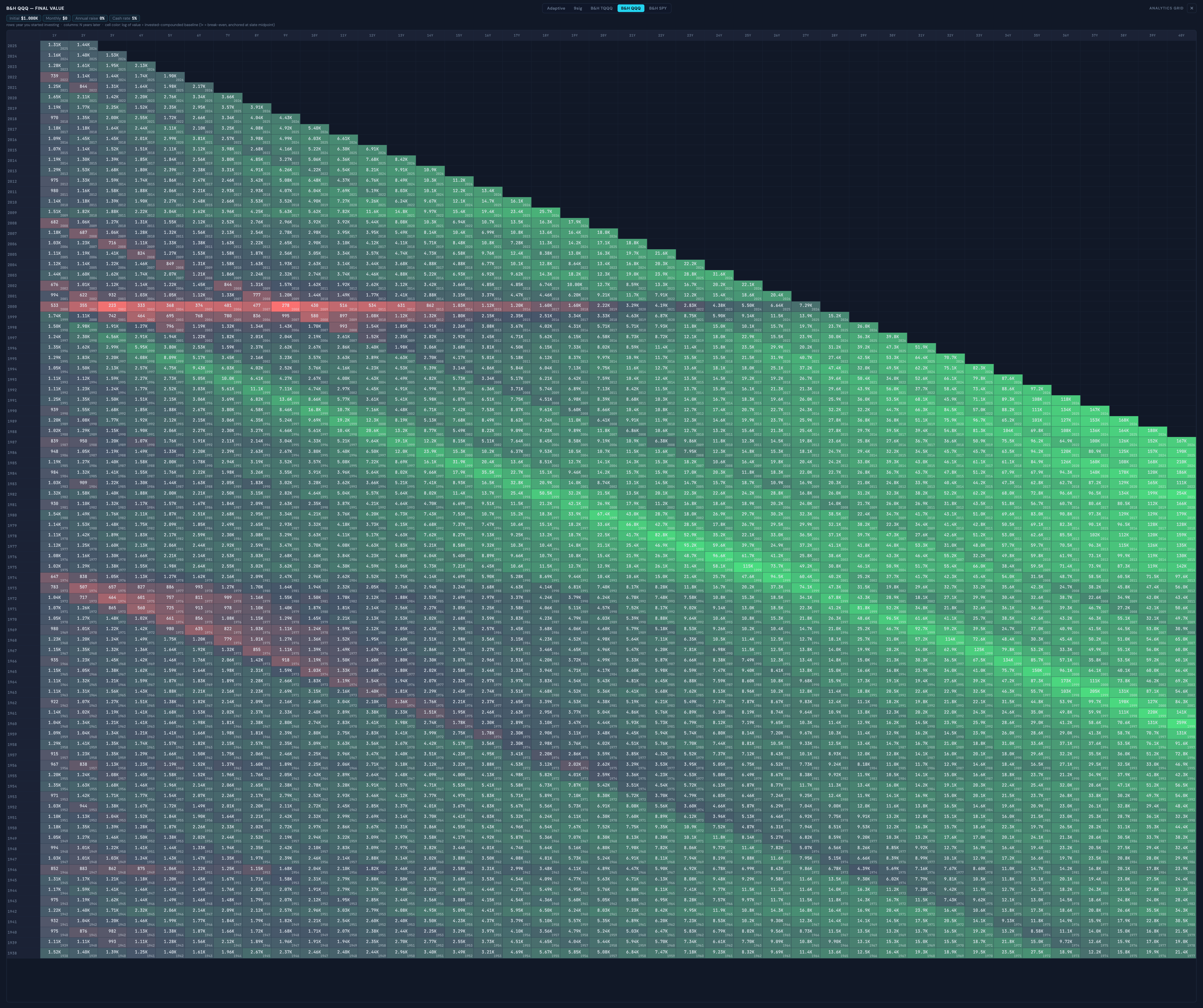
Here is a comprehensive visual Heatmap you will ever need when you have a question about long term tqqq

It shows, if you have invested 1000$, how much you'd have on each year (first column) after certain years of holding (first row)

Notice the lasting effect 1974, 2001, 2008 had

You would still be at loss in 2026 if you have invested 27 years ago

Update:

There were multiple remarks, addressing them here:

  1. Image is blurry - download high quality version here
  2. Color compare against qqq - Link to interactive version with qqq comparison
u/bumbeishvili — 4 months ago
▲ 239 r/Dewalt

I've integrated Dewalt box with 4500lb winch and made an adapter for it to run on dewalt batteries.

In the back it has a hitch connector, so it acts as a truly portable winch which I csn take anywhere.

What do you think of it?

u/bumbeishvili — 4 months ago