How I Became an Official Threat to Scientology

How I Became an Official Threat to Scientology

A friend of mine recently left the Church of Scientology, and I was delighted to learn from them that I’ve been officially declared an SP—a “Suppressive Person.” Members of the Church are now strictly forbidden from speaking to me. I have to admit, I’m flattered.I assume this stems from my behavior at past sci-fi conventions, combined with a Substack post I wrote. Apparently I managed to cross some invisible line between being an annoying guy with opinions to being an actual threat to Scientology. 

L. Ron Hubbard’s writings list classic examples of Suppressive Persons—Adolf Hitler, Napoleon Bonaparte and anyone who criticizes Scientology. It’s a weird list. Putting Hitler and Napoleon in the same category as someone who criticizes Scientology is like making a list of “lawbreakers” and putting murderers, child molesters, and jaywalkers on it. Technically, I suppose the definition works. But one of the three really doesn’t belong on that list.

Now I’m on that list. I find it hilarious that my supposedly dangerous influence is now great enough that Scientologists have been instructed to stay away from me. Most of the time, I’m pretty aware that my opinions don't have much impact on anything. I write about anything that concerns me—old age, art, illustration, movies, plays, and my career. Sometimes someone agrees, occasionally someone gets annoyed, but mostly people read it and move on with their day.

Yet somehow Scientology has decided that my commentary is dangerous. Well, hell, talk about an ego boost. I'd like to thank the Church for finally recognizing the terrifying influence I apparently have. So, thanks to David Miscavige, Tom Cruise, and whoever decided I needed to be declared an SP.

I feel super important. Of the honors I've received, this one is certainly the strangest.

You can read the whole article on Substack about becoming a Suppressive Person (SP) in Scientology, here:

https://myadventuresasanillustrator.substack.com/p/how-i-became-an-official-threat-to

u/davidbmattingly — 5 days ago

When the Ship Isn’t the Star: Solving the Star Trek Cover Problem

I painted nine covers for Alan Dean Foster’s novelizations of the Star Trek animated television series.
’ve love Alan’s writing. I read all of his books first and only later went back to watch the episodes they were based on. It didn’t take long to realize that his novelizations were often better than the source material. That was often the case with Alan’s work. He had a talent for expanding on what was there by adding background and story elements that didn’t exist in the original versions. A good example is his novelization of The Black Hole, a film I worked on. The publisher, Judy-Lynn del Rey, once told me she thought Alan’s book was better than the movie. After reading it myself, I had to agree. It even made me wonder why we hadn’t simply based the film on his novelization. It would have made for a much better movie.
When I was assigned the Star Trek covers, I was told I had to use the original design of the Enterprise. If you’ve watched the original series recently, you’ll notice that the ship has almost no surface detail. Later versions were covered in “nurnies” and paneling to give them a greater sense of scale, but the original is relatively smooth and simple.
Rather than fight that limitation, I decided to work with it. I made the Enterprise smaller in my compositions and focused instead on creating large, dramatic environments around it. That approach helped offset the simplicity of the ship and gave the covers a stronger sense of spectacle. The format of the paintings also presented a challenge. I typically work at a 2:3 ratio—14 inches wide by 21 inches tall. These covers, however, were designed as narrow vertical strips, measuring 21 inches tall by just 9 inches wide, roughly a 1:2.2 ratio. It was an unusual proportion, but one that ultimately made me think differently about composition.
One of the headaches of painting book covers is dealing with the top third of the image as the area that will inevitably be covered by type. Something still has to exist there, but it can’t be essential, since it will ultimately disappear beneath the title and author’s name. Different artists have handled this problem differently. Jeffrey Catherine Jones would sometimes cut off the top of his paintings after they were returned. Ken Kelly took a more practical approach. He would fully paint the top, then cover it with wax paper so he wouldn’t accidentally disturb it while working on the rest. If you ignored the issue altogether, the composition could feel unbalanced, with all of the important elements pushed into the lower two-thirds of the image.
The “strip” format for the Trek paintings avoided that. There would still be type over the top of the painting, but most of the important information would be on the other, non-painting part of the cover.
Alan wrote short books since they were novelizations of television episodes, and Ballentine/delRey decided to gang three of the books together to make a bigger book in the end.
I wasn’t thrilled about that since my paintings appeared about the size of postage stamps, but at least the original, slim volumes were still available.
While working on these covers, I looked closely at the work of one of my artistic heroes, Robert McCall. Whenever I start to feel pessimistic about the future, I immerse myself in his paintings. McCall was an eternal optimist. His vision of the future, filled with flying cars and vast, floating megastructures, is one I’d much rather live in.
He has 3 books of his work available, although some are out of print and will require an eBay purchase. All of them are all well worth checking out.
I wrote a Substack about painting 9 covers for Alan Dean Foster’s Star Trek novelizations. You can read it here:
substack.com/home/post/p-203289568

u/davidbmattingly — 6 days ago
▲ 70 r/offbroadwayNYC+1 crossposts

Disruption

My wife and I went to see "Disruption" on 42nd between 9th and 10th at the Romas Linney Courtyard Theater in New York City. John David Washington, the same guy from "BlacKkKlansman" and "Tenet," starred in it, which made me want to see it in the first place.

The setup is pretty simple. Washington plays a tech entrepreneur who’s trying to get an app off the ground and needs money, so he turns to his three closest friends, hoping they’ll invest. Most of the play is about what happens once he comes back into their lives. The story digs into their marriages, their infidelities, all the little cracks that were already there, and how one person can start pulling everything apart.

I thought it was terrific. The acting felt honest, and the staging was innovative and smart. And weirdly, even though I bought cheap tickets on TodayTix, we ended up in the front row, maybe ten feet from the actors. Close enough to catch every expression, every little shift in mood. It made the whole thing feel almost uncomfortably intimate at times, like you were sitting in the room with them.

The app itself is something that may well be coming. It can predict your future and tell you the “best” choice at every turning point in your life. Have a baby, divorce that person, go left instead of right, all based on information already available about you on the internet. At first it sounds like something people would kill for, but the more you think about it, the more unsettling it gets.

It got me thinking about where we are right now with technology. Not everything we’ve invented has made life better, even if it feels that way in the moment. Some things obviously have, like antibiotics, running water, and joint replacement. But there’s always a trade-off. You gain something, you give something up.

People feel more cut off now, even though we’re supposedly more “connected” than ever. Everyone’s staring at a screen, even when they’re together. And I think we’ve gotten a little dependent on it. Thirty years ago, if you wanted to know something, you had to go find it by hunting down the right book and  spend some time digging, maybe even get it wrong the first time. Now the answer’s just sitting there in your pocket, ready instantly. It’s convenient, but it also shortcuts the whole process of thinking things through. Libraries are fading, fewer people read, and attention spans feel like they’ve shrunk down to nothing.

I’m actually glad I grew up before all that took over. You didn’t have a choice, you had to talk to people, figure out how to connect, deal with awkward moments. Dating especially feels completely different  now. It’s all apps and swiping, quick judgments based on a photo and a couple lines. There’s barely any space to discover someone gradually. You either pass or move on in a second.

That’s really the question the play keeps circling—how much of our lives are we willing to hand over to something else to manage? To systems, to algorithms, to whatever you want to call it.

Because you can see where it might lead. A world where everything is optimized, decisions are made for us, and friction disappears. But maybe that friction, the uncertainty, the mistakes, the figuring it out, is the part that actually makes us human. And once that’s gone, I’m not sure what’s left.

u/davidbmattingly — 20 days ago
▲ 165 r/artcollecting+1 crossposts

Between Light and Illusion: Remembering Tom Kinkade

I was acquainted with Thomas Kinkade in art school. He was good friends with Jim Gurney, also at Art Center, and the two of them wrote a terrific book together, The Artist’s Guide to Sketching.

I was surprised and maybe a little jealous, when Tom went on to have massive success, especially since the person he presented publicly was nothing like the person I knew. People who read this Substack know that although I was raised in the Christian Science church, I’m not a believer in a supreme being. I’m best labeled an atheist. So I was struck when Tom came forward as extremely Christian, even signing his paintings with the Ichthys, a fish symbol of Christian faith. When I knew him, he didn’t have a hint of religiosity about him. I suspect his embrace of Christianity was fake.

This came to me full force when I visited my high school girlfriend, Beth Winzenried. I hadn’t seen her in years, and at some point I asked who her favorite painter was. She answered, “Tom Kinkade.” For middle America, his cottages and snow-capped mountains had made him the most popular living painter. What bothered me is that people had been sold a lie.

I don’t agree with people who run their lives by religious belief, but I have even less patience for people who exploit that belief to make money. Tom presented himself as a devout Christian, but in private he took drugs, drank, and had affairs. We all have our faults, but very few people position themselves as the extreme embodiment of one virtue while living the opposite in private.

Many artists are terrible people. If you love Caravaggio as much as I do, never read about his private life. Picasso by all accounts left a lot to be desired as a human being. Even Rembrandt, one of the greatest painters who ever lived, had a messy personal life. None of that stops me from enjoying their work, but none of them marketed themselves as paragons of virtuous living.

I love Monet’s work, and in some ways Tom’s resembles his, with the same broken color and soft edges. But Monet avoided the sentimentality that pervades Tom’s paintings. Monet let the subject speak for itself. I think people embraced his work because it conjured a world that never existed with no violence, no conflict, no racism.

Some might call me a hypocrite for loving Norman Rockwell’s work, after all, didn’t he do the same thing? I don’t think so. Rockwell didn’t just paint two people praying, rather he set them in a coffee shop with everyone around them looking on in confusion.

He didn’t just paint an optimistic young man gazing toward the future, rather he painted that young man beside his father waiting for a train, one looking forward, the other looking back. The older you get the better that picture is.

With Rockwell, the more you study the picture, the deeper it gets. With Tom, the more you study it, the shallower it gets. Rockwell had an edge as he thought deeply about his pictures. Tom’s pictures pour on the syrup, then add an extra dollop for good measure.

Which brings me to Tom’s friend, Jim Gurney. As much as it galls my cynical side to admit it, Jim is the real deal. After his success with Dinotopia, I kept waiting for him to dump his wife, move to LA, start dating a supermodel, and buy a Ferrari.

It never happened.

He’s one of the few genuinely nice people I know, without a cynical bone in his body. I don’t know Jim’s religious affiliation, if he has one, but if you wanted a model for how to live a Christian life, you could do worse than Jim Gurney. He writes a Substack that’s one of the few I read regularly (besides my own). If you’re an artist, you should too:

https://jamesgurney.substack.com

He’s privately good and publicly good. Tom, by contrast, performed the life of a saint in public while living quite differently behind closed doors. I’m certainly not a perfect person myself. I’ve probably broken eight of the ten commandments (no murder or adultery, yet). But I’ve never sold a fake image of myself to get people to buy my paintings.

u/davidbmattingly — 1 month ago

My Thoughts on AI

I don’t want to sound all doom and gloom about AI but I’d be lying if I said I wasn’t worried. We may be watching the early stages of something that brings about the end of civilization as we know it. AI may ultimately have a bigger impact on this planet than the atomic bomb, and unlike the bomb, which was contained by deterrence, and the sheer terror of mutual destruction, AI seems to be spreading in every direction at once with no meaningful way to slow it down.

The job losses alone are staggering. Not just the gig workers, the data processors, but the creative class. I was a cover illustrator. That career in the form I knew it will never come back. It’s not just that the market has shifted, it’s that the ground beneath it has been removed entirely.

Much of what’s accelerating this is a reading culture in collapse. Fewer people are buying books, fewer are discovering illustrators through the covers on bookstore shelves, and the art directors who once championed original artwork are now discovering that they can generate a passable cover image in twenty minutes without hiring an illustrator. 

And it’s not just visual art. Music, writing, screenwriting, voice acting, visual effects, the creative economy is being restructured from the ground up. We are building our own replacements. In ten years, The Terminator may look less like a thriller and more like a documentary.

AI is remarkably good at generating images. It is far less reliable at generating vision. In some ways, this mirrors what happened when photography arrived or when digital tools flooded the market and made every amateur a “designer.” But the economic threat to creative work is only part of what troubles me.

AI has turned Facebook into a cesspool. I had a friend forwarded me a post in which a well-known celebrity was apparently announcing they had discovered a cure for Alzheimer’s disease. It looked convincing enough, but the celebrity had absolutely nothing to do with it . The whole thing was fabricated with the image generated and the quote invented. Someone had constructed an elaborate false hope for desperate people for no reason other than clicks and money. I ask myself what kind of person does that. What do you tell yourself at night when you know that somewhere out there, a family caring for a loved one with dementia saw your post and felt for one brief moment that there might be an answer?

We will see vastly more of this. The tools to generate convincing fakes, images, videos, voices, entire personalities, are now available to anyone with a laptop and bad intentions.

Facebook was supposed to be a way to stay connected with friends. It’s become something else entirely. It is a marketplace for lies, a distributor of fabricated videos, a radicalization engine dressed up in the language of community. Shame on Mark Zuckerberg, who has had many opportunities to address this and has instead optimized for outrage. He keeps getting richer. The people being misled keep getting poorer, in money, in accurate information, in their ability to trust what they see. I paid more in taxes last year than Jeff Bezos. I try not to think too hard about that while he’s somewhere out on his private superyacht, with his surgically enhanced wife, flying around in a penis rocket, living a life utterly insulated from the consequences of what his industry has done.

I’m afraid of what the next political season looks like. Deepfakes, fabricated speeches, manufactured scandals, all of it arriving at volume and velocity that fact-checkers can’t match. The people most eager to exploit these tools are those who have built their power on the fear of anyone who looks, loves, or prays differently than they do. AI creates hatred, gives it a megaphone, a printing press, and a film studio all at once.

The real danger, in the end, isn’t that a machine can generate an image. It’s that AI slop is everywhere now, undifferentiated, unlabeled, indistinguishable to the casual eye, flooding every platform, every inbox, every feed. We are losing the shared ability to agree on what is real. And without that, it’s very hard to have a civilization at all.

u/davidbmattingly — 1 month ago
▲ 25 r/offbroadwayNYC+1 crossposts

A Walk on the Moon

My wife and I went to see the new musical A Walk on the Moon this afternoon at the Laura Pels Theatre, between 7th and 6th on 46th Street. We went in with pretty low expectations. The reviews have been brutal, and the show is already scheduled to close soon, but I still held out hope that maybe it had been treated unfairly. Sadly, the critics more or less got this one right. It’s not a good musical.

However, it’s not without its moments. Unlike most shows that completely miss the mark, this one manages to pull off something genuinely affecting late in the final act. There are a couple of scenes that briefly show what the production could have been. They don’t redeem the experience, as you still have to sit through about an hour and forty minutes of fairly dull material to get there, but they’re worth mentioning because they hint at a much better version of the show that never quite materializes.

One of the fundamental problems is baked into the source material. The musical is based on a film that already works beautifully. I’ve never understood this impulse to take a perfectly good film drama and turn it into a musical? If anything, musicals should be built from flawed source material like stories that need music to elevate them or fix structural issues. When the original already succeeds, the new musical version has a hard time justifying its existence.

The film stuck with me for another reason. It was directed by Tony Goldwyn, who lived right down the block from us in Hoboken. Goldwyn is one of those actors you instantly recognize even if you can’t quite place his name. He played the villain opposite Patrick Swayze in Ghost, and also appeared in The Last Samurai with Tom Cruise. Beyond being a wonderful actor, he’s had a solid career as a director including the original film version of A Walk on the Moon.

That movie benefited enormously from its casting, particularly Diane Ladd and Viggo Mortensen. Replacing actors like that is no small task, and the musical never quite overcomes that hurdle. The actor taking over Mortensen’s role, the “blouse man”, is perfectly competent, but let’s be honest: he’s no Viggo Mortensen. If my wife ever came home and said, “David, I had an affair with Viggo Mortensen,” I wouldn’t be thrilled, but I’d understand. That kind of presence is hard to replicate, and the absence of it here is felt.

The music is another issue. As with so many Broadway shows these days, most of the score feels generic and forgettable. There is a notable exception in a song the husband sings to his daughter late in the show that really landed. It’s emotional, and for a few minutes the show comes alive. It’s the kind of number that reminds you what musical theatre can do when everything clicks. Unfortunately, nothing else in the show rises to that level.

The production also feels mismatched to the theatre itself. The Laura Pels has a smallish stage, which works beautifully for intimate shows. But this production has a fairly large cast and feels cramped as a result. It might have been better suited to something smaller like the two person Two Strangers Carry a Cake Across New York, where the modest space would become an asset rather than a limitation.

Visually, the show didn’t do much for me either. The proscenium arch was designed to evoke a kind of rustic, handmade countryside aesthetic, but to my eye it looked more like a well-meaning, but underwhelming high school set. The show also had a lot of projections. I’ve never been much of a fan of projections in live theatre and this production certainly didn’t change my mind. The video screen (I think) at the back of the stage added little, and the front projections onto a scrim just looked cheesy.

All in all, it’s a disappointing production, especially given the strength of the source material. There are glimpses of something better buried inside it, but not enough to make the journey worthwhile.

u/davidbmattingly — 1 month ago

Joe Kubert’s Influence on Visual Storytelling

Another artist I greatly admired and occasionally drew inspiration from was the legendary comic artist Joe Kubert. Of all the things that made his work extraordinary, what I loved most was his masterful approach to visual storytelling. With Joe’s covers, you could almost always infer what had happened in the moments just before the scene he was illustrating. At the same time, you were invited to speculate about what might unfold in the moments that followed. Many comic book covers contain very little narrative content, even those by some genuinely great artists. But Joe’s covers almost uniformly did more than that. They told stories.

He was also an amazing draftsman. He was one of the rare comic artists who insisted on inking his own work, which gave everything he produced a consistency of vision that’s immediately recognizable. When you look at a Kubert page, you’re seeing one sensibility from pencil to finished line, undiluted. On those occasions when he did work with an inker, it was typically someone of unusual and complementary talent — someone who understood what he was doing and had the skill and restraint not to overwrite it. Russ Heath was one such collaborator, a pairing that felt less like artist and technician and more like two musicians who happened to be playing the same instrument.

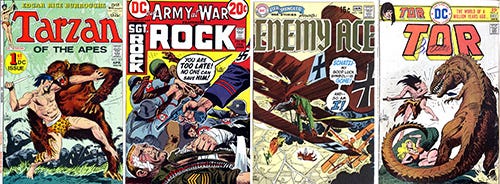
Kubert did a lot of remarkable work across a long and prolific career. Enemy Ace brought something genuinely unusual to war comics, dignity, tragedy, and moral complexity in a genre that too often settled for heroics. Our Army at War was a masterclass in storytelling. But my personal favorite will always be his Tarzan. I like John Buscema’s Tarzan enormously. Buscema was one of the great figure artists in the history of the medium, but Kubert’s "Tarzan" is the one for the ages.

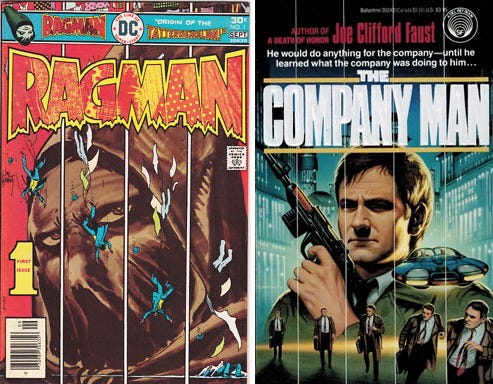
There are two covers I can point to as being directly inspired by Joe’s work. Both were for books written by one of my favorite authors, Joe Clifford Faust. The first was "The Company Man", for which I rather shamelessly stole from Kubert’s "Ragman" cover. I had first encountered that "Ragman" cover years earlier, and over time I had submitted versions of the concept for several other books, searching for the project where it would finally belong. It found its right home with Joe Faust’s novel. What drew me to it was the idea of segmenting the cover into panels and using that structure to show the progression of action over time. I had seen the technique employed in comics, but I had never seen it used on a book cover.

The second cover was for "Desperate Measures", the opening book in Faust’s Angels Luck trilogy. This one isn’t a direct lift from any particular Kubert piece. I was consciously trying to channel something of his storytelling sensibility, and specifically that quality where a single frozen image leaves you absolutely convinced that something dramatic and consequential is about to happen in the very next moment. The scene looks like a held breath. Kubert could do that better than almost anyone, and with Desperate Measures, I was reaching for some of that same suspended urgency, the feeling that the stillness in the image is only temporary, and that everything is about to break loose.

You can read the entire post, with illustrations, here:

https://myadventuresasanillustrator.substack.com/p/joe-kuberts-influence-on-visual-storytelling

You can buy signed prints of any of my paintings, including "The Company Man", here:

www.davidmattingly.com

u/davidbmattingly — 1 month ago

Joe Kubert’s Influence on Visual Storytelling

Another artist I greatly admired and occasionally drew inspiration from was the legendary comic artist Joe Kubert. Of all the things that made his work extraordinary, what I loved most was his masterful approach to visual storytelling. With Joe’s covers, you could almost always infer what had happened in the moments just before the scene he was illustrating. At the same time, you were invited to speculate about what might unfold in the moments that followed. Many comic book covers contain very little narrative content, even those by some genuinely great artists. But Joe’s covers almost uniformly did more than that. They told stories.

He was also an amazing draftsman. He was one of the rare comic artists who insisted on inking his own work, which gave everything he produced a consistency of vision that’s immediately recognizable. When you look at a Kubert page, you’re seeing one sensibility from pencil to finished line, undiluted. On those occasions when he did work with an inker, it was typically someone of unusual and complementary talent — someone who understood what he was doing and had the skill and restraint not to overwrite it. Russ Heath was one such collaborator, a pairing that felt less like artist and technician and more like two musicians who happened to be playing the same instrument.

Kubert did a lot of remarkable work across a long and prolific career. Enemy Acebrought something genuinely unusual to war comics, dignity, tragedy, and moral complexity in a genre that too often settled for heroics. Our Army at War was a masterclass in storytelling. But my personal favorite will always be his Tarzan. I like John Buscema’s Tarzan enormously. Buscema was one of the great figure artists in the history of the medium, but Kubert’s is the one for the ages.

There are two covers I can point to as being directly inspired by Joe’s work. Both were for books written by one of my favorite authors, Joe Clifford Faust. The first was Company Man, for which I rather shamelessly borrowed from Kubert’s Ragman cover. I want to be honest about the word borrowed here. This was a direct and deliberate act of creative theft, the kind that many artists commit at some point when they encounter an idea so right that they can’t let it go. I had first encountered that Ragman cover years earlier, and over time I had submitted versions of the concept for several other books, searching for the project where it would finally belong. It found its right home with Joe Faust’s novel. What drew me to it was the idea of segmenting the cover into panels and using that structure to show the progression of action over time. I had seen the technique employed in comics, but I had never seen it used on a book cover.

The second cover was for Desperate Measures, the opening book in Faust’s Angels Lucktrilogy. This one isn’t a direct lift from any particular Kubert piece. I was consciously trying to channel something of his storytelling sensibility, and specifically that quality where a single frozen image leaves you absolutely convinced that something dramatic and consequential is about to happen in the very next moment. The scene looks like a held breath. Kubert could do that better than almost anyone, and with Desperate Measures, I was reaching for some of that same suspended urgency, the feeling that the stillness in the image is only temporary, and that everything is about to break loose.

You can read the entire post, with illustrations, here:

https://myadventuresasanillustrator.substack.com/p/joe-kuberts-influence-on-visual-storytelling

u/davidbmattingly — 1 month ago
▲ 19 r/scientology+1 crossposts

Scientology: Extraordinary Claims, No Demonstrations

Anyone who’s spent time in science fiction fandom knows that Scientology has a big presence at sci-fi conventions. L. Ron Hubbard was a science fiction writer before he founded the church, and he reportedly viewed conventions as fertile ground for recruiting new members. After all, fans of speculative fiction were already primed to entertain big, strange ideas.

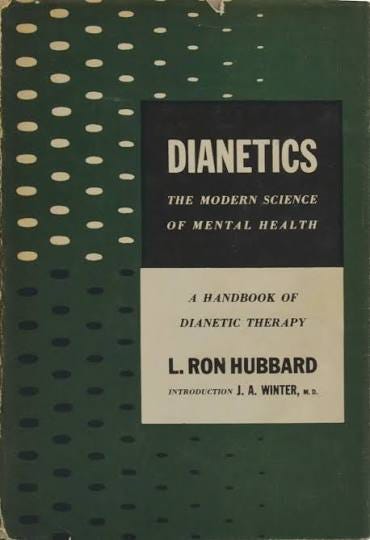
I first crossed paths with Scientology after reading Hubbard’s book Dianetics, which functions as something like the bible of his church. Here are some of the more eyebrow raising claims from the book:

  1. It takes only about 50 hours of auditing to reach the state of “Clear.”
  2. Once you’re Clear, you supposedly gain a perfect memory and can remember anything you have seen or experienced.
  3. Clears can practice “remote viewing”, sending their consciousness, without their body, into another room to observe what’s happening there.
  4. Some claims even extend to abilities like levitation. Of course, the church has since revised Dianetics to remove a lot of this, but that is what the first edition says.

Armed with this information from the first edition, I’d approach Scientologists at their booths and tell them I was ready to give all my money and devote myself entirely to the church, on one condition. I just wanted them to demonstrate remote viewing first. I could have asked for proof of perfect memory or levitation, but I always focused on remote viewing. Once they got excited, I’d lay out my test. I’d go into another room without the Clear, pull a single card from a deck, and a Clear would remotely view that room and tell me which card I’d drawn.

Unsurprisingly, no Scientologist ever took me up on it.

A Scientologist friend of mine offered this explanation: that doing so reduced Scientology to a parlor trick. My response was that if someone told me converting to Buddhism would let me fly, the first thing I’d want is to see another Buddhist already flying.

Eventually, word got around, and Scientologists at conventions were warned not to engage with me at all. The shame of it is that I think Scientology’s core practices contain a kernel of real truth. One thing Scientologists do during auditing is repeatedly revisit traumatic memories, the idea being that going over them again and again strips away their emotional charge. That’s not an unreasonable idea, something like it shows up in legitimate trauma therapy, and it’s probably genuinely useful for people with terrible experiences in their background.

The dark side is that the church reportedly keeps recordings of these auditing sessions. I don’t know about you, but I wouldn’t want a permanent record of the worst experience of my life sitting in someone else’s filing cabinet. And if you were a member with troubling things in your past, the prospect of the church producing those recordings could be a serious deterrent to ever leaving. That dynamic alone might explain why so few people walk away from the church once they’re in.

Where the church does shine, unintentionally, is in its cinema. The film adaptation of Hubbard’s Battlefield Earth is one of the worst movies ever made. There’s stiff competition for that title in Catwoman, Plan 9 from Outer Space, and Showgirls, but Battlefield Earth claims the crown for a number of reasons. The director chose to shoot nearly every scene with a tilted (Dutch angle) camera, alternating between tilting left and tilting right throughout the film, seemingly for no narrative reason at all. Combine that with a leaden script, bad visual effects, and what might be John Travolta’s worst on-screen performance, you get a film so spectacularly bad it’s genuinely worth watching.

The Church of Scientology sponsors the Writers of the Future andIllustrators of the Future contests in science fiction and fantasy. They put up significant prize money and, over the years, have recruited well-known authors and artists to lend their names and credibility to the programs. That kind of association raises troubling questions, and not without reason.

I remember one prominent writer being asked why he was comfortable attaching his name to contests backed by Scientology. His answer was disarmingly pragmatic—compared to other religions, Scientology has probably done less harm. It’s a provocative argument, but not an entirely unserious one. It’s hard to outdo events like the Spanish Inquisition when it comes to organized, church-sponsored brutality.

Of course, that comparison comes with a caveat. Older religions have had centuries to accumulate both influence and atrocities. Scientology, by contrast, is relatively young. Whether that means it has caused less harm, or simply hasn’t had as much time, is an open question.

u/davidbmattingly — 1 month ago
▲ 2.0k r/Aging

Aging sucks!!

Today is my 70th birthday, and it is a rough one for me, though, because of my circumstances. I had to retire from teaching at SVA and Pratt, not by choice, and I've also had to give up painting because of a condition called ataxia. It's affected my hands, my balance, even my voice — and after every test available, the honest answer is still "idiopathic," which is the medical profession's polite way of saying they don't know why. On top of that, I'm caretaking for my wife Cathleen, who has Parkinson's and memory loss from Alzheimer's. It's a lot, and some days it's hard to feel like celebrating.

But I also don't want to pretend it's all dark. I had decades doing work I loved, I got to teach, and Cathleen and I have had 34 wonderful years together. That's not nothing.

I wrote a longer Substack post about what's going on, if you want the fuller picture: https://myadventuresasanillustrator.substack.com/p/getting-old

That’s probably more than you want to know.

u/davidbmattingly — 2 months ago

Two Strangers Carry a Cake Across New York: A Terrible Title and a Really Good Show

This afternoon, my wife and I saw Two Strangers Carry a Cake Across New York at the Longacre Theatre on Broadway. I bought the tickets knowing very little about the show, and I'd been reluctant to see it because of the title. It's a terrible title, though, to be fair, it does describe exactly what happens in the show. But that's only the beginning, and it undersells everything else going on.

It's a musical, and I tend to gravitate toward straight dramas. But the music here was good, and I enjoyed it from start to finish. I couldn't help comparing it to another show we saw recently, Lost Boys, and I think the score in this one was consistently the stronger of the two.

It's a two-person show, and we saw the alternate in the female lead. The other usher mentioned they're not called understudies anymore, ”alternates" is the term now. I understand why the distinction matters here—the alternate, Jana Clover, was wonderful.

The show is a romantic comedy of sorts, but it defies the genre's usual conventions as neither of the two people involved is rich or famous. One is a homebody schlub from England, the other is a barista in Brooklyn. There's no happily-ever-after ending. Instead, each of them simply walks away having gotten something real out of their brief time together.

The first act was close to perfect, energized all the way through. The second act was more uneven for me with a fair amount of repetition that could have been trimmed to keep the momentum going. I went in expecting nothing and came out genuinely moved by what I'd watched. It's simply staged, with no bells and whistles, but in its own quiet way, it was quite wonderful.

reddit.com
u/davidbmattingly — 2 months ago

Fear of 13

My wife and I caught a matinee of "Fear of 13" starring Adrien Brody this afternoon at the James Earl Jones Theatre on Broadway. We were seated in the very last row of the balcony, and with the theater only two-thirds full, we decided to move closer. An usher told us we had to return to our original seats, despite roughly 200 empty seats in our section. I asked to speak with management, and after a brief standoff, we were allowed to stay. I'll never understand why ushers insist on keeping people in bad seats when hundreds are empty.

That aside, the main draw here was seeing Adrien Brody perform live, and he did not disappoint. He was terrific. Sadly, the play itself was not.

For the uninitiated, mild spoiler ahead, it’s about a man on death row who falls in love while fighting an unjust conviction. The show has plenty to say about the cruelties of the criminal justice system, but none of it will surprise anyone in the audience. I wanted to be moved, and the play never quite gets there. The meaning of the title is only revealed in the final moments, and even then it's so muddled that my wife didn't catch it. I expected a gut punch of an ending; instead it faded out with a whimper — though a dog who appears in the last thirty seconds was, genuinely, a highlight.

One suspects Brody could have chosen any project for his Broadway debut, and that he picked this one for its long, demanding monologues. For an actor looking to showcase his range, the appeal is obvious. His final monologue, however, goes on too long and ends up diluting its own impact. Ultimately, the play preaches to the converted. If you walked in opposed to the death penalty, you'll walk out the same. The same goes for the other side. It moves the needle far less than, say, "Dead Man Walking." Given that it's based on the true story of a man wrongly convicted, I expected to feel far more sympathy for the lead character than the writing managed to generate. Everything surrounding the play, the sets, the performances, the direction, was strong. And like many shows I review, it ran a bit long for me. Some judicious trimming could have sharpened the impact considerably.

I wanted to love this one. It just didn't deliver.

reddit.com
u/davidbmattingly — 2 months ago

Fear of 13

My wife and I caught a matinee of "Fear of 13" starring Adrien Brody this afternoon at the James Earl Jones Theatre on Broadway. We were seated in the very last row of the balcony, and with the theater only two-thirds full, we decided to move closer. An usher told us we had to return to our original seats, despite roughly 200 empty seats in our section. I asked to speak with management, and after a brief standoff, we were allowed to stay. I'll never understand why ushers insist on keeping people in bad seats when hundreds are empty.

That aside, the main draw here was seeing Adrien Brody perform live, and he did not disappoint. He was terrific. Sadly, the play itself was not.

For the uninitiated, mild spoiler ahead, it’s about a man on death row who falls in love while fighting an unjust conviction. The show has plenty to say about the cruelties of the criminal justice system, but none of it will surprise anyone in the audience. I wanted to be moved, and the play never quite gets there. The meaning of the title is only revealed in the final moments, and even then it's so muddled that my wife didn't catch it. I expected a gut punch of an ending; instead it faded out with a whimper — though a dog who appears in the last thirty seconds was, genuinely, a highlight.

One suspects Brody could have chosen any project for his Broadway debut, and that he picked this one for its long, demanding monologues. For an actor looking to showcase his range, the appeal is obvious. His final monologue, however, goes on too long and ends up diluting its own impact. Ultimately, the play preaches to the converted. If you walked in opposed to the death penalty, you'll walk out the same. The same goes for the other side. It moves the needle far less than, say, "Dead Man Walking." Given that it's based on the true story of a man wrongly convicted, I expected to feel far more sympathy for the lead character than the writing managed to generate. Everything surrounding the play, the sets, the performances, the direction, was strong. And like many shows I review, it ran a bit long for me. Some judicious trimming could have sharpened the impact considerably.

I wanted to love this one. It just didn't deliver.

u/davidbmattingly — 2 months ago
▲ 16 r/atheism

My experience at a Christian Science school

I was raised a Christian Scientist and attended a Christian Science prep school, Principia, for my first two years of high school and part of my third. Christian Science has a peculiar rule saying medication is forbidden, but surgery is allowed. That never made much sense to me, but Mary Baker Eddy, the founder, disdained medicine. At Principia that meant you couldn’t take any. The central teaching is that the human body is spiritual, not material, and that by seeing yourself as well, you can become well. Most of the time, that mindset probably does no harm, but in the small percentage of cases where it fails, it can be dangerous.

The summer before my junior year, I came down with colitis. My mother, an inveterate traveler, and I had been eating street food in Mexico City. I got violently ill. She, despite eating the same food, was completely fine. Instead of seeking medical help, she urged me to pray, “use my CS”, and made me feel that my continued illness was a kind of personal failure. I endured the rest of the trip and the summer in that condition, growing steadily worse. Eventually, I quietly sought medical help on my own because I knew it went against everything I had been taught. I returned to Principia still sick. Over the next weeks, my condition deteriorated dramatically. I dropped from 180 pounds to 110. Since I couldn’t consult a doctor at school, and they feared I would die, they finally sent me home to Fort Collins, where I was admitted to the hospital immediately. My mother arranged for surgery to remove the inflamed section of my colon. My parents were divorced by then, and the night before the operation my father intervened. After consulting with the doctors, he insisted the surgery be postponed and that I first be given the standard treatment for colitis at the time, Sulfasalazine. It changed my life. Within a week, my symptoms disappeared, and I began to regain weight. I will always be grateful to my dad for that.

I don’t mean this as a harsh judgment of my mother, who passed away in 2000. She faced her own challenges, which led her to embrace Christian Science. I can respect that those beliefs were meaningful to her. That said, I don’t think it’s right to impose esoteric or potentially harmful beliefs on a child. Once someone is an adult, say 21, they should be free to make their own choices, whether that means following a religion, getting a tattoo, or doing something more extreme. But children don’t have the maturity or independence to make those decisions for themselves. It feels unfair to require a child to follow beliefs that could put their health or safety at risk. Adults can choose for themselves, but children depend on others to protect them.

After leaving the hospital, I stayed with my father and his second wife, Frieda, on a farm outside my hometown. They took care of me and fed me well, helping me recover my strength. When I was healthy again, I assumed I would return to Principia. But I couldn’t do that while taking medication, and stopping it wasn’t an option. So I moved back in with my mother and enrolled in the local public high school instead.

If anyone had wanted to convince me that Christian Science was flawed, they could hardly have done better than my recovery. The effect of the medication felt miraculous. It forced me to question everything I had been taught. My father handled this carefully. He never openly criticized my mother’s beliefs. Instead, he gave me a book, Mrs. Eddy: The Biography of a Virginal Mind by Edwin Franden Dakin. It was an unvarnished look at the history of Christian Science, and much of it struck me as looney. I had a lot of questions after reading it. Without saying a word, my father had given me the space to rethink everything on my own. I also had long conversations with my older brother John, and those discussions helped shape my thinking. Over the next few years, I gradually moved away from Christian Science altogether. Today, I see it as little more than a cult, and I could best be described as an atheist. The universe, to me, is vast and beautiful and full of mystery, but I’ve never seen evidence of an overriding power or a god.

There were other challenges at Principia as well. My brother Jim had attended before me. He was four years older, a standout athlete who lettered in multiple sports and held the Missouri state record in the breaststroke for years. When I arrived, people expected the same from me. I joined the swim and water polo team, just like my brother.  I looked the part, tall and slim, but I had none of his athletic ability. It didn’t take long for everyone to realize that. I never lettered in anything. I lived in Jim’s shadow the entire time I was there.

At Principia, there was a headmaster I deeply admired, Arthur Schulz, Jr.  He loved art and comic books, and no matter how busy he was, he always made time to talk with me when I stopped by his office. Unfortunately, when I returned at the start of my junior year, sick, Art was away fundraising for the school. I should mention that Principia enforced very strict rules about students’ hair, and mine had grown longer over the summer. In Schulz’s absence, the acting headmaster was Harold Rusk, who bore a striking resemblance to Richard Nixon. He called me into his office, looked me over, and said, “David, I think you’re sick because your hair is too long.” I was devastated.

Shortly after I left the school, Arthur Schulz returned. When he learned what had happened, and hand wrote me a letter apologizing. He said he would have handled the situation differently. That letter meant a great deal to me. I still have it.

Despite everything, I have good memories of Principia. I had a great roommate, Tad Gage, and we’re still in touch. Many of my classmates, Sue Wall, David Lyons, Peter O’Toole, John Workman, Karl Kinley, were wonderful people. I loved the school in many ways. But I couldn’t accept one of its core beliefs, and in the end, that made it impossible to stay.

open.substack.com
u/davidbmattingly — 2 months ago
▲ 68 r/AccidentalWesAnderson+1 crossposts

My prep school experience at Principia and why I was kicked out

I was raised a Christian Scientist and attended a Christian Science prep school, Principia, for my first two years of high school and part of my third. Christian Science has a peculiar rule saying medication is forbidden, but surgery is allowed. That never made much sense to me, but Mary Baker Eddy, the founder, disdained medicine. At Principia that meant you couldn’t take any. The central teaching is that the human body is spiritual, not material, and that by seeing yourself as well, you can become well. Most of the time, that mindset probably does no harm, but in the small percentage of cases where it fails, it can be dangerous.

The summer before my junior year, I came down with colitis. My mother, an inveterate traveler, and I had been eating street food in Mexico City. I got violently ill. She, despite eating the same food, was completely fine. Instead of seeking medical help, she urged me to pray, “use my CS”, and made me feel that my continued illness was a kind of personal failure. I endured the rest of the trip and the summer in that condition, growing steadily worse. Eventually, I quietly sought medical help on my own because I knew it went against everything I had been taught. I returned to Principia still sick. Over the next weeks, my condition deteriorated dramatically. I dropped from 180 pounds to 110. Since I couldn’t consult a doctor at school, and they feared I would die, they finally sent me home to Fort Collins, where I was admitted to the hospital immediately. My mother arranged for surgery to remove the inflamed section of my colon. My parents were divorced by then, and the night before the operation my father intervened. After consulting with the doctors, he insisted the surgery be postponed and that I first be given the standard treatment for colitis at the time, Sulfasalazine. It changed my life. Within a week, my symptoms disappeared, and I began to regain weight. I will always be grateful to my dad for that.

I don’t mean this as a harsh judgment of my mother, who passed away in 2000. She faced her own challenges, which led her to embrace Christian Science. I can respect that those beliefs were meaningful to her. That said, I don’t think it’s right to impose esoteric or potentially harmful beliefs on a child. Once someone is an adult, say 21, they should be free to make their own choices, whether that means following a religion, getting a tattoo, or doing something more extreme. But children don’t have the maturity or independence to make those decisions for themselves. It feels unfair to require a child to follow beliefs that could put their health or safety at risk. Adults can choose for themselves, but children depend on others to protect them.

After leaving the hospital, I stayed with my father and his second wife, Frieda, on a farm outside my hometown. They took care of me and fed me well, helping me recover my strength. When I was healthy again, I assumed I would return to Principia. But I couldn’t do that while taking medication, and stopping it wasn’t an option. So I moved back in with my mother and enrolled in the local public high school instead.

If anyone had wanted to convince me that Christian Science was flawed, they could hardly have done better than my recovery. The effect of the medication felt miraculous. It forced me to question everything I had been taught. My father handled this carefully. He never openly criticized my mother’s beliefs. Instead, he gave me a book, Mrs. Eddy: The Biography of a Virginal Mind by Edwin Franden Dakin. It was an unvarnished look at the history of Christian Science, and much of it struck me as looney. I had a lot of questions after reading it. Without saying a word, my father had given me the space to rethink everything on my own. I also had long conversations with my older brother John, and those discussions helped shape my thinking. Over the next few years, I gradually moved away from Christian Science altogether. Today, I see it as little more than a cult, and I could best be described as an atheist. The universe, to me, is vast and beautiful and full of mystery, but I’ve never seen evidence of an overriding power or a god.

There were other challenges at Principia as well. My brother Jim had attended before me. He was four years older, a standout athlete who lettered in multiple sports and held the Missouri state record in the breaststroke for years. When I arrived, people expected the same from me. I joined the swim and water polo team, just like my brother.  I looked the part, tall and slim, but I had none of his athletic ability. It didn’t take long for everyone to realize that. I never lettered in anything. I lived in Jim’s shadow the entire time I was there.

At Principia, there was a headmaster I deeply admired, Arthur Schulz, Jr.  He loved art and comic books, and no matter how busy he was, he always made time to talk with me when I stopped by his office. Unfortunately, when I returned at the start of my junior year, sick, Art was away fundraising for the school. I should mention that Principia enforced very strict rules about students’ hair, and mine had grown longer over the summer. In Schulz’s absence, the acting headmaster was Harold Rusk, who bore a striking resemblance to Richard Nixon. He called me into his office, looked me over, and said, “David, I think you’re sick because your hair is too long.” I was devastated.

Shortly after I left the school, Arthur Schulz returned. When he learned what had happened, and hand wrote me a letter apologizing. He said he would have handled the situation differently. That letter meant a great deal to me. I still have it.

Despite everything, I have good memories of Principia. I had a great roommate, Tad Gage, and we’re still in touch. Many of my classmates, Sue Wall, David Lyons, Peter O’Toole, John Workman, Karl Kinley, were wonderful people. I loved the school in many ways. But I couldn’t accept one of its core beliefs, and in the end, that made it impossible to stay.

u/davidbmattingly — 2 months ago

The Maids

Tonight Cathleen and I went to see “The Maids” at St. Ann’s Warehouse in Brooklyn. I was genuinely excited going in, since it was directed by Kip Williams. I absolutely loved his Broadway adaptation of “The Picture of Dorian Gray" with Sara Snook. That production was dazzling, full of clever innovations, including live iPhone footage projected onto giant screens. My expectations were, perhaps unfairly, sky-high.
Unfortunately, The Maids was not my cup of tea. I tend to like a clear narrative spine in a play, and here the story felt elusive, drifting into a kind of surreal fog that reminded me, not fondly, of Beckett’s “Waiting for Godot.” Williams deploys many of the same theatrical tricks he used in “Dorian Gray”, but here they felt less like revelations and more like déjà vu.
The evening began with a transparent curtain stretched across the stage. I kept waiting for it to roll out of the way, but instead we spent the first fifteen minutes peering at the action as if watching theater through a shower curtain . When it finally did open, it didn’t seem to mark any particular shift, dramatic, thematic, or otherwise, which left me wondering if I had missed the point or if there simply wasn’t one.
The play is adapted from a work by Jean Genet, so it’s entirely possible that the confusion is part of the design and I’m just not tuned to his wavelength. A great deal of it didn’t quite land for me. In fairness, it held my attention enough that I stayed awake the entire time, which in this sort of theater, is sometimes its own small victory.

u/davidbmattingly — 3 months ago

The Lost Boys

Tonight my wife and I saw "The Lost Boys" on Broadway at the Palace Theatre. It’s based on the 1987 film directed by Joel Schumacher—never one of my favorite directors. I’ve always said that if you’re going to turn a movie into a musical, pick a bad one. Most would agree "The Lost Boys" is a safe distance from masterpiece territory.

This production has many of the usual big-musical problems: it’s too long, packed with weak songs, and suffers from bloated staging. At two hours and forty minutes, it could easily lose the intermission and trim about 25% from the songs to land closer to a tighter, two-hour show. The score is mostly bland and repetitive—though I’ll give it this: it has one and a half good songs, which is more than some musicals manage. Shoshana Bean delivers a genuine showstopper with “Wild” and is consistently strong throughout. What a set of pipes.

What you really come for, though, is the spectacle—and here the show delivers. The wire work is jaw-dropping, with up to five actors flying across the stage at once. The rigging was so well hidden I couldn’t spot it, although we were in the back of the theater (and I was looking).

I rarely recommend shows for kids—take a 12-year-old to "Death of a Salesman" and , as great as that show is, you’re in for a long night—but "The Lost Boys" is an exception. There’s enough substance to keep adults engaged, and enough razzle-dazzle to keep kids entertained, even if they squirm through the songs.

I know I did.

u/davidbmattingly — 3 months ago

The Lost Boys

Tonight Cathe and I saw "The Lost Boys" on Broadway at the Palace Theatre. It’s based on the 1987 film directed by Joel Schumacher who was never one of my favorite directors. I’ve always said that if you’re going to turn a movie into a musical, pick a bad one. Most would agree "The Lost Boys" is a safe distance from masterpiece territory.

This production has many of the usual big-musical problems: it’s too long, packed with weak songs, and suffers from bloated staging. At two hours and forty minutes, it could easily lose the intermission and trim about 25% from the songs to land closer to a tighter, two-hour show. The score is mostly bland and repetitive, though I have to admit that it has one and a half good songs, which is more than some musicals manage. Shoshana Bean delivers a genuine showstopper with “Wild” and is consistently strong throughout. What a set of pipes on that lady! It is worth seeing the show for her alone.

What you really come to this show for is the spectacle, and here the show delivers. The wire work is jaw-dropping, with up to five actors flying across the stage at once. The rigging was so well hidden I couldn’t spot it, although we were in the back of the theater (and I was looking).

I rarely recommend shows for kids, for if you take a 12-year-old to "Death of a Salesman," as great as that show is, you’re in for a long night, but "The Lost Boys" is an exception. There’s enough substance to keep adults engaged, and enough razzle-dazzle to keep kids entertained, even if they squirm through the songs. I know I did.

reddit.com
u/davidbmattingly — 3 months ago
▲ 1 r/scifi

My first book cover

The first book cover I ever did was for A Wizard in Bedlam by Christoper Stasheff.

I was working at Disney Studios at the time, and I started sending out samples by mail. That was mainly work I had done in art school at Art Center College of Design. Don Wolheim, of DAW books, was the first to bite, and he sent me Stasheff’s manuscript. I did the cover and sent it in, but I didn’t understand there would be a long delay until the book was published. It was months of waiting, looking at the mail in anticipation every day. Finally, it arrived, and I was a REAL book cover artist!

I posed for the figure with the cravat, and my first wife’s father, Marty, posed for the giant holding the staff. I still think it is an alright cover, although I wish I had made the background ship more dimensional.

A Wizard in Bedlam has been redone by other artists many times. Since it was part of a popular series, it has remained in print all these years. Here is a sampling of the other covers done for the book. I generally love Darrell Sweet’s work, but this isn’t one of his better covers. I think Steve Hickman’s cover is the best of the bunch, with Gino D’Achille’s a close second.

I did 14 books for DAW in the early part of my career, including a number of covers for Jack Vance, one of my favorite writers.Don Wolheim and I had a falling out when I was put under contract by Del Rey. Don felt that Del Rey stole some of his best artists, including Michael Whelan, and I wasn’t sensitive enough to maintain both relationships. I owe a lot to Don, but since he died in 1990 before I had a chance to tell him, all that will remain unsaid.I loved working with Don. A funny story I have about him was when I visited him in his office in the 1980s. We were talking about what we were going to do over the weekend. Don mentioned he had tickets to see “Sugar Babies,” a hot Broadway show at the time. He pulled out the tickets with great pride, looked down, and announced they were for the previous night. He had missed the show.

Don was his own art director, and he was an artist’s favorite. I don’t think Don ever asked for a change in a cover in all the years I worked for him. When I submitted sketches, he would choose one, and not ask for changes in the sketch or final. Many art directors ask for changes, in both the sketches and the finals, but rarely make the final better. Keeping your hands off the artist’s vision makes them feel trusted by the publisher, and not micro managed. It seems like the bigger the company, the more changes they would ask for. Independent publishers, like Don Wolheim and Jim Baen, would let the artists “do their thing,” and both companies had better covers for it.

I loved DAW’s yellow spines. People made fun of them, but it made the books instantly recognizable on the shelves. Unfortunately, when Don’s daughter took over the line after his death she abandoned them. Now DAW books look just like all the others on the shelves. DAW also had a numbering system, so each book had the DAW logo on the cover, and a number. I thought that was a clever way to build loyalty, since as a kid I wanted to have all of them. That too was abandoned after Don died.

open.substack.com
u/davidbmattingly — 3 months ago