▲ 14 r/LittleRock
RPG scene
Just trying to learn more about the RPG scene in Little Rock. I’m aware of Game Goblins. Are there groups or meetups for gamers in the area?
u/BrobaFett — 4 days ago
Just trying to learn more about the RPG scene in Little Rock. I’m aware of Game Goblins. Are there groups or meetups for gamers in the area?
How is the RPG and boardgame scene in Arkansas? Is LR a good place or NWA? I’m interested in likeminded gamers.
Disclaimer: I’m sure many of you are fine roleplayers, right?
Also Shonner was right
Hey Drawsteel!
Just wondering what you guys think is the best Actual Play that you feel shows off the combat mechanics of the game. I'm sure there are plenty of streams that show off high quality roleplaying, story, etc. There's probably more still of people learning the system. I'm more interested in streams where you watch and go "okay these guys have a firm grasp on the mechanics"
Any recs?
Happy Star Wars Day!
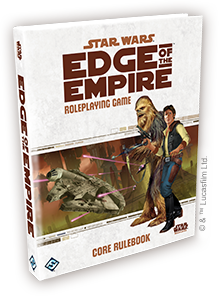
For this day I wanted to talk about my very favorite Star Wars RPG (and one of my favorite RPGs in general): Edge of the Empire. (The Wikipedia entry is pretty good!)
Those interested in more resources are best served by checking This (SWRPG Community) out as a vibrant haven of resources, intro materials and the rest.
I'd also recommend checking Table Top Empire on youtube for an intro series and how-to series. It's excellently done and Nate seems like a great guy!
Edit: Also, /u/Kill_Welly pointed out the Order 66 Podcast is another invaluable resource
Why should you strongly consider Edge of the Empire, Age of Rebellion and/or Force and Destiny?
The game is the first second (WFRPG 3ed was the first! Thanks /u/Ar4er13 for the correction) in FFG's use of the "Narrative Dice System". I posted an overview of this system in a different thread which I'm shamelessly copying here:
"Narrative dice are incredible. It's core resolution mechanic is so good that it will ruin other games you play. In fact, if you don't want to get into it for this reason? I understand.
First, Edge of the Empire (and the genre-neutral version Genesys*) uses proprietary custom dice (this is where 1/2 the people that bounce, bounce. They don't wanna buy special dice. I get it). There's good dice (attribute d8, proficiency d12, boost d6) and bad dice (difficulty d8, challenge d12, setback d6). The good dice have two symbols on them "Success" and "Advantage". The bad dice have "Failure" and "Threat" (all my homies just call it "disadvantage"). You make your dice pool up by taking your attributes (in attribute dice) and upgrading (substituting) a number of those dice into proficiency dice based on your skill ranks. If there's some positive complication (maybe you had some kind of favorable situational modifier or talent) you might add boost. The rules are very explicit when. The dice roll is* player facing*. So the GM then tells you how hard that thing is. Depending on how hard it is you add a number of Difficulty dice to your pool. If it's super hard, you might upgrade those difficulty dice to Challenge dice. If you have some situational modifier (enemy has cover, weather is bad, whatever...) you add some number of setback dice.*
Then you roll them and compare the symbols.
Failure cancels success. Threat/disadvantage cancels advantage. And you're left with some combination of succeed or fail (you need at least one success to succeed) and with some positive complication (rolled one or more advantages than threat) or negative complication (rolled one or more threat than advantages).
So you get really interesting outcomes. You can absolutely roll a straight succeed or fail, that's possible. But more frequently you get something like "Succeed with advantage" and now your advantage can do something cool- often open to narrative flexibility- but with good guidance on what 2 advantage might get you compared to... 4, for instance.
Now to add even more spice to the mix, the really important dice you can add: Proficiency and Challenge dice, have one facing with a special symbol. Those symbols are "Triumph" and "Despair", respectively. These serve as your "Critical Success" and "Critical Fail" results. But usually this is to introduce a major narrative complication as opposed to subverting the outcome of the total roll. So you can "Succeed with a Despair" which basically means you complete the task but something really bad happens ("I hacked open the spaceship airlock, but just learned that Boba Fett is on the ship I just docked with" Stuff like that).
The "interpreting the dice" part is the part that the other 1/2 of people bounce off of. But I'll die on the hill that they just need to keep trying. I've run so many games of this with so many players that I've yet to see a group say they actually don't like it once they get more comfortable with it (the inverse is always true for me, "Hey I didn't like this at first but now I love the results"). To be fair it does take a GM that is encouraging players to think of ways to interpret their advantage/ disadvantage and get creative with it. I wonder if some people get bored because they just default to "Oh you rolled 2 advantage? Take two boost dice on your next test" which is boring.
It's a skill-based game with a generic list of skills. However, there are "talent trees" that exist for each "class" which grant interesting and flavorful bonuses much like a class based game (very much a best of both worlds situation, in my experience) and it does things like multiclassing well. It's XP-to-buy improvements over time, so there's no levelling. Only a gradual but steady improvement in skills, talents, etc."
What does this system do very WELL:
What does the game do POORLY? (and my shameless excuse making)
What other Star Wars options do you have!
Well I can only recommend what I've played.
- WEG's D6 system is a good alternative for those wanting a more "traditional" experience and is the "OG" star wars RPG. It relies on D6 dice pools and is relatively easy to learn and play. It's a little bit more "OSR" in the sense that it shares similar design sensibilities as well as being a more lethal experience than Edge. At a certain dice pool size the system does break, but most folks lean into this and enjoy it- stating it satisfies the Star Wars feel. One particular advantage of WEG is that it was made pre-Prequels so much of the material is very Extended Universe (Legacy) content. Many of the community supplements have borrowed heavily from WEG. The rules do get heavier than Edge in my opinion (especially 2e content). So if you are looking for more crunch, this might satisfy that craving.
- Scum and Villainy - a Forged in the Dark system. If you like more rules light play this could be up your alley. It focuses more on fewer rolls providing more information. Say more, roll less, but with sufficient mechanical support to satisfy many players. It's well designed and balanced and I enjoyed it. However, while it definitely delivered on the feeling of Star Wars, it didn't quite have the lore support of FFG's product line. So if you want to get into the nitty gritty of modifying starships, buying and selling spice (or what each spice does to you), or running a rebel base with a little more granularity, this might not be the system for you.
- SAGA/D20- sort of a 3.5 D&D + Star Wars. I didn't really particularly enjoy this system, so I won't say much. It's class based and plays straight like D&D+Star Wars, in my experience.
As you can see, I've got my clear favorite.
Please AMA! I'm passionate about great system design and I can't stop coming back to this one after more than a decade of playing it. Some of my very favorite campaign moments and memories live in this system.
May the Force be With You!
Well, here it is... the season finale.
Fun facts about the show. In this epic finale the intrepid GM, Matt, absolutely delivered on exposition! Of the 2 hour 40 minute run time, Matt narrated nearly 70% of the total dialogue by himself!
Amazing performance.
I've been thinking through this in my own design journey and I felt like sharing to the designers out there.
You need to do the math!
What do I mean by this? You need to have a general idea for how likely you are to succeed or fail at a task and what that might feel like at the table. This requires some basic understanding of probability. Do you need to be able to pass a stats course? No. But even Gygax recognized that understanding math made a huge impact at the table. You don't even really need to crack the texbook, but have a method to at least derive an answer to "how likely is this thing going to happen using my system"; tools like Anydice are very helpful here and there's dozens of posts on how to use them.
Why should you care?
Probability will reflect what you feel at the table. If your core resolution mechanic succeeds 90% of the time, the game will begin to feel somewhat stale and lacking in stakes. If you succeed 20-40% of the time? Your game will feel frustrating or perilous. With how infrequently dice are rolled, players get upset when their supposedly competent characters fail several times in a row. In fact, during playtesting, I've found that even a 50% chance of failure (a coin flip) feels bad to most people.
For me, the sweet spot of "you should probably be able to do this" PLUS "this task is hard and has a risk of failure" is around 60-70%. That feels, to me, like a great spot to shoot for.
A practical example
In my own system, I use a variant of MYZ: D6 dice pools, 6= success. Most tasks that are "HARD" require 1 success. Average tests require 0 successes but can generate complications (I won't get into the "yes and" "no, but" resolution mechanics here).
So, I'm looking for at least one 6. Two 6's if it's an exceptionally hard task (such as doing medicine when you have no training). Three if it's incredibly difficult. Four if you're doing something legendary.
Next, I look at my typical dice pool sizes. So an average guy might have an attribute of 2, career rank of 1-2 (I use careers, a la barbarians of lemuria instead of skill lists) and a gear bonus of 1-3 (gear is pretty helpful in succeeding tasks). Let's get ourselves an average dice pool of around 6d6 for a sort of "journeyman" trained person trying a "hard" task.
Next I PLOT the success probabilities to see what it looks like. And, you know what? I really like the look of that curve. My journeyman is going to succeed around 66% of the time. Around 26% of the time he's going to succeed AND some additional success will be rolled (in my system this can be paid forward as bonus dice or a narrative boon). A WELL trained and capable person (let's say 10d6)? They'll not only succeed much more often 83% of the time, but have a much better chance at positive complications.
Add a "push, but at a cost" mechanic? Now we're thinking with portals.
This has paid in dividends at the table
DO. THE. MATH.
I'm adding u/ksarlathotep's post below because it's so good:
**"**I agree with everything OP said, but I wouldn't stop at calculating success probabilities for individual dice rolls. You really should also be looking at the distribution of results.
A single die roll (plus / minus some value) always generates a linear distribution, which is historically common, but really quite inelegant if you're looking for realism.
If the same character attempts the same task 10 times, they shouldn't be equally likely to have a few dramatic failures, a few extraordinary successes, and a few average results. When an experienced blacksmith creates 20 longswords, they don't statistically set the smithy on fire once. The average results should be the most common, with extreme outliers much rarer. In other words, you want a bell curve distribution.
D&D has used single d20 resolution (with linear distribution) forever, but gets around this in newer editions with the concepts of Advantage and Disadvantage. As soon as you roll multiple dice and use the highest, lowest, or center value, your distribution moves away from linearity. Dice pool systems achieve this by default. If you roll 10d10 and count 6+ as a success, 10 successes and 0 successes are both extremely unlikely, while 4-6 successes is by far the most common outcome.
However, when you have a distribution like that, you also need to be aware that increasing a target difficulty by +X doesn't always have the same effect on the success probability.
If you have a straight 1d20 vs. target difficulty check, then every adjustment of the difficulty by +1 makes success 5% less likely, and every adjustment by -1 makes success 5% more likely.
If you roll 10d10 and count 6+ as success, raising the required successes from 6 to 7 has a larger impact on the overall probability of success than raising the required successes from 9 to 10.
Other dice systems come with idiosyncrasies of their own. I believe it was Shadowrun 2nd edition (don't quote me on this though) where you rolled a pool of d6 versus a variable target difficulty, and under certain circumstances, 6s would "explode" (so you roll the dice again and add the second number to the original 6). But this of course means that in those circumstances, increasing the difficulty from 6 to 7 has no effect whatsoever on the probability of success. Anytime you roll a 6, you end up with at minimum a 7, so you get a weird jump in the probability distribution.
Other systems generate very awkward distributions - they don't necessarily feel bad at the table, they're just incredibly hard to work with, and success probability is very hard to gauge intuitively for newer players. The "roll and keep" system from Legend of the Five Rings is an example of such a system. Almost nobody who hasn't either run the numbers or has immense experience with the system can tell you whether 6k2 or 3k3 is better on average.
This is of course where linear distributions have their upside. As unnatural and weird as I find it to have every possible outcome be equally likely, on a straight 1d20 vs. target number roll, even a complete newbie can immediately tell what chance of success they have.
If you design a dice system without taking the distribution of results into account, you risk building in trap options in character generation (where raising a certain attribute won't increase your odds of success), building a system in which critical failures and successes are absurdly common, creating "diminishing returns" or "escalating returns" effects for character advancement in places where you don't want them, all kinds of effects that may not be immediately obvious, but can quietly generate very weird and unsatisfying play experiences.
So yeah, definitely do the math."
Lastly, I think as others have pointed out, this is Step #1. Step #2 is to play the game. You can trap yourself into thinking that the math looks perfect/elegant/etc but when you get to the table the game itself plays differently than what you expected. The Law of Large Numbers still applies! Playtesting doesn't refute mathematical facts. So don't go to the table expecting your experience to refute probability (it doesn't). But do understand what your chosen success/failure thresholds feel like in actual play.
Rather than a discussion on pulm topics by pulm experts it’s just a bullshit version of /r/askdoctors