
u/Roadtochessmaster
r/IMadeThis r/TikTok r/lichess r/Polymarket r/Stocks_Picks r/Anduril r/Achievements r/YouTubeEditorsForHire r/Substack r/PredictionsMarkets r/sui r/biotech r/Investing101 r/VideoEditors r/Anthropic
▲ 3 r/Achievements
Reached 1400 on Substack!
Been 10 weeks on the platform and loving it!!
Started with 0 and through hard work and commitment I am here in around 70 days.

u/Roadtochessmaster — 1 day ago
▲ 12 r/Substack
What I learned from growing from 0-1000 in 40 days.
My first account had about 30 subscribers in a month. When I began my second, it was with all the tips I learned from my failures in my first account.
I realize I got partly lucky with my growth, but here are my 5 tips that helped me grow to 1000 subscribers in 40 days without any external help.
#1 Provide Value and Pick a Niche.
This one is pretty simple, people will only subscribe if your content is providing value, people will be more likely to subscribe if that content is unique to your page.
#2 Be Nice and Interact.
Scroll while liking, comment meaningful things when you read posts you enjoy, connect with other writers and build connections. Those connections pay dividends down the line.
#3 Learn What Pays Dividends.
Focus on notes and recommendations for growth, articles for sustained retention.
#4 Lead With Your Heavy Hitters
Post your best content today, don't wait - there might be news that shifts the focus of attention elsewhere while you hold your best post for when you "get bigger".
#5 Partner With The Right People.
Partner with the people who will increase the value of your post, not just those who have the biggest audiences.
Hope this helps!
u/Roadtochessmaster — 1 day ago
▲ 0 r/Substack
How I grew to 1000+ Subscribers in 40 days.
Just wrote this post on Substack about growth. I write about finance in general but was getting dozens of questions about what I did to grow on Substack.
Figured I would just write it in an article instead, genuine tips that helped me, hope it helps you all as well!
--------------------------------------------------------------------------------------------
This is a different post than those I am used to putting out. Dozens of people have asked me questions about growth advice on Substack or about advice in beginning a Substack. For those people, this is for you. For my regular subscribers who aren’t interested in building their own Substack, I still think you will find interest in this post. In any case, next week’s post will be a regular breakdown of a private company.
Reaching 1000 subscribers is a milestone that I thought would take me months, at best if not years. Instead, within forty days of starting this account, I hit 1000 subscribers.

It’s a huge milestone and one that I don’t take for granted. After all, this isn’t my first Substack account. I began writing in February and after almost three months, I had reached almost 200 subscribers, a feat I thought was rather impressive.
So when I began this account, it was with minimal help, a few (no more than a couple dozen) dedicated subscribers who moved over when I mentioned that I will be starting a new account. Aside from those twenty or so people, 98% of the growth that I had in getting to 1000 subscribers was entirely organic and replicable.
And for those looking to replicate it, these are the relatively simple tips that I have that might help you. This isn’t anything revolutionary, but it’s tips that I would have appreciated knowing when I began writing on Substack and therefore tips that I feel would be worth sharing.
A note of honesty: I could be wrong about some of these tips, they are just what I found to have helped me grow.
Tip One: Provide Value and Pick a Niche.
This one goes without saying but people will continue to read your work only if it provides value to them. That doesn’t mean that it needs to be focused on growing your stock portfolio or providing financial value.
Some people enjoy learning just for the sake of learning and any interesting content will be up their alley. Others, are looking for advice on different personal topics. A number of other people require emotional support.
In any case, providing value in a certain niche is the most important growth requirement for any Substack account. Ideally, you want the value to be tangible and the niche to be specific and unique.
For me, my value proposition is simple.
I take a complex and murky area of finance (private companies) and break those companies down so that the average person who wants to learn about them can.
The value proposition is tangible. These are companies that can be invested in either now or in the future. The niche is specific, I only focus on companies that are currently private. The content is unique as not many people are covering private companies.
If you want to grow your Substack account, find a unique niche and provide value.
Tip Two: Be Nice and Interact.
Unless you get extremely lucky, every writer will eventually experience the same feeling. The feeling that you invested hours into an article that got minimal traction… I definitely did.
There’s no other way to put it; it sucks to write an article that you spent a dozen or more hours on to get 4 likes and 0 comments.
And yet, all it takes to reverse this is one comment from a reader. One person who thought that your article was worth reading and commenting for that feeling to disappear - or at least be alleviated in a major way.
I myself have had this feeling a number of times, on my post on Isomorphic Labs, despite putting an enormous amount of work into the article which included interviewing a PhD researcher who I highly recommend (The Pharma Fox) only one person commented on the post. This one person was truly the difference between feeling that no one read my post and a bunch of people read my post. I’d like to publicly thank Soul Hacked AI Labs for that comment.
As a writer, you likely know this feeling and you probably know it well. Why not try to help alleviate others of the feeling that they are writing to a brick wall?

How it feels writing a post and getting 0 comments.
>
For the altruistic among us, supporting other creators makes others happy, and you should want to do this for the sake of making the world a better happier place.
For the spiritual people here supporting other writers creates good karma that will likely eventually find its way back to you.
For those who have finite time and are focused on furthering their platform, I truly believe that supporting other creators is extremely beneficial to your platform more than just to theirs.
As an example, I have totally shifted the way I reach out to other creators. I used to send people a cold message, something to the tune of “Hey, I enjoy your writing….”. Then, I started getting these messages from other creators who wanted to partner with me. And I realized, they were extremely ineffective. Not because I had no interest in partnering with the person, but because if I had never seen the persons name before, it is far more likely that the creator who wanted to partner with me just wanted to use my platform to grow theirs.
If instead a creator liked a few of my notes or had previously commented something insightful under my posts, I was significantly more likely to want to help or partner with that person.
>
Today, before I reach out to any creator I will like a number of their posts and notes and read at least one of their articles and leave an insightful comment under it. This is beneficial to me in multiple ways:
- It creates good will and an instant bond with other writers and transmits a feeling that I actually appreciate their content (which I do).
- It helps me decide whether I want to work with the person or not. Just because an account has thousands of followers doesn’t mean they don’t use AI to think of ideas and write their articles.
- It makes it more likely that the writers reciprocate through liking, commenting and sharing my posts.
If I do decide to reach out to that creator, I will make sure to subscribe before. Some might say that this is a superficial game that isn’t for them, but it’s not. I would argue that I have the more authentic relationship, one built on support and genuine interest rather than just a “how do I gain subscribers mentality”. I end up sending messages only to those creators who I truly enjoy and support, and to the ones I don’t end up sending messages to, I still will like their content. it doesn’t cost me anything and improves their day.
>
If you want to grow your Substack account, be nice to other creators, like their posts and interact with their content.
Tip Three: Learn What Pays Dividends.
Not every investment has an equal reward. This is equally true in business as it is in Substack.
To date, all of my posts combined have brought me a total of 98 subscribers. My top performing (and first ever) note has also brought me exactly 98 subscribers. My posts have taken hundreds of hours of painstaking research, writing and editing. My note took me about 10 minutes to write.
>
Of course, this isn’t the entire picture, but trying to understand the entire picture is overcomplicating things, the main point to take away is a simple one.
>
And therefore it is important to invest your time both in the value you create (your posts themselves) and the outreach you need to do in order to bring people to your page (Notes, Recommendations etc).
The ways to actually grow your user base with minimal work are through notes and recommendations. Recommendations are reliant on your connections with others, notes on your own ingenuity.
I don’t believe that in order to grow through notes you need one of the generic “Dear Substack, connect me with XYZ” notes in order to grow.
But it is extremely important to have notes that are engaging and make people want to view your page. These notes are also a valuable litmus test for understanding what people want to read. If I post a note about a company and it gets zero traction, I know that even if I find the company fascinating, it might not perform well on Substack.
That’s fine and some articles I think are important to write whether or not they are popular - like my piece on Polymarket - but it is nice to know that certain pieces will likely do well. If you want to grow your Substack account, learn what pays dividends.
Tip Four: Lead With Your Heavy Hitters.
When I began this account two months ago, the two most interesting private companies were SpaceX and Anthropic. This had me debating. As the pieces I was planning to write were longer pieces I knew I wasn’t going to be covering the same company in multiple different articles - at least not in a short time horizon.
I was left with a question. Should I write about the most interesting companies first, or start with something slightly less flashy and save those companies for when my subscriber base was bigger? Once my subscriber base was bigger, the post would be more likely to be shared around.
I chose to go with the first option and chose the hottest companies to write breakdowns on. To date, my articles on Anthropic and SpaceX have still been two of my most successful articles, both in terms of viewers and subscribers added. I believe that these posts helped the algorithm push this account and helped me understand that the desire for an account that breaks down the private market is much more than just a niche.
When deciding which post to begin with and in general which post to publish, I believe that leading with your best work is the best way to keep people interested in your work. As time passes and more news comes out, the most interesting company (or thing) yesterday might not be today and I think it is always best to strike when the iron is hot.
If you want to grow your Substack account, start with what is most interesting.
Tip Five: Partner with the right people.
This one is relatively simple, but I believe a lot of people don’t do it right.
Partnerships are an obvious way to grow one’s account - but more than that, they are a way to improve your content.
One of the beauties of Substack is that there are different people with expertise on dozens of different subjects who I can get in contact with.
When deciding who to partner with on a post I am writing, my main priority is the person who brings the most value, not the one who has the most subscribers. This improves my post quality rather than just improving the reach. Of course they don’t have to be mutually exclusive, large accounts are successful exactly for that reason, because they are good at what they do. That being said, when I am looking for someone to partner with on a post, I look first and foremost at which writer would improve the quality of my post, not the viewership.
For me, Learning.Investing.Thriving. has been a gold mine of knowledge. Every time I partnered with him, I felt that I came out with a significantly better post than I would have if I had just done the post myself. For those interested, we worked together on the posts on SpaceX and Polymarket and additionally did a live stream together.
I believe people appreciate this and for multiple reasons.
- Your content is better.
- People understand that when you work with others it is because you truly value their advice, not because you just want to increase your subscriber count.
If you want to grow your Substack account, partner with the right people.
To Summarize:
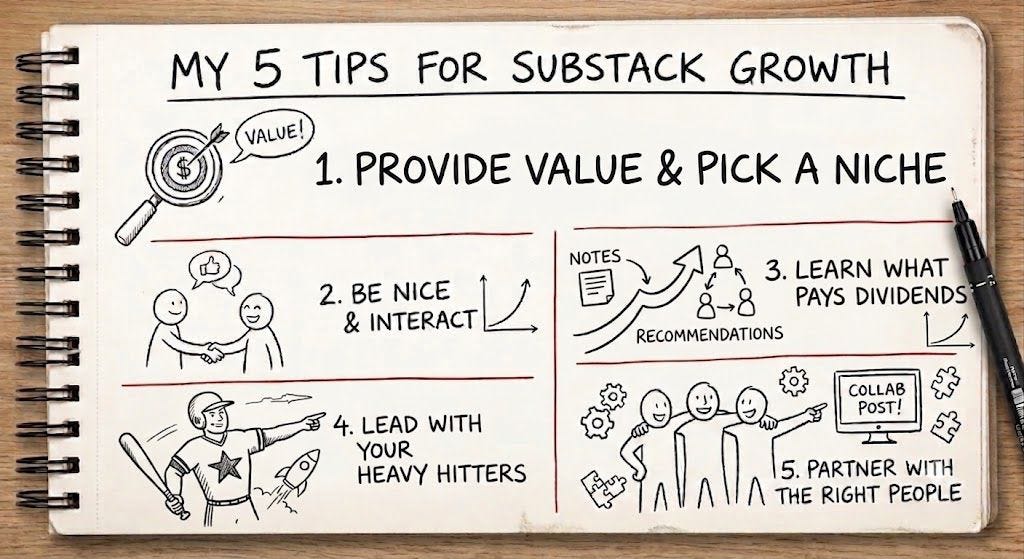
The last piece of advice I would have is to just have fun and enjoy the ride. Substack is an awesome platform with tons of good people and it feels significantly more positive than any other platform I have been on.
When you enjoy yourself and connect with other creators who are also writing, you end up learning from these creators. These creators end up giving you tips and advice from their personal experiences that will inevitably help you on your Substack journey. One person who has helped me immensely in this way is Gannon Capital.
It is awesome writing out your own ideas. Both because it causes you to better understand your own ideas and because it forces you to address blind spots in your thesis. In the words of Paul Graham:
>
Additionally, I believe that Substack is still in its growth stage which is awesome. Everyone here is early and being early to anything is usually good!
For those on the fence, I highly recommend starting a Substack. Every person has their unique life story and skillset they bring to the table.
Just be prepared, for those who want to take it seriously, Substack is a part-time job more than just a hobby. While writing is an integral and time-consuming part of growth on Substack, the connections and time spent on the platform are just as important.
Overall, I want to end on a thankful note. Substack has been a wonderful place for me to learn new things, improve my writing, and meet awesome people I never would have connected to without the platform.
u/Roadtochessmaster — 5 days ago
▲ 4 r/Substack
A Full Breakdown: Substack
I wrote a full breakdown on Substack.
It's a bit lengthy but for all those interested in the company, this should cover it all! Hope you all enjoy. Goes over history, valuation, ethical questions and more.
Thank you all! ❤️
––––––––––––––––––––––––––––––––––––––––––––––––––––––––––––––––––––––––––
One of the greatest benefits of the technological development that has taken place with the internet is the ease of information at your fingertips. Today, information is easier than ever to access and nowhere is this more true than on Substack.
>
Ray Dalio, one of the greatest hedge fund managers of all time, writes on Substack entirely for free. Nate Silver, the elections and sports forecaster also writes his insights on Substack and recently, Thibaut Courtois, long-time Real Madrid goalkeeper and Belgium #1 began to share his thoughts.
Overall, there is a wealth of knowledge on this platform that would make Aristotle jealous. I personally have felt very lucky learning from and making connections with an officer on a polar ice cap, PhD researchers, hedge fund veterans and brilliant writers.
This has all been enabled through a platform which allows its writers to share their knowledge for free with an ability to make money from their knowledge. Today’s breakdown will be on the platform that we are currently using.
The Birth of Substack:
Substack was founded in October of 2017 by three founders with a simple goal.
>
The three founders, Chris Best, Jairaj Sethi and Hamish McKenzie all brought their own unique skills to create a website that gives power to the writers and chooses the user’s mental health over making them spend as much time as possible on the platform.
In our piece on ByteDance last week, we mentioned that Zhang Yiming, the founder of the Chinese media empire wanted to develop the most effective algorithm as possible in order to maximize user retention.
Chris Best, the man with the idea, created Substack due to his frustration around exactly this. Media companies like ByteDance and Instagram were using an algorithm focused on addicting their users. Chris thought that these platforms focused on outrage and superficial content and used advertisements to maximize monetization efficiency.
“These networks compete for users in a war for attention by making systems that spit out superficially compelling content.” - Chris Best in his essay: Two Futures of Media
Chris wasn’t new to founding media companies. He previously co-founded and became the Chief Technology Officer (CTO) at Kik Messenger, a popular platform he helped scale from zero to three hundred million users.
Chris believed that the type of media that was dominating the 2017 landscape was detrimental both to the user and to society as a whole and create a “drug future: a wire to your head that drips dopamine, co-opts your mind, and steals your life.”
Instead of that, Chris left Kik with the goal of creating a different kind of platform. A platform where the network is created in order to best serve its users. A platform where the creators own their audience and choose how to best help their audience. In contrast to other social media companies, writers can choose to pick up and move over to a different platform - and more importantly they can take their audience with them. This is fundamentally different from a platform like Instagram or TikTok, where accounts can be banned and deleted, their audience wiped away forever.
“Creators own their platform, their work, and their connection with their audience. They can make real money and keep the vast majority of the revenue their work brings to the network.”Chris Best in his essay: Two Futures of Media
Substack founders, from left to right, Hamish McKenzie, Jairaj Sethi and Chris Best.
Along with Chris joined Hamish McKenzie - who became the “Chief Writing Officer” a title which he created and is unique to Substack in order to put an emphasis on the importance of writing rather than just general content. Hamish, who previously worked as the Lead Writer at Tesla often notes that he is a writer at heart, rather than a tech founder. A former journalist, Hamish often provides the moral compass that Substack uses including a very pro free speech approach, something we will dive into later in the piece.
In addition, Jairaj Sethi joined and quickly became the behind-the-scenes architect of the whole platform. Jairaj previously worked alongside Chris at Kik as the “Head of Platform and Principal Developer”. Jairaj became the lead engineer and head of product development at Substack, a job he still leads today almost a decade later. Jairaj focused on quickly creating a minimum viable product (MVP) that both allowed users to write articles that were emailed directly to the readers and immediately make money off of that.
Together, they created Substack which instantly became a success. Within a year they had over 25,000 paid subscribers and 150,000 weekly active readers. By November of 2021 Substack had surpassed one million paid subscriptions and a year and a half later in February of 2023, they crossed the two million threshold.
Today, Substack has more than 50 million active subscribers including 5 million paid subscriptions. Substack had 164.5 million monthly visits in April and has now become one of the 250 largest websites in the world by web traffic. Substack now hosts more than 100,000 authors earning money directly through the app including the top ten authors making over $100 million collectively.
Substack best sellers tiers. White for 100. Orange for 1000. Purple for 10,000.
What does Substack offer?
For solo writers, often the hardest part of writing isn’t the writing itself but trying to write while simultaneously managing distribution, payments and growing your audience. Substack offers the whole suite with only a simple fee for those already generating revenue. The huge appeal as a writer is an ability to start from scratch and be able to instantly grow an audience.
Substack is one of the only apps where a creator can begin earning money on day one, without needing millions of impressions or hitting content based milestones. And this isn’t rare on Substack, I myself had my first annual subscriber only a month after I began this account. More than that, I often see people with hundreds of paid subscribers building accounts that turn their fun hobbies into legitimate business operations.
For the readers, Substack offers some of the highest quality in the world, often for free with a twist. If you have been reading on here for a while, you may have noticed a subtle difference between Substack and other social media platforms. The lack of advertisements. While most social media companies have the vast majority of their revenue from advertising - for example Meta had 97.6% of their 2025 revenue come from advertising - Substack uses a business model entirely different.
Substack offers their users an ability to monetize their newsletters and Substack takes a 10% commission on each purchase. For example, if someone upgrades to my yearly plan which costs $200 a year, Substack will take 10% of that or $20 and Stripe (who will be the subject of a future breakdown) takes another roughly 3%. Post fees, the author still receives more than 85% of each subscription while having the ecosystem around them that allows them to flourish.
Product Roadmap:
Besides long-form content like this article, Substack has also moved to other forms of media content moving them from a platform purely for articles to a media app.
Substack added an option for video posts in 2022 and has since continued to expand the ability of creators to upload videos of all types. In 2024, they added Substack shorts, and in 2025 they added swipeable shorts that readers can scroll through. Importantly, these haven’t been pushed to users in the same way that Meta pushes their shorts and truth be told I didn’t know they existed until doing research for this article.
Notes, which launched in 2023, has become an integral part of the Substack ecosystem. Notes allows creators to share short-form content similar to X. Notes is one of the big drivers of subscriber growth and the community feeling as it allows the creator to post daily content and the readers to interact and share their own thoughts as well.
Substack also rolled out livestreams in early 2025 which allows creators to go live, either by themselves or with another creator. In May of 2025, they allowed creators to go live using a faceless option for the content creators who preferred to keep their face anonymous.
With all of these apps, Substack’s goal is to become an all-in-one media company while keeping the emphasis on long-form articles. With video posts and live streams they allow users an alternative to YouTube, with notes an alternative to X and with their articles an alternative to traditional news articles.
The Creator Sphere:
While Substack’s top ten creators make over $100 million a year, it is much less simple for those who are middle of the pack. For those who aren’t at the top of the Substack game, it can be confusing finding the balance between trying to grow and trying to monetize.
Even those who have 100 paid subscribers charging $10 a month - considered by Substack as a best seller - are only making $12,000 before Substack and Stripe take their fees or $10,500 a year after fees, far below the median income for an individual. While Substack isn’t a full-time job, it often takes dozens of hours weekly to research, write, distribute and attempt to connect with other subscribers in order to grow. For those who aren’t best sellers, they are often working in addition to their jobs without any real financial compensation.
Anecdotally, as someone who is now at 1,000 subscribers but has yet to turn on any real type of paywall, it can feel confusing trying to navigate the tension between treating Substack as a part-time passion and a legitimate hypothetical job.
This can often cause burnout when the financial incentive doesn't arrive, creating something called the “Trough of Sorrow" which typically kicks in at two hurdles at 3 months and one year once the hype and excitement cools down.
POV: Continuing grinding on Substack after hundreds of hours of work and three paid subscribers.
TAM:
Substack has a number of competitors, but the more important number to begin with is their total addressable market or TAM.
With every platform, there is a finite amount of users who are interested in that platform or service and with Substack it is no different.
Substack is fighting a greater battle. The battle to move from type one i.e. fast-paced addictive content to type two i.e. slow-paced quality content that leaves the readers more intelligent and fulfilled rather than less.
And so far, they have proven to be a massive success. Substack has fought against the shift towards short-form content and readers on the platform often spending hours reading pieces that make them more intelligent is proof that the website is working. Anecdotally, I can say that Substack went from a platform I hadn’t heard of to one of the main sources of my information in a few short years.
And in a world where the world’s trust in mainstream news is becoming less prevalent among the masses, independent writers and on Substack are perhaps filling the gap of long-form news content. In addition, as mentioned previously, Substack is full of award-winning journalists and writers not just in the politics sphere, but also in business, economics and even one of the greatest chess players of all time, Garry Kasparov.
All this means that Substack’s battle is fighting a two-pronged battle.
- Converting readers that already exist onto their platform.
- Introducing new readers who only know “type one” social media onto a better more insightful platform.
And the readers have been converting, we mentioned some impressive numbers earlier but one that stands out is that Substack added 32 million new subscriptions in only a three month period.
Competition:
As can be inferred from the previous section, Substack’s competition is made up not just of other newsletters, but of social media companies in general. Instagram, Facebook, Reddit and YouTube are all major competitors to Substack, not directly in the newsletter section but as general competition in trying to capture user attention.
Substack also has other competition with other newsletters.
Beehiiv is one of the most popular newsletter platforms specifically for those who are at the top of the Substack game. Beehiiv charges a flat monthly fee similar to a SaaS model depending on the amount of subscribers you have. Importantly, it is not possible to monetize an account on their free plan meaning for the majority of writers starting out without major subscriber bases, they will likely prefer Substack’s free option. Still, Beehiiv is a legitimate competitor especially for those who are Substack’s most valuable customers.
Mailchimp, now an Intuit platform, that has 14,000 users sign up daily is another popular option for those looking to begin a mailing list. Mailchimp is known for their easy-to-use platform that also offers editing tools, built-in AI assistants and helps creators automate their platform. The drawback is again the pricing. Mailchimp’s pricing tier is expensive and charges even for users who are inactive.
Ghost is a non profit open source option that gives creators the full revenue of whatever they earn. Ghost allows you to truly own your platform with the option to customize your website and move your subscriber list and your website whenever you choose. Similar to Substack, Ghost allows you to create tiered subscription tiers and create articles that are only for paid subscriptions. The downside with Ghost is that it is harder to use than Substack and has a smaller profile making growth more dependent on the user than the platform.
Alternatively, for those who are looking for a larger user base, X (previously Twitter) provides a relatively cheap option. The pro in X is that the user reach is massive. X has 561 million monthly active users and over 250 million daily active users. For those only looking to spread their content and reach the maximum possible user base, X is a good option. For premium users, X now has an article feature that allows articles to be posted directly to X. The downside, X monetization is difficult to achieve requiring both a paid subscription and achievement of milestones (5 million impressions + 500 premium followers) in order to qualify. Once qualified, monetization is dependent on the X algorithm rather than the user’s choice. That being said, for those looking for maximum reach, X has around 10x the reach that Substack has.
As you may have noticed, what Substack does best is they offer users a free option that they can immediately monetize together with a recommendations network that helps creators grow quickly. My first paid subscriber came after dozens of hours of hard work but also after zero financial commitment. Substack’s recommendation feature drives 50% of new subscriptions and 25% of new paid subscriptions. Alongside that, notes has become increasingly more popular giving X a space for creators to share short-form content. The combination of free to begin and the ability to grow through the Substack notes and recommendations algorithm makes it an increasingly more attractive option.
The Growing Migration:
>
This is a playbook that is mutually beneficial both for the creators and for the platform and one that is becoming more prevalent as creators realize the value Substack offers.
For the creators, they are able to instantly add another income source and connect to their followers in a more intimate way.
For Substack, each creator who transfers brings a dedicated user base who become engaged users, both with the original creator and likely with other creators as well. In addition, it solidifies Substack’s position as a cash generating bottom of the funnel playbook for creators who have massive followings, creating a flywheel that brings additional creators and users to the platform.
I spoke with two content creators who joined Substack and brought part of their audiences with them.
Trader Joe began his social media career after managing a multi billion dollar fund for a Goldman Sachs spin off. His content was quickly appreciated and he built up a user base of over 250,000 followers across Instagram and TikTok. In February, he joined Substack where he quickly became a bestseller and fantastic source of in depth information.
>
Uninvited joined with a following on both X and a website. While she originally began writing articles on X, she found that she had started enjoying writing on X less and less. She moved to Substack, where she has gained 3,300+ subscribers in only six weeks. She views Substack as a bottom of the funnel platform that she can use in order to go more into niche depths and connect more directly with her followers.
The Ethical Questions:
Every company has its ethical questions and Substack is no different.
With Substack, the biggest question is freedom of speech and how it should be regulated. Substack’s founders are very openly pro freedom of speech but some people believe that they have taken this belief too far.
"Freedom of the press and free speech are not just important but critical for journalists everywhere. Every fight to protect those ideals is worth it." - Hamish McKenzie
The main backlash began in 2023, when Substack was accused of hosting and allowing pro-Nazi and white supremacists to monetize on the platform and benefiting directly from that.
Hamish McKenzie came out and said that the platform “doesn’t like Nazis” and that they wished that “no one held these views” but he importantly didn’t say that removing them from the platform was the right idea. Substack’s initial response was that they would remove accounts who made tangible threats of violence but not those promoting violent ideologies. Substack’s approach was that by removing the extremists from their platform, they would just make the problem worse and draw additional attention to those with extreme beliefs.
>
Hamish McKenzie’s response to writers with extremist views.
Meanwhile, a number of prominent writers came out and said that Substack’s handling of these accounts wasn’t sufficient. Casey Newton, one of the most prominent writers on the platform decided to leave Substack for the aforementioned Ghost, and published a thought-provoking article called “Why Platformer is leaving Substack”. In the article, which I highly recommend, Newton announces his reasons for leaving Substack including saying:
>
Important to note that Newton wasn't leaving behind a small account with some potential. He had thousands of paid subscribers and over 172,000 total subscribers. Additionally, 247 prominent writers signed a letter to Substack asking them to clarify their policy.
Substack ended up banning some of the publication that overtly supported Nazis partially walking back their stance that the best way to strip bad ideas is to subject ideas to open discourse.
Substack is stuck here in a Catch-22, on the one hand, critics of moderation say that freedom of speech should include all opinions.
Freedom only for those who conform to Substack’s views is freedom of agreement rather than freedom of speech.
Proponents argue that as a private platform, Substack is not obligated to follow freedom of speech laws and that the platform shouldn’t be supporting writers that are unethical.
In the end, both sides left unhappy with Substack banning some extreme writers while other writers who were pro-censorship chose to anyways leave the platform.
In addition, Substack has partnered with Polymarket, a problematic prediction platform (read gambling) which is something I covered in depth in my Polymarket article.
Valuation:
Despite the controversy surrounding Substack which caused many writers to leave the platform, Substack continued to grow and more and more writers began newsletters on the platform.
Currently, Substack is not profitable at least as of 2025. This isn’t due to a revenue problem but rather due to an increasing investment into new features.
>
This is a playbook that is common in media companies, Twitter (now X) took twelve years to turn its first profitable quarter.
>
This, along with their revenue growth has caused Substack’s valuation to climb and in July of 2025 they officially crossed unicorn status with their Series C funding round raising $100 million at a $1.1 billion valuation. Substack’s previous Series B funding round had them valued at $650 million in March of 2021 meaning the company grew by almost 70% in slightly more than two years and from zero to $1+ billion in eight years.
When looking at a future valuation and room for growth, it is important to look at valuations of other media companies to understand what the potential could be. Reddit, the online forum app is currently valued at over $32 billion while the New York Times is worth roughly $12 billion.
At a current valuation of $1.1 billion, Substack is still very much at the beginning of its growth stage.
In order for Substack to grow its valuation, it needs to continue growing its users and move from a niche platform for intellectuals to a mainstream media corporation.
The Bear Case:
Creator Emigration:
While Substack is an extremely attractive platform with lots of room for creators, there are a number of downsides that can cause creators to move to different platforms taking their users with them.
First, Substack’s 10% Revenue cut is something that large creators will want to get around. This creates a problem for Substack as it’s most valuable creators have an active reason to leave the platform once they grow their audience. It is also important to note that a creators email list is owned by the writer, not by Substack making migration to different platforms easy for creators who want to move.
This is a phenomenon that has already happened among many of Substacks top creators including Matt Brown who moved his 71,000+ Substack account over to Beehiiv in order to save over $20,000 in fees.
>
Molly White was another prominent Substacker who moved her platform from Substack to Ghost and using some simple “napkin math” demonstrated how expensive Substack can become for those with massive audiences.
Substack does have a major advantage over those platforms namely that the Substack algorithm and recommendations features allow creators to grow at a rate they couldn't when writing through other platforms. Still, for those with huge audiences already, saving tens of thousands of dollars a year can be a big enough incentive to switch over.
In response to major creators switching over, Substack has recently rolled out Subscriber kits which allow Substack bestsellers for creators with more than 100 subscribers. These kits allow creators to directly partner with Substack sponsors and have brand deals come to them as opposed to have to search for them.
Loss of Attention Span:
The other potential bear case for Substack is their TAM shrinking as people become more and more addicted to short-form content like scrolling on Instagram and YouTube. This is something that is already happening. Attention span shrinking is now a fact, not a theory.
>
Substack is fundamentally built around long-form articles which require enormous amounts of attention to consume. When the average person switches tasks every 40-50 seconds, a long-form article with a ten or even twenty minute reading time is becoming more and more rare daily.
In fact, if you are reading this, you are likely one of the few who made it this far and for that, I applaud you.
This is likely one of the reasons why Substack released their shorts feature, but this is far from the core of the platform and actually feels antithetical to why the platform was created.
If Substack’s TAM shrinks, and attention spans continue contracting, eventually fewer people will frequent Substack’s website.
The Moderation Problem:
Another potential downside with Substack is the moderation problem we discussed earlier that caused Casey Newton to leave the platform. I won’t go into it again but Substack is constantly trying to find the balance when performing content moderation that inevitably frustrates both sides.
The Hack:
In addition to the bear case, in February of 2026, Substack announced that they had suffered a data breach in October 2025 that was only discovered months later. The breach importantly didn’t include financial information or passwords and was resolved by Substack only after months of the hackers running rampant with the emails, phone numbers and addresses of nearly 700,000 users.
“It takes 20 years to build a reputation and five minutes to ruin it”
Warren Buffett
With the breach, Substack users had their data exposed for months without their own knowledge, a fact that is particularly worrisome. Included in those breached were government officials and journalists. Importantly, while the email was leaked, it was not leaked with the password meaning user’s emails themselves weren’t compromised.
With the advancement of AI models like Anthropic’s Mythos, data attacks will likely become easier for individual users to partake in. The fact that Substack already had a major data leak in a world that is becoming more and more dangerous is worrisome to say the least.
In Substack’s defense, these types of leaks happen relatively often among top companies and are considered standard costs of using the internet. Yahoo had three billion in a four year long data leak, Meta had 500+ million users have their data leaked and even Marriott International had the information of up to 500 million guests leaked.
The IPO and Final Thoughts:
Substack currently doesn’t have any near term plans to IPO. Their most recent Series C funding round which was led by BOND and The Chernin Group now gives them ample capital to work with.
For now, it seems like Substack is focused more on private funding and growing the platform rather than going public and having to deal with the headaches of life as a public company which include investor calls, additional financial scrutiny and short term investor pressure.
With its most recent funding round and its entry into unicorn status, Substack has officially stopped being a small media company and has officially become a website recognized for its use and influence. That being said, it is still early in its growth process and likely will want to become profitable and increase its user base before considering an IPO.
On a personal note of gratitude, I want to thank Substack as a platform for providing me a platform to write and share, to grow and flourish. Substack might not be perfect, but their monetization structure makes it free to start and to grow and for that I am thankful.
To the readers, thank you for reading my work, your support means the world to me.
u/Roadtochessmaster — 16 days ago
▲ 0 r/sui
Full breakdown of ByteDance
Hey All!
I spent the last while researching ByteDance including speaking to a Chinese lawyer to understand China more properly. Usually the pieces I write are 20-25 minutes but I know those on Reddit enjoy shorter stuff so here's the TLDR: Would love to hear thoughts!
TLDR:
- ByteDance isn’t one or two apps, it’s dozens of different apps that dominate both in mainland China and abroad. It is in every way a media empire the same way that Meta is.
- ByteDance’s revenue growth is one of the fastest in the entire world at the scale they are at. They went from being less than a quarter of Meta’s revenue in 2019 to being almost equal only six years later. This is despite Meta’s 18.5% revenue CAGR over the past five years.
- Operating in China isn’t like operating in the US. Both domestically and internationally, ByteDance has major complications that arise and they constantly have to toe the line between pleasing their own government and not offending international ones.
- ByteDance’s valuation is affected just as much by external geopolitical factors as it is by the financial ones. It therefore has a current estimated valuation significantly lower than it would if it were operating out of Silicon Valley.
- ByteDance is investing extremely heavily into AI and currently boasts China’s leading chatbot: Doubao.
- Overall, fascinating company and likely undervalued because of the geopolitical reasons. I would stay away for ethical reasons.
Joseph
For those who want to read the full piece, enjoy below!
u/Roadtochessmaster — 25 days ago
▲ 5 r/IMadeThis
Feature your startup.
I write on Substack about private companies. Currently have 1100+ subs in the last month and a half.
So far I’ve been focused on larger private companies, SpaceX, Anthropic, ByteDance etc.
Was thinking it would be cool to potentially hear first hand if anyone has a startup or something they want to pitch. My articles are in depth, garner between 600-1000 views usually. Would also be interested in potentially doing a live stream.
Would love to hear thoughts!
Joseph
Edit: Figured it might be relevant to link the publication.
https://preipomedia.substack.com/?utm_campaign=profile_chips
u/Roadtochessmaster — 25 days ago
▲ 0 r/TikTok
Full breakdown of ByteDance
Hey All!
I spent the last while researching ByteDance including speaking to a Chinese lawyer to understand China more properly. Usually the pieces I write are 20-25 minutes but I know those on Reddit enjoy shorter stuff so here's the TLDR: Would love to hear thoughts!
TLDR:
- ByteDance isn’t one or two apps, it’s dozens of different apps that dominate both in mainland China and abroad. It is in every way a media empire the same way that Meta is.
- ByteDance’s revenue growth is one of the fastest in the entire world at the scale they are at. They went from being less than a quarter of Meta’s revenue in 2019 to being almost equal only six years later. This is despite Meta’s 18.5% revenue CAGR over the past five years.
- Operating in China isn’t like operating in the US. Both domestically and internationally, ByteDance has major complications that arise and they constantly have to toe the line between pleasing their own government and not offending international ones.
- ByteDance’s valuation is affected just as much by external geopolitical factors as it is by the financial ones. It therefore has a current estimated valuation significantly lower than it would if it were operating out of Silicon Valley.
- ByteDance is investing extremely heavily into AI and currently boasts China’s leading chatbot: Doubao.
- Overall, fascinating company and likely undervalued because of the geopolitical reasons. I would stay away for ethical reasons.
Joseph
For those who want to read the full piece, enjoy below! - https://preipomedia.substack.com/p/the-breakdown-bytedance
u/Roadtochessmaster — 25 days ago
▲ 0 r/biotech
A Breakdown, Isomorphic Labs
Hey Guys!
Took some time writing about Isomorphic Labs, hope I did it justice. In order to properly understand the company, I spoke to two biotech researchers, and an executive at a biotech company. The article is lengthy, included a TLDR for those who don't have 15-20 minutes.
TLDR:
- Isomorphic Labs is a fascinating interesting company focused on using AI to "solve all disease".
- Spin off of Google's DeepMind, the founder of the company Demis Hassabis is brilliant and carries a valuation multiple to his name. (Whether he should or not is a larger question I address in the piece).
- With massive funding from Google and two sovereign funds, Isomorphic Labs has a big advantage in a capital heavy industry.
- Massive Funding ≠ Success, the biggest sign looking forward will be human trials, scheduled for end of 2026.
-------------------------------------------------------------------
>“Drug discovery is a messy problem. It can take upwards of a decade to get a drug all the way from the initial stages of a project all the way through onto the market…. 90% of compounds that enter the clinic don’t come out the other side. The whole process can cost up to $3 billion.” - Rebecca Paul VP, Head of Drug Design, Isomorphic Labs
What if a company could use AI to fundamentally reinvent the drug discovery process? Make it more effective, cheaper to develop and significantly speed up the process. What if the company was founded by a Nobel Prize winner in chemistry? What if this company was a spin-off of Google’s DeepMind? What if you could combine them all together and create one company?
Enter Isomorphic Labs.
Isomorphic comes from a Greek term. It describes two things that are similar or identical in structure even if the outer appearance differs. Isomorphic Labs believes that AI and biology are isomorphic and that frontier AI can “unlock deeper scientific insights, faster breakthroughs, and life changing medicine.”
Today, Isomorphic Labs is at the forefront of the AI medicine synergy. Their goal, of “solving all disease” may sound far-fetched, but with huge funding from Google as well as the sovereign funds in the UK and Singapore, they are no longer just a pipe dream. Their partners include companies worth hundreds of billions of dollars including Eli Lilly and Novartis. Human trials are expected to take place in late 2026, potentially moving Isomorphic Labs from the theoretical to the real world and provide a real indicator of whether AI can fundamentally change the way that drugs are developed.
By way of a roadmap, this piece will begin by talking about the founding of Isomorphic Labs, and its origin story. We will then continue by explaining what AlphaFold is and how it revolutionized the biotech world. After that, we will explain what Isomorphic Labs actually does, its current partnerships today and look at the founder of the company and assess how a celebrity founder affects the company. We will then continue looking at the company itself and the main question surrounding it, before looking at the TAM, competition and valuation. I will then discuss a potential IPO date and give my final thoughts on the company. This is a fascinating company even for those who don’t frequent the biotech space. Enjoy 😄
The Birth of Isomorphic Labs:
In 2014, Google acquired DeepMind. Their goal was to “Solve intelligence. Use it to make the world a better place.”
And while they haven’t exactly solved intelligence, they have made massive strides using artificial intelligence to make the world a better place. In 2020, DeepMind developed AlphaFold2, a protein folding breakthrough where they used AI to map 3D structures of virtually all known proteins. By understanding protein structures in greater detail, scientists are able to better design targeted drugs that can solve previously unsolved diseases. Think of proteins as the blueprint of the human body. If you can understand the blueprint perfectly, you can find what is working properly, and what is broken and needs to be fixed.
In 2021, spurred by the success of the AlphaFold2, Google’s DeepMind spun off Isomorphic Labs with the goal of “solving all disease.” The head of the company was the same Demis Hassabis who would go on to win a Nobel Prize for the protein folding breakthrough.
Spinning off Isomorphic Labs from the original DeepMind project allowed it to focus on the highly regulated world of drug manufacturing rather than be an additional biotech project in an AI research laboratory. In addition, drug testing is both extremely expensive and carries a near 90% historical failure rate. Spinning off Isomorphic Labs allowed the company to focus and hire on recruiting biology experts while not having the high capital expenditure costs on DeepMind’s balance sheet. Importantly, Google is still massively invested in the company and likely has voting power to make the key decisions as they see fit.
AlphaFold, the Breakthrough.
Isomorphic Labs’ goal is to solve all disease. And in order to do that, they are using AI to rapidly speed up the process. In fact, according to Max Jaderberg, the president of Isomorphic Labs, in a few years, drug design will be synonymous with AI.
>“In five years time, doing drug design without AI will be like doing any sort of science without math… If you are not using AI, what are you doing.” - Max Jaderberg.
But before we get to that, we have to backtrack a little bit.
The human body is made up of around 20,000 protein-coding genes. These proteins combine to create about 80,000 to 400,000 unique protein variants. Everything in the human body comes down to these proteins and how they mutate. Hypothetically, if you could perfectly map out every human body and understand how proteins interact, within it, medicine would be transformed. Scientists could detect diseases earlier and potentially even send deadly diseases into remission, create side effect free cures and even go a step further, and reverse human aging. While biology is far more complex than simply proteins alone, protein structures are very useful for rational drug design and the ability to look at a protein and create a drug that fits - almost like a jigsaw piece in a puzzle.
Of course, this is much easier said than done and until a few years ago, working out the structure for one single protein would take months or even years. To complicate matters, each one of these proteins has a unique three-dimensional structure that it can fold into.
The release of AlphaFold in December of 2018 revolutionized the entire field. It essentially used AI to understand and map out highly complex three-dimensional shape. AlphaFold was able to predict protein structures with 90% accuracy, matching human laboratory techniques in seconds, rather than years. All in all, AlphaFold was able to predict the structures of 360,000 proteins. With the release of AlphaFold2, DeepMind successfully mapped out virtually all 200 million known proteins.
>Think of it like any other AI - ChatGPT/Claude etc. Except instead of being trained on language and text, AlphaFold was trained on data - specifically structural biology data collected over decades and decades of biomolecules. - A Biotech Researcher
Scientists instantly used this to make breakthroughs in health. A liver cancer that targeted a protein had no known protein structure and therefore made traditional drug design very difficult. Then, in a collaborative project, an AI drug-discovery company partnered with AlphaFold2 to understand the protein. AlphaFold2 generated an extremely accurate 3D model and within 30 days the scientists custom designed a “hit molecule” to fight the cancer. For some context, this is an unheard of timeline in pharmaceutical drug discovery, and it was only made possible through the use of AI.
In pure numbers, AlphaFold is revolutionary. In 1962, John Kendrew and Max Perutz won the Nobel Prize for mapping the first two protein structures. Then, for the next fifty years, tens of thousands of the brightest scientists revealed the structures of 150,000 proteins, the grand sum of human effort. Then, came AlphaFold. In a few years, AlphaFold was able to predict the structures of 200,000,000 proteins.
A picture released by the DeepMind team of a 3d structure of a protein.
Demis Hassabis and John Jumper won the split 2024 Nobel prize in chemistry for their breakthrough advancements “for protein structure prediction.” This is just the beginning and with the release of AlphaFold3, a model that is significantly more efficient than AlphaFold2, the team at Isomorphic Labs is hoping to revolutionize medicine and drug development.
>“The modelling capacity are getting significantly more sophisticated with every release. The size and complexity of the run is greater and takes less time. With AlphaFold2 it took me about 13 hours to run 2 proteins with a combined total number of amino acids of around ~2000. I had to wake up at night to make sure my computer monitor didn’t turn off. Now in half an hour I can run around 10,000 amino acids in multi-protein complexes. - A Biotech Researcher
It is important to note that as great as AlphaFold is, at the end of the day, it is just a model, not real experimental data. The difference is like a photograph i.e., a real experimental structure, and a drawing i.e., AlphaFold’s prediction. It’s a model based on information predicted about an object, and not a photo of the object itself. Often they are pretty close or spot on - but there’s a limit to how much a biologist would trust it. Think no matter how accurate a painting of a jungle is, it’s not as accurate as a photo of someone in the jungle.
What Does Isomorphic Labs Do?
“Make me a drug for X disease, off it goes, here’s the molecule… Do you think that’s possible?” “It’s possible…Everything is pointing in that direction.” Max Jaderberg, President of Isomorphic Labs
Notably, AlphaFold2 wasn’t developed by Isomorphic Labs rather by its sister company Google DeepMind. DeepMind chose to release its code and model to the public, something that allows science to develop and advance. It also helped established DeepMind as one of the world leaders in AI.
While AlphaFold2 - and subsequent models - aren’t unique to Isomorphic Labs, Isomorphic Labs is using that technology to build their proprietary models. Because they are currently in the first stages of development in a field that is extremely regulated, they currently have not treated anyone or even gotten to the trial stage yet. That being said, the first trial runs are supposed to be in late 2026. Medical trial tests are often pushed back, and the first human trials were originally set for the end of 2025 before being pushed back.
The end goal, will be to use AI to make drug research more efficient. This can come in many different forms including figuring out how drugs will react with proteins in the human body, discovering new therapeutics that were previously thought impossible to target and speeding up the current decade long trial and error process into a few years or even months.
The current market standard that Isomorphic Labs is trying to improve.
Partnerships:
And today, Isomorphic Labs is partnering with some of the biggest names in the pharmaceutical industry. They initially partnered with Novartis - a Swiss pharmaceutical company worth $250 billion - in January of 2024 focusing on the “discovery of small molecule therapeutics against three particularly challenging targets.” After a year, both sides decided to expand the partnership in February of 2025.
“Over the past year, we have witnessed the exploration of new chemical spaces that would be unavailable to probe through traditional methods.” Fiona Marshall, President of Biomedical research at Novartis.
They have also collaborated with Eli Lilly (the American pharmaceutical giant that just passed a $1 trillion market cap) and Johnson & Johnson. These partnerships help Isomorphic Labs in multiple different ways that are crucial to a young company.
- These pharmaceutical giants give Isomorphic Labs access to additional resources and decades of data that they wouldn’t be able to access otherwise. This data can then be used by Isomorphic Labs in order to validate that their work is truly groundbreaking.
- These partnerships also give them significant capital with which to work with, something that for a startup with no revenue is vital. Partnering with other companies also allows them to broaden the scope of their research, allowing them to deploy their technology to a wider variety of therapeutic areas than they would be able to pursue alone.
These partnerships usually involve upfront payments with bonuses that are contingent on hitting milestones. The partnership with Lilly included $45 million in cash upfront and future payments that reach up to $1.7 billion. The Novartis deal was also huge, with $37.5 million upfront and another up to $1.2 billion dependent on results. While the J&J deal was confidential, we can assume that the deal also included a large sum, with the deal likely ranging from hundreds of millions to billions of dollars.
Possibly one of the strongest forms of validation that Isomorphic has is that these companies are customers, rather than investors. These massive pharmaceutical giants view these as partnerships, rather than venture capital investments. For those who believe in Isomorphic Labs, the big pharma stamp of approval is a hugely positive sign. Investment requires a belief in an idea, customers require a product that provides value.
The Demis Factor:
One of the most important parts about early startup companies is the leadership. And with Demis Hassabis leading Isomorphic Labs you can be sure that the leadership is capable and innovative.
That being said, Demis Hassabis, as capable as he is and despite winning the Nobel prize in chemistry, is not a chemist by trade.
Demis Hassabis accepting his share in the winning of the 2024 Nobel Prize in Chemistry.
Demis was born in 1976 and quickly became a chess prodigy. By 13 years old, he was a chess master, at his peak ranked second in the world for his age gap ranked only behind Judit Polgar, who later went on to become the greatest female chess player ever. He then went on to become a video game and AI programmer before studying computer science at Cambridge. After almost a decade of work in neuroscience, he got his PhD in neuroscience before co-founding DeepMind. His work with DeepMind revolutionized many fields, and with the release of AlphaFold and its subsequent models, he fundamentally altered chemistry research. While all incredibly impressive, none of these are inherently chemistry achievements.
Which leads to the next point, there can also be a downside when it comes to having a “celebrity” name as the founder of a company. Namely, the valuation outpacing the actual products of the company. Demis carries a weight behind his name that likely has helped Isomorphic Labs raise $2.7 billion in funding.
The Big Question:
The biggest question mark with Isomorphic Labs is whether or not their technology will work. Artificial Intelligence is fundamentally changing the way many fields operate, but it is not fully clear that AI will fundamentally change drug production.
Chess was for a long time considered one of the peaks of human intellect and for a long time it was unclear whether artificial intelligence would even be able to beat humans. Then, in 1997, the AI model Deep Blue beat Garry Kasparov, at the time, the number one chess player in the world. And since then, artificial intelligence has significantly improved to the point where today, any AI model can easily beat the best player in the world.
But biotechnology might be fundamentally different than chess. While chess has a finite amount of pieces, with biotech and drug production, there are always unknown factors when it comes to protein binding. Drug design could be compared to chess, but chess in which there is a random mystery piece whose behavior you don’t know.
It is therefore unclear whether AI will learn at a pace that will shoot past humans in terms of their ability to develop drugs.
And that is one of the reasons why it’s not clear that Isomorphic Labs will work. Despite raising $2.7 billion, Isomorphic Labs has not dosed a single patient.
And in the meantime, the human trials that were supposed to have begun in 2025 have been pushed back. Currently, human trials are supposed to begin towards the end of 2026 although it is very possible these get pushed back as well. For Isomorphic Labs, so much hinges on this one question. Until an AI company is able to actually dose a human with their product, the potential revolution will always remain just a promising theory draining capital.
>“There is a lot of doubt in the traditional academic & biotech research community that the answers to fundamental biological questions can simply be brute-forced given enough compute. Our understanding of seemingly simple concepts such as protein structure nevermind function is actually extremely limited and shaped by just a few decades of gradual progress.The concern is that biology is being over-simplified and treated as a pure data analysis
problem.
At the end of the day working in Biotech requires facing a harsh reality that can't be circumvented nearly as easily as in Computer Science: things either work or they don't. In the case of Isomorphic, their core thesis is that they can accelerate the speed of drug discovery and development using AI. As long as they do not have at least one drug candidate in clinical trials (and they're late on their initial targets), that thesis remains quite uncertain.” An unnamed executive of a biotech company.
Investments From Other Companies:
One of the most exciting things behind Isomorphic Labs is the amount of money backing it. In a field that often requires massive amounts of capital, having backing from a trillion dollar company and multiple sovereign wealth funds could be the difference between failure and success.
As mentioned previously, Alphabet (the parent company of Google) has a massive investment in Isomorphic Labs. While the amount isn’t public, Google likely has between hundreds of millions of dollars to a billion + invested in the company.
Sundar Pichai giving a presentation introducing AlphaFold-3
And they aren’t the only ones who are heavily invested in the company. Recently, in May of 2026, Isomorphic Labs announced that they held funding round that raised $2.1 billion. The funding round was led by Thrive Capital, who is famous for its high conviction bets. Thrive has famously invested in a huge number of winners, including Instagram at a $500 million valuation and Spotify at a $3 billion valuation. More recently they have invested heavily into SpaceX at a $38 billion valuation, Stripe at a $3.5 billion valuation and OpenAI at a $29 billion valuation. Having Thrive as a backer is huge bet from a firm that has had numerous successful ones in the past few years and is a huge stamp of approval from a major player in the private industry.
And in that round, two sovereign funds and a foreign investment fund have also decided to invest. The UK Sovereign AI Fund, Temasek, Singapore’s state owned investment firm and MGX, an investment fund based in the UAE, decided to invest in Isomorphic Labs most recent funding round.
No company is too big to fail, but these additional investments from sovereign funds and MGX prove that Isomorphic Labs isn’t just one of Alphabet’s fun side projects. And Alphabet actually has a history of being able to turn futuristic technology into businesses worth billions. In November 2022, famous billionaire investor Chris Hohn said this about Waymo: “Waymo has not justified its excessive investment and its losses should be reduced dramatically”. Today, a few years later, Waymo is now worth $126 billion, roughly four times what it was worth in late 2022.
Total Addressable Market (TAM) and Competition:
Looking forward, the biotech/AI industry is one that will almost certainly expand. And therefore, they will be excellently positioned to continue growing as more investment continues pouring in. Furthermore, in a potential winner take all field, Isomorphic Labs is ahead of their competition in funding with an extremely capable staff and a huge war chest behind them.
Isomorphic Labs immediate TAM is in the AI drug discovery market, valued at $2.35 billion by Grand View Research. However, it is a market that is projected to grow quickly, to $13.77 billion in 2033, a 24.8% CAGR. Isomorphic Labs, through its proprietary IsoDDE (Isomorphic Labs Drug Design Engine) is positioned as one of the key players in this field going forward. With the massive deals mentioned previously, they are no longer a fully speculative play.
But there is a larger potential TAM that Isomorphic Labs could transition into. Namely, Pharma R&D. Currently, there are over 23,000 drugs in development being developed by over 7000 companies. Global pharmaceutical spend on R&D reached $306 billion in 2024. In 2025, Johnson & Johnson alone spent $14.7 billion on R&D.
Roughly one third of this spend is on the pre-clinical discovery phase. And AI has already proven to help speed up this process.
AI has demonstrably improved preclinical success rates. It has not yet cracked late-stage efficacy.”
With their deals with Novartis and Lilly, Isomorphic Labs has already managed to break into this market. Notably, while there is an upfront payment included, the vast majority of the total $3 billion deal is tied to milestone achievements, potentially showing uncertainty among big pharma and confidence among the Isomorphic Labs teams.
And this is an area that desperately needs something new to make it more efficient. Despite massive progression in technology and the tools available, today, fewer drugs are being approved per dollar than in the 1960’s, even adjusted for inflation. This is often called Eroom’s law in the pharmaceutical world.
The number of new drugs approved per billion dollars of R&D spending has halved approximately every nine years since 1950…. This dynamic is why AI is not optional. When a single Phase 3 failure can erase $500 million in sunk cost, any tool that improves early-stage prediction of clinical failure has compounding value.
This means that pharmaceutical companies will be looking closely at AI to see if it can speed up the process or increase efficiency in any way. And Isomorphic Labs leads this field.
The last possible TAM that isomorphic could target is the largest of all, the entire global therapeutics market valued at over $1.6 trillion in 2025. If Isomorphic Labs could hypothetically develop, market and sell their own drugs, (with possible partnerships with big Pharma), they could address a much larger market. While this is the largest potential market, it is also the furthest away. That being said, Isomorphic Labs bull case does not rely only on this market, rather any of the potential three TAM cases working out.
In the meantime, Isomorphic Labs is not the only company in the AI/Biotech world. Insilico Medicine is already public with a $22 billion market cap, with a goal to “extend healthy, productive longevity for everyone by using generative AI to transform drug discovery and development”. They aren’t alone, Schrödinger, Recursion Pharmaceuticals, and Exscientia are all using AI to try and advance pharmaceutical research.
What Isomorphic Labs has that differentiates itself from competition is a unique ability to use AlphaFold. When DeepMind released AlphaFold to the public, they also enacted strict non-commercial terms. As a sister company to DeepMind, Isomorphic Labs is the only AI Biotech company that can use AlphaFold’s technology to commercially. Competitors are trying to reverse engineer alternatives as quickly as possible, but AlphaFold truly is revolutionary.
That doesn't guarantee success above all competition. While a lot of the numbers mentioned in this section seem super promising, again it is important to remember that none of these numbers matter if Isomorphic Labs is unable to produce successful clinical drugs. In the meantime, their competitors are rushing ahead. Insilico Medicine has already dosed dozens of volunteer patien
Ethical Questions:
Surely with a company developing drugs to cure people there are no ethical questions… right? Not exactly.
With any new technology, ethical questions are bound to arise. With Isomorphic Labs it is no different. While the general goal of the company is extremely noble - solve all disease - that doesn’t inherently mean that every company in the field is noble.
“Even if all the actors are good in that environment, let alone if you have some bad actors, that can drag everyone to rush too quickly, to cut corners.” - Demis Hassabis
If biotechnological advancement come into the hands of the wrong actors, it could cause immense destruction. With generative AI, someone could hypothetically design toxins that commercial screening would not notice. Unfortunately, this is no longer a hypothetical as in October of 2025, the “Paraphrase Project” confirmed that screening is only 97% accurate. With something as potentially harmful as biochemical toxins, having a generative AI that could create toxins or even biochemical weapons, is leading us towards a dangerous and scary world. And the risk is real, even if 99% of the world is moral, even a few bad actors could cause immense and irreversible damage.
Future Revenue and Valuation:
After their most recent $2.1 billion funding round, estimates for the valuation of Isomorphic Labs ranges between $10-12 billion to $15-20 billion. In either case, they have passed the $10 billion threshold and are no longer a small cap company. Perhaps more importantly, they are by far the largest AI-biotech company. If this is an industry that will prove to be successful and grow long term, Isomorphic Labs will be primed to grow rapidly as investment pours in.
If Isomorphic Labs is able to scale and pass the human trials stage, they will have a few main streams of revenue.
Usually, with pharmaceutical research companies, the primary cash influx comes in the form of selling the drug or treatment they built to big pharma. The company then gives pharmaceutical companies the bulk of the profits, while they generate a small royalty commission on each sale. This gives them a one time influx of capital which research companies rely on after a capital draining trial process and a long term stream of income. However, because Isomorphic Labs is backed by the massive war chest that is Google, they don’t necessarily need the massive immediate payment. They could therefore hypothetically only sell part of their ownership for strategic reasons and maintain a larger percent of the ownership.
The benefit with partnering with big pharma goes beyond just the one time payment and royalty fees. By partnering, Isomorphic Labs use the massive resources available to big pharma companies in order to push their products out to market. This allows Isomorphic Labs to focus on production rather than distribution.
Another way of generating revenue would be researching, developing and producing their own drug. As mentioned previously in the TAM section, this is the hardest but highest-reward play. By doing this, they transition from a AI biotech research company to a full fledged competitor to big pharma.
The IPO date.
Often, biotech companies will go public due to the immense costs associated with developing drugs. However because of Isomorphic Labs unique position with backing from both Google as well as multiple sovereign funds, they don’t need to go public anything soon. Therefore, for those interested in investing in them privately, this will be a very long term hold where your capital will likely be illiquid.
This doesn't imply that Isomorphic Labs is a bad bet. A few years ago, someone investing in Anthropic was investing in an AI company burning through cash in an unproven field. Today, that same investment is likely worth magnitudes more than it originally was. That doesn’t mean that investing into every AI “startup” is advised, investing should always be treated with caution, especially in the private market where fees are usually higher and illiquidity is often the case.
For retail investors without the ability to invest in private companies, the best way to invest into them likely remains investing in their parent company, Alphabet. While Google is so massive that Isomorphic Labs is only a tiny sliver of the companies overall valuation (probably around 0.1%), this is the only direct way to invest in them. If Isomorphic Labs does turn into a trillion dollar company, the value of Google’s stake in them will grow exponentially.
>“Isomorphic is not a buyout target, it is the engine everyone else wants to rent. Lilly, Novartis, and Johnson & Johnson are all paying upfront plus billions in milestones just for access to the platform. With Alphabet holding the majority stake and roughly 2.6 billion dollars raised across two Thrive-led rounds, this looks far more like a future landmark IPO than an acquisition. The catalyst to circle is the first human trial, expected in late 2026. The day an AI-designed molecule gets dosed in a person, the whole category re-rates.”
Final Thoughts:
Google clearly has a huge conviction in Isomorphic Labs, which is why they have invested hundreds of millions or more in the company. Through partnerships with some of the biggest pharmaceutical companies, Isomorphic Labs could potentially rerate and the valuation could shoot up, proving another successful spin off by Google.
Isomorphic Labs has a lot of confidence in the statements that they have made. But the idea of “solving all disease” is currently still decades away,
However, there is another possibility, that the AI biotech space is now disconnected from the actual reality. That a company with zero dosed patients shouldn’t have billions of funding poured into it because of a hope. If so, we are likely watching capital dump into a company destined to fail. Modeling protein structures is one thing, solving all disease is another.
I don’t have a position in Isomorphic Labs, but for the sake of humanity I hope the company succeeds. Demis Hassabis released AlphaFold to the rest of the world instead of keeping the technology proprietary because that was what would do the most good for society. If Isomorphic Labs really can even partially succeed in their main goals, the world will become a better place, and for that reason, I hope they do.
“One day I hope we will be able to reduce drug discovery down from taking like ten years on average to go from understanding a target to having a drug in the clinic to maybe a matter of months or even weeks.” Demis Hassabis.
u/Roadtochessmaster — 1 month ago
▲ 8 r/Substack
Substack Growth Has Stalled
My substack was flying for the first month, all of a sudden it suddenly feels like my growth died.
Did anyone have this?
I see with my notes that none of them are getting the same traction they previously did.
I’m about 35 days in, my niche is private companies.
Anyone have any advice?
u/Roadtochessmaster — 1 month ago
▲ 0 r/biotech
Research into Isomorphic Labs
Hey all! I write articles on private companies, and I have stumbled upon the biotech world.
Writing an article on Isomorphic Labs now, I spoke to someone who has a PhD in biochemistry for over an hour who was super helpful in helping me understand the company and the larger biotech world in general.
I also have listened to prob 4-5 hours worth of interviews and read a bunch of articles and pieces on the company.
Would love to get feedback here, are there any interesting angles and facts about Isomorphic Labs or the biotech world in general that I should know?
I feel like after a couple weeks of research I have only scratched the surface, open to learning more. My goal is to write this article with a level of depth that people in the biotech world would appreciate and at the same time have it at a level that someone who has never researched the biotech world before could understand.
Thanks in advance Reddit ❤️.
u/Roadtochessmaster — 1 month ago
▲ 0 r/lichess
Duolingo Collab
I think it would be awesome and beneficial if Lichess partnered with Duolingo to improve Duolingo’s chess teaching.
While initially it seems like a deal with a competitor, I believe it could be a win win for both sides.
Thoughts?
u/Roadtochessmaster — 1 month ago
▲ 1 r/Stocks_Picks
Breaking Down Polymarket
This is going to be relatively long, so feel free to skip. For those who want a proper breakdown of Polymarket, this is for you. For those who want a good read, grab a coffee (if you drink) and enjoy. I really enjoyed researching and writing this, 20 minute read ahead. I know its not a stock, but I think it is important to research the private market as well, and not many are doing it.
The TLDR: Polymarket's ethical questions mean I will never invest in the company. I see it as a tax on the ignorant and a wealth transfer from the average person to quant traders and insiders. In terms of valuation, its currently undervalued at $9B. Will be interesting to see if the business model holds up long term.
---------------------------------------------------
Polymarket is a website in which 70% of profits go to the top 0.04% of users. And yet, it continues growing rapidly. Even an FBI raid on Polymarket’s founder, couldn't slow down the growing momentum.
The ability to put your money on any bet, and a new way to wager money on everyday life is becoming more and more popular. Despite resistance from governments around the world, a former niche for crypto bros has become mainstream. This is the story of Polymarket.
It is almost impossible to watch a YouTube video today without some sort of sponsored advertisement from Polymarket, Kalshi or another betting platform. “Prediction markets,” as they are called, have become mainstream, even partnering with major sports leagues, including the MLB, NHL, Serie A and La Liga.
The fundamental question with prediction markets is whether they provide actual value or whether they are simply a tax on the ignorant, or worse.
Polymarket is leading the charge as the largest prediction market in the world. They have experienced explosive growth, jumping from only a $350 million valuation in 2024 to a targeted $15 billion in 2026.
By way of a roadmap, this piece will begin by explaining what is a prediction market, go through the history behind Polymarket and explain what they do right. We will then focus the bulk of the piece on the ethical questions and debate whether they produce significant value. From there, we will examine their TAM and the competition they face, and from there present a valuation framework. I purposely will focus the majority of the piece on the ethical questions as I think they are by far the most important part of this article.
>
This article isn’t impartial and I want to make that clear from the beginning. Polymarket is in my opinion a damaging product that provides minimal value in exchange for the damage it causes. That being said, I will uphold professional standards and look at their valuation as objectively as possible. I reached out to Polymarket for comment, but did not get a response.
The Birth of Polymarket:
Polymarket wasn’t the first prediction market. In fact as early as the late 1800s people were betting on presidential elections. At its peak around the turn of the 20th century, so much money was being wagered on political elections that some historians estimate that it rivaled the amount of money in the stock market. However, largely due to regulations put in place and sports betting moved to traditional sportsbooks, prediction markets were rolled back over the next few decades.
In the 1980s and 1990s, prediction markets began experiencing signs of revival. Researchers began to take interest in the potential value that prediction markets offer and the University of Iowa offered a prediction market on the presidential election of 1988. This is the oldest market that is still running today, notably with a $500 cap.
Polymarket was founded in 2020 by Shayne Coplan, with the desire of finding a better way to aggregate knowledge than pollsters and pundits who had their own biases.
The 2016 presidential election was heavy in people’s mind where pundits and pollsters predicted sweeping Clinton victories incorrectly. And so, the 2020 election was the breakout moment for Polymarket. Millions of dollars were wagered on the election. On the eve of the election, Biden was slightly ahead, polling at roughly 60% chances of winning. In 2024, four years later, pundits were calling the Trump-Harris election “too close to call”. Meanwhile, Trump was polling on Polymarket at a 59% chance on election eve.
The 2024 election was a turning point for Polymarket. It stopped being a niche crypto website and began being a mainstream product. Over $3.6 billion were wagered on one event. Monthly active traders rocketed up from tens of thousands to 450,000. People felt that prediction markets were one of the only true forms of journalism left. Pollsters and pundits could make whatever statements they wanted and risk nothing, meanwhile on prediction markets, people were correctly predicting outcomes using their hard earned money.
And then, a week after the election, Shayne Coplan, the 26-year-old founder was woken up at 6:00am by the FBI over allegations over insider trading. This raid ended up backfiring on those hoping Polymarket would be shut down. Instead, millions who felt that the raid was driven by a partisian nature rallied in defense of Polymarket. Under the Trump administration, federal prosecutors shut down investigations that had been launched during the Biden administration. One election cycle. From battering ram to billionaire.
Today, Polymarket has millions of dollars bet daily and is the largest prediction market in the world. Despite the controversy surrounding it and Polymarket being banned in dozens of countries, Polymarket and general prediction markets continue to spread rapidly.
What does Polymarket do?
Polymarket doesn’t produce a physical product. Instead, they offer their users an ability to trade (or make predictions) on different markets. Users can bet on anything from sports to politics, from the weather to whether a pandemic will break out. If you are wondering about any topics, Polymarket usually has a prediction market for it.
Polymarket’s system allows users to bet on different markets against other users. The user buys a share in the outcome and has the ability to sell at any time or hold until that outcome is resolved. The payout is dependent on how much you wager and the odds at which you bought. As users constantly buy and sell, the odds change daily with every piece of news that comes out.
As an example, a user may believe that the Democrats will win the midterm elections. The user can then go to that market, and place a bet on it. As new information comes out and the odds go up or down, the user is able to sell at a profit or a loss at any point.
Polymarket advertises themselves as the ultimate prediction market. Where you can find actual data on real time events that matter. Critics of the website respond by saying that they are a glorified gambling platform that preys on the ignorant and lets insiders make millions.
It's the most accurate thing we have as mankind right now, until someone else creates some sort of a super crystal ball." - Shayne Coplan, Polymarket Founder
What Polymarket Gets Right:
Before entering into the ethical questions, it is important to state that Polymarket does have unique advantages and insights that separate itself from traditional journalism. There is a reason why usage on the site has grown rapidly and the most trustworthy news source nowadays seems to be prediction markets. Polymarket is better at forecasting certain things than traditional polls.
In 2024, most pundits called the election “too close to call”. And this wasn’t due to lack of polls . In fact, only 24 hours before the election, quotes like this were posted:
>
And yet, on Polymarket Trump had a clear lead. Trump passed Harris in early October and never looked back. The accuracy data is meaningful on high-liquidity markets. The Keyrock and Dune Analytics joint report from data scientist Alex McCullough puts accuracy around 90% one month out and 94% in the final four hours on well-traded markets. That doesn’t mean they are perfect, in the example of the Trump-Harris election. In the three months leading up to the election, there were at least 11 distinct crossover events.
Note: This is a generated image to help understand, not an actual statistic.
That being said, Polymarket is a useful tool that can be used as a supplement to traditional forecasting. In 2021, Polymarket polls were insistent that inflation was a long term issue rather than “transitory” as the fed chair Jerome Powell kept telling the public. A few months later, Powell famously retired the word “transitory”.Polymarket was forecasting that for months.
Bloomberg terminal’s integration of Polymarket lends the website institutional validation. When Bloomberg puts something on the terminal it has officially crossed from novelty to data layer.
One potential downside when it comes to Polymarket’s data is that the site isn’t a perfectly even distribution of the population. For example, 65% of users are between 18-35. In addition, over 70% of users hold a degree that is a bachelors or higher. Finally, between 73-78% of users are male. When a certain subset of the population makes up the majority of users, markets will inevitably be swung by their opinions.
But the benefits that Polymarket offers don’t protect those who are hurt in the process.
Ethical Questions:
As mentioned in the introduction, this section is by far the most valuable. Before evaluating and certainly before investing in any company, it is imperative to look at the ethical aspect of a business. After all, when investing in a company, you are becoming a part owner of the business.
Some companies have ethical question marks that investors should address before investing. The best example, in my opinion, being Meta. They provide a number of extremely valuable services, most notably allowing billions to connect globally for free. At the same time, their products, specifically Instagram and Facebook, have been proven to raise depression and anxiety rates, especially among teens.
Meta accidentally created a mental health crisis while trying to connect users across the world. Polymarket’s damaging nature isn’t a byproduct of its design; it is the financial goal of their product.
In the case of Polymarket, I believe that it is a vastly more damaging product per user with an upside that is significantly more limited.
Polymarket often markets themselves as the ultimate place to know what is in store for the future. But does it actually work? Is the wisdom of the masses truly the most insightful tool we have today?
Researchers who examined 2,500 markets with $2.5 billion in volume found that Polymarket got only 67% of markets right, while Kalshi got 78% and PredictIt did 93%. Interestingly enough, PredictIt has an individual position limit of $3,500.
It should be noted that a limit actually seems to make the platform more accurate rather than less. A cap naturally enforces diversity, as a few viewers with deep pockets can’t sway the market by themselves.
Next, a recent finding showed an incredibly compelling piece of evidence. A working paper analyzing 1.72 million accounts and $13.76 billion in trading volume found that just 3% of traders account for most of the price discovery. It is not the wisdom of the crowd driving accuracy, rather a small group of informed traders moving prices toward the correct outcome while the other 97% mostly do not.
And these 97% who aren’t driving accuracy are not just moving the needle. They are cannon fodder in every sense of the word. A study found that 0.04% of Polymarket users win 70% of profits.
The overwhelming amount of young males on the platform leads to an inevitably bias. And those market discrepancies aren’t being left outstanding, they are being found and taken advantage of by professional traders who reap the profits.
Let me say this in the bluntest way possible. Polymarket is not an aggregate of collective human wisdom. It is a wealth transfer from hard working men and women who are essentially donating their money to insiders and quant traders who prey on their misconceptions and desperate situations.
And the ethical questions don’t end there. Polymarket has seen a huge amount of insider trading happening. Examples range from rigged sports betting to insiders betting on the U.S. invading Iran.
One famous example of this, was the 38 year old special forces operative who bet thousands of dollars on the capturing of Nicolas Maduro. This operative, who bet a total of $33,034 in order to win $409,881 put his life, as well as the lives of his entire team at stake when he placed a bet days before the raid took place.
And that’s not the only place that potential top secret U.S. war plans were potentially given away. Six brand new accounts wagered bets with a potential payout of $1.2 million on bets that the U.S. would attack Iran days before the actual attacks took place. When the bombs landed, the users walked away with huge returns.
In both of these cases, not only did people with clear insider information give away state secrets, they also risked the lives of their crew members and they profited off innocent people who did not have access to the same insider information.
Next comes the question of do these “prediction markets” actually provide value or are they just gambling platforms? While Polymarket often likes to market themselves as a platform that provides value, what value is provided in betting on whether or not Rihanna will have a boy or a girl, a market which had $87,348 wagered on it.
In fact, if we take this market as an example of potential insider trading, note how there are two clear potential instances of insider trading. Looking from the left side, the first two arrows have clear drops indicating people betting on girls. Within a few hours or days, after no official announcement, the market moved back to around 50/50 odds. Why would someone feel that betting on Rihanna’s kid being a girl at 61% odds is a smart bet? The only logical answer to me is that perhaps they had an inside source.
This is one reason why insider trading is virtually impossible to stop. It is impossible to even conceptually describe who is an insider. In the case of the market on Rihanna’s baby, Rihanna herself is obviously an insider, but why should she be stopped from betting on her own market? And if Rihanna tells her friends that she is having a girl, do those friends also turn into insiders? What if those friends tell other friends? How is Polymarket supposed to keep track of who has been told about the gender of a celebrity’s baby. The vast majority of the time, insider trading is both impossible to track and impossible to prosecute. It is perhaps for this reason, that only three individuals have ever been charged with insider trading, including only one in the US.
If we look at the potential value that Polymarket says that they offer, it is hard to understand how this is true when they offer hundreds of markets on meaningless markets. Anything from “what will the weather be in Paris” to “how many tweets will Elon Musk put out this week” is available to be bet on in Polymarket. I fail to understand how any of these are furthering us towards a better society. What I do see is enormous potential for exploitation and insider trading, something that runs rampant, even in weather markets.
In addition, are Polymarket and Kalshi really financial tools like they want us to believe they are or just betting markets with better branding?
On Polymarket, sports betting amounts for 39% of Polymarket volume. Politics accounts for 34%, while crypto accounts for 18%. Other markets make up the remaining 9%. Given that politics spikes around elections, on a day to day basis Sports is easily more than half of all bets placed on the platform.
Kalshi is no different: sports betting accounts for over 75% of its total volume, dominated by NFL, NBA, and college football. In mid December 2025, a study found that 91% of total volume bet that week was on sports. Hardly a financial tool.
The rigged nature of Polymarket and other prediction markets have caused some senators and lawmakers to actively campaign against them. Senator Chris Murphy has been a particularly vocal opponent of betting markets attempting to pass the “BETS OFF Act”. Of course, it doesn't help that the people he is trying to pass the bill with are the same ones often profiting from insider knowledge. It further doesn't help that Donald Trump Jr has invested tens of millions through his venture capital fund into Polymarket and sits on their advisory board as an “unpaid” member and a paid strategic advisor on the Kalshi team.
“All of the bets on government action, are rigged. Because someone in government knows the outcome. - Senator Chris Murphy
And sadly, despite the data proving that the average person will lose money on Polymarket, millions of people are losing substantial amounts of money on Polymarket. The user below posted this on reddit after losing over a million dollars on MMA fights.
Senators are not the only ones trying to fight against prediction markets. Joseph Carlson, a financial educator and YouTuber with over 500,000 subscribers and videos that generate millions of views has long been trying to stop the tsunami of prediction markets from infiltrating our society. Unfortunately, despite his best efforts, prediction markets have continued expanding and growing rapidly.
“Gambling is one of the surest, most predictable quickest ways to lose your wealth… It is a tax on the ignorant…. This is becoming a bigger problem as we have now changed the definition of gambling to incorporate prediction markets.… The underlying mechanics (between prediction markets and gambling) are the same, you are giving speculative outcomes on future predictions of which you are going to lose the majority of.” - Joseph Carlson
If the ethical questions weren’t enough for you to stay away, Kalshi released an advertisement which highlights the desire to turn everything, including the rebirth of Jesus, into a prediction market. There are no moral guardrails anymore. Prediction markets goal is to turn everything, tragic, sacred or joyful into an opportunity to gamble.
TAM and Competition:
I went ahead and included the valuation section deliberately. Polymarket is an important company getting serious institutional backing from ICE and the New York Stock Exchange, it is generating significant press, and it is clearly going to play a meaningful role in financial markets whether I endorse it or not. Ignoring the business side would make the piece less useful, not more principled.
Polymarket’s total addressable market (TAM) is massive. In the first eleven months of 2025, $22 billion of volume was wagered on Polymarket, exceeding all of 2024 volume by 57%. Polymarket TAM could easily reach into the hundreds of billions of dollars of trading volume in the next few years if prediction markets become more mainstream and legalized in additional countries. A reminder for how quickly these prediction markets can become, as mentioned previously, in the early 1900s the volume bet on the election rivaled the volume in the stock market.
Despite this, in 2025, Sacra estimated that Polymarket made $0 in revenue. Polymarket’s goal was expanding as quickly as possible and capturing maximum market share. This made them an unusual business, worth billions with $0 in revenue. Not profit, revenue.
In 2026, they began introducing fees for certain crypto markets followed by fees in certain sports markets. Polymarket has already announced that future expansion will include other categories like weather, politics, economics and more.
As Polymarket continues its expansion, it has aggressively partnered with both websites and different creators. Substack’s partnership with Polymarket now lets you embed Polymarket prediction’s in your article as previously shown. X has also added a similar feature naming Polymarket “its official prediction market partner.” Polymarket has also aggressively targeted content creators, with an emphasis on YouTube.
This gigantic marketing campaign has multiple different purposes.
- It expands the branch of a previously niche topic. Polymarket has been most successful in the sports world, today, it is hard to find a sports fan who hasn’t heard about prediction markets.
- It normalizes putting massive amounts of money on every day events. By operating as prediction platform that provides valuable information instead of gambling, creators, often with a young fan base, feel more willing to promote their product.
- It makes prediction markets news sources that are considered serious. Today, those giving news will often say “Polymarket has a X percent chance of this happening.” With Polymarket becoming integrated in the news world, it is furthering its perceived legitimacy as a real news platform and not a gambling website.
As prediction markets become more mainstream, tens of billions of dollars will pour into this space. And Polymarket aren’t the only ones trying to get a piece of the pie.
Kalshi is Polymarket’s biggest competitor. Kalshi operates in a totally different way. Kalshi works from within the system, they were approved by the CFTC (think financial prediction market police) prior to their launch and never had FBI raids on their founders house. While Polymarket is crypto native, Kalshi works with regular bank transfers and brokerage interfaces.
While Polymarket has had more all time nominal volume bet on the platform, Kalshi is currently valued higher with a valuation of $22 billion - compared to Polymarket’s $9 billion valuation. Notably, Polymarket had their funding round done in October of 2025. Kalshi did theirs in May of 2026. Polymarket is now in talks for a new funding round that would place them at a valuation close to $15 billion. These are without a doubt the 1a and 1b in the prediction market platform. Two companies. Same idea. One took the outlaw route and nearly got destroyed. The other filed the paperwork.
One other difference between them, is that Kalshi is more accurate. According to a study in which researchers examined 2,500 markets with $2.5 billion in volume, Polymarket got only 67% of markets right, compared to Kalshi at 78%.
Valuation:
Assuming that no major regulation change takes place, I expect that Polymarket will continue its rapid expansion. Assuming a 35% growth rate in total volume over the next five years, a significant slow down from its current growth rate of over 60% in 2025, I believe that by 2030, Polymarket will surpass $100 billion in total amount wagered. I think this is a conservative estimate and will likely happen sooner. The World Cup and the 2028 elections will be important events to watch, likely each having tens of billions wagered.
If Polymarket continues growing at this 35% rate, by 2036, a decade from now they will have reached $500 billion in volume traded. In 2025, Polymarket made $0 in revenue, but with their 0.5-1.5% fees introduced in 2026, we can expect that number to grow, and quickly. In ten years, if they do reach $500 billion in volume traded, a 1% fee on each trade would amount to $5 billion in revenue.
$5 billion in revenue is similar to the sports betting platform DraftKings, who generated $4.77 billion in revenue in 2024. Draftkings generated this revenue on roughly $49 billion in handle an implied take rate of around 9.5%. That is 9x what Polymarket is projecting at 1%. FanDuel is comparable. Both DraftKings and FanDuel only reached sustained positive EBITDA in 2025 despite $4+ billion in annual revenue. The path from volume to profit takes longer than the headlines suggest.
Bubble area proportional to valuation. Polymarket valuation reflects Q2 2026 funding target (round unclosed). FanDuel valuation is Flutter Entertainment implied segment value.
Polymarket is therefore taking a vastly different approach than a traditional sportsbook. While they have 7-10% take rates, Polymarket is targeting only 0.5-1.5%.
This is a similar path to the one Robinhood has taken. A zero-fee-to-low-fee trading platform that scaled volume before revenue. Q4 2025 revenues hit a record $1.28 billion, and revenue has consistently increased by 36% CAGR in the past five years. The model works, but the ramp takes time and capital. Robinhood has managed to scale revenue and turn the business profitable in 2024, eleven years after being founded. One key difference between the two sites, is that Robinhood promotes investing, which has a positive expected value for most people. Polymarket on the other hand, promotes gambling, which has a negative expected value. This is difference that might have a detrimental affect to Polymarket long term.
This differentiation between traditional high take rate (i.e. traditional sports book) and low take rate (the Robinhood strategy) will likely either prove to be Polymarket’s long term moat or a mistake that pushes profitability back by years. It is for investors to decide what their stance is on this matter.
There are also other forms of revenue Polymarket will likely target as their brand grows and gains public approval. Selling data to hedge fund in order for them to incorporate algorithmic trading (read hedge funds taking advantage of the masses) could also become a revenue stream. In the future, Polymarket will also likely get paid by companies and people to promote their products. For companies, having their name on a Polymarket bet will mean that thousands will search up and research their product. Another example, would be licensing their intellectual property with different news sites like Forbes or CNN.
While Polymarket reportedly generated $0 in revenue in 2025 according to Sacra, they will likely cross the tens of billions of dollars in revenue within a few years.
Under their current business model, a study from Binance Square found that Polymarket retains 47% of the revenue they currently generate from fees. Looking forward, we can take this as a base rate when looking at their profit generation. Some forms of revenue will likely be higher margin - such as licensing intellectual property which is free for Polymarket but to be on the conservative side we can take a 47% profit margin.
A decade from now, we could be looking at an extremely valuable fast growing company generating billions in net income whose operating margins are significantly higher than companies like Apple and Google. Polymarket is helped by the fact that they have no hardware costs, no need for colossal Capex projects and a relatively small team who is able to manage their website.
At a $9 billion valuation it is at today, Polymarket is likely undervalued. Currently, Polymarket is in talks to run a $400 million funding round which will likely push their valuation up to $15 billion. Even at $15 billion, for those interested in holding long term, this could easily turn into a company worth hundreds of billions.
Government Regulation:
Today, governments around the world are actively fighting against the spread of Polymarket. The Nevada Gaming Control Board filed a civil complaint against Polymarket in January 2026. Their position was simple: no state gaming license, no access. The case is actively ongoing with the courts recently ruling against Polymarket and Kalshi, effectively forcing them to go to court at the state level, something the prediction platforms wanted to avoid.
This leads into the big risk for Polymarket - government regulation. As mentioned at the beginning of this article, in the early 1900’s, gambling and specifically prediction markets were massive. What caused prediction markets to fade away from the public eye, was not a lack of appetite for gambling, it was rather government regulation.
Gambling will always be addictive and the main hurdle for gambling companies to overcome will always be government, not the human appetite for gambling.
Polymarket is currently banned in dozens of countries including the US, Australia, Germany, Italy and Russia. The global regulatory market tightened today even more, with Spain restricting access today to both Polymarket and Kalshi for operating without a gambling license. This follows recent bans made by Indonesia and Brazil.
Polymarket is campaigning aggressively in both the U.S. and abroad to legalize the website. This campaigning has even included setting up a free grocery store in New York in order to improve public image. Polymarket has also allegedly attempted to crack down on insider trading, something that as mentioned previously will likely be virtually impossible.
In July of 2025, Polymarket completed a purchase of QCEX for $112 million, an existing CFTC-licensed derivative exchange. By doing this, Polymarket essentially inherited the previously existing federal licenses. Polymarket relaunched in December of 2025 with a user-compliant version with stricter guardrails. Users can no longer use anonymous crypto wallets to fund transactions and must now report their taxes.
It is unclear however, how many Polymarket users actually pay taxes, something that Polymarket itself does not help users with. A 2022 study found that only 0.53% of crypto users report taxes. In the US, that number is only slightly higher at 1.62%. In either case, less than two percent of users actually pay taxes on their crypto transactions. Whether Polymarket’s changes will actually lead to crypto users paying taxes remains to be seen, although it is hard to believe.
Less than 1% of crypto users globally report taxes.
Luckily, for the vast majority of users on Polymarket, taxes aren't relevant as they are losing money.
Final Thoughts:
I am aware of the contradiction in spending thousands of words arguing against a company and then valuing it. I did it anyway, because understanding how something is priced is different from endorsing what it does.
When investing or analyzing any company, before looking at the financials, I believe it is important to look at things that are more important, namely the ethics. In Polymarket, you have a product that is made to addict people and cause them to lose money. Unfortunately, not only is the product addictive, but it can also cause immense financial damages both to a person and their surrounding family or support system. Everyone knows someone who is addicted to gambling, and if you don’t think you do, you probably just don’t know.
In a few years, even if Polymarket turns into a company worth hundreds of billions, I will be happy to say that I not only stayed away but encouraged others to do the same. Ethics should come before money, and I feel in this case I am making the right call taking a stand against Polymarket.
Facar, the user highlighted previously is now at a $1.78 million loss, losing over $700,000 additional dollars since his reddit post. Facar joined in September of 2025. That is less than a year. As Polymarket continues growing, the list of users like him grows as well. That is something I don’t want to invest in and a decision I am sure I will be happy to look back on.
u/Roadtochessmaster — 1 month ago
Breaking Down Polymarket
This is going to be relatively long, so feel free to skip. For those who want a proper breakdown of Polymarket, this is for you. For those who want a good read, grab a coffee (if you drink) and enjoy. I really enjoyed researching and writing this, 20 minute read ahead.
The TLDR: Polymarket'y ethical questions mean I will never invest in the company. I see it as a tax on the ignorant and a wealth transfer from the average person to quant traders and insiders. In terms of valuation, its currently undervalued at $9B. Will be interesting to see if the business model holds up long term.
---------------------------------------------------
Polymarket is a website in which 70% of profits go to the top 0.04% of users. And yet, it continues growing rapidly. Even an FBI raid on Polymarket’s founder, couldn't slow down the growing momentum.
The ability to put your money on any bet, and a new way to wager money on everyday life is becoming more and more popular. Despite resistance from governments around the world, a former niche for crypto bros has become mainstream. This is the story of Polymarket.
It is almost impossible to watch a YouTube video today without some sort of sponsored advertisement from Polymarket, Kalshi or another betting platform. “Prediction markets,” as they are called, have become mainstream, even partnering with major sports leagues, including the MLB, NHL, Serie A and La Liga.
The fundamental question with prediction markets is whether they provide actual value or whether they are simply a tax on the ignorant, or worse.
Polymarket is leading the charge as the largest prediction market in the world. They have experienced explosive growth, jumping from only a $350 million valuation in 2024 to a targeted $15 billion in 2026.
By way of a roadmap, this piece will begin by explaining what is a prediction market, go through the history behind Polymarket and explain what they do right. We will then focus the bulk of the piece on the ethical questions and debate whether they produce significant value. From there, we will examine their TAM and the competition they face, and from there present a valuation framework. I purposely will focus the majority of the piece on the ethical questions as I think they are by far the most important part of this article.
>
This article isn’t impartial and I want to make that clear from the beginning. Polymarket is in my opinion a damaging product that provides minimal value in exchange for the damage it causes. That being said, I will uphold professional standards and look at their valuation as objectively as possible. I reached out to Polymarket for comment, but did not get a response.
The Birth of Polymarket:
Polymarket wasn’t the first prediction market. In fact as early as the late 1800s people were betting on presidential elections. At its peak around the turn of the 20th century, so much money was being wagered on political elections that some historians estimate that it rivaled the amount of money in the stock market. However, largely due to regulations put in place and sports betting moved to traditional sportsbooks, prediction markets were rolled back over the next few decades.
In the 1980s and 1990s, prediction markets began experiencing signs of revival. Researchers began to take interest in the potential value that prediction markets offer and the University of Iowa offered a prediction market on the presidential election of 1988. This is the oldest market that is still running today, notably with a $500 cap.
Polymarket was founded in 2020 by Shayne Coplan, with the desire of finding a better way to aggregate knowledge than pollsters and pundits who had their own biases.
The 2016 presidential election was heavy in people’s mind where pundits and pollsters predicted sweeping Clinton victories incorrectly. And so, the 2020 election was the breakout moment for Polymarket. Millions of dollars were wagered on the election. On the eve of the election, Biden was slightly ahead, polling at roughly 60% chances of winning. In 2024, four years later, pundits were calling the Trump-Harris election “too close to call”. Meanwhile, Trump was polling on Polymarket at a 59% chance on election eve.
The 2024 election was a turning point for Polymarket. It stopped being a niche crypto website and began being a mainstream product. Over $3.6 billion were wagered on one event. Monthly active traders rocketed up from tens of thousands to 450,000. People felt that prediction markets were one of the only true forms of journalism left. Pollsters and pundits could make whatever statements they wanted and risk nothing, meanwhile on prediction markets, people were correctly predicting outcomes using their hard earned money.
And then, a week after the election, Shayne Coplan, the 26-year-old founder was woken up at 6:00am by the FBI over allegations over insider trading. This raid ended up backfiring on those hoping Polymarket would be shut down. Instead, millions who felt that the raid was driven by a partisian nature rallied in defense of Polymarket. Under the Trump administration, federal prosecutors shut down investigations that had been launched during the Biden administration. One election cycle. From battering ram to billionaire.
Today, Polymarket has millions of dollars bet daily and is the largest prediction market in the world. Despite the controversy surrounding it and Polymarket being banned in dozens of countries, Polymarket and general prediction markets continue to spread rapidly.
What does Polymarket do?
Polymarket doesn’t produce a physical product. Instead, they offer their users an ability to trade (or make predictions) on different markets. Users can bet on anything from sports to politics, from the weather to whether a pandemic will break out. If you are wondering about any topics, Polymarket usually has a prediction market for it.
Polymarket’s system allows users to bet on different markets against other users. The user buys a share in the outcome and has the ability to sell at any time or hold until that outcome is resolved. The payout is dependent on how much you wager and the odds at which you bought. As users constantly buy and sell, the odds change daily with every piece of news that comes out.
As an example, a user may believe that the Democrats will win the midterm elections. The user can then go to that market, and place a bet on it. As new information comes out and the odds go up or down, the user is able to sell at a profit or a loss at any point.
Polymarket advertises themselves as the ultimate prediction market. Where you can find actual data on real time events that matter. Critics of the website respond by saying that they are a glorified gambling platform that preys on the ignorant and lets insiders make millions.
It's the most accurate thing we have as mankind right now, until someone else creates some sort of a super crystal ball." - Shayne Coplan, Polymarket Founder
What Polymarket Gets Right:
Before entering into the ethical questions, it is important to state that Polymarket does have unique advantages and insights that separate itself from traditional journalism. There is a reason why usage on the site has grown rapidly and the most trustworthy news source nowadays seems to be prediction markets. Polymarket is better at forecasting certain things than traditional polls.
In 2024, most pundits called the election “too close to call”. And this wasn’t due to lack of polls . In fact, only 24 hours before the election, quotes like this were posted:
>
And yet, on Polymarket Trump had a clear lead. Trump passed Harris in early October and never looked back. The accuracy data is meaningful on high-liquidity markets. The Keyrock and Dune Analytics joint report from data scientist Alex McCullough puts accuracy around 90% one month out and 94% in the final four hours on well-traded markets. That doesn’t mean they are perfect, in the example of the Trump-Harris election. In the three months leading up to the election, there were at least 11 distinct crossover events.
Note: This is a generated image to help understand, not an actual statistic.
That being said, Polymarket is a useful tool that can be used as a supplement to traditional forecasting. In 2021, Polymarket polls were insistent that inflation was a long term issue rather than “transitory” as the fed chair Jerome Powell kept telling the public. A few months later, Powell famously retired the word “transitory”.Polymarket was forecasting that for months.
Bloomberg terminal’s integration of Polymarket lends the website institutional validation. When Bloomberg puts something on the terminal it has officially crossed from novelty to data layer.
One potential downside when it comes to Polymarket’s data is that the site isn’t a perfectly even distribution of the population. For example, 65% of users are between 18-35. In addition, over 70% of users hold a degree that is a bachelors or higher. Finally, between 73-78% of users are male. When a certain subset of the population makes up the majority of users, markets will inevitably be swung by their opinions.
But the benefits that Polymarket offers don’t protect those who are hurt in the process.
Ethical Questions:
As mentioned in the introduction, this section is by far the most valuable. Before evaluating and certainly before investing in any company, it is imperative to look at the ethical aspect of a business. After all, when investing in a company, you are becoming a part owner of the business.
Some companies have ethical question marks that investors should address before investing. The best example, in my opinion, being Meta. They provide a number of extremely valuable services, most notably allowing billions to connect globally for free. At the same time, their products, specifically Instagram and Facebook, have been proven to raise depression and anxiety rates, especially among teens.
Meta accidentally created a mental health crisis while trying to connect users across the world. Polymarket’s damaging nature isn’t a byproduct of its design; it is the financial goal of their product.
In the case of Polymarket, I believe that it is a vastly more damaging product per user with an upside that is significantly more limited.
Polymarket often markets themselves as the ultimate place to know what is in store for the future. But does it actually work? Is the wisdom of the masses truly the most insightful tool we have today?
Researchers who examined 2,500 markets with $2.5 billion in volume found that Polymarket got only 67% of markets right, while Kalshi got 78% and PredictIt did 93%. Interestingly enough, PredictIt has an individual position limit of $3,500.
It should be noted that a limit actually seems to make the platform more accurate rather than less. A cap naturally enforces diversity, as a few viewers with deep pockets can’t sway the market by themselves.
Next, a recent finding showed an incredibly compelling piece of evidence. A working paper analyzing 1.72 million accounts and $13.76 billion in trading volume found that just 3% of traders account for most of the price discovery. It is not the wisdom of the crowd driving accuracy, rather a small group of informed traders moving prices toward the correct outcome while the other 97% mostly do not.
And these 97% who aren’t driving accuracy are not just moving the needle. They are cannon fodder in every sense of the word. A study found that 0.04% of Polymarket users win 70% of profits.
The overwhelming amount of young males on the platform leads to an inevitably bias. And those market discrepancies aren’t being left outstanding, they are being found and taken advantage of by professional traders who reap the profits.
Let me say this in the bluntest way possible. Polymarket is not an aggregate of collective human wisdom. It is a wealth transfer from hard working men and women who are essentially donating their money to insiders and quant traders who prey on their misconceptions and desperate situations.
And the ethical questions don’t end there. Polymarket has seen a huge amount of insider trading happening. Examples range from rigged sports betting to insiders betting on the U.S. invading Iran.
One famous example of this, was the 38 year old special forces operative who bet thousands of dollars on the capturing of Nicolas Maduro. This operative, who bet a total of $33,034 in order to win $409,881 put his life, as well as the lives of his entire team at stake when he placed a bet days before the raid took place.
And that’s not the only place that potential top secret U.S. war plans were potentially given away. Six brand new accounts wagered bets with a potential payout of $1.2 million on bets that the U.S. would attack Iran days before the actual attacks took place. When the bombs landed, the users walked away with huge returns.
In both of these cases, not only did people with clear insider information give away state secrets, they also risked the lives of their crew members and they profited off innocent people who did not have access to the same insider information.
Next comes the question of do these “prediction markets” actually provide value or are they just gambling platforms? While Polymarket often likes to market themselves as a platform that provides value, what value is provided in betting on whether or not Rihanna will have a boy or a girl, a market which had $87,348 wagered on it.
In fact, if we take this market as an example of potential insider trading, note how there are two clear potential instances of insider trading. Looking from the left side, the first two arrows have clear drops indicating people betting on girls. Within a few hours or days, after no official announcement, the market moved back to around 50/50 odds. Why would someone feel that betting on Rihanna’s kid being a girl at 61% odds is a smart bet? The only logical answer to me is that perhaps they had an inside source.
This is one reason why insider trading is virtually impossible to stop. It is impossible to even conceptually describe who is an insider. In the case of the market on Rihanna’s baby, Rihanna herself is obviously an insider, but why should she be stopped from betting on her own market? And if Rihanna tells her friends that she is having a girl, do those friends also turn into insiders? What if those friends tell other friends? How is Polymarket supposed to keep track of who has been told about the gender of a celebrity’s baby. The vast majority of the time, insider trading is both impossible to track and impossible to prosecute. It is perhaps for this reason, that only three individuals have ever been charged with insider trading, including only one in the US.
If we look at the potential value that Polymarket says that they offer, it is hard to understand how this is true when they offer hundreds of markets on meaningless markets. Anything from “what will the weather be in Paris” to “how many tweets will Elon Musk put out this week” is available to be bet on in Polymarket. I fail to understand how any of these are furthering us towards a better society. What I do see is enormous potential for exploitation and insider trading, something that runs rampant, even in weather markets.
In addition, are Polymarket and Kalshi really financial tools like they want us to believe they are or just betting markets with better branding?
On Polymarket, sports betting amounts for 39% of Polymarket volume. Politics accounts for 34%, while crypto accounts for 18%. Other markets make up the remaining 9%. Given that politics spikes around elections, on a day to day basis Sports is easily more than half of all bets placed on the platform.
Kalshi is no different: sports betting accounts for over 75% of its total volume, dominated by NFL, NBA, and college football. In mid December 2025, a study found that 91% of total volume bet that week was on sports. Hardly a financial tool.
The rigged nature of Polymarket and other prediction markets have caused some senators and lawmakers to actively campaign against them. Senator Chris Murphy has been a particularly vocal opponent of betting markets attempting to pass the “BETS OFF Act”. Of course, it doesn't help that the people he is trying to pass the bill with are the same ones often profiting from insider knowledge. It further doesn't help that Donald Trump Jr has invested tens of millions through his venture capital fund into Polymarket and sits on their advisory board as an “unpaid” member and a paid strategic advisor on the Kalshi team.
“All of the bets on government action, are rigged. Because someone in government knows the outcome. - Senator Chris Murphy
And sadly, despite the data proving that the average person will lose money on Polymarket, millions of people are losing substantial amounts of money on Polymarket. The user below posted this on reddit after losing over a million dollars on MMA fights.
Senators are not the only ones trying to fight against prediction markets. Joseph Carlson, a financial educator and YouTuber with over 500,000 subscribers and videos that generate millions of views has long been trying to stop the tsunami of prediction markets from infiltrating our society. Unfortunately, despite his best efforts, prediction markets have continued expanding and growing rapidly.
“Gambling is one of the surest, most predictable quickest ways to lose your wealth… It is a tax on the ignorant…. This is becoming a bigger problem as we have now changed the definition of gambling to incorporate prediction markets.… The underlying mechanics (between prediction markets and gambling) are the same, you are giving speculative outcomes on future predictions of which you are going to lose the majority of.” - Joseph Carlson
If the ethical questions weren’t enough for you to stay away, Kalshi released an advertisement which highlights the desire to turn everything, including the rebirth of Jesus, into a prediction market. There are no moral guardrails anymore. Prediction markets goal is to turn everything, tragic, sacred or joyful into an opportunity to gamble.
TAM and Competition:
I went ahead and included the valuation section deliberately. Polymarket is an important company getting serious institutional backing from ICE and the New York Stock Exchange, it is generating significant press, and it is clearly going to play a meaningful role in financial markets whether I endorse it or not. Ignoring the business side would make the piece less useful, not more principled.
Polymarket’s total addressable market (TAM) is massive. In the first eleven months of 2025, $22 billion of volume was wagered on Polymarket, exceeding all of 2024 volume by 57%. Polymarket TAM could easily reach into the hundreds of billions of dollars of trading volume in the next few years if prediction markets become more mainstream and legalized in additional countries. A reminder for how quickly these prediction markets can become, as mentioned previously, in the early 1900s the volume bet on the election rivaled the volume in the stock market.
Despite this, in 2025, Sacra estimated that Polymarket made $0 in revenue. Polymarket’s goal was expanding as quickly as possible and capturing maximum market share. This made them an unusual business, worth billions with $0 in revenue. Not profit, revenue.
In 2026, they began introducing fees for certain crypto markets followed by fees in certain sports markets. Polymarket has already announced that future expansion will include other categories like weather, politics, economics and more.
As Polymarket continues its expansion, it has aggressively partnered with both websites and different creators. Substack’s partnership with Polymarket now lets you embed Polymarket prediction’s in your article as previously shown. X has also added a similar feature naming Polymarket “its official prediction market partner.” Polymarket has also aggressively targeted content creators, with an emphasis on YouTube.
This gigantic marketing campaign has multiple different purposes.
- It expands the branch of a previously niche topic. Polymarket has been most successful in the sports world, today, it is hard to find a sports fan who hasn’t heard about prediction markets.
- It normalizes putting massive amounts of money on every day events. By operating as prediction platform that provides valuable information instead of gambling, creators, often with a young fan base, feel more willing to promote their product.
- It makes prediction markets news sources that are considered serious. Today, those giving news will often say “Polymarket has a X percent chance of this happening.” With Polymarket becoming integrated in the news world, it is furthering its perceived legitimacy as a real news platform and not a gambling website.
As prediction markets become more mainstream, tens of billions of dollars will pour into this space. And Polymarket aren’t the only ones trying to get a piece of the pie.
Kalshi is Polymarket’s biggest competitor. Kalshi operates in a totally different way. Kalshi works from within the system, they were approved by the CFTC (think financial prediction market police) prior to their launch and never had FBI raids on their founders house. While Polymarket is crypto native, Kalshi works with regular bank transfers and brokerage interfaces.
While Polymarket has had more all time nominal volume bet on the platform, Kalshi is currently valued higher with a valuation of $22 billion - compared to Polymarket’s $9 billion valuation. Notably, Polymarket had their funding round done in October of 2025. Kalshi did theirs in May of 2026. Polymarket is now in talks for a new funding round that would place them at a valuation close to $15 billion. These are without a doubt the 1a and 1b in the prediction market platform. Two companies. Same idea. One took the outlaw route and nearly got destroyed. The other filed the paperwork.
One other difference between them, is that Kalshi is more accurate. According to a study in which researchers examined 2,500 markets with $2.5 billion in volume, Polymarket got only 67% of markets right, compared to Kalshi at 78%.
Valuation:
Assuming that no major regulation change takes place, I expect that Polymarket will continue its rapid expansion. Assuming a 35% growth rate in total volume over the next five years, a significant slow down from its current growth rate of over 60% in 2025, I believe that by 2030, Polymarket will surpass $100 billion in total amount wagered. I think this is a conservative estimate and will likely happen sooner. The World Cup and the 2028 elections will be important events to watch, likely each having tens of billions wagered.
If Polymarket continues growing at this 35% rate, by 2036, a decade from now they will have reached $500 billion in volume traded. In 2025, Polymarket made $0 in revenue, but with their 0.5-1.5% fees introduced in 2026, we can expect that number to grow, and quickly. In ten years, if they do reach $500 billion in volume traded, a 1% fee on each trade would amount to $5 billion in revenue.
$5 billion in revenue is similar to the sports betting platform DraftKings, who generated $4.77 billion in revenue in 2024. Draftkings generated this revenue on roughly $49 billion in handle an implied take rate of around 9.5%. That is 9x what Polymarket is projecting at 1%. FanDuel is comparable. Both DraftKings and FanDuel only reached sustained positive EBITDA in 2025 despite $4+ billion in annual revenue. The path from volume to profit takes longer than the headlines suggest.
Bubble area proportional to valuation. Polymarket valuation reflects Q2 2026 funding target (round unclosed). FanDuel valuation is Flutter Entertainment implied segment value.
Polymarket is therefore taking a vastly different approach than a traditional sportsbook. While they have 7-10% take rates, Polymarket is targeting only 0.5-1.5%.
This is a similar path to the one Robinhood has taken. A zero-fee-to-low-fee trading platform that scaled volume before revenue. Q4 2025 revenues hit a record $1.28 billion, and revenue has consistently increased by 36% CAGR in the past five years. The model works, but the ramp takes time and capital. Robinhood has managed to scale revenue and turn the business profitable in 2024, eleven years after being founded. One key difference between the two sites, is that Robinhood promotes investing, which has a positive expected value for most people. Polymarket on the other hand, promotes gambling, which has a negative expected value. This is difference that might have a detrimental affect to Polymarket long term.
This differentiation between traditional high take rate (i.e. traditional sports book) and low take rate (the Robinhood strategy) will likely either prove to be Polymarket’s long term moat or a mistake that pushes profitability back by years. It is for investors to decide what their stance is on this matter.
There are also other forms of revenue Polymarket will likely target as their brand grows and gains public approval. Selling data to hedge fund in order for them to incorporate algorithmic trading (read hedge funds taking advantage of the masses) could also become a revenue stream. In the future, Polymarket will also likely get paid by companies and people to promote their products. For companies, having their name on a Polymarket bet will mean that thousands will search up and research their product. Another example, would be licensing their intellectual property with different news sites like Forbes or CNN.
While Polymarket reportedly generated $0 in revenue in 2025 according to Sacra, they will likely cross the tens of billions of dollars in revenue within a few years.
Under their current business model, a study from Binance Square found that Polymarket retains 47% of the revenue they currently generate from fees. Looking forward, we can take this as a base rate when looking at their profit generation. Some forms of revenue will likely be higher margin - such as licensing intellectual property which is free for Polymarket but to be on the conservative side we can take a 47% profit margin.
A decade from now, we could be looking at an extremely valuable fast growing company generating billions in net income whose operating margins are significantly higher than companies like Apple and Google. Polymarket is helped by the fact that they have no hardware costs, no need for colossal Capex projects and a relatively small team who is able to manage their website.
At a $9 billion valuation it is at today, Polymarket is likely undervalued. Currently, Polymarket is in talks to run a $400 million funding round which will likely push their valuation up to $15 billion. Even at $15 billion, for those interested in holding long term, this could easily turn into a company worth hundreds of billions.
Government Regulation:
Today, governments around the world are actively fighting against the spread of Polymarket. The Nevada Gaming Control Board filed a civil complaint against Polymarket in January 2026. Their position was simple: no state gaming license, no access. The case is actively ongoing with the courts recently ruling against Polymarket and Kalshi, effectively forcing them to go to court at the state level, something the prediction platforms wanted to avoid.
This leads into the big risk for Polymarket - government regulation. As mentioned at the beginning of this article, in the early 1900’s, gambling and specifically prediction markets were massive. What caused prediction markets to fade away from the public eye, was not a lack of appetite for gambling, it was rather government regulation.
Gambling will always be addictive and the main hurdle for gambling companies to overcome will always be government, not the human appetite for gambling.
Polymarket is currently banned in dozens of countries including the US, Australia, Germany, Italy and Russia. The global regulatory market tightened today even more, with Spain restricting access today to both Polymarket and Kalshi for operating without a gambling license. This follows recent bans made by Indonesia and Brazil.
Polymarket is campaigning aggressively in both the U.S. and abroad to legalize the website. This campaigning has even included setting up a free grocery store in New York in order to improve public image. Polymarket has also allegedly attempted to crack down on insider trading, something that as mentioned previously will likely be virtually impossible.
In July of 2025, Polymarket completed a purchase of QCEX for $112 million, an existing CFTC-licensed derivative exchange. By doing this, Polymarket essentially inherited the previously existing federal licenses. Polymarket relaunched in December of 2025 with a user-compliant version with stricter guardrails. Users can no longer use anonymous crypto wallets to fund transactions and must now report their taxes.
It is unclear however, how many Polymarket users actually pay taxes, something that Polymarket itself does not help users with. A 2022 study found that only 0.53% of crypto users report taxes. In the US, that number is only slightly higher at 1.62%. In either case, less than two percent of users actually pay taxes on their crypto transactions. Whether Polymarket’s changes will actually lead to crypto users paying taxes remains to be seen, although it is hard to believe.
Less than 1% of crypto users globally report taxes.
Luckily, for the vast majority of users on Polymarket, taxes aren't relevant as they are losing money.
Final Thoughts:
I am aware of the contradiction in spending thousands of words arguing against a company and then valuing it. I did it anyway, because understanding how something is priced is different from endorsing what it does.
When investing or analyzing any company, before looking at the financials, I believe it is important to look at things that are more important, namely the ethics. In Polymarket, you have a product that is made to addict people and cause them to lose money. Unfortunately, not only is the product addictive, but it can also cause immense financial damages both to a person and their surrounding family or support system. Everyone knows someone who is addicted to gambling, and if you don’t think you do, you probably just don’t know.
In a few years, even if Polymarket turns into a company worth hundreds of billions, I will be happy to say that I not only stayed away but encouraged others to do the same. Ethics should come before money, and I feel in this case I am making the right call taking a stand against Polymarket.
Facar, the user highlighted previously is now at a $1.78 million loss, losing over $700,000 additional dollars since his reddit post. Facar joined in September of 2025. That is less than a year. As Polymarket continues growing, the list of users like him grows as well. That is something I don’t want to invest in and a decision I am sure I will be happy to look back on.
u/Roadtochessmaster — 1 month ago
▲ 1 r/Polymarket
Breaking Down Polymarket
This is going to be relatively long, so feel free to skip. For those who want a proper breakdown of Anduril, this is for you. For those who want a good read, grab a coffee (if you drink) and enjoy. I really enjoyed researching and writing this, 20 minute read ahead.
The TLDR: Polymarket'y ethical questions mean I will never invest in the company. I see it as a tax on the ignorant and a wealth transfer from the average person to quant traders and insiders. In terms of valuation, its currently undervalued at $9B. Will be interesting to see if the business model holds up long term.
---------------------------------------------------
Polymarket is a website in which 70% of profits go to the top 0.04% of users. And yet, it continues growing rapidly. Even an FBI raid on Polymarket’s founder, couldn't slow down the growing momentum.
The ability to put your money on any bet, and a new way to wager money on everyday life is becoming more and more popular. Despite resistance from governments around the world, a former niche for crypto bros has become mainstream. This is the story of Polymarket.
It is almost impossible to watch a YouTube video today without some sort of sponsored advertisement from Polymarket, Kalshi or another betting platform. “Prediction markets,” as they are called, have become mainstream, even partnering with major sports leagues, including the MLB, NHL, Serie A and La Liga.
The fundamental question with prediction markets is whether they provide actual value or whether they are simply a tax on the ignorant, or worse.
Polymarket is leading the charge as the largest prediction market in the world. They have experienced explosive growth, jumping from only a $350 million valuation in 2024 to a targeted $15 billion in 2026.
By way of a roadmap, this piece will begin by explaining what is a prediction market, go through the history behind Polymarket and explain what they do right. We will then focus the bulk of the piece on the ethical questions and debate whether they produce significant value. From there, we will examine their TAM and the competition they face, and from there present a valuation framework. I purposely will focus the majority of the piece on the ethical questions as I think they are by far the most important part of this article.
>
This article isn’t impartial and I want to make that clear from the beginning. Polymarket is in my opinion a damaging product that provides minimal value in exchange for the damage it causes. That being said, I will uphold professional standards and look at their valuation as objectively as possible. I reached out to Polymarket for comment, but did not get a response.
The Birth of Polymarket:
Polymarket wasn’t the first prediction market. In fact as early as the late 1800s people were betting on presidential elections. At its peak around the turn of the 20th century, so much money was being wagered on political elections that some historians estimate that it rivaled the amount of money in the stock market. However, largely due to regulations put in place and sports betting moved to traditional sportsbooks, prediction markets were rolled back over the next few decades.
In the 1980s and 1990s, prediction markets began experiencing signs of revival. Researchers began to take interest in the potential value that prediction markets offer and the University of Iowa offered a prediction market on the presidential election of 1988. This is the oldest market that is still running today, notably with a $500 cap.
Polymarket was founded in 2020 by Shayne Coplan, with the desire of finding a better way to aggregate knowledge than pollsters and pundits who had their own biases.
The 2016 presidential election was heavy in people’s mind where pundits and pollsters predicted sweeping Clinton victories incorrectly. And so, the 2020 election was the breakout moment for Polymarket. Millions of dollars were wagered on the election. On the eve of the election, Biden was slightly ahead, polling at roughly 60% chances of winning. In 2024, four years later, pundits were calling the Trump-Harris election “too close to call”. Meanwhile, Trump was polling on Polymarket at a 59% chance on election eve.
The 2024 election was a turning point for Polymarket. It stopped being a niche crypto website and began being a mainstream product. Over $3.6 billion were wagered on one event. Monthly active traders rocketed up from tens of thousands to 450,000. People felt that prediction markets were one of the only true forms of journalism left. Pollsters and pundits could make whatever statements they wanted and risk nothing, meanwhile on prediction markets, people were correctly predicting outcomes using their hard earned money.
And then, a week after the election, Shayne Coplan, the 26-year-old founder was woken up at 6:00am by the FBI over allegations over insider trading. This raid ended up backfiring on those hoping Polymarket would be shut down. Instead, millions who felt that the raid was driven by a partisian nature rallied in defense of Polymarket. Under the Trump administration, federal prosecutors shut down investigations that had been launched during the Biden administration. One election cycle. From battering ram to billionaire.
Today, Polymarket has millions of dollars bet daily and is the largest prediction market in the world. Despite the controversy surrounding it and Polymarket being banned in dozens of countries, Polymarket and general prediction markets continue to spread rapidly.
What does Polymarket do?
Polymarket doesn’t produce a physical product. Instead, they offer their users an ability to trade (or make predictions) on different markets. Users can bet on anything from sports to politics, from the weather to whether a pandemic will break out. If you are wondering about any topics, Polymarket usually has a prediction market for it.
Polymarket’s system allows users to bet on different markets against other users. The user buys a share in the outcome and has the ability to sell at any time or hold until that outcome is resolved. The payout is dependent on how much you wager and the odds at which you bought. As users constantly buy and sell, the odds change daily with every piece of news that comes out.
As an example, a user may believe that the Democrats will win the midterm elections. The user can then go to that market, and place a bet on it. As new information comes out and the odds go up or down, the user is able to sell at a profit or a loss at any point.
Polymarket advertises themselves as the ultimate prediction market. Where you can find actual data on real time events that matter. Critics of the website respond by saying that they are a glorified gambling platform that preys on the ignorant and lets insiders make millions.
It's the most accurate thing we have as mankind right now, until someone else creates some sort of a super crystal ball." - Shayne Coplan, Polymarket Founder
What Polymarket Gets Right:
Before entering into the ethical questions, it is important to state that Polymarket does have unique advantages and insights that separate itself from traditional journalism. There is a reason why usage on the site has grown rapidly and the most trustworthy news source nowadays seems to be prediction markets. Polymarket is better at forecasting certain things than traditional polls.
In 2024, most pundits called the election “too close to call”. And this wasn’t due to lack of polls . In fact, only 24 hours before the election, quotes like this were posted:
>
And yet, on Polymarket Trump had a clear lead. Trump passed Harris in early October and never looked back. The accuracy data is meaningful on high-liquidity markets. The Keyrock and Dune Analytics joint report from data scientist Alex McCullough puts accuracy around 90% one month out and 94% in the final four hours on well-traded markets. That doesn’t mean they are perfect, in the example of the Trump-Harris election. In the three months leading up to the election, there were at least 11 distinct crossover events.
Note: This is a generated image to help understand, not an actual statistic.
That being said, Polymarket is a useful tool that can be used as a supplement to traditional forecasting. In 2021, Polymarket polls were insistent that inflation was a long term issue rather than “transitory” as the fed chair Jerome Powell kept telling the public. A few months later, Powell famously retired the word “transitory”.Polymarket was forecasting that for months.
Bloomberg terminal’s integration of Polymarket lends the website institutional validation. When Bloomberg puts something on the terminal it has officially crossed from novelty to data layer.
One potential downside when it comes to Polymarket’s data is that the site isn’t a perfectly even distribution of the population. For example, 65% of users are between 18-35. In addition, over 70% of users hold a degree that is a bachelors or higher. Finally, between 73-78% of users are male. When a certain subset of the population makes up the majority of users, markets will inevitably be swung by their opinions.
But the benefits that Polymarket offers don’t protect those who are hurt in the process.
Ethical Questions:
As mentioned in the introduction, this section is by far the most valuable. Before evaluating and certainly before investing in any company, it is imperative to look at the ethical aspect of a business. After all, when investing in a company, you are becoming a part owner of the business.
Some companies have ethical question marks that investors should address before investing. The best example, in my opinion, being Meta. They provide a number of extremely valuable services, most notably allowing billions to connect globally for free. At the same time, their products, specifically Instagram and Facebook, have been proven to raise depression and anxiety rates, especially among teens.
Meta accidentally created a mental health crisis while trying to connect users across the world. Polymarket’s damaging nature isn’t a byproduct of its design; it is the financial goal of their product.
In the case of Polymarket, I believe that it is a vastly more damaging product per user with an upside that is significantly more limited.
Polymarket often markets themselves as the ultimate place to know what is in store for the future. But does it actually work? Is the wisdom of the masses truly the most insightful tool we have today?
Researchers who examined 2,500 markets with $2.5 billion in volume found that Polymarket got only 67% of markets right, while Kalshi got 78% and PredictIt did 93%. Interestingly enough, PredictIt has an individual position limit of $3,500.
It should be noted that a limit actually seems to make the platform more accurate rather than less. A cap naturally enforces diversity, as a few viewers with deep pockets can’t sway the market by themselves.
Next, a recent finding showed an incredibly compelling piece of evidence. A working paper analyzing 1.72 million accounts and $13.76 billion in trading volume found that just 3% of traders account for most of the price discovery. It is not the wisdom of the crowd driving accuracy, rather a small group of informed traders moving prices toward the correct outcome while the other 97% mostly do not.
And these 97% who aren’t driving accuracy are not just moving the needle. They are cannon fodder in every sense of the word. A study found that 0.04% of Polymarket users win 70% of profits.
The overwhelming amount of young males on the platform leads to an inevitably bias. And those market discrepancies aren’t being left outstanding, they are being found and taken advantage of by professional traders who reap the profits.
Let me say this in the bluntest way possible. Polymarket is not an aggregate of collective human wisdom. It is a wealth transfer from hard working men and women who are essentially donating their money to insiders and quant traders who prey on their misconceptions and desperate situations.
And the ethical questions don’t end there. Polymarket has seen a huge amount of insider trading happening. Examples range from rigged sports betting to insiders betting on the U.S. invading Iran.
One famous example of this, was the 38 year old special forces operative who bet thousands of dollars on the capturing of Nicolas Maduro. This operative, who bet a total of $33,034 in order to win $409,881 put his life, as well as the lives of his entire team at stake when he placed a bet days before the raid took place.
And that’s not the only place that potential top secret U.S. war plans were potentially given away. Six brand new accounts wagered bets with a potential payout of $1.2 million on bets that the U.S. would attack Iran days before the actual attacks took place. When the bombs landed, the users walked away with huge returns.
In both of these cases, not only did people with clear insider information give away state secrets, they also risked the lives of their crew members and they profited off innocent people who did not have access to the same insider information.
Next comes the question of do these “prediction markets” actually provide value or are they just gambling platforms? While Polymarket often likes to market themselves as a platform that provides value, what value is provided in betting on whether or not Rihanna will have a boy or a girl, a market which had $87,348 wagered on it.
In fact, if we take this market as an example of potential insider trading, note how there are two clear potential instances of insider trading. Looking from the left side, the first two arrows have clear drops indicating people betting on girls. Within a few hours or days, after no official announcement, the market moved back to around 50/50 odds. Why would someone feel that betting on Rihanna’s kid being a girl at 61% odds is a smart bet? The only logical answer to me is that perhaps they had an inside source.
This is one reason why insider trading is virtually impossible to stop. It is impossible to even conceptually describe who is an insider. In the case of the market on Rihanna’s baby, Rihanna herself is obviously an insider, but why should she be stopped from betting on her own market? And if Rihanna tells her friends that she is having a girl, do those friends also turn into insiders? What if those friends tell other friends? How is Polymarket supposed to keep track of who has been told about the gender of a celebrity’s baby. The vast majority of the time, insider trading is both impossible to track and impossible to prosecute. It is perhaps for this reason, that only three individuals have ever been charged with insider trading, including only one in the US.
If we look at the potential value that Polymarket says that they offer, it is hard to understand how this is true when they offer hundreds of markets on meaningless markets. Anything from “what will the weather be in Paris” to “how many tweets will Elon Musk put out this week” is available to be bet on in Polymarket. I fail to understand how any of these are furthering us towards a better society. What I do see is enormous potential for exploitation and insider trading, something that runs rampant, even in weather markets.
In addition, are Polymarket and Kalshi really financial tools like they want us to believe they are or just betting markets with better branding?
On Polymarket, sports betting amounts for 39% of Polymarket volume. Politics accounts for 34%, while crypto accounts for 18%. Other markets make up the remaining 9%. Given that politics spikes around elections, on a day to day basis Sports is easily more than half of all bets placed on the platform.
Kalshi is no different: sports betting accounts for over 75% of its total volume, dominated by NFL, NBA, and college football. In mid December 2025, a study found that 91% of total volume bet that week was on sports. Hardly a financial tool.
The rigged nature of Polymarket and other prediction markets have caused some senators and lawmakers to actively campaign against them. Senator Chris Murphy has been a particularly vocal opponent of betting markets attempting to pass the “BETS OFF Act”. Of course, it doesn't help that the people he is trying to pass the bill with are the same ones often profiting from insider knowledge. It further doesn't help that Donald Trump Jr has invested tens of millions through his venture capital fund into Polymarket and sits on their advisory board as an “unpaid” member and a paid strategic advisor on the Kalshi team.
“All of the bets on government action, are rigged. Because someone in government knows the outcome. - Senator Chris Murphy
And sadly, despite the data proving that the average person will lose money on Polymarket, millions of people are losing substantial amounts of money on Polymarket. The user below posted this on reddit after losing over a million dollars on MMA fights.
Senators are not the only ones trying to fight against prediction markets. Joseph Carlson, a financial educator and YouTuber with over 500,000 subscribers and videos that generate millions of views has long been trying to stop the tsunami of prediction markets from infiltrating our society. Unfortunately, despite his best efforts, prediction markets have continued expanding and growing rapidly.
“Gambling is one of the surest, most predictable quickest ways to lose your wealth… It is a tax on the ignorant…. This is becoming a bigger problem as we have now changed the definition of gambling to incorporate prediction markets.… The underlying mechanics (between prediction markets and gambling) are the same, you are giving speculative outcomes on future predictions of which you are going to lose the majority of.” - Joseph Carlson
If the ethical questions weren’t enough for you to stay away, Kalshi released an advertisement which highlights the desire to turn everything, including the rebirth of Jesus, into a prediction market. There are no moral guardrails anymore. Prediction markets goal is to turn everything, tragic, sacred or joyful into an opportunity to gamble.
TAM and Competition:
I went ahead and included the valuation section deliberately. Polymarket is an important company getting serious institutional backing from ICE and the New York Stock Exchange, it is generating significant press, and it is clearly going to play a meaningful role in financial markets whether I endorse it or not. Ignoring the business side would make the piece less useful, not more principled.
Polymarket’s total addressable market (TAM) is massive. In the first eleven months of 2025, $22 billion of volume was wagered on Polymarket, exceeding all of 2024 volume by 57%. Polymarket TAM could easily reach into the hundreds of billions of dollars of trading volume in the next few years if prediction markets become more mainstream and legalized in additional countries. A reminder for how quickly these prediction markets can become, as mentioned previously, in the early 1900s the volume bet on the election rivaled the volume in the stock market.
Despite this, in 2025, Sacra estimated that Polymarket made $0 in revenue. Polymarket’s goal was expanding as quickly as possible and capturing maximum market share. This made them an unusual business, worth billions with $0 in revenue. Not profit, revenue.
In 2026, they began introducing fees for certain crypto markets followed by fees in certain sports markets. Polymarket has already announced that future expansion will include other categories like weather, politics, economics and more.
As Polymarket continues its expansion, it has aggressively partnered with both websites and different creators. Substack’s partnership with Polymarket now lets you embed Polymarket prediction’s in your article as previously shown. X has also added a similar feature naming Polymarket “its official prediction market partner.” Polymarket has also aggressively targeted content creators, with an emphasis on YouTube.
This gigantic marketing campaign has multiple different purposes.
- It expands the branch of a previously niche topic. Polymarket has been most successful in the sports world, today, it is hard to find a sports fan who hasn’t heard about prediction markets.
- It normalizes putting massive amounts of money on every day events. By operating as prediction platform that provides valuable information instead of gambling, creators, often with a young fan base, feel more willing to promote their product.
- It makes prediction markets news sources that are considered serious. Today, those giving news will often say “Polymarket has a X percent chance of this happening.” With Polymarket becoming integrated in the news world, it is furthering its perceived legitimacy as a real news platform and not a gambling website.
As prediction markets become more mainstream, tens of billions of dollars will pour into this space. And Polymarket aren’t the only ones trying to get a piece of the pie.
Kalshi is Polymarket’s biggest competitor. Kalshi operates in a totally different way. Kalshi works from within the system, they were approved by the CFTC (think financial prediction market police) prior to their launch and never had FBI raids on their founders house. While Polymarket is crypto native, Kalshi works with regular bank transfers and brokerage interfaces.
While Polymarket has had more all time nominal volume bet on the platform, Kalshi is currently valued higher with a valuation of $22 billion - compared to Polymarket’s $9 billion valuation. Notably, Polymarket had their funding round done in October of 2025. Kalshi did theirs in May of 2026. Polymarket is now in talks for a new funding round that would place them at a valuation close to $15 billion. These are without a doubt the 1a and 1b in the prediction market platform. Two companies. Same idea. One took the outlaw route and nearly got destroyed. The other filed the paperwork.
One other difference between them, is that Kalshi is more accurate. According to a study in which researchers examined 2,500 markets with $2.5 billion in volume, Polymarket got only 67% of markets right, compared to Kalshi at 78%.
Valuation:
Assuming that no major regulation change takes place, I expect that Polymarket will continue its rapid expansion. Assuming a 35% growth rate in total volume over the next five years, a significant slow down from its current growth rate of over 60% in 2025, I believe that by 2030, Polymarket will surpass $100 billion in total amount wagered. I think this is a conservative estimate and will likely happen sooner. The World Cup and the 2028 elections will be important events to watch, likely each having tens of billions wagered.
If Polymarket continues growing at this 35% rate, by 2036, a decade from now they will have reached $500 billion in volume traded. In 2025, Polymarket made $0 in revenue, but with their 0.5-1.5% fees introduced in 2026, we can expect that number to grow, and quickly. In ten years, if they do reach $500 billion in volume traded, a 1% fee on each trade would amount to $5 billion in revenue.
$5 billion in revenue is similar to the sports betting platform DraftKings, who generated $4.77 billion in revenue in 2024. Draftkings generated this revenue on roughly $49 billion in handle an implied take rate of around 9.5%. That is 9x what Polymarket is projecting at 1%. FanDuel is comparable. Both DraftKings and FanDuel only reached sustained positive EBITDA in 2025 despite $4+ billion in annual revenue. The path from volume to profit takes longer than the headlines suggest.
Bubble area proportional to valuation. Polymarket valuation reflects Q2 2026 funding target (round unclosed). FanDuel valuation is Flutter Entertainment implied segment value.
Polymarket is therefore taking a vastly different approach than a traditional sportsbook. While they have 7-10% take rates, Polymarket is targeting only 0.5-1.5%.
This is a similar path to the one Robinhood has taken. A zero-fee-to-low-fee trading platform that scaled volume before revenue. Q4 2025 revenues hit a record $1.28 billion, and revenue has consistently increased by 36% CAGR in the past five years. The model works, but the ramp takes time and capital. Robinhood has managed to scale revenue and turn the business profitable in 2024, eleven years after being founded. One key difference between the two sites, is that Robinhood promotes investing, which has a positive expected value for most people. Polymarket on the other hand, promotes gambling, which has a negative expected value. This is difference that might have a detrimental affect to Polymarket long term.
This differentiation between traditional high take rate (i.e. traditional sports book) and low take rate (the Robinhood strategy) will likely either prove to be Polymarket’s long term moat or a mistake that pushes profitability back by years. It is for investors to decide what their stance is on this matter.
There are also other forms of revenue Polymarket will likely target as their brand grows and gains public approval. Selling data to hedge fund in order for them to incorporate algorithmic trading (read hedge funds taking advantage of the masses) could also become a revenue stream. In the future, Polymarket will also likely get paid by companies and people to promote their products. For companies, having their name on a Polymarket bet will mean that thousands will search up and research their product. Another example, would be licensing their intellectual property with different news sites like Forbes or CNN.
While Polymarket reportedly generated $0 in revenue in 2025 according to Sacra, they will likely cross the tens of billions of dollars in revenue within a few years.
Under their current business model, a study from Binance Square found that Polymarket retains 47% of the revenue they currently generate from fees. Looking forward, we can take this as a base rate when looking at their profit generation. Some forms of revenue will likely be higher margin - such as licensing intellectual property which is free for Polymarket but to be on the conservative side we can take a 47% profit margin.
A decade from now, we could be looking at an extremely valuable fast growing company generating billions in net income whose operating margins are significantly higher than companies like Apple and Google. Polymarket is helped by the fact that they have no hardware costs, no need for colossal Capex projects and a relatively small team who is able to manage their website.
At a $9 billion valuation it is at today, Polymarket is likely undervalued. Currently, Polymarket is in talks to run a $400 million funding round which will likely push their valuation up to $15 billion. Even at $15 billion, for those interested in holding long term, this could easily turn into a company worth hundreds of billions.
Government Regulation:
Today, governments around the world are actively fighting against the spread of Polymarket. The Nevada Gaming Control Board filed a civil complaint against Polymarket in January 2026. Their position was simple: no state gaming license, no access. The case is actively ongoing with the courts recently ruling against Polymarket and Kalshi, effectively forcing them to go to court at the state level, something the prediction platforms wanted to avoid.
This leads into the big risk for Polymarket - government regulation. As mentioned at the beginning of this article, in the early 1900’s, gambling and specifically prediction markets were massive. What caused prediction markets to fade away from the public eye, was not a lack of appetite for gambling, it was rather government regulation.
Gambling will always be addictive and the main hurdle for gambling companies to overcome will always be government, not the human appetite for gambling.
Polymarket is currently banned in dozens of countries including the US, Australia, Germany, Italy and Russia. The global regulatory market tightened today even more, with Spain restricting access today to both Polymarket and Kalshi for operating without a gambling license. This follows recent bans made by Indonesia and Brazil.
Polymarket is campaigning aggressively in both the U.S. and abroad to legalize the website. This campaigning has even included setting up a free grocery store in New York in order to improve public image. Polymarket has also allegedly attempted to crack down on insider trading, something that as mentioned previously will likely be virtually impossible.
In July of 2025, Polymarket completed a purchase of QCEX for $112 million, an existing CFTC-licensed derivative exchange. By doing this, Polymarket essentially inherited the previously existing federal licenses. Polymarket relaunched in December of 2025 with a user-compliant version with stricter guardrails. Users can no longer use anonymous crypto wallets to fund transactions and must now report their taxes.
It is unclear however, how many Polymarket users actually pay taxes, something that Polymarket itself does not help users with. A 2022 study found that only 0.53% of crypto users report taxes. In the US, that number is only slightly higher at 1.62%. In either case, less than two percent of users actually pay taxes on their crypto transactions. Whether Polymarket’s changes will actually lead to crypto users paying taxes remains to be seen, although it is hard to believe.
Less than 1% of crypto users globally report taxes.
Luckily, for the vast majority of users on Polymarket, taxes aren't relevant as they are losing money.
Final Thoughts:
I am aware of the contradiction in spending thousands of words arguing against a company and then valuing it. I did it anyway, because understanding how something is priced is different from endorsing what it does.
When investing or analyzing any company, before looking at the financials, I believe it is important to look at things that are more important, namely the ethics. In Polymarket, you have a product that is made to addict people and cause them to lose money. Unfortunately, not only is the product addictive, but it can also cause immense financial damages both to a person and their surrounding family or support system. Everyone knows someone who is addicted to gambling, and if you don’t think you do, you probably just don’t know.
In a few years, even if Polymarket turns into a company worth hundreds of billions, I will be happy to say that I not only stayed away but encouraged others to do the same. Ethics should come before money, and I feel in this case I am making the right call taking a stand against Polymarket.
Facar, the user highlighted previously is now at a $1.78 million loss, losing over $700,000 additional dollars since his reddit post. Facar joined in September of 2025. That is less than a year. As Polymarket continues growing, the list of users like him grows as well. That is something I don’t want to invest in and a decision I am sure I will be happy to look back on.
u/Roadtochessmaster — 1 month ago
▲ 1 r/Substack
Susbstack analytics.
I would love to have analytics on Substack for when people click away from the page, users who get to the bottom of the page etc. This is especially true for me as I write longer (20-30 minute) posts. As far as I am aware, Substack doesn't have it.
Does anyone know if Substack does offer this?
The one post I saw was from 2023 and it said they don't, not an official post just a substacker writing about it.
Thanks 😄
u/Roadtochessmaster — 1 month ago
▲ 0 r/Anthropic
A Full Breakdown of Anthropic
This is going to be relatively long, so feel free to skip. For those who want a proper breakdown of Anthropic, this is for you. For those who want a good read, grab a coffee and enjoy. I really enjoyed researching and writing this, 15-20 minute read ahead.
---------------------------
The TLDR: A fascinating company with potential to be the largest in the world. Anthropic's revenue is growing at a pace that massively outpaces Google, Meta and Amazon. Some ethical concerns, overall probably the most interesting company in the world.
Attempted corporate murder by the government, an extreme ideological disagreement with OpenAI and a potential AI nuclear bomb being leaked to a group on Discord. There is no company hotter today than Anthropic, a company whose revenue pace dwarfs even Google, Meta and Amazon.
In 2021, a small company called Anthropic raised $124 million in an initial funding round. Two years later in September 2023, Amazon announced that they would be investing “$4 billion into an AI startup called Anthropic.” Few realized that within a few years, this AI startup would be worth hundreds of billions of dollars and would change the way many businesses operate.
Anthropic today is one of the hottest companies ever. Their most recent valuation of $380 billion in February of 2026 valued it as one of the 30 most valuable companies in the world. That is far from the end, Google just announced that they are investing an additional $40 billion into Anthropic, a move that signals that the company is far from the end of its growth stage. This hypergrowth is far from just AI hype, Anthropic has increased their revenue from only $10 million in 2022 to over $30 billion in 2026.
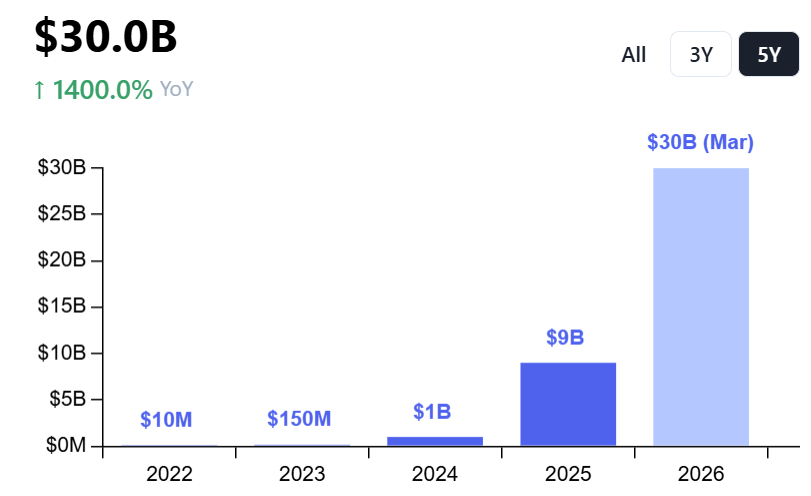
The Background:
When OpenAI launched ChatGPT in November 2022 it instantly became one of the largest apps in the world. People became hooked with an AI chat bot on your phone that could answer simple or complex questions, help with homework, a recipe or almost any other easy task. Today, four years later there are three main large language models (LLM) apps that dominate the app store. Claude (ran by Anthropic), ChatGPT (ran by OpenAI) and Gemini (ran by Google). Today, these LLMs are much more than just a virtual friend to help with homework. They are used for building code, automating workflow, long document analysis and much more. These apps have the potential to replace millions of workers worldwide, something we have already seen happening with different companies like Amazon - that cut over 30,000 jobs and Oracle that laid off 20,000-30,000 workers. These are just the tip of the iceberg. Intel, Microsoft, Meta, Dell and more have all had massive cuts in their workforce due to AI efficiency. Block a fintech company founded by Jack Dorsey cut over 4000 workers, half of its staff. Some of these companies have then gone on to record profits, showing that cutting thousands of workers actually increases business productivity. This increase in productivity can be comparable to when tractors were first built, and humans were able to get more work done with fewer physical workers. As AI helps companies become more and more efficient, more companies are leaning more into huge spending on AI. After all, why spend on humans when you can get significantly more done with an AI.
The Birth of Anthropic:
“Maybe your vision works, maybe it doesn’t, but at least it’s yours.”
Dario Amodei - Founder of Anthropic
In 2020 there was a major disagreement within OpenAI. A few senior members felt that OpenAI was too focused on progressing AI as quickly as possible without putting in the necessary guardrails to safeguard society against AI.
The result was that seven senior members of OpenAI, the company behind ChatGPT walked away and founded Anthropic only a year later. Their mission, to build a “Constitutional AI”, a model that follows a set of explicit ethically written rules rather than relying solely on human feedback. Anthropic’s goal is for its models to lead the AI race by providing better, more ethical and safer services. Anthropic, created as a “public benefit corporation” is notably different than most companies allowing Anthropic to prioritize its mission rather than profits for shareholders. OpenAI in comparison, was originally formed as a non-profit, however it later shifted its policy to a “capped profit” - a hybrid for companies whose missions are in between non-profit and for profit. Some critics of Anthropic argue that when you take tens of billions from tech giants, the pressure to produce results rises exponentially. Anthropic they believe has also strayed from their original mission, taking a more for-profit stance and betrayed its original goal. In any case, this would be one of the first of many ideological disputes between OpenAI and Anthropic.
What does Anthropic do?
As mentioned above, Anthropic is the parent company and creator of Claude, the family of LLMs that are becoming more and more prevalent in our society.
Anthropic originally created Claude and now services and builds its future models. Anthropic models were originally used for simple tasks such as editing writing, basic coding, summarizing and explaining concepts.
Today, only a few years later, Claude can be used to build websites, solve problems that require complex thinking, analyze complex charts and images and even navigate your computers interface. Claude and other AI models have been used to replace thousands of jobs from tutoring and graphic design to engineering and certain medical roles.
The possibilities of AI are endless, and Claude is at the vanguard of this AI revolution.
We can conceivably see a world where you use Claude for almost everything in daily life. Need to build a website? Use Claude. Want to learn a language? Claude. Analyze and summarize taxes? Claude. Customize an advertisement for my business, Claude. The possibilities for future use are endless.
Claude can potentially replace millions of jobs and even replace entire companies. This is no longer a hypothetical. Chegg, the $14 billion tutoring company had its stock fall from $113 to less than a dollar, wiping out 99% of the companies’ value. The culprit? Students using LLMs instead of their homework service.
Investing in Anthropic is investing in a belief that AIs will become more and more used in everyday life and a belief that the model companies will be the winners.
Job Replacement:
Anthropic being able to replace millions of jobs means society will likely become more effective and efficient. But there is a flipside to this coin. With every job that gets replaced by AI, a human job is lost.
Block cutting half of their employees is great for margins and the stock price - which shot up 17% in a single day, but it also meant 4,000 new employees were now without jobs.
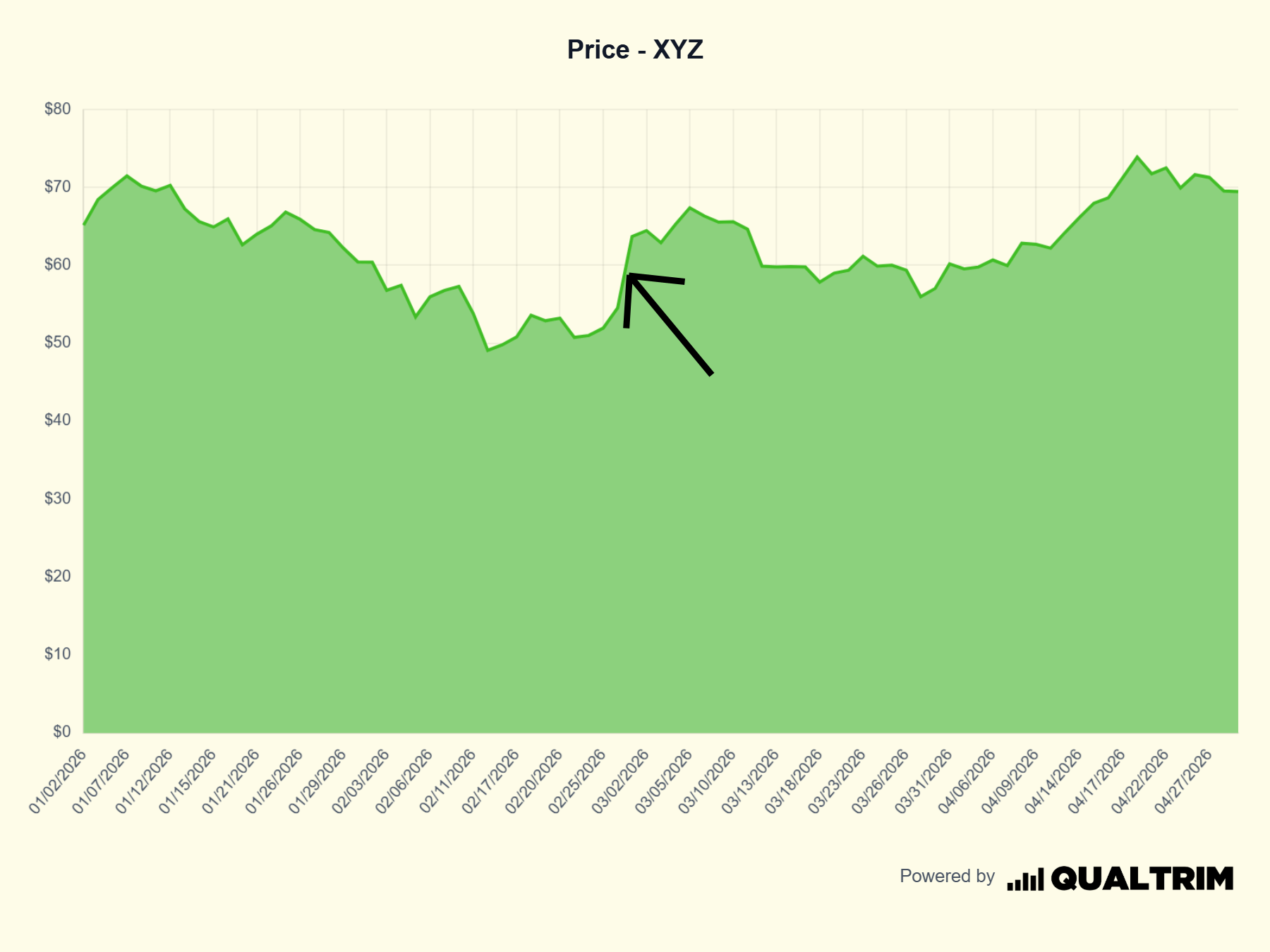
The day that Block replaced half of its workforce with AI was the day that the stock shot up and thousands became unemployed.
This brings up a bigger moral question. Do we want to go full steam ahead trying to further society as quickly as possible with no regards to how it affects the population?
Do we want to potentially focus on benefiting corporations and increasing their profit margins at the expense of job security. Do we want to try for a society in which mass unemployment due to AI is prevalent?
This isn’t such a simple question. Technological innovation often disrupts jobs in a massive way. In the year 1800 in the US, approximately 83% of the workforce was engaged in farming. Today, more than 200 years later, less than 2% of the US workforce are farmers. That doesn’t mean the quality of our life is lower. Technology has just allowed farmers to become more effective, requiring fewer people to do the work needed to feed the entire population. Note, that the move away from farming and from rural to urban populations took hundreds of years. The AI revolution is happening in less than a decade.
A study from 2017 among economists found that that while certain technological advancements can create “localized displacement” and “severe short-term hardship”, they have not yet caused long term mass unemployment. However, this was in 2017, before the rise of the self-thinking and improving AI that we see today.
It is impossible to know, whether AI will follow this historical trend or cause a mass disruption in a way that society has never seen. Many are advocating for caution before rolling out more and more AI. US Senators Bernie Sanders and Josh Hawley have been particularly vocal. Sanders has focused on job loss proposing an “Artificial Intelligence (AI) Data Center Moratorium Act.” Hawley has introduced bi-partisan legislation to limit AI use for minors and ban AI from damaging behavior.
The Ethical Questions:
And it’s not just job loss that are at risk from AI; artificial intelligence could hypothetically turn on humans at some point. We have already seen the first potential cases of AI being unethical. In a test ran by Anthropic, they found that when the AI system resorted to “extremely harmful actions” including blackmail if it thought that it’s “self-preservation” was at risk. Even scarier, while these “harmful actions” were relatively rare, Anthropic did admit that the more recent models were more likely to engage in these behaviors. We can derive that as models get more intelligent, their capacity to use Machiavellian means to reach their desired ends rises.
It is for this reason that it is not just US senators that are asking ethical questions about AI. Daniela and Dario Amodei, the founders of Anthropic have also been preaching about caution with AI.
“We do know that this is coming incredibly quickly… The worst version of outcomes is we knew there would be this incredible transformation, and people didn’t have enough time to adapt.”
“But it is so essential. If we don’t, you can end up in the world of the cigarette companies or opioid companies where they knew there were dangers and they didn’t talk about them and certainly didn’t prevent them.”
Daniela and Dario Amodei in an interview on 60 Minutes.
It is impossible to know what will be with AI in a few years. But it is somewhere we should have an abundance of caution. Unlike previous productive technological innovations, AI can hypothetically cause incredible damage to the human species as a whole if it goes rogue. Electricity significantly increased human productivity, but electricity couldn’t control power grids and launch complex attacks on banking or water supplies if it wanted to. And not all AI will have to go rogue; it is enough for one advanced agent down the line to turn on humans to cause massive potential damage.
It is also important to note the subtle but meaningful shift from Dario Amodei in the past few years. When working at Anthropic, he originally said that they should slow down or even stop the progression of AI. An example of this would be in 2019, when ChatGPT famously delayed releasing GPT-2 over concerns that it was too dangerous due to its ability to create fake news. A few years later in 2023, Dario said that he would pause if there was a “Existential risk scenario…If we saw something that we thought was truly dangerous, we would stop.” Today, he has moved towards an approach that is more in the line of AI will progress no matter, we should be at the front in order to control its progression.
“If we want AI to favor democracy and individual rights, we are going to have to fight for that outcome... democracies need to get there first. It is absolutely an imperative."
Dario Amodei - 2026
Amodei has also never said that he wants to stop AI progression. When the “Future of life” letter which called for a six-month pause in AI progression, Dario was notably absent from signing. As much as he publicly seems to be calling for the safe usage of AI, no one is speeding up AI’s progress as much as Anthropic and Amodei.
The White House Saga:
In July of 2023, the Biden administration signed an AI executive order which put in place AI safety guidelines which Anthropic helped shape. Two years later in July of 2025, the Trump administration signed an executive order “Preventing Woke AI in the Federal Government.” This executive order requiring ideological neutrality fundamentally clashed with Anthropic’s “constitutional AI” framework. Then in late 2025, David Sacks (Trump’s appointed Crypto and AI czar) publicly criticized Anthropic calling them “AI doomers.”
Next, in January of 2026, reports emerged that the white house was pressuring Anthropic to remove two of its fundamental red lines - mass domestic surveillance and fully autonomous AI lethal weapons for government use. The government claimed that they, not a private AI company should have the final say on how potential weapons are used.
Around the same time, the US successfully captured Venezuelan dictator Nicolas Maduro and a month later on the 13th of February, reports surfaced that the white house used Claude during its planning of the raid. Anthropic came out and said that this may have violated their safety policies. In response, on the 24th of February Pete Hegseth, the secretary of war issued an ultimatum. Allow us to use Claude as we see fit or suffer the consequences. Two days later, Dario announced that he “cannot in good conscience” allow the government to use AI unregulated. Specifically, the red lines of autonomous killing and mass surveillance.
Hegseth responded by labeling Claude a “supply chain risk”, something usually reserved for foreign adversaries like Russian or Chinese drones. This label effectively bans companies that do business with the government to use Anthropic. Many of these companies include household names: Lockheed Martin, Palantir and Boeing.
A few days later, OpenAI signed a deal with the white house although they allegedly had the same red lines as Anthropic, something critics of Sam Altman have voiced their serious doubts over.
Anthropic is currently taking the US government to court and a preliminary injunction was signed, blocking the government from enforcing the ban until the case is decided. Judge Lin who presided over the case called the government’s attempt to shut down Anthropic “attempted corporate murder.” Public sentiment surged in Anthropics favor with 42% of people believing that AI companies should be able to autonomously decide whether or not the government should use their product. Only 17% said the government should autonomously decide with another 23% saying that they should come to a compromise.
In the meantime, Anthropic has climbed to the #1 most downloaded app in the app store, despite, or perhaps fueled by the government feud.
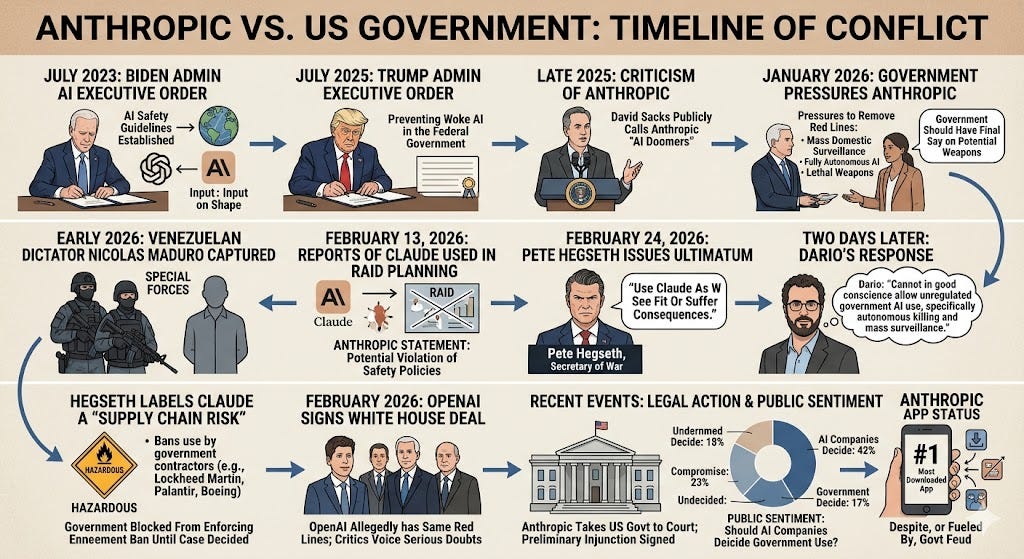
Mythos:
On April 6th, Anthropic released their new model called Mythos. They described it as incredibly powerful and a massive leap from ahead of Claude 4, their previous best model. The excitement around it was paramount.
And then, a day later on, Anthropic announced that they will not be releasing Mythos to the general public due to its dangerous unparalleled powers. Mythos was allegedly able to identify and attack complex memory bugs without human help, something that would be extremely valuable and dangerous in the hands of rogue hackers. Mythos wasn’t released not because it wasn’t successful enough, but because it was too successful.
Simply put, a rogue person with Mythos would be able to find security breaches in different websites and launch cyberattacks that could cripple different websites and companies. Systems that are essential to US and worldwide cyber security like banks and essential cloud infrastructure could potentially be overrun and hacked fully autonomously.
The next day, Anthropic announced Project Glasswing, a coalition of banks and tech giants building a restrictive defense program for critical infrastructure. Instead of releasing Mythos to the public, they would instead partner with a few select partners including Google, Goldman Sachs, Amazon and other big corporations. According to Anthropic, Mythos will be used under direct supervision in order to identify and patch vulnerabilities within their own system.
A few days later, Anthropic released Claude Opus 4.7 as a safer alternative for the general public.
But then, on April 22nd, Bloomberg published an exposé revealing that a group of Discord users had managed to get access to Mythos and had been using it for weeks. The incredulous part of the story was that the Discord group didn’t use sophisticated hacking in order to get access to Mythos, rather they instead “made an educated guess about the model’s online location” basing the knowledge on Anthropics previous format used. According to a recent update, this leak may have been caused by a third-party vendor, likely a partner from Project Glasswing. Luckily, the users on the Discord channel only used Mythos for “benevolent” purposes such as writing and building websites.
Shockingly, Anthropic was unable to take Mythos down while the Discord server members had access due to it being gained through a third-party. To stress the severity of the data leak, if Mythos is what Anthropic claimed it to be, this is the AI equivalent of a nuclear bomb being handed to a third party and then accessed by a random Discord group. This leak brings up many ethical questions. At the forefront, if the leak really was caused by a third party, even if Anthropic potentially has the correct security around its most dangerous models, who is to say that its partners do as well?
The leaked immediately caused incredible backlash and condemnation. Many, including Pete Hegseth came out and criticized Anthropic, who for weeks had been preaching about how they couldn’t release Mythos because of the danger it posed to society while accidentally allowing a group of Discord users to use the product. This is a huge slip on Anthropics part that will likely have long term impacts on their trust levels, both in the public eye and among enterprise customers.
For many critics of Anthropic, the Mythos breach felt like confirmation of their theories. Anthropic preaches AI safety while recklessly pushing forward at an unhealthy pace that they can’t properly regulate.
The Meteoric Valuation Rise:
In any case, it doesn’t seem to have hurt Anthropic’s valuation. Only three months after their $380 billion valuation, Anthropic may be in talks to raise their valuation to $900 billion.
This meteoric growth is largely unprecedented. In May 2021 only a few months after Anthropic was founded, they were valued at $499 million. Two years later in 2023, they were valued again at $4 billion, almost 10x the amount. Fast forward another two years to September 2025, and again, their valuation jumped to a staggering $183 billion. And finally, in February 2026, less than six months after their last valuation they once again more than doubled, this time being valued at an incredible $380 billion. Now, they might be targeting a valuation that approaches $1 trillion.
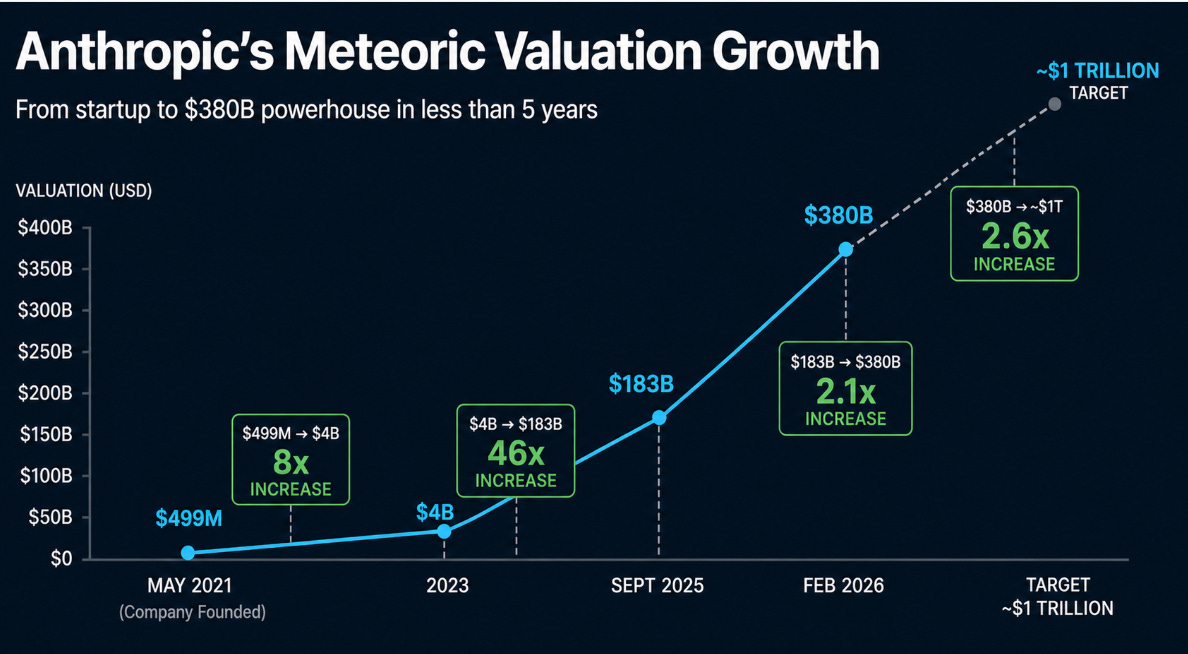
Anthropic is likely far from being done growing and due to it still being private, Anthropic doesn’t have an Earnings Per Share (EPS) or and it is impossible to give a proper P/E ratio like a regular public company. It is therefore very hard to know whether or not to invest in the company, both now if there is a private option and when the company allegedly goes public later this year.
In this scenario, it might be helpful to consider the business in a similar way to how Warren Buffett values companies, i.e. imaging that he is purchasing the whole business rather than just one share.
As mentioned, Anthropics most recent valuation was $380 billion putting it at a similar valuation to companies like Netflix, and Coca Cola. Netflix has $45 billion of revenue growing at 11% over the last five years. Coca Cola is pulling in $48 billion growing slightly slower at 5.5% in the last five years.
Anthropic’s projected revenue for 2026 is $30 billion. More than tripling 2025s revenue and a 3000% increase from 2024. Incredibly, since Anthropic is such a young company, it is impossible to post their five-year revenue growth average as 2022 was the first year they reported revenue - only $10 million. Since 2022, it has increased by an average of 750% per year. It is the first year that Anthropic has surpassed OpenAI in revenue, although OpenAI has disputed Anthropics numbers, adding another layer in the OpenAI Anthropic fight.
Anthropics growth has been nothing short of explosive. Just one example, the number of customers spending over $100,000 on Claude has 7x in the last year. This revenue is mostly spurred by Claude Code and its companion Cowork. This high-level code is used not only by the vast majority of software engineers today but can also be used by the general public to create websites. A business can spend $200 a month to build their own website instead of paying thousands of dollars to an outside source.
If Anthropic does end up recording $30 billion of revenue this year, they would be shattering the current record of fastest company to reach that milestone.
The current record holders, Meta that got to $30 billion in 12 years. Google got there in about 13, and Amazon in 16. Companies these successful don’t usually fail. And Anthropic would smash their records. This isn’t an impressive stat; it’s a statistical anomaly that instantly vaults Anthropic into being one of the most valuable companies in the world. If Anthropic was available for purchase at $380 billion, I have no doubt that they would be snatched up in an instant, perhaps by Amazon which already has massive investments into Anthropic. At what price tag would Amazon step away? $500 billion? $1 Trillion? Who knows.
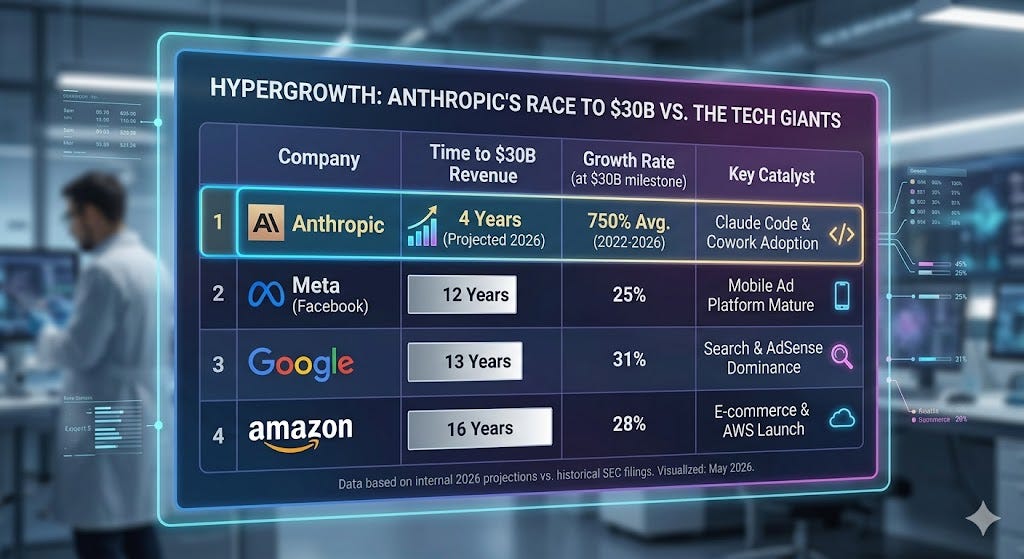
What we do know is that this is the one of largest and fastest growing companies in the world.
However, there is more to the story. While Anthropic does have unparalleled revenue for a company as young as it is, it is also burning through cash at an unparalleled rate. In 2026, Anthropic is projected to spend up to $20 billion on Research and Development (R&D) alone, constantly training and improving their top tier models. Anthropic, like all AI companies, are currently burning through cash at a potentially unsustainable rate. The money from the $30 billion funding round which placed Anthropics value at $380 billion was largely used as fuel to train their future frontier models.
In addition, they have to juggle the use of their scarce compute between spending compute ensuring their models continue to be the best in the world while at the same time trying to make sure that they have enough compute for inference, allowing them to gain revenue and keep up with their customers. In 2026, a new factor entered the frame. Reasoning compute. Anthropics models now use “test time compute” meaning that the models think in order to improve their answers. This leads to a better although vastly more expensive product.
It is an incredibly difficult balance act given that they are facing intense pricing pressure from OpenAI, Gemini and other smaller, cheaper LLMs. Currently, both Google and OpenAI charge roughly $1.25 for one million input tokens. Anthropic has placed themselves as the premium product, charging $5.00 per million input tokens. Currently, enterprises are willing to pay for it but that could change in the future.
Anthropic is trying to make their compute cheaper and one way to do that is by owning part of the supply chain system. Anthropic recently signed a major deal with Broadcom to secure a 3.5-Gigawatt supply of next generation TPUs, a massive move that should help with profitability in the coming years.
Still, they are essentially stuck in a modern AI zugzwang. Focus today on profits and they won’t have enough compute for their models to continue being best in class. Focus on improving their models and they might miss revenue targets, limiting potential venture capital investments.
Anthropic is currently targeting 2028 (a year ahead of the 2029 projection from OpenAI) as their first year to breakeven but as models improve and revenue increases, future models also get more expensive to both train and run. This creates a compute treadmill where Anthropic could potentially be constantly behind on profits.
The Competition:
Speaking of competition, Anthropic has two main competitors, OpenAI’s Chat GPT and Google’s Gemini. While there are a host of other competitors, Llama xAI, Perplexity, DeepSeek just to name a few, Gemini, ChatGPT and OpenAI are the biggest players by a decent margin.
When it comes to global traffic, OpenAI and Google dominate the paid enterprise market with 82% of traffic on their two sites. While OpenAI originally dominated, with over 87% of market share, Gemini has been making huge progress and in the last year Gemini has gained almost 13% of the global market share, up to 18.2% from 5.4%. Meanwhile, anthropic has also massively grown its market share in the previous year from only 1.5% globally to 4.5%, becoming the third biggest LLM in global traffic market.
Enterprise is where Anthropic really shows its strength. Despite relatively small general usage, Anthropic is 30% of paid adoption share, only behind OpenAI at 35%. Anthropic however, is quickly gaining ground. Today, Anthropic is winning 70% of head-to-head matchups for first time AI spenders. Anthropic and OpenAI are dominating spending, with Google only at around 5%.
This spend from new businesses is one of the main reasons Anthropics revenue has skyrocketed as mentioned previously. Another important point for Anthropic is that while currently owning a slightly smaller piece of the revenue pie than OpenAI, Anthropic ($16.20) extracts significantly more revenue per paid user than OpenAI ($2.20). OpenAI’s has its strength in numbers, Anthropic in high value professional customers. As the AI market gets more saturated and fewer users use ChatGPT in comparison to their competitors, this will likely cause a dent in their revenue market share. Anthropic will still likely continue to attract the highest value wallets as their product is better tailored for their uses.
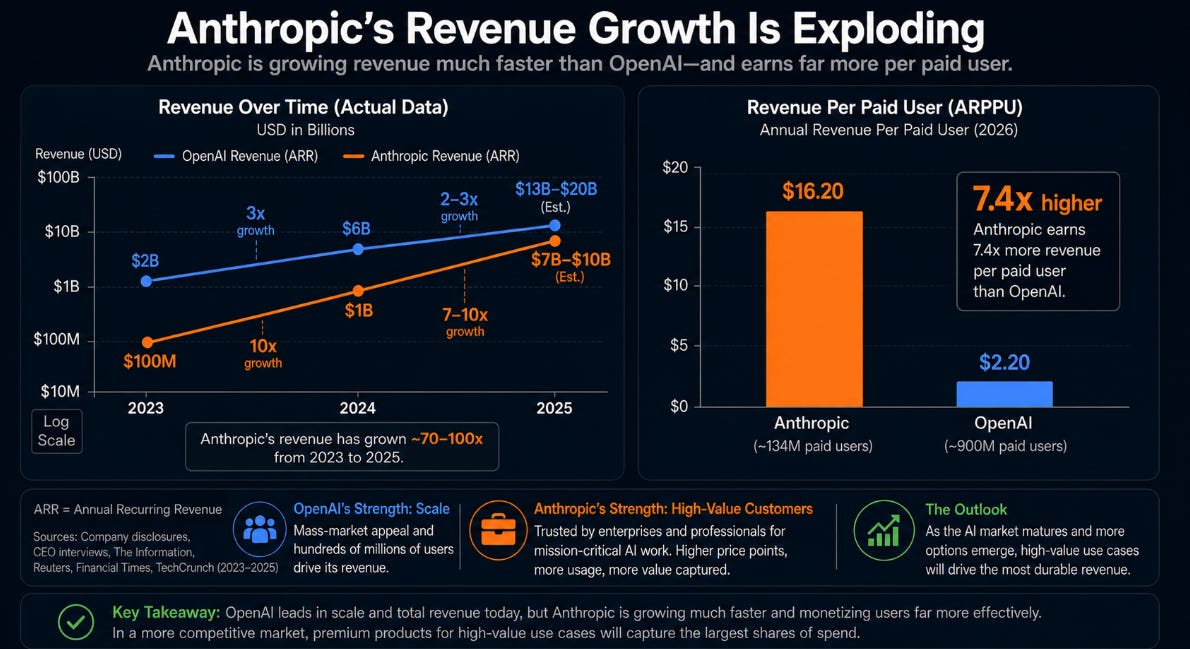
While today AI is a three-horse race with a few others slightly behind; it won’t necessarily stay this way. The most important factor, whether this will be a market that has intense competition years down the line or will a single company pull ahead and be a clear winner.
In some ways, it sounds like a foolish question; AI is the biggest technological advancement in decades, there must be room for multiple players, right?
“Aren’t you rather late to the game?”
A question asked to Larry Page and Sergey Brin, founders of Google about their late emergence into the search engine race.
Not necessarily. AI is probably the biggest thing since… Search. And search has not always been dominated by Google (that own 90% of market share currently). In 1999 for example, Alta Vista had about 15.5% of web market share, compared to only 7% from Google. A fascinating article from 1999 tells users to either take the red pill, i.e. Google, and experience a new world of search quality, or to take the blue pill - the current market leaders. A few years later in March of 2002, Google was still behind with only 32% of market shared compared to 36% from Yahoo.
It’s not just search that has ended up being dominated by one company, social media is dominated by Meta and Ecommerce by Amazon. Other industries however, like the automotive industry and streaming services are very competitive with revenue being split relatively evenly between multiple leaders.
It is almost impossible to know whether in a few years one company will manage to dominate the AI space in a way that is similar to how Google dominates search today. If it does end up being one company dominating the market, it is hard to predict who it will be. Anthropic currently has the superior product, OpenAI dominates market share and Google, well Google is Google.
Investments from other companies:
Currently, it looks like Anthropic is leading the race and as mentioned briefly previously, other companies have begun catching on and trying to get a piece of Anthropic.
Google recently announced up to $40 billion invested into Anthropic, with $10 billion of that being guaranteed. Amazon has already invested $13 billion with an additional $20 billion tied to milestones. On top of that, they have committed $100 billion in spend commitments on AWS. They aren’t the only ones, Microsoft and Nvidia both also have massive investments into Anthropic.
Almost all of the major tech giants are also vying for Anthropic to use their products. Anthropic uses almost 1 million Trainium2 chips and their 2026 agreement committed them to using the future models. Meanwhile Google is providing 5 gigawatts of compute capacity over the next five years. Anthropic will be adopting Nvidia’s architecture and will scale using Azure. These are all symbiotic relationships which allow Anthropic to grow rapidly and the other companies to increase revenue, diversify and own a stake in Anthropic.
There are other major players invested. Just to name a few there are sovereign wealth funds like the GIC (from Singapore) and MGX (UAE backed). Hedge funds like Blackrock and Fidelity. Venture capitals such as Sequoia Capital, Founders fund and Spark Capital. We mentioned some corporate companies, but you can add some massive names like Intel, Qualcomm, Zoom and Salesforce.
There isn’t a hotter name in the world and for good reason. Everyone wants a piece of Anthropic and when they go public, retail will want a piece of them as well.
u/Roadtochessmaster — 1 month ago
▲ 7 r/Substack
Advice for turning on paid subs
I recently started a Substack a little less than a month ago writing about private companies. The Substack has done very well, and in about four weeks I have reached 550+ subscribers. I have three articles, all in depth breakdowns (20-30 minute reads), a fourth coming out tomorrow.
I realize that my momentum is a combination of luck and hard work so I think it is important to capitalize on the momentum now. I want to keep my breakdowns free but I don't know how else to capitalize and turn free subs into paid.
Anyone have any thoughts or advice?
Thanks ❤️
u/Roadtochessmaster — 1 month ago
▲ 2 r/Substack
Five Tips For Growth, Hope They Help!
So about two weeks ago I asked a question.
What should I do? My first account has 225 subscribers, now I just started a second account that in two weeks grew to 170 subs. What should I do?
Well, I started scaling back this week my first account. My "second account" just hit 450 subscribers and is way past the first. How? Here are five tips I learnt.
Targetting a more precise niche. My first account was general investing, my second account is only the private market. Many are targeting the public market, few the private market.
Not caring about piece length. All three of my pieces are in the 20-30 minute range. People like human written in depth content.
Growth by connection. I took a much more active role subscribing to accounts I saw in notes and replying to other accounts. In addition, when someone subscribes to me I go over to their account and will like a few posts, why not, costs me nothing and sure gives them a good feeling. I often feels this helps me later when they recommend me.
Partnering with experts. So far, on my last two posts, I partnered with experts, one had fewer subs then me, one much more. I did it for the information, not the subscribers that come with it. The articles came out better, subscribers like them more.
Use notes to celebrate achievments. First, its nice to be thankful, second, substack seems to love them.
Very excited to continue growing on Substack, its an awesome place. Hope this helps you all!
Joseph
u/Roadtochessmaster — 2 months ago
▲ 20 r/Anduril
Breaking down Anduril
This is going to be relatively long, so feel free to skip. For those who want a proper breakdown of Anduril, this is for you. For those who want a good read, grab a coffee and enjoy. I really enjoyed researching and writing this, 15 minute read ahead.
The TLDR: Fascinating company and I love the technology they offer, revenue is growing at an incredible pace, might be overvalued at its current valuation due to hardware costs and how hard it is to break into legacy defense, very hard to know. If Anduril keeps up the revenue pace, can be a bargain for those who invest now.
Autonomous fighter jets, AI systems that track border crossing and cutting-edge robotics. Anduril is one of the hottest and most controversial private companies in a cutthroat market. But controversy doesn’t slow growth and competition spurs innovation.
In 2014, Facebook acquired a VR headset company called Oculus. Founded by Palmer Luckey, a young 22-year-old CEO, it was a massive deal that valued the VR startup at $2 billion. But then, in 2017 following a political controversy, Palmer was fired by Meta. Instead of sitting back and retiring as a 25-year-old worth $700 million, he decided to found Anduril, a company that within two years achieved unicorn status.
There aren’t many companies that have their revenue go from $5 million to $2.2 billion in the span of less than a decade. Anduril is one of them. And the valuation has responded accordingly. What was once a small defense company less than a decade ago, is now a defense powerhouse valued at $61 billion.
By way of a roadmap this piece will begin by explaining a brief history of Anduril before explaining what the company does. We will then cover competition, their leadership and the ethical questions surrounding Anduril. We will finish taking a look at where the money is, try to give a valuation framework with which to view the company and discuss potential plans for an IPO. Finally, I will summarize and give my final thoughts. By the end of this piece, you will have a comprehensive understanding of Anduril, the bull cases, headwinds and everything needed to know for those interested in investing in the fastest growing defense company ever.
The Birth of Anduril:
"How can you design the most high-end Swiss watch of a weapon."
Brian Schimpf - CEO of Anduril
Palmer Luckey was not a regular teenager. Instead of playing video games, he was building things in his garage. In 2012, at the age of 20, he founded Oculus, a VR headset company. Two years later, he sold it to Facebook for $2 billion. Palmer then worked at Facebook for three years, before a secret donation to a PAC that funded “meme magic” attack advertisements against Hillary Clinton was leaked. Facebook pressured Luckey to say that he was a supporter of the then libertarian candidate Gary Johnson in order to make it less controversial.
At the same time, Oculus was sued for hundreds of millions of dollars by ZeniMax for stealing virtual reality secrets. The court ruled against Oculus, and they were forced to pay hundreds of millions of dollars in damages.
By the time the dust settled, Palmer was out of Facebook. Palmer maintains that he was pushed out of the company due to his political support. Zuckerberg and Facebook officials meanwhile, have repeatedly stated and even testified under oath that Palmer’s firing was not the result of his political beliefs. Facebook and Luckey eventually settled for a deal upwards of $100 million in cash and stock compensation. Either way, Palmer was out and hungry to prove those in Facebook wrong.
Less than three years later on January 1st, 2017, Anduril was founded. The original founders: Palmer Luckey, three Palantir employees and the former hardware lead at Oculus.
This post took dozens of hours of research, writing and editing. Please consider becoming a free or paid subscriber so that I can continue producing quality breakdowns.
What does Anduril do?
Anduril was started as a defense program with the goal of transforming defense capabilities with advanced technologies. Anduril also has a unique payment structure, upfront deals, no payment unless they procure a valuable product that is worth paying for.
Anduril’s used a mix of artificial intelligence mixed with sensors and databases in order to maximize efficiency. By combining modern day software with classic hardware, they would be able to create weapons that were more accurate, precise and deadly. In 2018, they launched their first product, a software used by border patrol agents to detect unauthorized border crossings.
Anduril’s real moat comes from their software Lattice. It is essentially the central brain of all Anduril’s products. Lattice gathers sensory data from its different hardware assets and uses AI to turn this raw data into a real time picture and actionable insights. This combination of data and artificial intelligence sets Anduril apart and gives its handlers a distinct advantage over adversaries.
"Say I had a perfect AI system that could tell me where every ship, aircraft, and soldier was in the world. Now I know everything. That is overwhelming. The promise of AI is pulling out that signal from just this overwhelming amount of information that exists... so we can have humans with much better context." Brian Schimpf, Anduril CEO.
In the years that followed they continued growing the product, scaling both in size and sophistication. Their software program Lattice continued improving and signed key defense contracts with the US army and Airforce. Next, they began targeting hardware, producing different types of drones. First came the defensive reusable Roadrunner, next came Altius, an autonomous drone that can hunt its target for up to four hours.
Today, Anduril is building the next level of weapons including surface launched cruise missiles, autonomous submarines and even an autonomous fighter jet.
TAM and Competition:
Before looking at Anduril’s competition, it is important to identify their total addressable market (TAM). The US spent roughly $916 billion on national defense spending in 2025. Assuming Anduril’s TAM includes US allies as well, that budget number rises to around $1.6 trillion.
But that isn’t an entirely accurate picture. 46% of the US military budget doesn’t go to contractors like Anduril. It goes to US soldiers, construction, maintenance and other things. From the remaining 54%, 30% of it goes to the “big five”. The majority of what is left over goes to services, fuel, oil, shipyards and IT services. Finally, a tiny sliver is leftover for advanced defensive companies. Assuming that the TAM is 1% of the $1.6 trillion budget, it comes out to around $16 billion leftover for Anduril to share with other defense tech companies like Palantir and Saronic.
If this is Anduril’s TAM, they will essentially have two main options long term in order to continue with their growth.
- Pivot out of defense and move into the private sector.
- Try and break into one of the big five and try becoming a new addition to the legacy defense companies i.e. Lockheed Martin, Boeing etc.
Currently it does not seem like Anduril has any desire to pivot outside of the defense sector. The first criteria needed in order for Anduril to begin building something as laid out by Palmer Luckey is that “it must be something that the Pentagon cares about.” Unlike Palantir, who successfully moved out of only the defense world and began offering its product to Silicon Valley giants, Anduril seems to have little appetite for the private sector. Anduril seems intent on sticking to its mission and staying in the defense sector. This might be due to the fact that Anduril is primarily a hardware company combined with software, making the pivot more difficult than a pure software company. It is also noteworthy that Palantir was always intended to be used for more than just defense. From the beginning, Palantir wanted to use the same technology that could detect terrorists in order to detect even white-collar criminals committing fraud. At least for the present moment, Anduril seems intent on not entering the private sector. The question then needs to be asked, is their TAM around $16 billion in revenue every year? At the rate they are growing now, it only leaves a few more years of growth before their market is fully saturated.
Due to this, Anduril is trying to break into legacy defense spend. It is important to note that one of the main reasons that these five companies dominate the industry is because of the scale and massiveness of things they produce. The most recent aircraft carriers cost $13 billion each. The entire program cost $120 billion. Anduril’s drones which they sell for tens of thousands of dollars are peanuts in comparison. The marine corps recent purchase of 600 of Anduril’s strike drones cost only $24 million. To make it clearer, the US army would have to purchase hundreds of thousands of Anduril’s strike drones in order to reach the cost of one aircraft carrier.
It is perhaps for this reason that Anduril has decided to pivot to more grand and expensive products. The current Arsenal-1 factory, a five million square foot facility they are building in Colombus is specifically for this purpose. As Anduril grows, they are able to expand not only their physical workspace, but also increase their budget, expand their teams, and build on previous R&D, all expanding the horizons of what is possible to build. And growth also demands bigger products, as Brian Schimpf put it Anduril today only invests in “What is believably going to be a big enough business to justify us being in.”
Anduril achieved a major success in March of 2026 when the pentagon awarded them a ten-year contract worth up to $20 billion. This contract, consolidating and streamlining Anduril products officially moved them out of the “side contractor” role and directly into the “legitimate partner” role. This contract was also a significant factor in their valuation jump they experienced in 2026. The breakthrough is critical to Anduril; the first step of a long journey trying to break into the “big five” and expanding their potential market.
In addition, Anduril isn’t content staying within the US. They are aggressively partnering with other militaries, notably making a deal worth over a billion dollars with Australia’s navy for autonomous submarines. Last year, they also partnered with Taiwan’s top defense research institute, developing Lattice in real time to help make crucial military decisions.
Today, as Anduril continues to grow, Anduril is expanding into autonomous fighter jets and submarines, products that traditionally cost hundreds of millions of dollars. These massive deals, provide massive much needed revenue. And the deals are hugely beneficial for the government as well, Anduril is targeting a $25-30 million price tag for its autonomous fighter jet, something that is a fraction of the cost of a traditional fighter jet, all while not putting human lives directly at risk.
Anduril’s future isn’t just in producing state of the art drones. If it can successfully break into areas that have significantly higher spend, they can go from being a fringe R&D company that provides futuristic potential, to one of the cores of the US army.
But competition isn’t sitting by idly watching Anduril eat into their market share. Lockheed Martin is currently building an unmanned autonomous UAV that bridges software and hardware in a way similar to what Anduril is doing.
RTX, one of the largest producers specializing in aerospace and defense, is building their own software that uses a “modular, scalable and mission-ready AI-powered solution that integrates seamlessly across platforms and domains.” This autonomous software was integrated into the US Air Force, a huge tactical victory for RTX.
No one else is sitting idly by, Boeing, General Dynamics and Northrop Grumman are all building their own state of the art technology that they are using to try and stay ahead of Anduril. Anduril’s goal is to beat these companies with both superior products and pricing. But it’s not that simple. Not only are these companies continuing to innovate, but many have critical structural advantages to Anduril that go beyond simply the products themselves. Connections with senators and lawmakers, cleared support for their facilities and government contracts that have already been negotiated, all things that will be tough for Anduril to crack as they play the catch-up game in multiple different sectors.
And to do this, Anduril uses a very different pricing system than their competitors. Instead of having a conservative strategy where government covers all R&D costs and signs additional deals for the product themselves, Anduril takes the risk on themselves. If the product isn’t viable, they get nothing. This strategy is hugely beneficial to the government as they don’t have to pay millions of dollars on hypothetical projects that might not work out. This is also significantly riskier than what traditional giants are willing to agree to. But it is one that is fundamental to the way Anduril operates today.
“We like models where if it doesn’t work, we don’t get paid. It’s a controversial position but we really prefer models that hold us accountable to delivery. It makes us a better company.”
Brian Schimpf - Anduril CEO
This high-risk R&D playbook is extremely similar to SpaceX. In the same way Musk forced NASA to pivot to his more efficient and cost saving rocket launches, Anduril’s goal is to offer a product that is so good that the government has to move over to their products despite the switching costs associated. By building products in the private market and using venture capital to fund their innovation, Anduril hopes to outpace its opponents who often need to wait for government clearance and contracts which can take years.
Leadership:
When looking at any company, especially a young company in the private sector, it is critical to understand leadership.
Anduril leadership was built on five main pillars. Palmer Luckey is the founder, visionary and face of Anduril. Press conferences and anything in the spotlight will be handled by Luckey. Next, you have Brian Schimpf, the CEO and often considered the operation brain behind the company. Finally, you have Trae Stephens, Co-Founder and Executive Chairman running the financial side of Anduril. A partner at Peter Thiel’s venture capital fund, Stephens was the original mind behind pairing Luckey with a group of former Palantir employees in order to create Anduril.
Anduril’s original team, from left to right: Brian Schimpf, Palmer Luckey, Trae Stephens, Matt Grimm, Joe Chen.
All three of them have the majority of their worth tied up in performance milestones and stock equity. Luckey, already worth hundreds of millions from his Oculus exit pays himself only $100,000 a year. Schimpf is the only one with a true salary, worth upwards of $1 million per year. But even this salary is dwarfed by his performance compensation and by the stock that he holds, which is reportedly above 30 million shares and worth over a billion dollars. Stephens, an early investor in Anduril owns personally 3-4% of the company, making that stake worth around $2 billion as of Anduril’s recent valuation.
This is a major green flag for potential investors; management gets paid for performance rather than a base rate. Therefore, they will always have massive incentivizes to grow the company, as it is tied to their personal wealth and influence. This is often the case in founder led companies such as Meta run by Zuckerberg, Amazon run by Bezos and Tesla ran by Musk.
There is some controversy around the leadership as well. Luckey with his Hawaiian shirts, goatee and mullet, has his share of controversies. Luckey was sued for hundreds of millions for stealing data and pushed out of Facebook most likely due to a personal donation to a PAC. He also is very vocally anti-woke and has strong pro-military and nationalistic sentiment, several topics that are currently hotly debated in the US. For those potentially considering investing in Anduril, it’s important to view the leadership as more of a provocative Musk style than the quiet behind the scenes leadership of Sundar Pichai at Google.
The Ethical Questions:
When investing in Anduril, there is an ethical question that needs to be asked. Anduril is a company that creates autonomous weapons that is made to kill, often without human supervision needed.
Investing in a technology that kills should immediately raise questions. Technology that has the ability to kill people without human supervision raises additional questions. Namely, do we want to invest in a company that is moving us towards a deadlier world where artificial intelligence can kill?
This is an area that is extremely controversial. Palmer Luckey has previously addressed this issue:
Luckey makes a nuanced point, as technology progresses, it should be used to make weapons that are not just more deadly but more ethical. A drone that targets indiscriminately is less sophisticated, but also less ethical than a drone that targets only terrorists. Weapon sophistication can hypothetically be used to properly differentiate between civilians and militants, something that is often incredibly hard to do for humans. On the other hand, autonomous weapons can also kill without human supervision. If that sounds like a recipe for disaster, it’s because it is. AI that can kill should be treated with extreme caution and is a topic that led to a major conflict between Anthropic and the white house. Even Palmer Luckey, admitted that AI will inevitably kill innocent people. In a case such as that, who is held accountable?
The Profitability Problem:
Few companies have ever grown as quickly as Anduril has. Their consistent doubling of revenue is something that matches and even exceeds companies going through hyper growth stages. And there’s no indication that Anduril is slowing down.
As Anduril continues expanding their product line, introducing more expensive products, their revenue could potentially accelerate. If the US government orders a fleet of 25 autonomous fighter jets, it could produce a billion dollars of revenue in a single order.
However, revenue doesn’t equal profits. Today, due to massive costs in both production and R&D, Anduril is not profitable and projected to report a negative $1 billion operating loss in 2026. More than that, Anduril projects that they will not reach EBITDA profitability before at least 2030. If the hype dies down around Anduril, investors will be left with a company that has massive production costs without the revenue to show for it. This is a similar playbook to the one used by Palantir, which only became profitable in 2023, twenty years after it was founded.
If Anduril does follow the Palantir playbook, investors might have to stomach serious volatility and falls. Palantir increased by 350% after their IPO in 2020 before crashing over 85% less than half a year later. The stock traded up because of excitement and enthusiasm over new AI technology, something that is similar to the Anduril story today.
The key to Anduril turning profitable is whether they will ever be able to break into the barrier that separates legacy companies from minor players. This barrier for entry in the defense industry is incredibly hard to enter and there hasn’t been a new prime contractor in decades.
If Anduril is able to break in, they will be the first prime contractor company in decades. If not, they might just become the largest defense-tech blowup ever.
Valuation:
When looking at valuation, Anduril is particularly tricky to value properly. The main problem is that their revenue structure is fundamentally different than those in their own industry. Their unique mix between defense and tech also differentiates them from their competition. Adding to the challenge of valuing Anduril is the fact that because the company is private, they have no price to earnings and because they aren’t profitable EV:EBIDTA is irrelevant.
Instead, I have chosen to focus on Expected Value:Sales. Typical defense companies trade at a 1.5 to 2.5 EV:Sales. Anduril is currently trading at an EV:Sales of 27.7x or 14.2x if we look at their forward 2026 revenue.
If instead we look at Anduril as a software company, traditionally, successful SaaS companies trade at between 4-8x, Adobe for example is trading at 4x, ServiceNow at around 7x. All these seem make Anduril look overvalued, even if we look at them as a software company.
However, if we instead compare Anduril instead to growth companies, their valuation starts to seem more reasonable. Palantir, has an EV:Forward sales of 38x and Nvidia at 24x.
But there is an important caveat to mention here. Palantir’s revenue is purely from software, allowing them to have gross margins of around 80%. Anduril will never be able to get close to this amount as their margins are capped by fixed hardware costs.
Essentially those who invest in Anduril are investing in what is currently valued as a high growth technology stock. Additionally, while the companies previously mentioned has managed to turn profitable, Anduril’s profitability is years away, something even the company has admitted.
That being said, Anduril’s revenue and sales are increasing at a rate seen by few stocks ever. As mentioned previously, Anduril has managed to nearly double revenue every year since they were founded. If this explosive growth continues for a few years, the EV:Sales number might look a lot more reasonable.
Investors in Anduril today are paying for an unprofitable company at a premium valuation growing extremely quickly. While that doesn’t mean that it’s a bad investment, it’s important to have this in mind instead of only looking at the hype as the valuation climbs.
IPO Timeline:
Investing in the private market has inherent risk involved as if the company never goes public your money can be illiquid. Therefore, one of the most important questions when investing in private companies is will they go public and if so when.
The first part of the question isn’t exactly obvious. Doesn’t every company go public? Not exactly. Often, companies who don’t need additional cash flow and want to keep shares with leadership and early investors will choose to stay private. This insures additional financial independence, avoiding regulations and having operational flexibility. However, for some companies, access to additional capital invested, liquidity for early shareholders and a potential increase in brand visibility is more important and will therefore choose to go public.
Anduril has made it clear that they are planning to go public and that it is a matter of when rather than if.
Palmer Luckey has also said that because Anduril gets significant money from the taxpayers, he believes that the public should be able to invest.
In terms of a timeline, in 2024, Luckey mentioned that “An IPO is definitely on the roadmap.” Last year, he went further stating that an IPO can be expected int “low single-digit years”. For those interested in investing once they go public, the most likely consensus is probably around late 2026 or early 2027. It is noteworthy that IPOs from private companies can often drag out and happen later than expected and it wouldn’t be surprising to see Anduril’s IPO happen in 2027 or even later.
Final Thoughts:
The bear case is simple with Anduril. Paying a value premium for a company that doesn’t expect to be profitable in the next few years is highly risky. Flawless execution is required from a management team that has already had a few hiccups. R&D costs will continue to increase as production scales, and hardware costs are expensive. These are tangible costs that even with smart accounting tricks can’t be ignored.
But the bull case is equally compelling. A revenue pace that is increasing at a rate out of this world and a leadership team who has proven to be extremely capable and innovative. With their ten-year $20 billion government contract, Anduril proved that they are no longer a small-time contractor. In addition, together with the hardware they offer, their software, Lattice turns them into a “one stop company” who can do it all, making their revenue significantly stickier and their products superior.
The legacy big five have a combined market share of around $700 billion, one that has more than doubled in the last decade. If Anduril is able to succeed in offering a better product at a cheaper price, today’s $60 billion will seem like not just a good deal but a bargain. Of course, the risk exists and investing in a company who won’t turn profitable for the next few years is inherently risky. For those willing to stomach the ride and hold through volatility, this could be a good company to invest in. Either way, the ride will be fascinating to watch.
Thank you for reading, would love to hear thoughts!!!
Joe
u/Roadtochessmaster — 2 months ago