Our Top 5 Value Picks in Switzerland

Our Top 5 Value Picks in Switzerland

One of them could be Alcon (ALC), which has quietly started showing real improvement, and now Ackman has shown up too.

Alcon has had a rough year: two failed acquisitions (STAAR, then LENSAR terminated), tariff noise, and a steady de-rating while the market looked elsewhere.

This week's Q2 changed the tone. Sales grew 8% across both surgical and vision care, and management raised full-year EPS growth guidance to 12-15%, their first upward revision in a long while. They also did some deliberate housecleaning, killing a struggling lens initiative that crushed reported profit this quarter but clears the deck going forward. With the M&A drama behind them, the focus is back on what Alcon actually does well: premium lens launches (PanOptix Pro), taking share in contacts, and grinding out margin.

Then the kicker: Pershing Square's semiannual report revealed a brand-new Alcon position, initiated after June 30, one of six new names in Ackman's biggest portfolio shakeup in years, alongside Netflix, Visa and Mastercard. His letter's argument was that a market obsessed with AI has left dislocations elsewhere. A Swiss-domiciled eyecare leader that de-rated all spring while fundamentals held up fits that thesis pretty well.

Not saying follow anyone blindly into a trade. But when the guidance inflects up and one of the most concentrated funds on the street starts buying the same week, it's at least worth a look.

(Not financial advice. Do your own DD).

Read full story here, alongside our Swiss Portfolio, our brand new Private Investment Dashboard to track in real time our movements, research, elegant special situations and high-quality content: https://swisstransparentportfolio.substack.com/p/our-top-5-value-picks-in-switzerland-578

u/SwissTPortfolio — 7 days ago

👀 Curious about $HIMS price action? Just keep an eye on who has been accumulating.

Remember those “killer” FTC headlines 2 weeks ago and the sell-off + V-shape that followed?

The 2 wonderful numbers I care about here: subscribers and monthly revenue per avg subscriber, those are the ones you want to see going up and to the right.

u/SwissTPortfolio — 9 days ago
▲ 5 r/AsymmetricAlpha+1 crossposts

oOh!media (OML:AX): take-private, binding agreement signed

The auction we have been tracking since April just ended, and it ended well. This morning, August 10, OML entered into a binding Scheme Implementation Agreement with I Squared Capital, which will acquire 100% of the shares for a total consideration of A$1.70 cash per share, A$1.68 of scheme consideration plus a fully franked interim dividend of 2.00 cents.

That is A$0.30 above the initial proposal of A$1.40 from late April, a 21.4% bump through the competitive process, a 6.9% premium to Friday’s close of A$1.59, and a 100% premium to the undisturbed price of A$0.85 before the first approach became public. Equity value around A$898 million. The board recommends it unanimously, with one director abstaining for a potential conflict, and there is also an anticipated fully franked special dividend of around A$0.10 per share, which would reduce the scheme consideration by the same amount but could add up to A$0.04 per share in franking credits for those who can use them, mostly relevant for Australian holders.

We flagged this one at A$1.38 back in April, so the agreed A$1.70 represents about 23% from the flagged level, above the A$1.60-A$1.65 zone we had been tracking, the three-way tension between PEP, I Squared and Oaktree did its job. From here it becomes a normal completion story, scheme booklet in October, shareholder vote expected late October, implementation late November or early December, subject to court, FIRB, NZ approvals, with an A$8.9 million break fee each way and even a small ticking fee if it slips past December 31.

The remaining spread from Friday’s close to A$1.70 is roughly 7%, which is the market’s way of pricing a few months of waiting and some residual approval risk. In my view the hard part is done, a superior proposal is still technically possible with two underbidders around, but I would not count on it.

Read full story here, alongside our Swiss Portfolio, our brand new Private Investment Dashboard to track in real time our movements, research, elegant special situations and high-quality content: https://open.substack.com/pub/swisstransparentportfolio/p/real-time-special-situations-recap

u/SwissTPortfolio — 10 days ago
▲ 2 r/AsymmetricAlpha+1 crossposts

Duolingo (DUOL) Down +70%, growing 27%, reporting Wednesday

Over the last year, almost the entire discussion around Duolingo has been the same: AI will eventually replace language apps. The stock reflects that fear. From the highs above $530s, shares fell as much as 80%+, bottoming around $88 in April. Even after recovering to roughly $135, they are still about 70%+ below the peak, and almost every major AI announcement continues to pressure the stock. The average analyst target now sits around $110, below the current share price, something you don’t often see for a company still expected to grow around 27%.

At the same time, the company has been very clear about what this year is. Management is investing heavily, margins are under pressure by choice, and AI spending is part of that decision. None of that is new. The question is whether those investments are translating into a stronger business.

On July 23, Apptopia published research showing that average time spent per daily active user among Americans aged 17-25 reached its highest level since January 2025. More interestingly, the users spending the most time with AI chatbots were also spending more time in Duolingo, not less.

https://preview.redd.it/gfie9f7laihh1.png?width=1024&format=png&auto=webp&s=32c53f12005b920add83ee3e6ecb647553bee7f2

Paraphrasing Netflix’s Ted Sarandos, one data point does not prove the investment case, but it does challenge the narrative the market has been trading on for months. If AI was replacing Duolingo, this probably isn’t what we’d expect to see. Instead, engagement has gradually improved over the last year, reaching its highest level in the dataset during July.

Similarly, the reviews and the downloads over time show healthy trends.

https://preview.redd.it/rkef1evoaihh1.png?width=1381&format=png&auto=webp&s=9bb1308cba83901155a137325f0a7f00130a828b

That’s why we think Wednesday matters. The quarter itself is important, but we’ll probably spend more time looking at DAUs, bookings and management’s comments on engagement than at EPS.

Those numbers should tell us much more about where the business is heading over the next couple of years.

Here is everything you need to walk into earnings: the numbers that matter, the lines that carry the story, what the options market is pricing, what institutional investors are doing and the exact levels where we act, alongside our Swiss Portfolio, our brand new Private Investment Dashboard to track in real time our movements, research, elegant special situations and high-quality content: https://swisstransparentportfolio.substack.com/p/duolingo-duol-down-70-growing-27

reddit.com
u/SwissTPortfolio — 15 days ago

Hims & Hers (HIMS): Here is why we are calm

Last Wednesday the FTC, joined by Utah and California, sued Hims & Hers over data-sharing and billing practices. The stock dropped double digits intraday.

Here is why we are calm: this lawsuit is the conclusion of an investigation that has been running for almost 3 years. It is not new information about the business, it is old information finally reaching a courtroom. We think this is temporary noise. A company like Hims has been building legal muscle for exactly these fights, and the same way META collected regulatory headlines for a decade while disrupting media, a company disrupting healthcare delivery should absolutely expect these headlines. They are the cost of being the disruptor. They do not change the business.

That is why someone could profit from the drop ahead of Q2 earnings on August 10, in a moment where I honestly expect more tailwinds than headwinds. July has been the most eventful month of the year for this name, and the most misunderstood. Start with the chart everybody should be looking at:

https://preview.redd.it/hhqpnd1ie4hh1.png?width=799&format=png&auto=webp&s=78f4ee50c2a001e66c63151b45b62d265b7aa425

Novo Nordisk’s Wegovy pill has scaled to roughly 165,000 weekly prescriptions, while Eli Lilly’s competing oral sits near 24,000. That gap is not just a Novo win. It is a Hims win. Since the March agreement, Hims distributes Wegovy pills, Wegovy injections and Ozempic directly on its platform, so the fastest-growing oral GLP-1 in the market is being sold through our company’s front door. This is the whole platform argument: Hims does not need to win the drug war, it needs to be the place where patients buy whichever drug wins.

The Peptide scorecard the Market refuses to read

Then the peptides. The FDA’s Pharmacy Compounding Advisory Committee met on July 23-24 and recommended six of seven peptides for the 503A Bulks List, including BPC-157 (8-6 with one abstention), KPV, TB-500, MOTS-C, Epitalon and Semax, with only emideltide rejected. The committee broke with its own FDA staff scientists, who had recommended against all seven. The stock swung violently: up more than 10% on the BPC-157 vote (the most sought-after peptide in the world), then down more than 11% on the emideltide rejection, which frankly tells you the market is trading headlines rather than reading the scorecard.

https://preview.redd.it/fs5pcamle4hh1.png?width=879&format=png&auto=webp&s=16f745e511421e922a8f5d7f1cdb17fc73ecd4be

Six out of seven is a win. California peptide facility Hims bought in early 2025 is already built and waiting. The caveats are real: an advisory vote is a recommendation, not approval, and formal FDA rulemaking still has to happen (which typically takes 8 to 12 months or longer, so realistic availability runs into 2027). The popular use cases listed above are what these peptides are marketed for in wellness clinics and online, not what the FDA evaluated, and none of them are supported by robust clinical evidence of safety or efficacy.

Q2 lands August 10, and the Eucalyptus integration plus the Japan entry via Juniper are the numbers to watch.

What the smart money is doing

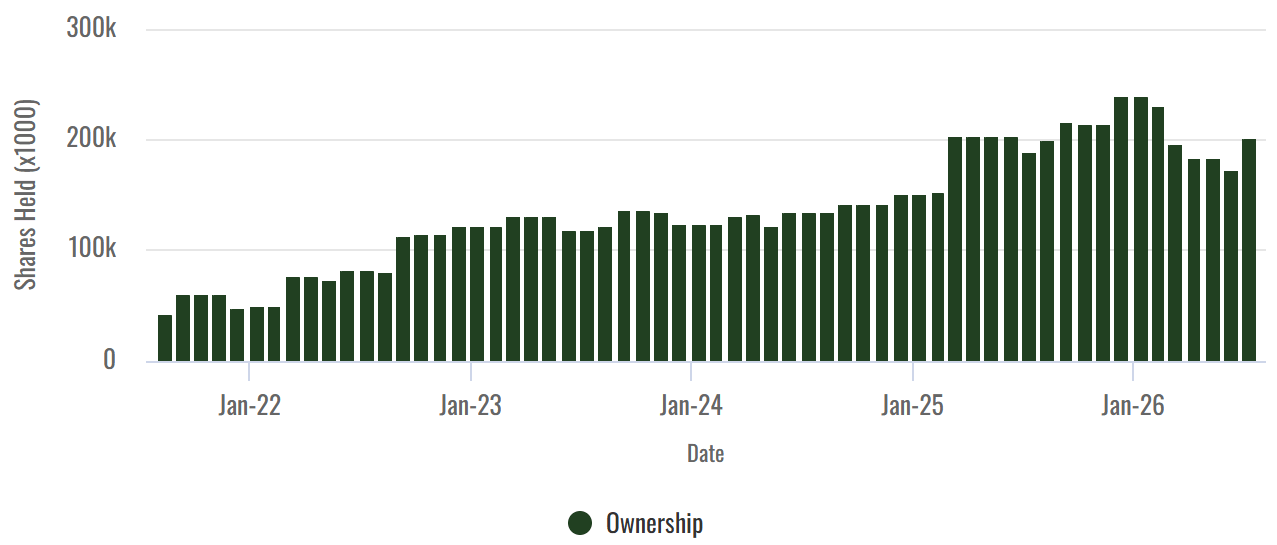
Institutional ownership: accumulation continued through the volatility, and the peptide vote brought a fresh wave of institutional attention. Q2 filings should confirm whether the Eucalyptus close pulled in long-term holders.

https://preview.redd.it/60k3wbrme4hh1.png?width=1080&format=png&auto=webp&s=8873c46ffc1fd519ee741c7fb50b8c24e8a443f5

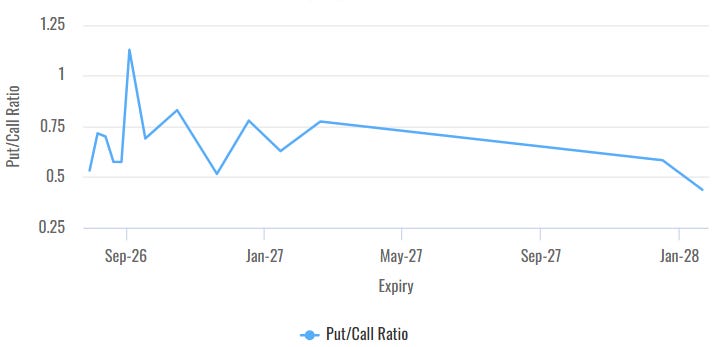
Put/Call ratio: heavily elevated near-dated puts through the FDA meeting, then dropping off for later expiries. Classic event hedging: the options market bought insurance for two specific days, not for the business.

https://preview.redd.it/ns4ayabne4hh1.png?width=716&format=png&auto=webp&s=e8138db01d8c5ee37301505ca2e39c330d19bca9

reddit.com
u/SwissTPortfolio — 17 days ago
▲ 3 r/AsymmetricAlpha+1 crossposts

Hims & Hers (HIMS): Here is why we are calm

Last Wednesday the FTC, joined by Utah and California, sued Hims & Hers over data-sharing and billing practices. The stock dropped double digits intraday.

Here is why we are calm: this lawsuit is the conclusion of an investigation that has been running for almost 3 years. It is not new information about the business, it is old information finally reaching a courtroom. We think this is temporary noise. A company like Hims has been building legal muscle for exactly these fights, and the same way META collected regulatory headlines for a decade while disrupting media, a company disrupting healthcare delivery should absolutely expect these headlines. They are the cost of being the disruptor. They do not change the business.

That is why someone could profit from the drop ahead of Q2 earnings on August 10, in a moment where I honestly expect more tailwinds than headwinds. July has been the most eventful month of the year for this name, and the most misunderstood. Start with the chart everybody should be looking at:

https://preview.redd.it/xlaedpuqjxgh1.png?width=799&format=png&auto=webp&s=3a7bc46fb6145a70ca4712c364498e640ffb1372

Novo Nordisk’s Wegovy pill has scaled to roughly 165,000 weekly prescriptions, while Eli Lilly’s competing oral sits near 24,000. That gap is not just a Novo win. It is a Hims win. Since the March agreement, Hims distributes Wegovy pills, Wegovy injections and Ozempic directly on its platform, so the fastest-growing oral GLP-1 in the market is being sold through our company’s front door. This is the whole platform argument: Hims does not need to win the drug war, it needs to be the place where patients buy whichever drug wins.

The Peptide scorecard the Market refuses to read

Then the peptides. The FDA’s Pharmacy Compounding Advisory Committee met on July 23-24 and recommended six of seven peptides for the 503A Bulks List, including BPC-157 (8-6 with one abstention), KPV, TB-500, MOTS-C, Epitalon and Semax, with only emideltide rejected. The committee broke with its own FDA staff scientists, who had recommended against all seven. The stock swung violently: up more than 10% on the BPC-157 vote (the most sought-after peptide in the world), then down more than 11% on the emideltide rejection, which frankly tells you the market is trading headlines rather than reading the scorecard.

https://preview.redd.it/cli7c2syjxgh1.png?width=879&format=png&auto=webp&s=f9c3c79a44e6823e42da82d424020816d06d0388

Six out of seven is a win. California peptide facility Hims bought in early 2025 is already built and waiting. The caveats are real: an advisory vote is a recommendation, not approval, and formal FDA rulemaking still has to happen (which typically takes 8 to 12 months or longer, so realistic availability runs into 2027). The popular use cases listed above are what these peptides are marketed for in wellness clinics and online, not what the FDA evaluated, and none of them are supported by robust clinical evidence of safety or efficacy.

Q2 lands August 10, and the Eucalyptus integration plus the Japan entry via Juniper are the numbers to watch.

What the smart money is doing

Institutional ownership: accumulation continued through the volatility, and the peptide vote brought a fresh wave of institutional attention. Q2 filings should confirm whether the Eucalyptus close pulled in long-term holders.

https://preview.redd.it/d4tgjnm4kxgh1.png?width=1277&format=png&auto=webp&s=744092e77cc5ceb634d78467c28a6a9f6a48fa00

Put/Call ratio: heavily elevated near-dated puts through the FDA meeting, then dropping off for later expiries. Classic event hedging: the options market bought insurance for two specific days, not for the business.

https://preview.redd.it/vb6hx2s6kxgh1.png?width=716&format=png&auto=webp&s=0de61f7a0d5aad5969bcc97fb88db676bb7ba736

Read full story here, alongside our Swiss Portfolio, our brand new Private Investment Dashboard to track in real time our movements, research, elegant special situations and high-quality content: https://swisstransparentportfolio.substack.com/p/swiss-portfolio-f1d

reddit.com
u/SwissTPortfolio — 18 days ago
▲ 4 r/AsymmetricAlpha+1 crossposts

Microsoft's most important quarter yet? What is the options market itself pricing?

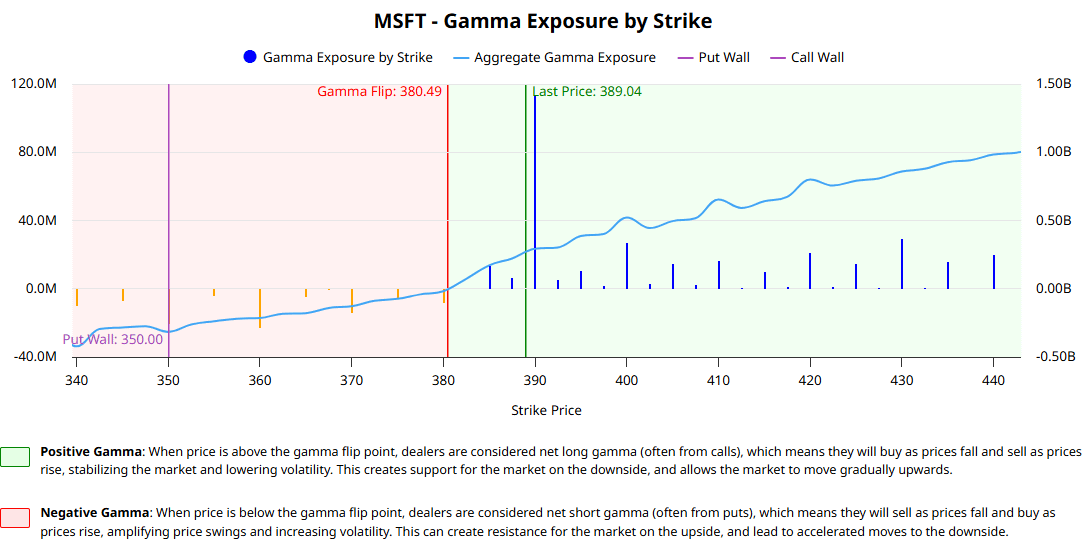
The weekly straddle implies roughly an 8% move, or about $360 to $420 from Friday’s close at $389. That’s larger than Microsoft’s typical earnings move, which has usually been closer to 4-5%. We wanted to see whether the options positioning supported that expectation, or whether implied volatility was running ahead of reality.

https://preview.redd.it/gr0gyic8p5gh1.png?width=1084&format=png&auto=webp&s=6234bd2cbf3698f799a1df0822df6a56703d2bd1

Microsoft is trading above the gamma flip, around 380.5, which keeps dealers in positive gamma. In that environment they tend to buy weakness and sell strength, helping stabilize price action. The put wall also stands out. It’s around $350, well below the current price, suggesting most downside protection has been bought further away rather than near current levels. That could change quickly if the stock trades back below the gamma flip.

The largest gamma position sits at the $390 strike, almost exactly where the stock has been trading. That helps explain why price action has been relatively quiet heading into earnings.

https://preview.redd.it/zqj1j83bp5gh1.png?width=801&format=png&auto=webp&s=c547ef7f0dec3547510fabc30992fcfa4db00ca6

The term structure points in the same direction. Put activity increases noticeably in the expirations following earnings before falling away again further out. That suggests the bigger concern is not necessarily Wednesday night, but what management says about FY2027 and how investors digest that over the following weeks, but overall bullish long term.

https://preview.redd.it/tk03ixlcp5gh1.png?width=875&format=png&auto=webp&s=ac4f469d10e6b537184e4a29cda77241ee7f80d5

And, finally, one chart outside the options market. Institutional ownership declined through the selloff earlier this year before recovering sharply in the most recent data. While short-term positioning has become the focus ahead of earnings, longer-term investors appear to have been adding during the weakness.

Putting everything together, we think the positioning is broadly supportive while Microsoft remains above the gamma flip. The main risk is straightforward. If the stock breaks below that level after guidance, dealer positioning becomes less supportive and the path toward the $350 put wall becomes much easier. That’s also the area where we’d be most interested in potentially adding. We have no interest in paying elevated implied volatility the day before earnings. If guidance disappoints and the stock sells off, we’d rather prefer the shares than the options.

Read full story here, alongside our Swiss Portfolio, our brand new Private Investment Dashboard to track in real time our movements, research, elegant special situations and high-quality content: https://swisstransparentportfolio.substack.com/p/microsofts-most-important-quarter

reddit.com
u/SwissTPortfolio — 22 days ago
▲ 20 r/AsymmetricAlpha+1 crossposts

Cerebras (CBRS): The Chip without HBM that could break the Memory Trade.

A 92% grower with a $24.6 billion backlog, down nearly 50% from its peak, built on an architecture that skips the memory powering SK Hynix, Micron and Samsung.

A chipmaker prices the largest AI IPO in history, doubles on day one, and two months later trades nearly 50% below its peak. Behind that violent tape sits a business growing revenue 92%, holding $3.3 billion of cash, carrying a $24.6 billion backlog worth roughly 48 times last year’s sales, and signed to a $20 billion deal with one of the most important AI company in the world.

https://preview.redd.it/0v789147hceh1.png?width=1600&format=png&auto=webp&s=80368783def798b85ce567bdc88c3b9770a085b0

And here is the twist that earns it a headline: its chips consume zero of the high-bandwidth memory that has repriced SK Hynix, Micron and Samsung into the trillions.

The hottest trade in all of semis has a disruptor hiding in plain sight, and almost nobody is truly understanding it.

The setup first, because it is striking. Cerebras priced the largest AI IPO ever at $185 in mid-May, opened at $350, touched $386.34, then fell as low as $160.81 in late June, nearly half off the peak in six weeks, before settling near $170 today.

https://preview.redd.it/vgp7r16fhceh1.png?width=1262&format=png&auto=webp&s=5ffdab34e8b8c0207020cef2d8e8b7808fa423e6

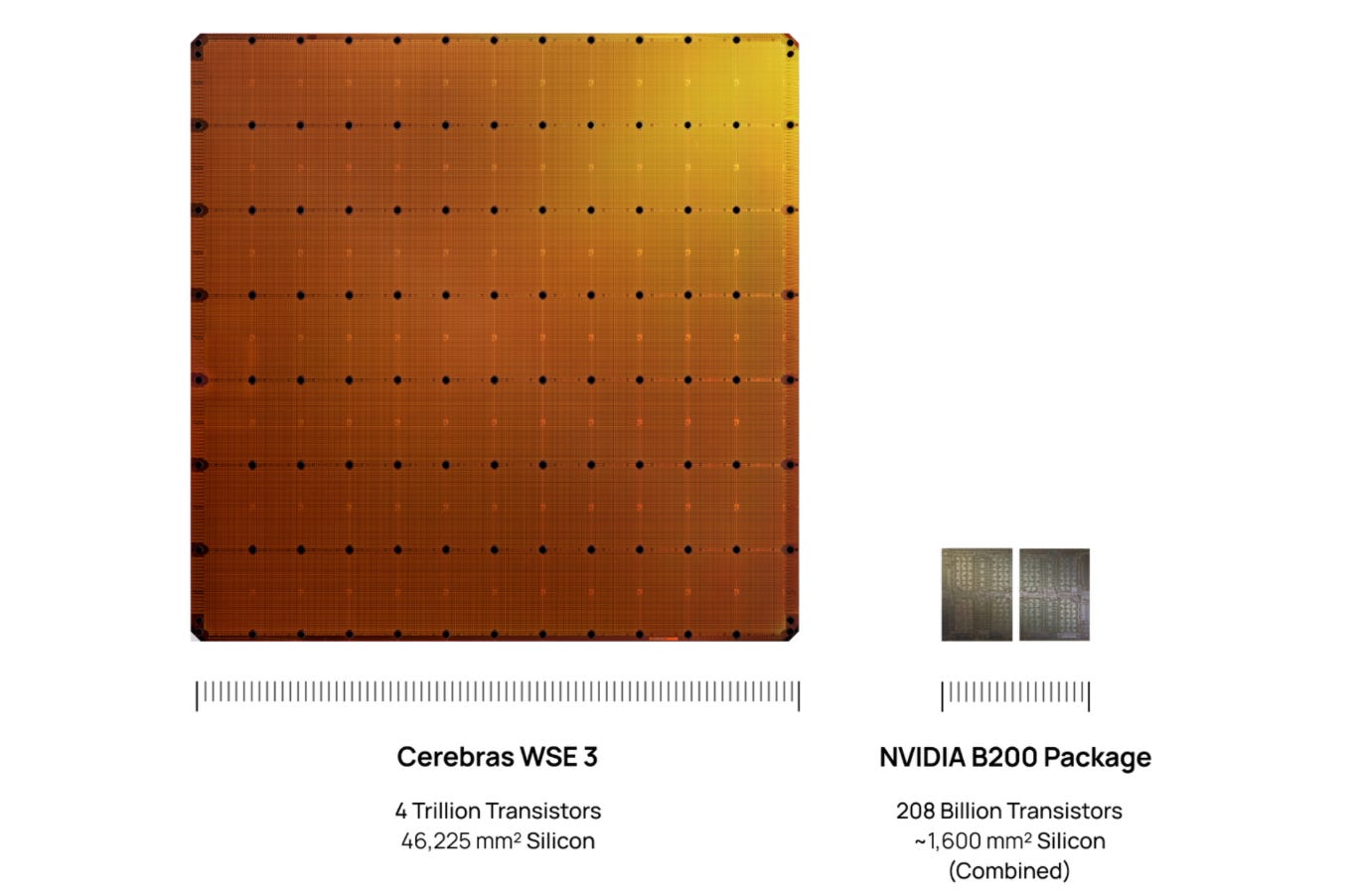
Cerebras builds AI compute around a single audacious idea: instead of stitching together thousands of small GPUs, it makes one chip the size of an entire silicon wafer, the Wafer Scale Engine, and delivers it in racks up to supercomputer scale. The architecture gives it genuine speed and cost advantages over GPUs specifically in inference, the serving of AI models, which is where the industry’s spending is migrating as agents and applications scale.

Source: cerebras.ai

Crucially, the company has pivoted from selling hardware to selling compute as a cloud service, which makes it part chip designer, part AI infrastructure provider, competing with Nvidia on one side and leaning on partners like AWS for distribution on the other.

Source: cerebras.ai

Read full story here, alongside our Swiss Portfolio, our brand new Private Investment Dashboard to track in real time our movements, research, elegant special situations and high-quality content: https://swisstransparentportfolio.substack.com/p/cerebras-cbrs-the-chip-without-hbm

reddit.com
u/SwissTPortfolio — 1 month ago
▲ 28 r/stockmarketcrash+2 crossposts

August and September are historically the 2 worst months of the year for equities

Since 1950, they are the only 2 months with negative average returns for the S&P 500, and September is the worst of all.

Macro experts are already out in force, predicting a bear market during these historically bad months, followed by new highs by the end of the year.

It is a wonderful story, and it may even be right.

u/SwissTPortfolio — 1 month ago
▲ 3 r/AsymmetricAlpha+1 crossposts

Netflix (NFLX) Q2 2026 Earnings Preview. What is the options market itself pricing?

The options market is bracing for a large move, and NFLX has a beautifully violent earnings history: an average one-day post-earnings move near 9.8%, with recent prints ranging from down 10% to up 11%, and the earnings-week implied move running around 8% to 10%. Front-week implied volatility sits near the 97th percentile, which guarantees a sharp volatility crush after the print. Now look at what dealers and the term structure are actually telling us:

https://preview.redd.it/ng2z6h16x6dh1.png?width=1364&format=png&auto=webp&s=1e80e9cf0ff865379283d35c9a113f7b5844428c

The gamma map is the more uncomfortable of the two. The last price at 73.94 sits below the Put Wall at 75, and the gamma flip is all the way up at 79.63, nearly 8% above spot. The entire trading zone around the print is negative gamma territory: dealers hedge with the move, selling as the stock falls and buying as it rises, amplifying whatever Thursday delivers. The aggregate gamma curve is most negative around the high-$60s, exactly where downside acceleration peaks, and the stabilizing green zone only begins after a rally of roughly the full implied move. The Call Wall at 90 is too far away to matter this week. Structurally, this is a slightly bearish setup: fragile below, with no dealer support until the flip.

https://preview.redd.it/ipmdz799x6dh1.png?width=1083&format=png&auto=webp&s=76b0e38d5d3788a72d3cbabb42e5f17b2eee0806

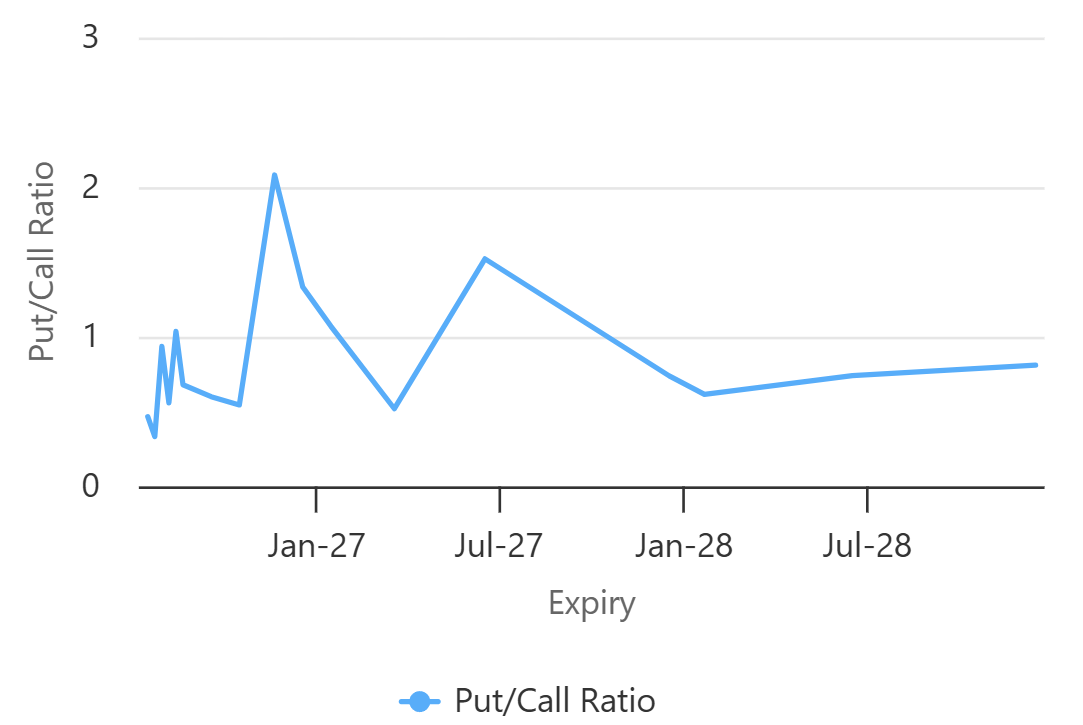
The put/call term structure adds the nuance. Near-dated expiries into the print sit well below 1.0, call-heavy and arguably complacent. The hedging hump comes later: ratios spike above 2.0 into the late-2026 expiries, telling us the market’s real fear is not this print but the next two or three quarters of engagement data. Then the ratio slides back toward 0.74 by mid-2028 and stays low. Nervous about the middle, bullish about the destination. The practical read: do not buy expensive options into an IV crush, and note that the zone of maximum dealer-driven overshoot, the high-$60s, is precisely our first add level. Forced selling there is a gift, not a warning.

Read full story here, alongside our Swiss Portfolio, our brand new Private Investment Dashboard to track in real time our movements, research, elegant special situations and high-quality content: https://swisstransparentportfolio.substack.com/p/netflix-nflx-q2-2026-earnings-preview

reddit.com
u/SwissTPortfolio — 1 month ago

ASML Q2 2026 Earnings Preview. What is the options market itself pricing?

Management guided Q2 to EUR 8.4 to 9.0 billion of total net sales, roughly EUR 2.5 billion of Installed Base Management revenue, and a gross margin of 51% to 52%, a deliberate step down from Q1’s 53.0% as the high-margin upgrade mix normalizes and headcount ramps ahead of the 2027 volume wave.

https://preview.redd.it/opim15i6uych1.png?width=1272&format=png&auto=webp&s=1b583d3d5fd8dc856965e095382b7fe21856fc73

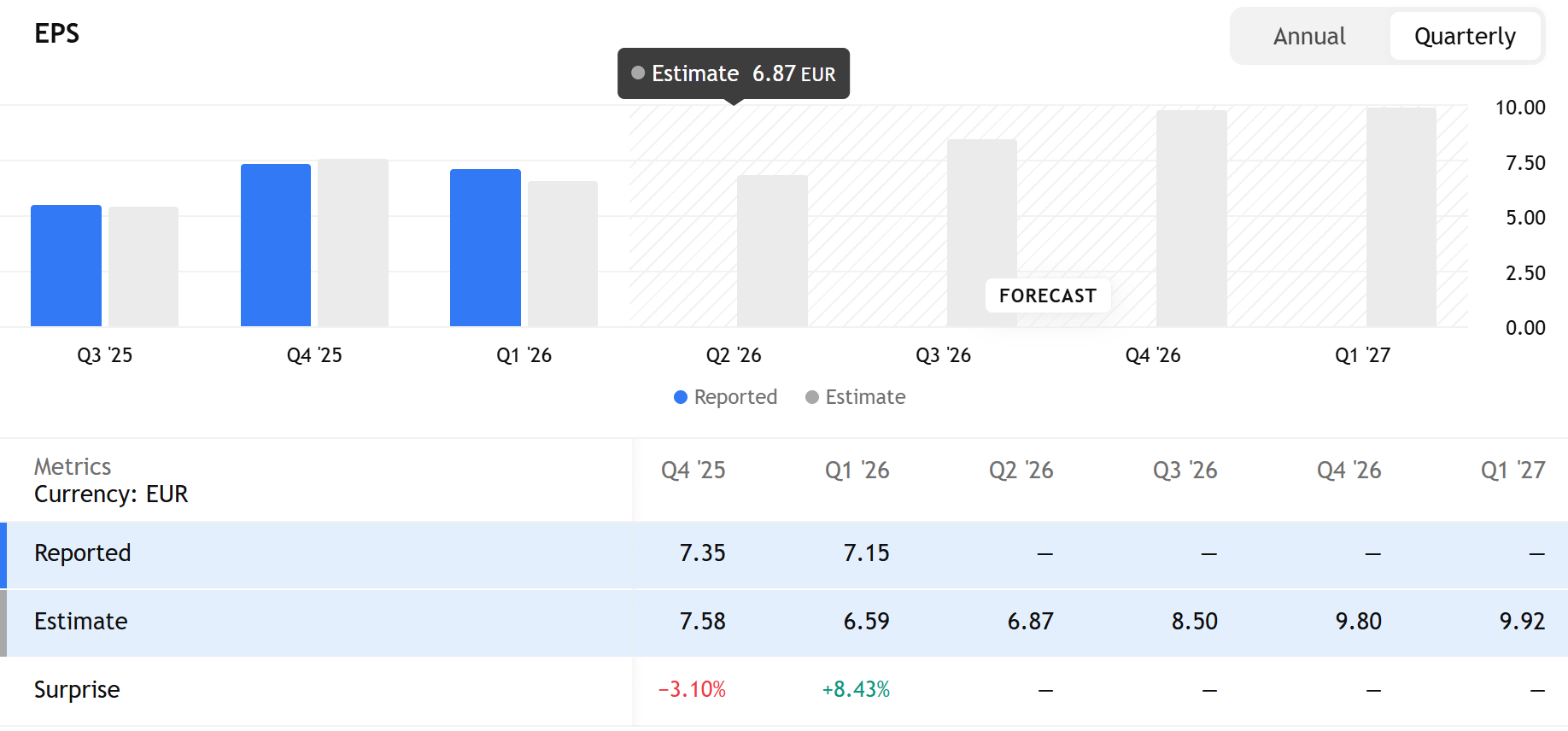
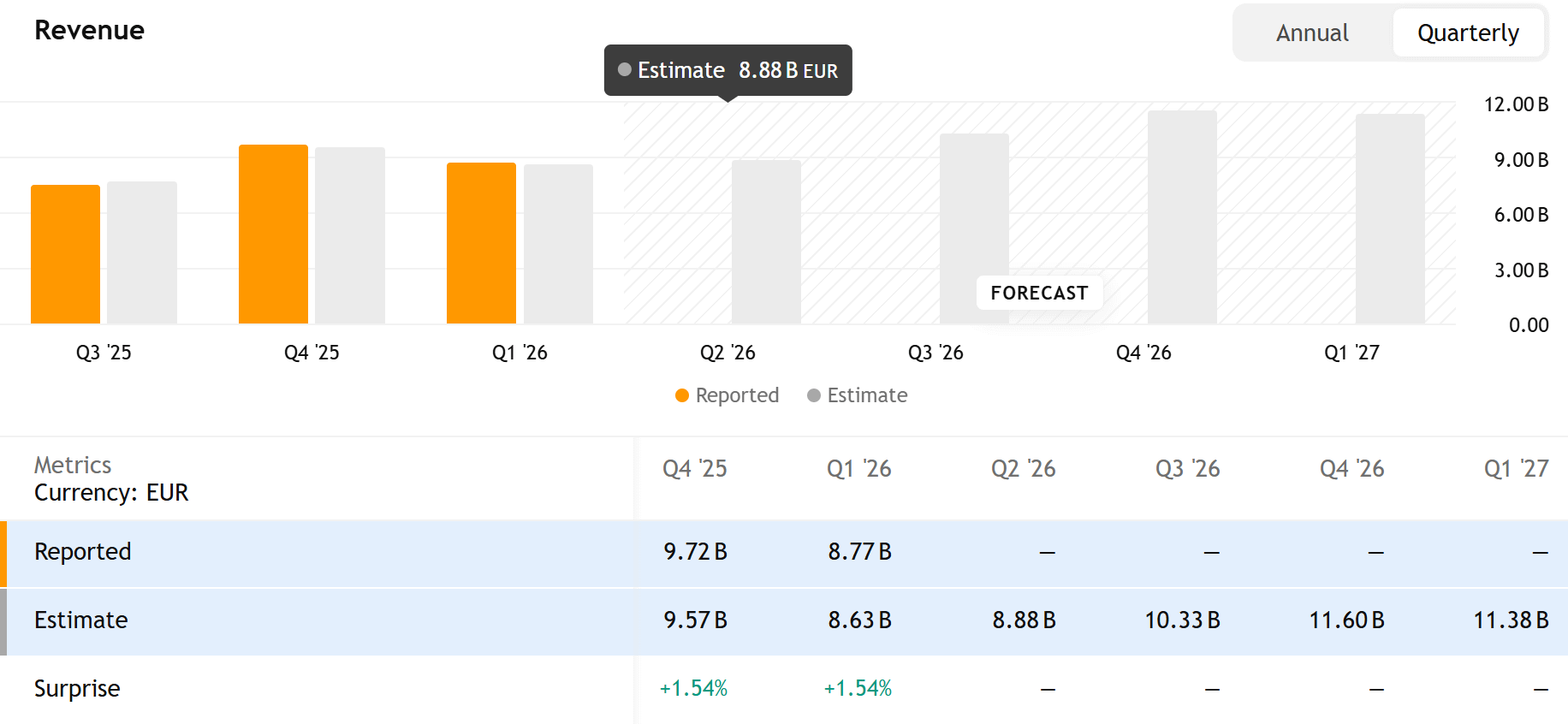
Consensus sits near the midpoint with EPS around EUR 6.87, up 16% from EUR 5.90 a year ago. The Q1 baseline was strong: EUR 8.77 billion in sales at the high end of guidance, EUV at EUR 4.1 billion including two High NA systems, services growing 25%, and, for the first time ever, memory taking 51% of system sales.

https://preview.redd.it/lvtrse5auych1.png?width=1836&format=png&auto=webp&s=4789975e8a1a243aad67f71747a1e0ee9de67957

And what is the options market itself pricing? The gamma map below tells a precise story. Four elements matter. The ADR last traded at 1,797, just below the gamma flip at 1,811, the level where aggregate dealer gamma crosses from negative to positive (the blue curve crossing zero). Below the flip, in the red zone, dealers hedge with the move: they sell as the stock falls and buy as it rises, amplifying every swing. Above it, in the green zone, they do the opposite and dampen volatility. The two purple lines are the guardrails: the Put Wall at 1,700, the strike with the heaviest put concentration and the natural magnet on a sell-off, roughly 5% below, and the Call Wall at 1,900, where dealer selling into strength caps rallies, roughly 6% above.

https://preview.redd.it/3uqma5yeuych1.png?width=2226&format=png&auto=webp&s=3d6c8fc0851f479af99300ea641a04330e08a9cd

The implication is a slightly bearish near-term signal, with an asymmetric twist. ASML walks into Wednesday in negative gamma territory, an unstable regime where a miss gets amplified downward, and the walls frame a market positioned for only a 5% to 6% swing, tight for a print of this importance and arguably complacent. But the flip sits just 0.8% above spot: a modestly positive reaction pushes the stock into stabilizing positive gamma, while a disappointment travels through an accelerant zone toward 1,700.

https://preview.redd.it/x7y7zr5iuych1.png?width=978&format=png&auto=webp&s=5c73bf61f61db2edb8e1f61a6647e8a69572bf6e

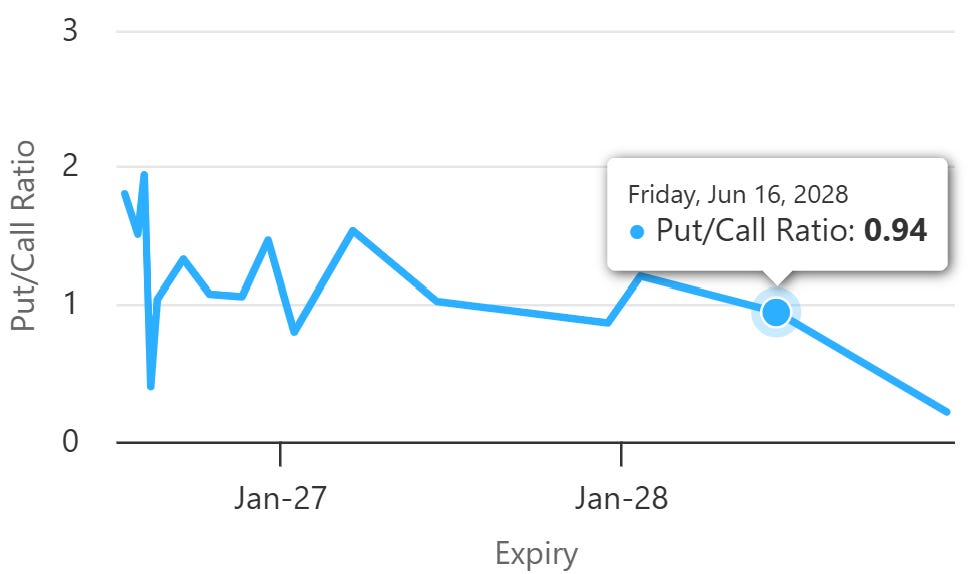
The term structure of the put/call ratio completes the picture: near-dated expiries around the print sit at or above 1.0, reflecting tactical hedging into Wednesday, but the ratio slides steadily toward 0.2 by late 2028. In other words, the options market is nervous about the event and unambiguously bullish about the destination, which is exactly the setup a patient long-term holder wants.

Read full story here, alongside our Swiss Portfolio, our brand new Private Investment Dashboard to track in real time our movements, research, elegant special situations and high-quality content: https://swisstransparentportfolio.substack.com/p/asml-q2-2026-earnings-preview

reddit.com
u/SwissTPortfolio — 1 month ago

The Most Profitable Company on Earth (GOOGL) Just Said It Doesn’t Have Enough Money. That Is the Bullish Part.

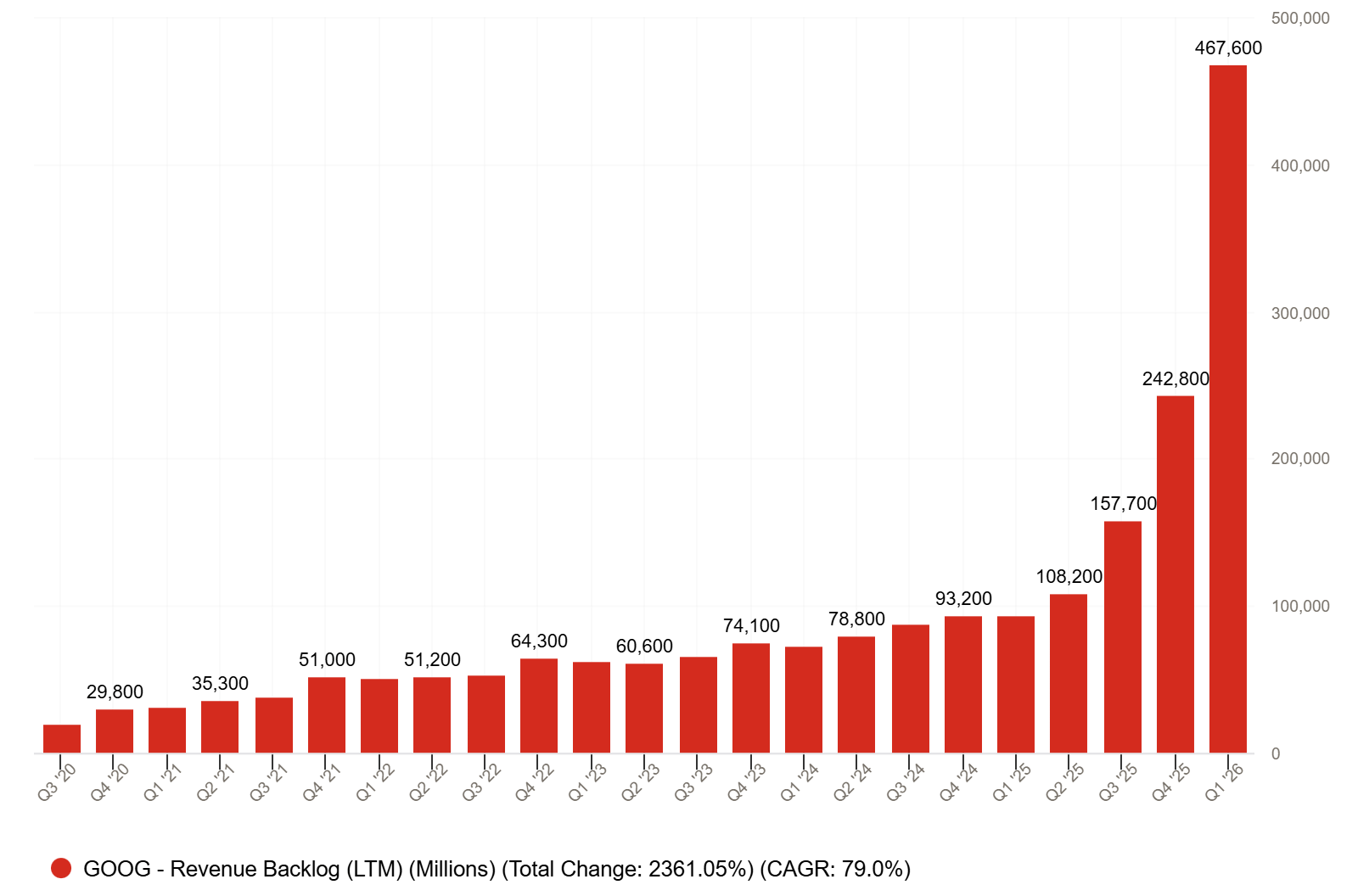
An $80 billion equity raise from a business that earns ~$130B a year and ~$174B in operating cash flow.

The internet called it the top. We think it is one of the most strategic moves this company has ever made. Here is why.

Start with the contradiction, because it is the entire hook. The companies that dilute shareholders to raise cash are supposed to be small, unprofitable, and starved of scale. This one is the opposite of all three. It throws off roughly $174 billion of operating cash flow a year and over $130 billion of normalized net income, numbers that rival entire nations.

https://preview.redd.it/a4ehzoqfya5h1.png?width=1600&format=png&auto=webp&s=baa2eb309aba6fbfe123938f120d2663175f04fd

And yet it just went to the equity markets, willingly diluting holders, to raise $80 billion. One of the largest equity raises ever printed by a public company, possibly the largest.

The headline numbers, before we go further:

  • 💸 The raise: a proposed $80B equity capital raise to expand AI infrastructure and compute, confirmed by the company itself.
  • 🏦 The cash machine behind it: ~$170B operating income, ~$130B normalized net income, ~$174B operating cash flow over the trailing twelve months. Second only to one chipmaker.
  • 🏗️ The reason it isn’t enough: 2026 capex is guided to $180-190B, more than the company earns in a year, and 2027 is guided to increase “significantly” from there.
  • 💳 Debt already tapped: ~$85B raised across six currencies in the last twelve months, lifting total debt past $100B. The debt window is closing; equity is the next lever.
  • ⏱️ The timing tell: this lands just before a wave of mega-IPOs (a ~$75B space raise, plus $100B-scale rounds from the leading AI labs) all chasing the same finite pool of capital.

The reaction online was near-uniform: bubble, exit liquidity, the beginning of the end. We are going to take the other side. This is not a company lighting money on fire. It is the most strategic capital move it has made in years, and once you see the logic, it makes the business more investable, not less.

What the raise actually signals

A company this profitable does not dilute holders on a whim. It does it when its conviction is absolute. Read the move correctly and it tells you one thing above all: management no longer treats AI demand as speculation. They are not rolling dice. They sit on more data points than anyone, search, a top-tier model, and a large enterprise cloud book, and every one of those signals is screaming the same message: they need more capacity than they can build. You do not put $80B of fresh equity on the table at this scale unless the demand is, to you, a certainty.

The real constraint here is not money or models. It is compute. Management has said plainly for over a year that capacity is the single biggest thing standing between them and consolidating an enormous share of AI demand: power, land, supply chain, all of it. The most painful detail is that they are reportedly turning away enterprise customers because they cannot serve the demand. Imagine owning the chips, the models, the security, and the distribution after a decade of building, and still having to say no to paying clients for lack of physical infrastructure. That is the frustration this raise is meant to end.

https://preview.redd.it/px12thklya5h1.png?width=1600&format=png&auto=webp&s=77bae2724bfb648492fee66539626f7b8150a7b7

Why a money machine still has to raise

The obvious objection: if it earns ~$170B in operating income, why not self-fund? Because the spend is bigger than the earnings. Capex is guided to $180-190B in 2026 alone, already far above the ~$130B analysts had penciled in, and explicitly higher again in 2027. The company makes a lot of money. It does not make $250B. So it funds the gap externally. It already drained the debt markets, ~$85B in a year, and pushing total debt toward $180B would pressure the rating and the interest bill at exactly the moment lenders are tightening terms. With debt sour, equity is the rational next move, not a distress signal.

https://preview.redd.it/1p7ftexmya5h1.png?width=1600&format=png&auto=webp&s=a1e308a2cc55a30ed6fa1991381d0781f19ca72d

The part the bubble crowd missed: a preemptive strike

Here is the move inside the move, and it is beautiful. There is a finite pool of capital willing to fund AI right now, and a queue of giants about to compete for it: a ~$75B space-company IPO within weeks, then $100B-scale rounds from the leading AI labs. By raising $80B of equity first, the company drinks from that pool before the others reach it. That is a double win: it funds its own buildout cheaply while draining the oxygen its competitors need to fund theirs. It is not just advantaging itself; it is actively disadvantaging the challengers trying to catch up.

And the capital lands on a vertically integrated base, not a commodity reseller. Custom chips built years ahead of most rivals, a leading model, the security layer, and the distribution to put it all in front of billions of users. That is what turns a capex number into a widening moat rather than a cash bonfire. The bears see spending. We see a business buying scarcity, capacity, before its rivals can.

https://preview.redd.it/h2a6cg7oya5h1.png?width=1600&format=png&auto=webp&s=91e9610d7850e03daea8228ebe6664514743e210

What it means for this year and next

For 2026, expect the story to be dominated by the spend: $180-190B of capex, the equity raise closing, and the market arguing every quarter about whether the returns justify it. The honest near-term risk is real, this much capex compresses free cash flow and gives skeptics ammunition if AI revenue does not visibly scale with it. For 2027, the company has already told us capex rises significantly again, so the test simply repeats at a larger size. The bull path is straightforward: capacity comes online, the turned-away demand converts to revenue, and the cloud and AI lines compound into the infrastructure. The bear path is that the spend outruns the monetization and the multiple pays for it. Both are credible. The raise is what makes the bull path physically possible.

Dates and events to follow

  • The $80B equity raise close: watch the structure, pricing, and exact dilution. The terms decide how much the move actually costs holders.
  • Next quarterly earnings: the first read on capex pacing, cloud growth, and whether capacity is converting the backlog of turned-away demand into revenue.
  • The ~$75B SpaceX IPO (June 12): the first big test of how much AI-adjacent capital the market will absorb after this raise.
  • The leading AI-lab IPOs / mega-rounds: $100B-scale raises that will reveal whether the preemptive-strike thesis is working, i.e. whether rivals struggle for capital.
  • 2027 capex guidance updates: the “significant” increase gets a number. That figure will reset the whole debate.

Our take

Strip away the panic and what you have is a best-in-class operator with absolute conviction in AI demand, a constraint that is physical rather than financial, and a capital plan that funds the buildout while starving the competition of oxygen. The dilution is real and the capex is enormous, so this is not free, and a holder should expect noisier free cash flow and a louder bubble chorus along the way. But the move itself is a signal of strength dressed up, to the untrained eye, as weakness.

We read the $80B raise as strategic offense, not distress. It makes the business more investable, not less, provided you have the stomach for the spend and the patience to let the capacity convert. Watchlist-worthy at minimum, and a name we are comfortable defending here, even with the whole timeline shouting bubble.

Read full story here, alongside our Swiss Portfolio, our brand new Private Investment Dashboard to track in real time our movements, research, elegant special situations and high-quality content: https://swisstransparentportfolio.substack.com/p/the-most-profitable-company-on-earth

Read us. Join us. Sleep well. ✨

reddit.com
u/SwissTPortfolio — 3 months ago

Hims & Hers (HIMS) What Moves Hims From Here?

Q1 2026 looked ugly on the headline and entirely different on the substance: this is the trough quarter of a deliberate strategic pivot, and Q1 captured roughly one week of full branded Ozempic and Wegovy sales after the late-March launch. The transition’s costs are all in the print. Almost none of the new revenue is.

The numbers. Revenue: $608.1M, +4% YoY, missing $616.85M consensus. GAAP EPS: -$0.40 vs Street +$0.03. Net loss: $92.1M, swinging from +$49.5M last year.

Gross margin: 65%, down 800 bps and including $33.5M of restructuring charges for the compounded-GLP-1 write-down. Adjusted EBITDA: $44.3M, -51% YoY. ARPU: $80, down from $85. U.S. revenue: -8% YoY as compounded GLP-1s were phased out. Subscribers grew 9% to 2.584M, a sharp deceleration from the 111% top-line growth in this same quarter last year.

The parts that recalibrate the picture. Rest-of-world revenue: $78.2M from $7.3M, +969% YoY, validating the international diversification thesis. FY2026 revenue raised to $2.8B-$3.0B (+$100M on both ends) and Q2 guide: $680-$700M, well above consensus and implying ~16-19% sequential acceleration. The Q2 raise is the most important number in the report. It reflects branded GLP-1s flowing through plus the new $39-$149/month weight-loss membership program (med pricing as low as $149/month) plus the absence of the lawsuit overhang. The Eucalyptus acquisition closes in roughly three weeks, bringing $700-$900M of incremental revenue (post-close GAAP recognition only). Adjusted EBITDA was cut $25M to $275M-$350M, but the margin guide was raised to 10-12% from 6-9%. H1 trough, H2 recovery, 2027 inflection.

The forward catalyst stack is where this position earns its keep. First, the peptide and longevity vertical. The July 2026 FDA meeting on lifting restrictions on 12 peptides plus the RFK Jr. administrative push creates a credible path for HIMS’ longevity specialty (peptides, coenzymes, GLP/GIP combos). HIMS already acquired a peptide manufacturing facility in California in 2025: capacity is built, waiting for the regulatory window. High-margin, sticky, no compounded-pharma overhang.

Second, broader GLP-1 expansion beyond Novo Nordisk: LLY’s Zepbound and Mounjaro plus future branded partnerships, with oral GLP-1 formulations removing the injection stigma and unlocking mass-market adoption.

Third, ARPU re-acceleration as more FDA-approved GLP-1 products and doses flow through. CEO Andrew Dudum has been consistent that the “tremendous growth opportunities” sit precisely here.

Fourth, the reaffirmed 2030 targets of $6.5B+ revenue and $1.3B+ Adjusted EBITDA, implying 2.2x revenue growth over four years and a return to ~20% EBITDA margins. None of this is unreasonable. None of it shows up in Q1 either.

Institutional accumulation through Q1 was large and concentrated:

Meanwhile, short interest remained elevated, but below peak levels:

We are not adding yet, but we don’t discard improving our cost average with a new buy below $25 levels. The position is held because the 2030 targets are credible, the international flywheel is real, Eucalyptus closes in three weeks with $700-$900M of incremental revenue, the peptide vertical has a July regulatory catalyst, and Q1 captured almost none of the branded GLP-1 economics. If Q2 hits the top of $680-$700M with stable 65% gross margins and visible Eucalyptus contribution, we already know how this stock can swing by year-end. If Q2 misses again or gross margin slips below 64%, volatility is guaranteed. The thesis is on probation, not broken. Best-in-class telehealth platforms with 2.6M paying subscribers, a $3B revenue run-rate accelerating into Q2, peptide capacity ready for a regulatory tailwind, and a credible path to 5x scale by 2030 do not trade at $24 for very long. “Not very long” still means “could trade at $20 first” too.

Imho, the market hasn't connected the dots yet. Worth revisiting our original thesis and Financial & Valuation models.

u/SwissTPortfolio — 3 months ago
▲ 3 r/AsymmetricAlpha+1 crossposts

Hims & Hers (HIMS) What Moves Hims From Here?

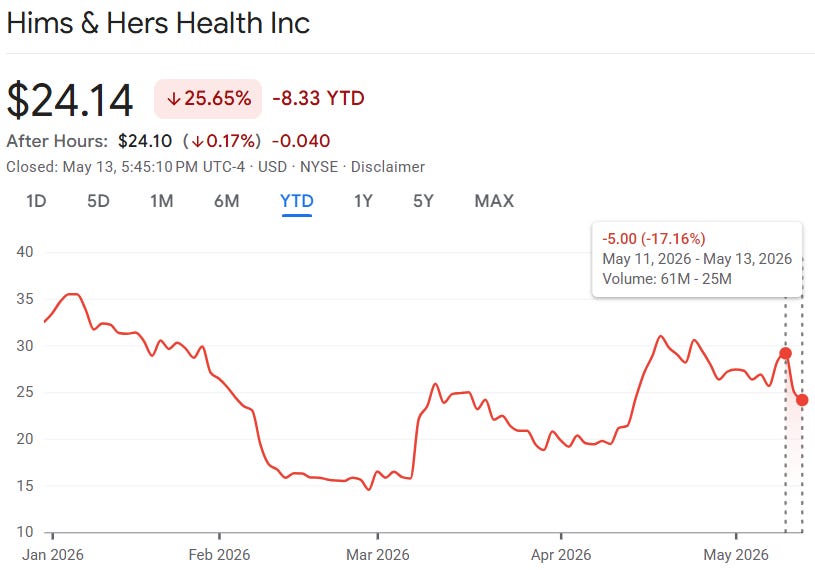
Current price: ~$24 (May 13 intraday, after a 15.2% drop from $29.07 to $24.66 on May 12). Position return: ~-23%.

https://preview.redd.it/snb0au8pr21h1.png?width=815&format=png&auto=webp&s=90fe25bcc946a27bb06708f5851f045ca36fd293

Q1 2026 looked ugly on the headline and entirely different on the substance: this is the trough quarter of a deliberate strategic pivot, and Q1 captured roughly one week of full branded Ozempic and Wegovy sales after the late-March launch. The transition’s costs are all in the print. Almost none of the new revenue is.

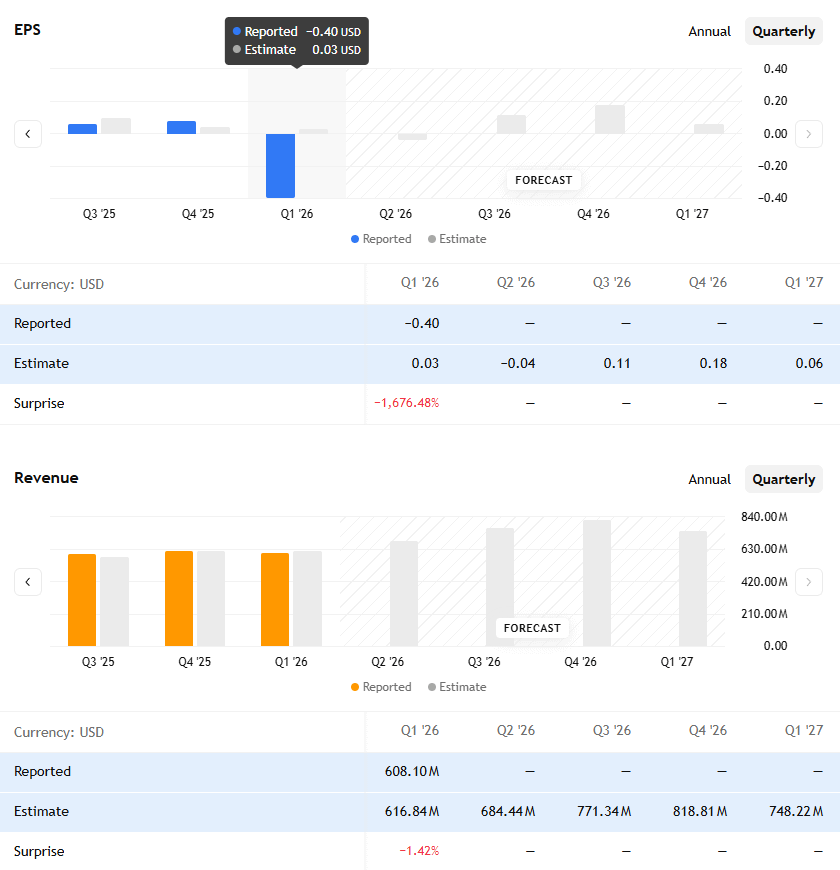
The numbers. Revenue: $608.1M, +4% YoY, missing $616.85M consensus. GAAP EPS: -$0.40 vs Street +$0.03. Net loss: $92.1M, swinging from +$49.5M last year.

https://preview.redd.it/aeq7k6ctr21h1.png?width=840&format=png&auto=webp&s=0181e3272cd26aee1cef13d8c250949c5f83681a

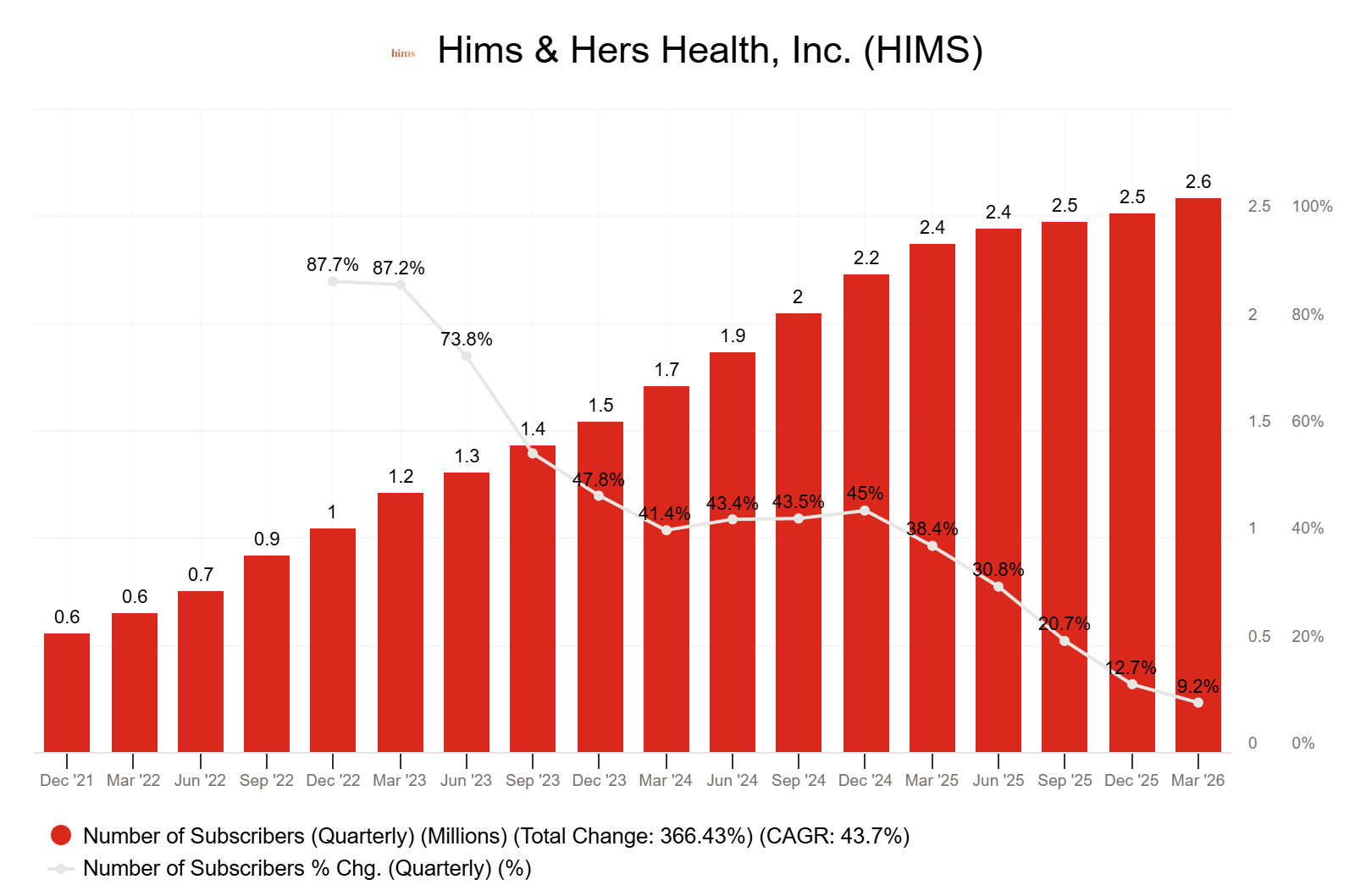
Gross margin: 65%, down 800 bps and including $33.5M of restructuring charges for the compounded-GLP-1 write-down. Adjusted EBITDA: $44.3M, -51% YoY. ARPU: $80, down from $85. U.S. revenue: -8% YoY as compounded GLP-1s were phased out. Subscribers grew 9% to 2.584M, a sharp deceleration from the 111% top-line growth in this same quarter last year.

https://preview.redd.it/76679zlur21h1.png?width=1600&format=png&auto=webp&s=cb7ae414fdb1c32b937c759eddfbfa82682da8d8

The parts that recalibrate the picture. Rest-of-world revenue: $78.2M from $7.3M, +969% YoY, validating the international diversification thesis. FY2026 revenue raised to $2.8B-$3.0B (+$100M on both ends) and Q2 guide: $680-$700M, well above consensus and implying ~16-19% sequential acceleration. The Q2 raise is the most important number in the report. It reflects branded GLP-1s flowing through plus the new $39-$149/month weight-loss membership program (med pricing as low as $149/month) plus the absence of the lawsuit overhang. The Eucalyptus acquisition closes in roughly three weeks, bringing $700-$900M of incremental revenue (post-close GAAP recognition only). Adjusted EBITDA was cut $25M to $275M-$350M, but the margin guide was raised to 10-12% from 6-9%. H1 trough, H2 recovery, 2027 inflection.

The forward catalyst stack is where this position earns its keep. First, the peptide and longevity vertical. The July 2026 FDA meeting on lifting restrictions on 12 peptides plus the RFK Jr. administrative push creates a credible path for HIMS’ longevity specialty (peptides, coenzymes, GLP/GIP combos). HIMS already acquired a peptide manufacturing facility in California in 2025: capacity is built, waiting for the regulatory window. High-margin, sticky, no compounded-pharma overhang.

https://preview.redd.it/hzcw8tcxr21h1.png?width=924&format=png&auto=webp&s=7a91e0feeaa74234c1a54492b83ef399d4c3f48d

Second, broader GLP-1 expansion beyond Novo Nordisk: LLY’s Zepbound and Mounjaro plus future branded partnerships, with oral GLP-1 formulations removing the injection stigma and unlocking mass-market adoption.

Third, ARPU re-acceleration as more FDA-approved GLP-1 products and doses flow through. CEO Andrew Dudum has been consistent that the “tremendous growth opportunities” sit precisely here.

Fourth, the reaffirmed 2030 targets of $6.5B+ revenue and $1.3B+ Adjusted EBITDA, implying 2.2x revenue growth over four years and a return to ~20% EBITDA margins. None of this is unreasonable. None of it shows up in Q1 either.

Institutional accumulation through Q1 was large and concentrated:

https://preview.redd.it/br3zn2nzr21h1.png?width=2366&format=png&auto=webp&s=867ed01b64082302285ed9af58cfa8ac9b835fb9

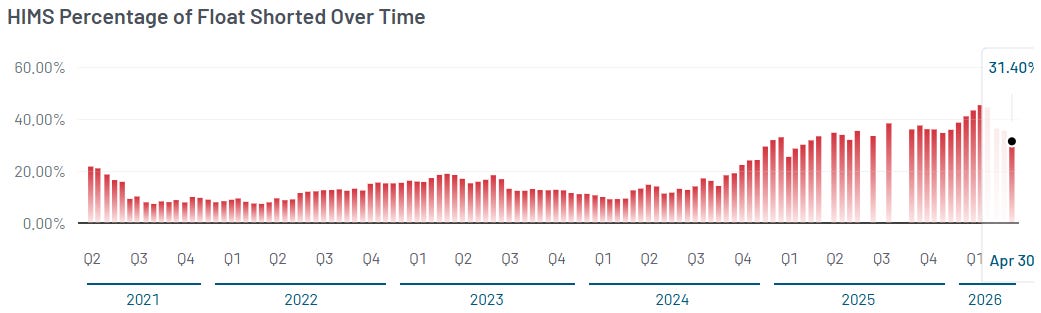
Meanwhile, short interest remained elevated, but below peak levels:

https://preview.redd.it/lw3vvlw0s21h1.png?width=1041&format=png&auto=webp&s=caefea722d2e214e460b247df0053c65305b8afc

We are not adding yet, but we don’t discard improving our cost average with a new buy below $25 levels. The position is held because the 2030 targets are credible, the international flywheel is real, Eucalyptus closes in three weeks with $700-$900M of incremental revenue, the peptide vertical has a July regulatory catalyst, and Q1 captured almost none of the branded GLP-1 economics. If Q2 hits the top of $680-$700M with stable 65% gross margins and visible Eucalyptus contribution, we already know how this stock can swing by year-end. If Q2 misses again or gross margin slips below 64%, volatility is guaranteed. The thesis is on probation, not broken. Best-in-class telehealth platforms with 2.6M paying subscribers, a $3B revenue run-rate accelerating into Q2, peptide capacity ready for a regulatory tailwind, and a credible path to 5x scale by 2030 do not trade at $24 for very long. “Not very long” still means “could trade at $20 first” too.

Read full story here, alongside our Swiss Portfolio, our brand new Private Investment Dashboard to track in real time our movements, research, elegant special situations and high-quality content: https://open.substack.com/pub/swisstransparentportfolio/p/swiss-portfolio-9a2?r=52o9v1&utm_campaign=post-expanded-share&utm_medium=web

Read us. Join us. Sleep well. ✨

reddit.com
u/SwissTPortfolio — 3 months ago

The numbers are starting to align beautifully

Remaining performance obligations, a.k.a. backlog, jumped from $16.5M in 2024 to $55.9M in 2025. A 3.4x move in twelve months. That alone tells a story most of the market hasn't priced in.

Management expects roughly 39% of that $55.9M, around $21.8M, to convert into 2026 revenue. The remaining 61% rolls in thereafter. Clean, contracted, already-signed business sitting on the balance sheet, just waiting to be recognized.

But the real beauty is in what RPOs leave out. Contracts with original durations under twelve months don't even appear in that number. Given the velocity of $SPCB's smaller-ticket deal flow, there's likely another $25-30M+ of shorter-cycle work already embedded in total backlog, invisible to anyone reading the headline figure.

Layer in the new EU contracts coming online and the weekly stream of contract wins out of the ramping US market, and 2026 revenue could realistically print north of $60M. More than double 2025. The US is the strategic theater here, the one with the largest TAM, the highest margins, the longest runway and the best business model (recurring revenue, pay per use). That is the engine.

At $60M in 2026 sales, $SPCB could generate over $3 in EPS. Apply a non-sense 10x multiple, and you get a 3-bagger. Apply a 25x one, well within range for a profitable, growing security tech name with this kind of operating leverage, and you arrive at a $75 share price. From today's levels, that's a potential 9-bagger.

Of course, execution is everything, do you own due diligence, not financial advise. Contract timing slips. Recognition lumps. But the building blocks are visible, contracted, and accelerating. Imho, the market hasn't connected the dots yet.

Worth revisiting our original thesis and Financial & Valuation models.

u/SwissTPortfolio — 4 months ago

The numbers are starting to align beautifully

Remaining performance obligations, a.k.a. backlog, jumped from $16.5M in 2024 to $55.9M in 2025. A 3.4x move in twelve months. That alone tells a story most of the market hasn't priced in.

https://preview.redd.it/1kqnmkuak4yg1.png?width=1366&format=png&auto=webp&s=120762162b1b624f0adcac59b43ee95ace65186d

Management expects roughly 39% of that $55.9M, around $21.8M, to convert into 2026 revenue. The remaining 61% rolls in thereafter. Clean, contracted, already-signed business sitting on the balance sheet, just waiting to be recognized.

But the real beauty is in what RPOs leave out. Contracts with original durations under twelve months don't even appear in that number. Given the velocity of $SPCB's smaller-ticket deal flow, there's likely another $25-30M+ of shorter-cycle work already embedded in total backlog, invisible to anyone reading the headline figure.

Layer in the new EU contracts coming online and the weekly stream of contract wins out of the ramping US market, and 2026 revenue could realistically print north of $60M. More than double 2025. The US is the strategic theater here, the one with the largest TAM, the highest margins, the longest runway and the best business model (recurring revenue, pay per use). That is the engine.

At $60M in 2026 sales, $SPCB could generate over $3 in EPS. Apply a non-sense 10x multiple, and you get a 3-bagger. Apply a 25x one, well within range for a profitable, growing security tech name with this kind of operating leverage, and you arrive at a $75 share price. From today's levels, that's a potential 9-bagger.

Of course, execution is everything, do you own due diligence, not financial advise. Contract timing slips. Recognition lumps. But the building blocks are visible, contracted, and accelerating. Imho, the market hasn't connected the dots yet.

Worth revisiting our original thesis and Financial & Valuation models.

reddit.com
u/SwissTPortfolio — 4 months ago

The numbers are starting to align beautifully

Remaining performance obligations, a.k.a. backlog, jumped from $16.5M in 2024 to $55.9M in 2025. A 3.4x move in twelve months. That alone tells a story most of the market hasn't priced in.

Management expects roughly 39% of that $55.9M, around $21.8M, to convert into 2026 revenue. The remaining 61% rolls in thereafter. Clean, contracted, already-signed business sitting on the balance sheet, just waiting to be recognized.

But the real beauty is in what RPOs leave out. Contracts with original durations under twelve months don't even appear in that number. Given the velocity of $SPCB's smaller-ticket deal flow, there's likely another $25-30M+ of shorter-cycle work already embedded in total backlog, invisible to anyone reading the headline figure.

Layer in the new EU contracts coming online and the weekly stream of contract wins out of the ramping US market, and 2026 revenue could realistically print north of $60M. More than double 2025. The US is the strategic theater here, the one with the largest TAM, the highest margins, the longest runway and the best business model (recurring revenue, pay per use). That is the engine.

At $60M in 2026 sales, $SPCB could generate over $3 in EPS. Apply a non-sense 10x multiple, and you get a 3-bagger. Apply a 25x one, well within range for a profitable, growing security tech name with this kind of operating leverage, and you arrive at a $75 share price. From today's levels, that's a potential 9-bagger.

Of course, execution is everything, do you own due diligence, not financial advise. Contract timing slips. Recognition lumps. But the building blocks are visible, contracted, and accelerating. Imho, the market hasn't connected the dots yet.

Worth revisiting our original thesis and Financial & Valuation models.

reddit.com
u/SwissTPortfolio — 4 months ago