Using the TM-39-25 flicker standard to classify lighting (better than IEEE-1789)
▲ 21 r/PWM_Sensitive+2 crossposts

Using the TM-39-25 flicker standard to classify lighting (better than IEEE-1789)

TM-39-25 is a document from the Illuminating Engineering Society that puts forth a classification system that seeks to reduce human responses to flicker. I often call the classification system itself "TM-39-25".

The system utilizes three different flicker effect visibility metrics, Mp, SVM, and PAVM. These metrics are scores computed from the flicker waveform that seek to predict the likelihood of a "temporal light artifact". I go over each metric in detail in the video, but here's a summary table:

https://preview.redd.it/wcv2st4dl8kh1.png?width=2720&format=png&auto=webp&s=959251de6d086b0e7e14ac6f2db3e2f29c9538ed

Simply put, a temporal light artifact is a visual disturbance of some kind due to flicker. TM-39-25 classifies light sources based on all three metrics simultaneously. I see this classification system as a vastly improved (but not perfect) replacement for IEEE-1789 classification, which are the frequently posted here as part of the results the Opple Light Master produces. Here's how the metrics scores map to the classifications:

https://preview.redd.it/eu77sdtkl8kh1.png?width=1505&format=png&auto=webp&s=bdaab419feb5c6a00f6c45dcbbc1bf5b39487d0b

I think this standard can be used as a replacement for the IEEE-1789 classification. The three metrics or "scores" it uses provide much more useful information and were created based on the results of experimental studies.

I have built this system into the flicker meter I'm working on (TLM-110), and used it to measure a variety of bulbs:

https://preview.redd.it/k6h1yilfk8kh1.png?width=2300&format=png&auto=webp&s=4bc5c3624bc7fd71a4c7f82ab347d5ebf3180e51

You can see there's a wide range of classifications in the bulbs I tested, as well as a large spread in the scores. The bulbs that are "Not Recommended" are unbearable to me, while the bulbs that are "Better" are much more tolerable.

I think this system has the ability to be broadly useful, especially for non-experts. However it isn't perfect. Firstly, while it technically applies to all light sources (displays included), it is most relevant to lighting such as bulbs and lamps. There are likely screen-specific flicker effects that haven't been described yet. Also, it mainly predicts the visibility of flicker artifacts, which are visual disturbances, not health effects. I think flicker artifacts and visual disturbances may be correlated, but there is not a one-to-on relationship.

Thanks to u/Rx7Jordan for making me aware of this standard.

youtu.be
u/BearNecessary4141 — 1 day ago
▲ 84 r/PWM_Sensitive+1 crossposts

An Update on r/PWM_Sensitive Moderation

Many of you have noticed that r/PWM_Sensitive has gone through some growing pains when it comes to how posts and comments are moderated. While the subreddit was never unmoderated, it became clear that some additional help was needed due to personal circumstances, and that a fresh approach to moderation would benefit the community.

We are happy to share that u/the_top_g, the creator of r/PWM_Sensitive, has graciously stepped aside to welcome in three enthusiast community contributors to help with moderation and the future direction of the subreddit. We sincerely appreciate the trust he has placed in us and, most importantly, his work in creating this community in the first place.

The interim moderation team is currently discussing ways to improve the subreddit while preserving what has made it such a useful resource for people who are sensitive to PWM, display flicker, and related technologies. Our goal is to keep this an open, welcoming, and informative community where people can share their experiences, testing, research, questions, and device recommendations without unnecessary barriers.

AutoModerator Changes

Perhaps the most noticeable (and controversial) issue has already been addressed: the previous AutoModerator configuration is gone.

This means comments should no longer be automatically removed simply for using common words or phrases that naturally come up when discussing PWM and related topics. This includes “temporal dithering.” Members banned over this issue are also being reinstated.

That said, we ask everyone to continue keeping discussions primarily focused on PWM sensitivity, display technology, eye comfort, device experiences, testing, and closely related subjects. Normal subreddit rules and Reddit-wide policies will, of course, continue to apply.

The Future

This is only the beginning. We're reviewing the subreddit's rules, moderation practices, organization, place within the wider community, and other areas where we believe improvements can be made. As those changes are decided upon, we'll communicate them with the community.

We also want r/PWM_Sensitive to be shaped by the people who actually use it. Constructive feedback and suggestions are welcome. If there are things you think could make the subreddit more useful, organized, or welcoming, please let us know.

Finally, thank you again to u/the_top_g for creating r/PWM_Sensitive and building the foundation for this community. And thank you to everyone who has contributed over the years -- whether by sharing measurements and research, documenting your experiences with different devices, answering questions, or simply participating in the discussion.

We're looking forward to the next chapter of r/PWM_Sensitive and making this community an even better resource for everyone.

p.s. Check out the new (temporary) subreddit logo! 😁

Edit: for tweaks suggested by u/Z3R0gravitas.

reddit.com
u/Z3R0gravitas — 8 days ago
▲ 4 r/Temporal_Noise+1 crossposts

Poll: dark vs light mode? (Polling viability trial)

I gave up polling when I lost access to posting on PWM_sensitive. But if we can get at least 100 responses, here, that would make it viable, still. For my liking.

In which case I will try to make a little write-up of the (biological) issues associated with each colour scheme mode.

Anyone is welcome to cross-post this to that sub and then let us know in the comments. [Edit: done, thank you!] (I will cross-post to Temporal_Noise myself.) There are other ways to support post visibility, of course.

View Poll

reddit.com
u/Z3R0gravitas — 17 days ago
▲ 24 r/ScreenSensitive+1 crossposts

Hi everyone, I’m from the Bigme team. We’re bringing the Hibreak Dual 2 to Kickstarter soon, and we’d love to hear your honest thoughts.

We know there’s been some discussion (and skepticism) about this device. Thank you for all the advice.

Our goal with Hibreak Dual 2 was simple: create a phone that gives you both a comfortable E Ink screen for reading/writing and a smooth LCD for everything else. No more carrying two devices.

But we also know there are real concerns — performance, durability, software optimization, price. And you’re right to ask.

So we’d like to open this up:

What are your biggest hopes for a dual-screen E Ink phone?

What worries you most about it?

If you could change one thing, what would it be?

Looking forward to the conversation. 🙏

reddit.com
u/Decent-Tough-4273 — 1 month ago

What does success with Avulux glasses mean for melanopsin and light spectrum sensitivity?

[Edit: success vs PWM & flicker!] I wanted to say more than just cross-posting this post by u/xrmttf. Here's their body text (and my follow-up after):

>I'm not a spokesperson or influencer, I just want to post and say that these glasses completely changed my life. I have severe sensitivity to LED lights and pulsing screens and stuff, beyond the normal frequency that people notice. I had a whole neurological work up because I thought I had a seizure disorder but I think it's just autism+ haha. With these glasses I can actually live like a normal human pretty much.

>They're really expensive but you have 2 months to try them out. My personal experience as a careless person is that they hold up pretty well. F41 does nothing. Since I got avaluxe I can finally go back to college and get my degree, and I can go into businesses and restaurants with LED lighting, and I can go to my friend's houses again.

>You can also get the tint added to your normal glasses.

>Hope this helps somebody!

I've not looked into these filters previously. I'm surprised that they don't look more green(?) from this light spectrum graph (from the Avulux website):

https://preview.redd.it/54lbj6j27pah1.jpg?width=843&format=pjpg&auto=webp&s=69165adc522d43411217d0f4058ed2b11ac25874

The light wavelengths they most strongly remove appear to be exactly the peak sensitivity of melanopsin (480nm, cyan/turquoise) and the smaller KSF phosphor peak (600nm red/amber). But I guess the the maximum transmission envelope slopes down from red to (damaging) blue at about 50% blocked.

So anyway, would general success (vs PWM, etc) with these filters fly exactly contrary to my hypothesis of *too little* melanopic light from screens? See section 4 (malanopsin gap) of my big spectrometer post. Diagram from my post:

(Composite of Wikipedia images.)

My thinking being that too little melanopsin stimulation should lead to excessive pupil dilation and excess visible light wavelengths stressing cones, retina and the brain more... Also (in section 4b) contrast sensitivity and colour perception reduced, so increased with these glasses? Some other factors harder to fathom out.

Bonus question: does this filtering help avoid screen light delaying sleep onset? But then also reduce alertness in the morning and daytime, or potentially worsen depression/SAD? (Malanopsin stimulation produces dopamine and suppresses melatonin.)

The official theory behind why Avulux glasses help migraine sufferers comes from a paper I also referenced in my big spectrometer post (only green light doesn't exacerbate migraine):

>However, in a follow-up 2016 paper they demonstrated that rods and cones also mediate this pain, with isolated blue, red, and amber all problematic, but not green.

So, I'm curious for your perspective on the above questions, Avulus users. Including OP, u/DramaticKnight, u/Life_Tree_6568, u/DGG_DGG and any others. I understand xrmttf is not sensitive to daylight and this is a bit of a surprise result? Although has autism and other issues with health?

I and some others here are not currently able to reply over on the PWM sub, for unclear reasons (see the latest pinned post for context). So one of you is welcome to add a comment on your original post, to link back to here, on our behalves, please. If you see fit.

reddit.com
u/Z3R0gravitas — 2 months ago
▲ 37 r/Temporal_Noise+1 crossposts

State of PWM_Sensitive subreddit, ScreenSensitive and the wider community (June 2026)

tl;dr (contents):

  1. Preface, call for collaboration and mutual support.
  2. PWM_Sensitive, a dysfunctional ghost ship.
  3. What to do about it?
  4. The broader community, and beyond.
  5. ScreenSensitive, my hope for it (thumbnail image).
  6. Recent positive developments.
  7. Addendums

___

(1) Everyone in this community is struggling, by definition! On top of visual sensitivities, about 2/3 of us have either chronic illness and/or neurodiversity (I suspect mostly autism) per this poll. Each of which will typically impact social interaction, either directly or via general cognitive or executive dysfunction.

Those few who have set up and run groups may be somewhat privileged, to be able to invest the time and energy. But are also invariably amongst the most heavily impacted (hence motivated), of those I’ve managed to talk with. For this reason, I’m imploring all of us to extend compassion and support to each other. Including anyone visibly failing; let's assume the best of intentions, with differing perspectives and circumstances.

We are a small community, with no formal advocacy groups I know of. There have been a bunch of valiant efforts to make a difference (eg highlighted in 4 and 6). But these appear to all be solo endeavours. Hence, I would love to make r/ScreenSensitive a hub for collaboration (see 5).

___

(2) PWM_Sensitive situation: subreddit creator u/The_Top_G has been inactive for around a year. So too the other mod account there, u/Chance-Republic-4971. Which we believe to be his alt, for various reasons. Including having only 2 posts, both in a fairly similar writing style to his.

Neither account has responded to any DMs or mod mails in this time (to me or many other Redditors who have talked about trying). They have no publicly visible comments, although I believe that Chance has them set to be hidden. Having seen (2nd hand) a notification accounting for the 4th of 4 comments on this redditrequest post, that failed to be given control.

Up until then, we had been working on the assumption that Top G had fully abandoned PWM_Sensitive, as he is reported to have said privately that he would, per this post by u/DSRIA. Whose later post to the PWM sub itself was deleted after a few hours of uptime. Again showing some, but very limited, activity. Seemingly only to retain control of the sub. Three commenters, there, attempted and failed their requests to be made mods.

► Why this is a problem: 

a) Automod is malfunctioning - haphazardly deleting comments of some people that contain no words at issue. Sometimes, for no stated reason, it merely warns people, allowing us to see clear examples of malfunction: 1, 2, 3, 4, 5, 6, 7, etc (you can post more below, but they are quite easy to find)... 

This was a major frustration for myself and some other enthusiast members. Understandable that it would flare some tempers, although I ask we please remain civil. I was not sure if automod was intended to be set to give special scrutiny to those having triggered the target phrase more often. Which I did a few times, out of naivety, forgetfulness, or trying to explain to new members the below situation…

b) Automod deletes mentions of “temporal dithering” (TD) - and makes a mess of comment sections, suggesting users post to r/TemporalNoise instead. Ironically not deleting sneakpeekbot’s preview interjections containing the phrase (eg 4, 7, etc).

There is no explicit rule against using the term on the sub. In fact, the sub description says “A community for those with Temporal Light Modulation (rapid pulsing light flicker) sensitivity.” Of which I would personally include TD, by definition.

It is impossible for new users to know what type of screen intolerance they are experiencing, from symptoms alone. Our struggles are a bewildering situation, in which PWM is the most well known trigger and perhaps the most prevalent. But we don’t know for sure and the tech is evolving rapidly (sometimes even retroactively, via updates). Blanket filtering “temporal dithering” has forced the community into an awkward dance, having to circumvent the automod. People using hints or alternate spellings, to clue new posters in. Or even be able to comment that it is not relevant or shouldn’t be mentioned. There a loss of nuance because this measure makes it Ironically harder/risky to try to debunk claims of TD involvement…

It seems Top G felt the sub was under attack from someone trying to derail it in favour of TD only. I can’t speak to seeing any direct evidence of this (which may be as expected). Regardless, I would set that bad behaviour aside from legitimate casual mentions. I enthusiastically agree with him that not enough has been done to identify different temporal dithering algorithms in action (very difficult, experimentally). And commend him for taking a stab at starting to explain this domain. He clearly sees it as an important issue along-side PWM. But the logic of enforcing a partitioning of discussion doesn’t follow, for me. Perhaps there’s an innocent misunderstanding of human nature, to even attempt this.

It could be argued that the sub’s name should constrain the topics it discusses accordingly. But I’ve not seen Top G make a clear case for exactly this. Regardless, there are plenty of counter-examples to this principle and PWM_Sensitive has become a general hub for everyone with screen issues. With its first mover advantage (relatively big size of 9.8k members) preferentially pulling in new Redditors (and external links). So there is a case for it to accommodate the community’s needs. But this is a separate debate to automod malfunction (above) and  further points (below)…

[Edit: Top G explaining that he set the automod to allow occasional use of TD/FRC with just a warning (instead of only deleting originally). So it's unclear if it should ever delete, in principle.]

c) Reddit filters - These also block content spuriously. Then there is no one to appeal to when this randomly deletes something innocuous (more likely with bigger works, including more external links).

An aside: I had a Kafkaesque experience with my first big posts to this community. They were killed by PWM automod. Then by reddit filters, upon editing them. Each attempt temporarily locked my account and, in conjunction with logging in from various test phones, glitched my login altogether. Thus ensued a stressfully tenuous mission to recover it, via one specific reddit Admin, only occasionally available. No mods were about on ScreenSensitive for a few days, either. Hence, I later agreed to help out here.

d) Unjustified bans - I, and a others, appear to have been quietly banned. New posts immediately deleted, comments invisible to others (not quite all of the time, confusingly, a bug?). No notification, explanation, or mod mail responses. Could this be an extension of automod issues? I think it more likely a human action, given the delay and pattern. For me, I belatedly suspected this comment chain (ending here) with another enthusiast poster (also seemingly banned). We discussed circumventing automod and where to post instead. Both under the impression the sub was truly abandoned and just in need of new caretakers to “stick their necks out”. In another banning case, insults may have played a role, but not here.

___

(3) What can be done about PWM_Sensitive? Please, no harassment or pestering of u/The_Top_G! It seems like he may already feel under siege and is very likely still struggling with health issues; he posted on reddit about migraines and other issues. So I don’t want to add more stress to that misery and I feel that forceful pressure would be ineffective, anyway.

I tag him (you) in this post as a last try to get unambiguous attention, without threat. I want to, again, sincerely offer assistance. I hope others may too, or rather instead of me; to be honest, I have a lot on my plate too! (I’m months overdue to refocus on continuing my ME/CFS improvements.) Running an active group, of any size, on social media, is usually more work than it looks. Typically quite thankless and potentially very stressful. So I want to thank you for all your efforts and posts. I recommend (to others) that they remain acknowledged and honoured, regardless of what does (or doesn’t) happen, going forwards.

But I request that you allow some people to help you out, as part of your moderation team. I feel that a vigilant human touch is still essential; the bots always err and need correcting at some point. Pooling our efforts to achieve redundancy in roles, is called for. Given our individual challenges and fluctuating circumstances. Perhaps we could work towards an exchange of moderators, or something, to cover each other? Although I hope that fresh names may volunteer, given the opportunity and an explanation. Some may want concessions regarding TD censorship, but others may be happy to continue with it, however they are directed.

I would frame moderating a sub as more of a secretarial role, working for the benefit of its members. Rather than as a ruler or CEO. There’s a responsibility to the people present and the broader community looking in on us. One does not own the poster's content (morally or legally), just by having labelled a space for others to use. Which isn’t to trivialise the important act of nucleating a successful social gathering. And the potential for continuing to lead its information sharing, constructively.

___

(4) Broader community: I would count, within our immediate community: the three reddits mentioned above (maybe others like r/eyestrain and r/Reflective_LCD); LEDstrain (founded and run by Slacor); the Telegram (by MrAquila), BlurBusters forum “Display comfort” section (founded by the impressive Mark Rejhon); and various individual’s video comment sections and websites (like Flicker Sense by Jenny Hackett). 

Familiar faces: many of the same people crop up across these groups. But I’d like to see more explicit ties-ins and cross-promotion. Eg re-sharing important posts (like this), information pooling, maybe even donation drives (if appropriate for specific goals).

Chinese community: there is a difficult language barrier between our English speaking sites and (I think?) a much bigger audience, over there. BiliBili video creators, like Wild Lee (u/GearGeekSP) and Production Line, net a lot of views. I’ve barely scratched the surface of their device analysis content (and have no idea about Chinese forums)... So it seems obvious that we could benefit from translating some of those over (with official collaborations) and opening more communication channels both ways. Note, they seem much more keen on checking colour spectrum and polarisation, but not pixel flicker/TD. There is government level concern for their nation’s eye health and manufacturers seem more enthused about innovations in this area.

Health related communities: stepping back from our focus on display technology characteristics, our lived experiences are usually one corner of the many accessibility issues faced bigger demographics. Primarily: neuro divergence, chronic illness and those with eye/vision problems. I think there could be advantages to building bridges and being seen as part of the much bigger (and more active) autism community, for example. Even grossly neglected ME/CFS ‘patients’ have various associated organisations. Recognition as a specific disability (like visually impaired) might be too ambitious? But framing things as a disability/minority rights issue seems more likely to get traction than an n=1 personal anecdote. More the merrier.

Raising awareness: It may help others in those communities, too, who aren’t aware of screen/light triggers that they could avoid. A reason why I got so involved, here, was intending to report back to my ME/CFS (and Long Covid, etc) social media circles. Where about 3 in 4 have some level of screen sensitivity (my Twitter poll). So I was hoping that an informative write up thread could give pointers to ease one aspect of disease burden.

___

(5) My hopes for ScreenSensitive: u/Rx7Jordan (as sub founder) kicked off the spirit of collaboration by inviting me in (my joining announcement). Having appreciated the effort I’d put into writing up device reviews (indexed here). Giving me latitude to shape things…

https://preview.redd.it/7tplavuhws4h1.png?width=777&format=png&auto=webp&s=824c4723c431424371425f227130598950a32b39

[Above image: part of the (painstakingly) redesigned banner image (discussed here) I made to communicate the sub’s role and perhaps help mold its identity; a figurative rallying ‘banner’, too.]

Being a small sub, there’s been minimal pressure on moderation, so far, in the defensive sense. But I’d love to bring more mods aboard, largely to work on projects. Be it wiki curation or whatever gets you fired up (within reason); I feel that harnessing the whims of hyperfocus and always giving personal credit may be key motivators for many of us here.

What the community needs - people just want to know what device will work for them! Easy to say, hard to achieve. When everyone has different triggers and device specs all have trade-offs. Ideas to work towards this:

a) Aggregate existing testing data and anecdotes: A link list of resources (from across the community) and a customised AI are incoming. But I welcome ideas for more mass processing of existing info into more accessible formats. Reading, interpreting, remembering and integrating endless personal tales is too hard for most/me.

b) Standardise testing methods: Hard data from members has been rare, despite the relative affordability of adequate testing gear. Hopefully clear instructions would catalyse some would-be reviewers into action. A range of written testing guides (and discussion there-of) could build towards standardisation, within and beyond the sub. Feel free to submit these (for eg Opple, microscope, slow-mo, etc) and I will endeavour to link them into a master post/wiki.

c) Structured polls/surveys: to look for correlations in a systematic fashion. Between symptoms, technologies, treatments and successful tricks. Proper statistical analysis could yield an (informal) scientific paper, if done well. A big undertaking I probably won’t have time to dive into. Hence the couple of exploratory polls I made (1, 2), where results were quick and fairly self-evident. (I’d like to run more, given back access to the PWM sub’s bigger pool of potential respondents.) Jenny Hackett ran a very detailed survey, but it was perhaps too big and has had fewer than 30 responses.

d) In depth articles: exploring the connections between biology and screen technologies (spectroscope example). To gather together what we know and what existing science says (I think there’s a lot we have left on the shelf). To help us frame our thinking and streamline how we appraise devices. The's currently no clear consensus on exactly what aspects of PWM are more problematic, let alone much more difficult (sub)pixel level flickering.

e) Engage experts and industry (if possible): I can imagine that various well known reviewers and even flicker researching scientists may do Q&As on the sub, if politely invited. I’m not sure there’s as much scope for bagging engineering staff from tech companies, due to NDAs, etc? Maybe more luck with marketing/accessibility oriented representatives. Hoping for 2-way exchange of insights.

f) Business as usual: I still want to encourage people to post whatever questions and info comes up. Avoiding feeling too elitist.

g) Your ideas..?: keeping in mind things are 1% inspiration and 99% perspiration (as the saying goes).

► Why here?:

What’s in a name?: A subreddit name is immutable and as important as a company trade mark. I feel that “ScreenSensitive” does a very good job of being both clearly specific yet general enough for a holistic approach. One that does not get hung up on any specific technologies (PWM, LEDs even) that may become less relevant in future. (Depending perhaps on if headsets can be considered “screens”, I guess?) Whole room lighting is part of the picture, too. But the social disenfranchisement that can come if unable to use any displays is profound and harder to side-step. So rightfully a central focus.

Consolidation?: There’s an argument to be made that (if there were a magical melting of ego) we might encourage Redditors to migrate to posting here. In lieu of (the less catchy) r/TemporalNoise and as an official sister site to PWM_Sensitive. While welcoming aboard influences and personnel from them (and elsewhere) to focus efforts in one place. 

Conversely, ScreenSensitive was setup in the context of PWM_Sensitive’s failings. So, if that situation were resolved (division ended, with new mods added to PWM) there’s an argument for moving towards going all-in there, once more: the 9.8k (vs 1.4k here) members and 10x more daily visitors (17k vs 1.8k).

Even an amicable exchange of side-bar links could be a nice bonus; acknowledging each sub’s specialism so visitors can understand the community more easily. But realistically, none of these eventualities seem likely, at this point. Which is fine, I suppose.

Greener pastures?: Reddit’s filters can be a nuisance (eg random domains it dislikes) and there is the theoretical potential for being shut down unfairly. But perhaps with that shows some vestiges of propriety and safety? Future corporate shenanigans, who knows? Long running bugs/idiosyncrasies with disappearing images, etc, are other downsides.

Platforms like Telegram (or Discord, which I prefer) may tend to pull active people in more strongly, with the feel of immediate interaction and semi-privacy. But public facing, Googleable info is also an important strength. The post & comments format, hyperlinking and wiki features arguably lend Reddit to being potentially better suited, as a repository for finding info..?

Compared to custom forums, Reddit has arguably a lower barrier to user entry; many people already have an account here and won’t have to learn new user interface idiosyncrasies. Plus there’s no upkeep cost or back-end maintenance, compared to self-hosting. All platforms can exist in parallel, but this is the case for focusing more on posting here.

___

(6) Hopeful developments: A few highlights, to end on a positive note…

a) u/NoFlickerPhone - has been polling (post 1, 2) for input on specifying a custom built handset with our needs in mind! I have my critiques, but this is undoubtedly a very exciting and ambitious project that I am very grateful for! (Note, his initial post to PWM_Sensitive was rebuffed by automod; a prime example of the efforts it hampers.)

b) Our u/DSRIA has put a huge amount of effort into this community, despite extremely difficult circumstances. He's frequently seen all over comments sections and behind the scenes too. Ostensibly trying to find an Apple computer that is usable with his extreme sensitivity symptoms, following a Covid infection a couple years ago… u/NSutrich (whose efforts we are also grateful for) published a piece about him

DSRIA succeeded in contacting Tim Cook’s office at Apple. From conversations there, through to accessibility engineering teams, they have agreed to look into creating a new accessibility panel within MacOS! See his LEDstrain post (as AshX there)... I’m not an Apple user myself, but I think it’s important to support each other’s efforts; successes in one part of the industry may spread to others.

c) BOE “iHealth” showcase - A sign that panel manufacturers are aware of most of our triggers and are at least prototyping attempted solutions (with commercial products within a year).

d) u/BearNecessary4141 - has been quietly working on a custom designed and built testing device. He aims to better characterise the entire spectrum of flicker frequencies created by PWM, FPS dips, etc. When connected to a computer via USB, his own software processes and graphs a ‘Fast Fourier Transform’. Early version in action shown here. This goes well beyond the Opple meter’s single frequency number, which usually gives just the PWM duty cycle length or FPS. Thus failing to fully and clearly characterise key aspects of light modulation. He’s also made a website visualisation to explain PWM.

Please post (below) any promising developments I may have missed! Thank you for your time and good luck to all. 

___

(7) Addendums: To be edited in...

I created this forwarding post (copy-paste the link) to here, for people wishing to explain the PWM_Sensitive sub's situation to unaware commenters over there. Be aware that even if automod lets it through, Top G, or whoever is behind the moderator accounts, may not be happy with this.

reddit.com
u/Z3R0gravitas — 3 months ago
▲ 26 r/ScreenSensitive+1 crossposts

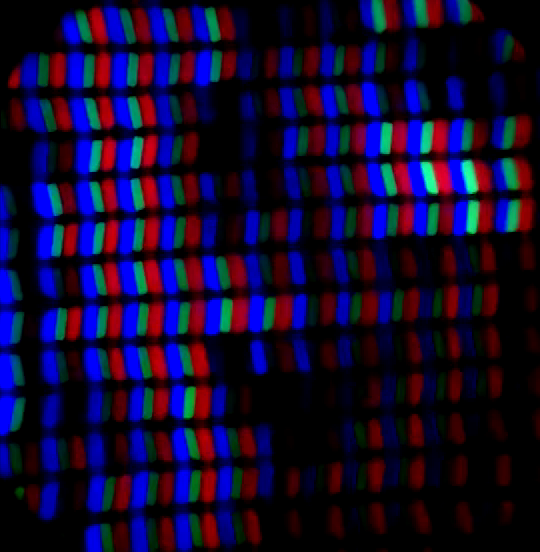
Hydrogel screen protector reveals sub-pixels and temporal dithering of TCL NXTpaper 60 Ultra screen

I bought a cheap (£5) "Anti-Blue Light Hydrogel Screen Protector" via eBay, not expecting anything. Surprisingly, the screen does possibly feel a little more comfortable than it did without it (although my tolerance may have shifted). It makes it massively more reflective, of course...

But the bigger surprise: it made the sub-pixel structure crystal clear! Compared to without, shown in my review... This indicates the "nano etched" matte surface finish is the only thing obstructing the view. I had the impression there should be more going on under the surface, but the information about a "Middle Layer: Diffuse Reflection" in the version 3 screen whitepaper is omitted in version 4's. And this is my first TCL product, so I've no feel for any changes in appearance.

Microscope video at 480fps (16x slowdown) of the middle of the test image on the \"Colour mode & temperature\" settings screen (indicated in image below).

The upshot is that we can clearly spot any temporal dithering going on (YouTube version of above as a backup)... But I actually struggled to find any TD in the usual places: home screen icon text, gradients, including Lagom test page (in image below), or NXTpaper modes (surprisingly)... But it is definitely there in HDR YouTube videos (eg "COSTA RICA IN 4K 60fps HDR") and performing an absolute disco on the settings page test image (below):

TCL NXTpaper 60 Ultra. Left: settings page with dithering image and flash reflection demonstration. Right: Lagom test page and Carson Microflip scope (that was attached to my old OnePlus 8T).

A problem is that I have previously used ADB commands to try to disable HDR capabilities (and so TD). I think I re-enabled this (back to default) upon retesting, previously. But I couldn't be sure then (or now) if I've changed something that will reduce TD. And don't have the time to fiddle with it a 3rd time. u/NSutrich has done similar and reported similar observations. But I'd appreciate anyone else, with a 'clean' new phone, confirming what they see, too. Using a suitable screen protector - hydrogel may be more clearly visible than glass, conforming to the surface texture better.

Example of the lack of obvious dithering (below and on YouTube). There are possibly slight fluctuations of the half-dimmed green sub-pixels, on the long edge of the "r". Which I wouldn't know enough to distinguish between TD, text anti-aliasing or pixel inversion..? There are, however, little black splotch flashes, kind of like film grain. I wondered if they are camera sensor noise..? But I've not noticed them elsewhere. So maybe some phenomenon with the backlight? They don't appear to align well with sub-pixels, although they are more visible on red ones, at the ends (some inversion artifact?).

Example of a lack of clear TD on lettering. But clear black flashes all over.

Bonus screen protector filtering evaluation: I had a go at making a precise measurement of the colour spectrum of the screen, before and after, using my cheap spectroscope. By locking my camera to the exact same Pro mode settings and measuring the same part of the screen, etc, I measured a possible blue colour intensity reduction of about 5% (relative to the red and green intensity changes). But I guestimate the potential error in my measurement to be as big as this value. So not significant. And directly overlaying (and subtracting) the 'before' and 'with protector' spectrum photos showed total black, so no notable difference between them.

Top: screenshot of phone taking the spectrum photo. Bottom: Affinity photo comparison.

Hence I'd say the blue light blocking of the screen is wishful thinking, at best (perhaps block some UV, who knows). So any change in comfort is more likely from the crisper screen appearance. It feels nicer to my finger tips. Looks better used indoors, in dim lighting. But it hopeless outside; the worse of both worlds, being reflective and less bright than contemporary OLEDs.

tl;dr: cheap blue-light screen filter doesn't work as intended, but may help those who suffered from the blurriness of this screen finish. But reflections are far worse. Handy trick for testing other devices with a matte finish obscuring the pixel structure. TCL 60 Ultra shows minimal temporal dithering in most everyday contexts.

Edit 2026-05-10: fixed images broken by delayed Reddit bug. Minor text tweaks.

(Thumbnail image hack)

reddit.com
u/Z3R0gravitas — 3 months ago

tl;dr (contents):

  1. Device explained (illustration).
  2. KSF phosphor - my LCD device readings & hypothesis for it causing some issues.
  3. Blue light peak wavelength location, measurement accuracy, my other LCDs and OLED phones.
  4. Melanopsin gap, eye physiology deep dive (excess pupil dilation, modulated flicker sensitivity, etc).
  5. Light bulbs - Incandescent, LED, Fluorescent (all have better spectra).
  6. My personal experiences.
  7. Tips for taking readings.
  8. Credits.
  9. Summary of suggestions.

(Questions and feedback are welcome after a partial reading or only looking at the pictures.)

Fig.1: Illustration of use: device on, or held up to, a screen (left). View through the lens (right).

(1)  I propose..:

This Eisco Spectroscope as a cheap tool to add to our testing arsenal. Along with established Opple, Carson Microflip + slow-motion phone cams, and maybe a polarising filter next? I just bought the Eisco in the UK (from Rapid, via eBay) for £9 delivered.

This device is entirely passive, relying on your eye or phone cam to peek into the lens. Arguably a little less fiddly than a clip-on microscope, in my experience. It only shows off the most obvious colour spectrum features, with more of a vibe check for the absolute amplitude of light. But it is about 1/50th (or less) the cost of a professional spectrometer, which only a few here have access to.

Bonus STEM fun for kids, or anyone, to see emission/absorption lines in the colour spectrum of light, split by the cheap diffraction grating inside (500 lines per millimetre). Projected alongside a backlit wavelength scale (400-700nm). Eg fluorescent tubes have the most striking and varied emission lines (examples later on).

(2)  KSF phosphor confirmation may be the killer app, for us(?):

Fig.2: Annotated composite of readings from 3 of my LCD devices, below an illustrative reading from a high quality spectrometer (of a laptop) showing there are, in fact, 5 total peaks, at high spectral resolution.

KSF Phosphor is used in almost all contemporary LCD backlights. It gives more vivid reds, for less power consumption than nitride phosphors (that are still included in lesser amounts). KSF achieves this via very sharp spectrum spikes, which stimulate human retina L-cones (long wavelength = red) more strongly

Perhaps too strongly, causing some of us direct over-stimulation (or retinal neurons). Our bright light eyelid closing reflex is more red dependant, too, I believe.

Or, the lower overall red light flux fails to balance deleterious biological effects of the blue peak photons (eg inhibits mitochondria). See this diagram of KSF’s smaller area under curve, vs traditional nitride red phosphor. Taken from this “Introduction to KSF Phosphor LEDs[…]”.

Or, some point to the slower decay of KSF's light emissions, potentially causing visual processing stresses, in conjunction with flickering of screens (eg black frame insertion). Although I don’t quite understand how this would work with non-emissive pixels… 

What else?

I was wondering if KSF could be the reason I can't stand the blueness of my TCL NXTpaper 60 Ultra (my review)... But my ThinkPad, which I tolerate OK, also shows KSF lines very clearly (above); the split in the larger spike can even be seen..! And my 11" Lenovo tablet, I used heavily a year ago (also above)... So I suspect KSF may only be a contributing factor that (for some) can be compensated for with: lower brightness, better software colour filters (F.Lux on windows) and maybe hardware level blue filtering layers (which reduce energy efficiency)..?

3)  Peak positions (and measurement precision): 

I'm told the exact wavelength of the blue peak can also have a big impact on screen tolerance. Shorter wavelengths of electromagnetic radiation are intrinsically more damaging (higher energy photons, closer to UV)... 

A healthy macula (inside the eye) may filter ~90% of blue light from reaching the retina, using carotenoid nutrients: lutein and zeaxanthin. Shielding it from excess oxidative stress, etc. According to Wikipedia, blue light hazard is implicated in eye stain, but evidence is contested, with blue blocking glasses not necessarily helping (a bit on this later).

I’m not sure what might be interpreted from the green peak position. Shorter wavelength (left shift) may stimulate rods a little more strongly? Cones less?

Fig.3: More of my devices. QD (quantum dot) backlight has a longer wavelength red (maybe more gentle) and shorter wavelength green (unknown effect). Note: vertical divisions in the green bar are sub-pixels spread across the width of the spectroscope’s slit, forming a 1D image. Older WLED LCD backlights have gentler spectrum curves, but fainter red zones; the Dell needs permanent F.Lux dimming for my comfort. 

This scope can definitely give a good relative comparison between devices, for emitters with narrow spreads. But I’m not sure it is precise enough to make confident absolute measurements of eg 430 vs 450nm; the wavelengths on my unit appear slightly offset. Possible per-unit calibration issue?

I did, however, slightly improve the spectral resolution by narrowing the slit using black tape stuck partly over it (width-wise). The trade-off being a dimmer display of colours. Using pro mode on a phone cam is also important to preserve the details, avoiding the colour bands over-exposing (when the surroundings are the dark black interior).

Fig.4: My Comfy old OnePlus 8T vs a new Nord 5 that looks a bit too yellow-green when dimmed (vs pinky-red). All devices at full brightness, eye-care disabled, etc, for these tests.

I couldn’t assess the absolute amplitudes of each colour peak, from this. Or even a firm relative indication… In principle, one could use the same phone camera, in the same pro-mode settings, with the exposure dialed down far enough. Then check the colour values in a paint program/tool. 

(Blue sky thinking: maybe this process could be digitised, using a custom-made app? (Any bored vibe-coders in chat? Of course the camera’s (specific) colour response curves will filter what can be measured.

4)  Melanopsin gap hypothesis with vision deep dive:

A big feature of all the screens I’ve shown here is the *absence* of light between blue and green. A dark strip in the spectrum. It is more energy (and material) efficient for devices to only emit ‘photopic’ wavelengths - the light we consciously perceive via the rods and cones in our retinas. But this omission has consequences…

Melanopsin is a light sensitive pigment that reacts to detect photons, very similar to the opsins in cones/rods (but discovered later). It’s located inside intrinsically photosensitive retinal ganglion cells (ipRGCs) - neurons in the retina that process signals from rods and cones directly beneath them (they are mostly transparent). Melanopsin is most sensitive in this illumination dip, at around 480-490nm (precise sensitivity still seems debated).

Fig.5: Annotated composite image of Wikipedia illustrations.

Stimulating melanopsin is most well known to delay circadian rhythm at night (and entrain it in the morning) by suppressing melatonin production. (It also stimulates dopamine release.) We’ve all heard how “blue light” is bad at bed time. While there is some stimulation by pure blue, cyan (half way to green) is most potent. Wearable devices (like eg Re-timer) emit only this range of light, for its health benefits (circadian and alertness). 

Fig.6: (Top) Screenshot from blog, link and details below. (Bottom) screenshot of sunlight spectrum in their visualiser tool. Note the extra UV (which may guard against myopia) and infrared, as well as cyan.

This old F.Lux blog piece (screenshot above) lamented the advent of the OLED iPhone X, for an *increased* amount of light encroaching on the “melanoptic” region of the spectrum. (Sunlight comparison from their old “Fluxometer” visualiser tool, discussed here.) So, while my post is researched in its details, what I suggest below is somewhat of a hot-take interpretation; it runs somewhat counter to these mainstream concerns (too much ‘blue’) and I’ve not seen this talked about in our community, either...

Melanopsin’s other effects:

(a) Pupil constriction (up to 16x) over which melanopsin has the strongest effect. Sustaining contraction in bright light, after a few seconds to respond. This follows immediate (eg bright flash) responses mediated by cones. And precedes the ‘bleaching’ effect on rod/cone opsin photopigments, which can take minutes to fully transition. This last mechanism is what leaves a *negative* colour after-image from staring at strong colours. (Positive after-images, palinopsia, probably relates more to neuron hyper-excitability.)

Hypothesis: under-stimulating melanopsin will surely contribute to our eyes letting in more photoptic (consciously visible) light from screens, compared with naturally lit scenes. Increasing visual stress by heightening the strength of signals sent down the optic nerve. Presumably contributing to a sense of glare or excess colour saturation. Merely give a wow factor to unaffected people. But taxing the energy intensive cellular processes of the retina itself...

Compounding effects: the sympathetic nervous system (SNS) also dilates pupils more. It is commonly over-active in our screen sensitive demographics: neurodivergent and/or chronically ill (eg ME/CFS). More dilated pupils also makes focusing harder (narrower depth of field), taxing the eye’s ciliary muscles and exacerbating astigmatism or difficulties with close-work… Dark mode may cause further dilation.

Speculations: blue blocking glasses (or FL-41) may not help this issue, because reducing the blue (and green) screen light would also reduce their stimulation of melanopsin. They could cause further dilation, sensitising to red more… Some people may have genetic mutations, inhibiting the sensitivity of melanopsin. Or acquired damage to the signalling pathway that runs up the optic nerve to midbrain and back… 

Conversely: melanopsin-containing ipRGCs have a direct neural pathway to the thalamus, allowing them to signal severe photophobic pain during migraines or brain inflammation See Noseda et al., 2010. So, while supplementing this wavelength would be an interesting screen tolerance experiment, I’m expecting it could instead cause more problems for some, or many, here. However, in a follow-up 2016 paper demonstrated that rods and cones also mediate this pain, with isolated blue, red, and amber all problematic, but not green.

(b) Modulating retinal image processing - the retina encodes different aspects of light stimuli into separate streams of information, sent along the optic nerve. Which is made of the long axons of the various retinal ganglion cells, of which ipRGCs are just one type (accounting for 1-2% of total). They modulate other RGCs via amacrine cells, that release dopamine (see c, below). The main information pathways and their RGC classes:

  • Parvocellular (P-Pathway), Midget Cells (narrow field), ~80% of total - fine spatial detail, colour, (red-green), slow (low-frequency).
  • Magnocellular (M-Pathway), parasol cells (large receptive field), ~10% - motion, luminance, contrast, high speed.
  • Koniocellular (K), Small Bistratified Cells, ~10% - blue (vs yellow) colour processing.
  • Direction-Selective Cells (depending how one divides things) and others…

There’s overwhelming functional detail here that I’ve not managed to research and remember. But some rough indications of effects are..:

Contrast sensitivity - is increased by melanoptic ipRGCs stimulation (2023 paper). So relatively less stimulation should decrease visual acuity and spatial resolution, making it harder to read small text, etc. More eye strain if already struggling… Note that reduced contrast sensitivity is taken as a sign of CIRS (mold toxicity) by Dr Richie Shoemaker and followers. I think this is caused by inflammation of the optic nerve and such?

Colour sensitivity - altered, shift in perceived “unique white” (colour balance). Ability to discriminate colours may be reduced with less melanotic light, especially on the blue-yellow axis..? A lack of NIR light may also inhibit colour discrimination, via decreased mitochondrial function (2026 Glen Jeffery paper).

Temporal (Flicker) sensitivity - malanopsin itself is too sluggish to respond to flicker directly (2016 paper). But modulates the frequency receptivity of other retinal neurons. Findings seem varied and possibly species dependent. A mouse study (2016 paper) showed reduced melanopsin function tuned vision to lower frequency stimuli, 0.2Hz vs 1Hz (I don’t understand the meaning of such low rates)...

While decreased melanopsin resulted in increased (but more variable) flash ERG response gain (2014 paper). ERG being the “Cone Flash Electroretinogram”, which specifically checks cone cell function by using higher frequency stimulation, eg 30Hz, while rods only go up to ~15Hz (2015 paper). So both lower frequency discrimination and an increased sensitivity to flicker/flashes, with less cyan light..? Complex.

I think it would be very helpful for us to map out and understand the differing frequency (and other stimuli) responses of the various cell types, pathways and brain regions. It’s convoluted and contradictory to comprehend though; both me (and I think) Gemini Pro have inverted meanings a few times, going over aspects of the above repeatedly. And we’ve not gone past the relatively well defined retina to cortical processing, the likely location of most of our visual stress.

(c) Slight tangents (vague speculations): melanopsin's effects, in the retina, are signalled by localised dopamine release. So I’m wondering about tie-ins with ME/CFS, autism, etc, possibly having reduced dopamine levels  with hypothesised metabolic issues synthesising and degrading this neurotransmitter… Similarly, these conditions may be associated with slowed glutamate recycling/conversion - excess sat around leading to a degree of CNS (brain) hyper-excitability. Tying in with migraines, seizure-like effects, visual snow, etc… 

Oddly, cones signal darkness with continual glutamate release. The signal is then inverted. I’m not sure how this idiosyncrasy would be differently affected by such pathology. But Latanoprost (eye drops to lower intraocular pressure), which some had success with, also counteracts excess glutamate… Finally, the opsins use active vitamin-A (11-cis-retinal, to make the light sensitive rhodopsin pigments) and our vit-A metabolism may often be impaired (with consequences I’m not sure of).

(5)  Light bulbs: 

Note the smooth spectrum of the incandescent - pure black body radiation, with its glowing element at the actual temperature of its rated colour temperature. Stray refractions in the device can obscure the scale, somewhat.

Even cheap LED bulbs can approximate most of a spectrum, with notable cyan in there. Highlighting the potential usefulness of r/Reflective_LCD screens, even without daylight. (Dependant on TD or other triggers.)

Fluorescents are very varied, with it being hard to tell which have more filled in spectra vs just the very tight (elemental) emission bands. All mine had a line right in the cyan section. Note that their colour temperature is tuned by adding more of the red and green phosphor types to reduce the apparent temperature. Also, the second order refractions are evident in the space between the (strong) red and green lines. An artifact of using a grating to split the light. I think that’s what is going on there.

Fig.7 Composite of spectra from light bulbs around my house (details above).

(6) My personal experiences: moved to comment below.

(7) Tips for using this spectroscope:

(a) Bring up a pure white image or user interface element (eg settings screen) to point the slit at.

(b) Set device to max brightness. Disable eye comfort (Night Shift), dimming or colour modifying settings (or 3rd party apps). These can have very pronounced effects on relative colour strength or the spectra, if not the positions of the peaks.

(c) Rest the device on the screen only for easy stability, ideally it should be further away. 

(d) Preview the on-screen camera image while moving it closer to the lens aperture, to get it easily aligned. having pre-zoomed by 2-3x. Then angle down the diagonal (flat edge up top) to catch sight of the scale. 

(e) The scale needs illumination behind it too. Either the tested screen, or if too bright, some other backlighting (more fiddly).

(f) Use pro/manual mode on your phone camera. Set the shutter speed to at least 1/15 or faster, to keep the image steady. Iso will need to be high, auto is fine if just getting a feel. Focus can be set, to avoid hunting causing blur (get the scale in sharp focus). Colour temperature could be fixed, but only if trying to make precise comparisons.

(g) A darkened room is not really necessary. The slit is very directional.

(h) For more refined spectral resolution (less blurred peaks), make the slit even narrower. Use black tape or metal foil to partly cover it.

(i) Please crop and rotate your image before posting (eg to this subreddit).

(j) Advanced: we could attempt to check the scale positioning calibration using known wavelengths, like the KSF peaks and fluorescent lines.

(k) Any more..?

8) Credits: 

  • u/BearNecessary4141 showed this scope off first in a YouTube video I found via this post. His 2025 Macbook Air showing KSF phosphor peaks.
  • u/simplex_first for the KSF example spectrum (in Fig.2). See also the Telegram channel “Opple and Spectrometer tests”.
  • Wild Lee (what’s his reddit handle?) for all his testing and the OnePlus 8 spectrograph in Fig.4 (as seen here on BiliBili).
  • u/Rx7Jordan for talking about this topic and posting various spectrograph results here before (sorry, I don’t know of a good search term to bring those all up?).

9) Summary of suggestions:

(a) Anyone here could buy a cheap spectroscope, as a learning aid to anchor thinking about this topic.

(b) Enthusiast amateur device reviewers could add a spectroscope sample as bonus content.

(c) Pro reviewers, please consider using proper digital spectroscopes, if not doing so already.

(d) Validating this cheap scope by using it alongside a pro meter would be nice.

(e) Let’s talk about light colour spectrum features vs biology more and politely ask reviewers about it.

(f) What else? What did I mistake or neglect? Please leave critique and questions. I may update this post as an ongoing guide, if there’s any interest. (I also started looking at screen dimming spectrum changes a little.)

reddit.com
u/Z3R0gravitas — 4 months ago