r/guitarlessons
▲ 121 r/guitarlessons
How can I read these symbols?
Is the first one a gallop and the two next ones simple downstrokes? No idea about the last one.
u/radufloringR — 11 days ago
▲ 12 r/guitarlessons
How do professionals get such a clean sound? I turn my Fender amp up a bit and its just string noise and I lose all tone
I'm constantly having to mute strings when I turn my amp up, losing all my tone. How do people get such a clean sound on stage? Is it all just muting technique?
u/sayitaint5788 — 11 days ago
▲ 20 r/guitarlessons
is this even playable
HELPPP how do i play this im so lost
what am i looking at
edit: the song is Welcome to Chaos by (K)NOW_NAME and i found these tabs off songsterr
u/lunatic-qt — 11 days ago
▲ 16 r/guitarlessons
Beginner acoustic Dave Matthews song choices
Hey there
I am a big Dave Matthews fan have been playing for eight months and I’m curious what songs you think might be appropriate to work towards.
F chord is getting close. I would say I’m a bit ahead of average for less than 1yr
Piano for 20 years….20 years ago. Didn’t much like it.
Thanks!
Photo: Dave Matthews in Concert by slgckgc Creative Commons BY 2.0.
u/Just_Association4255 — 11 days ago
▲ 6 r/guitarlessons
Do you play acoustic guitar differently than electric?
I find that with my acoustic guitar I have to be much more delicate in the way I strum the strings, if I strum too hard or don't glide the pick smooth enough the sound gets muddy. Is this normal in acoustic guitars or does it point more to a setup issue?
u/Former_Spray_9373 — 11 days ago
▲ 0 r/guitarlessons
Is there like a list of things to learn in guitar?
I just started playing two days ago and im not paying for any lessons so im just kind of freeballing and looking everything up, but is there a list of things to learn in order that i can find somewhere? I have an electric guitar and right now im just working on the spider exercise to get used to it but where do i go from there? I know pretty much nothing aside from the frets and the very basics of guitar anatomy, neck, body and the tuners and thats about it, ive got no clue where to go from the spider exercise 😅
u/Jam-of-the-Dan — 10 days ago
▲ 95 r/guitarlessons
I got myself an new acoustic guitar
I got a passion for guitar, I'm also a singer doing covers and composing music. Guitar is a new chapter for me and I don't know where to start or how to begin. I know how to tune (with apps like Fender Tune/GuitarTuna), how to hold the guitar but nothing else. Where should I begin? İt's an acoustic guitar with 6 string.
u/Realistic-Ad6305 — 12 days ago
▲ 11 r/guitarlessons
Focused vs unfocused practice
I often find myself watching sports and use that time to practice guitar (and workout/mobility training). While I think this is time well spent since I enjoy sports and I am still improving my physical health and guitar playing, I am wondering just how much more focused practice will improve my playing.
By that, I mean sitting for a solid half hour undisturbed and completely focused on my practice. I feel like I'm still getting some benefit from practicing while watching games (chord change practice, scales, etc), but just wonder how much more effective focused practice sessions are. I'm looking for input from others who may have tried both and noticed a difference in improvement.
u/SnooPaintings4641 — 11 days ago
Trying out Dust in the Wind (Fingerstyle First Part)
u/Repulsive-Pack224 — 11 days ago
▲ 4 r/guitarlessons
Does anybody else have a hard time playing when switching between guitars with different string gauge or after playing the bass?
Yesterday I was rehearsing with my bandmates and I decided to try out the bass for the first time. I had a blast. However, after I picked up my guitar, the fretboard and the instrument itself felt SO different.
It’s like I still had the spatial orientation of the bass in mind and my fingers were going for those positions. The same thing happened when I bought a new guitar. I used to play with a Les Paul whose gauge is 0.10 and now I mostly play with a 0.09 RG. Whenever I pick up the Les Paul or any 0.10 guitar I have a hard time playing and I make mistakes I don’t normally make
u/yellowamarello — 11 days ago
▲ 1 r/guitarlessons
Pads or fingertips?
Slowly learning to play guitar, and one big inconsistency I've noticed is that some things will tell you to press with the tips of your fingers, and some will say to press with the pads. Both will say that the other is a terrible habit that you should never form. So which is it? I have a feeling the truth is somewhere in the middle, so in which situations would one be better than the other
Sorry if this has been asked before, i admit I am a little bit lazy
u/Asleep-Grass-2748 — 11 days ago
▲ 2 r/guitarlessons
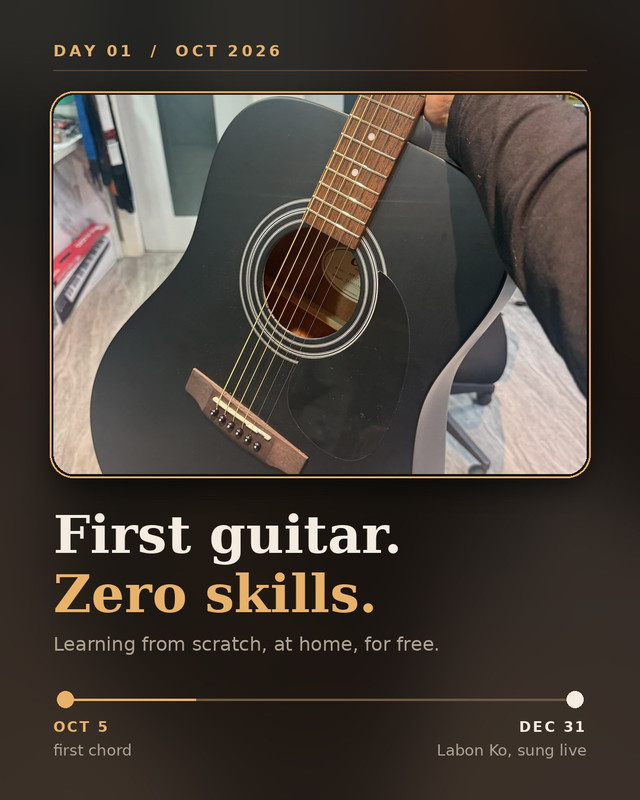
Complete beginner with a new acoustic. What free path would you follow for 12 weeks?
First guitar, bought today. No music background. Learning at home on my own.
Target: play and sing along to one song by end of December. Labon Ko by KK, a Hindi song with simple open chords as far as I know. Corrections welcome.
Looking for a free structured path. Which website or YouTube series would you start with, and what should I practice first week? Happy to follow one clear route instead of jumping around.
Bonus round: how do you sing and strum at the same time without both falling apart? Singing tips for someone who sounds like a kettle are welcome.
the graphic: https://i.postimg.cc/MKp2GX0X/2-guitar-post-v2.jpg
u/FumGlumpp — 11 days ago
▲ 1 r/guitarlessons
Late 50's learning a solo
I started practicing guitar a long time ago and never really progressed much at all, can play cords and very simple short leads, barely of any. Never really picked up the guitar for years.
I picked up the guitar just recently and became determined to learn the stairway to heaven solo. I'm in my late 50's - is it possible at this age to play that solo?
Why in asking? I have about 75% of the solo down at about 60% of the normal speed more or less and it seems no matter how much I practice I have really seem to have got a brick wall. I saw lots of progress from when I began about two weeks ago but it seems I hit a wall.
So:
Is it possible for a guy my age to learn it just like on the track of I just keep on going ahead and trying?
It seems no matter how much I try I just can't seem to figure out how to do " lick#8". That's the lick where your pinky is on fret 20 b string, middle finger bending fret 19 on the g string and index finger on fret 17 high e string. And to have them pretty much ring out simultaneously. How does one accomplish that!!!???
Thank you!!!
u/pizzaromana — 11 days ago
▲ 2 r/guitarlessons
How to practise chord tones in the guitar ? My teacher demo playing using chord tones up down the fret and ask me to memorize the shapes of the chord. I tried at home but stuck with no licks and ideas.
​
u/InvestigatorSolid330 — 10 days ago