Athena asks Zeus to help Odysseus
▲ 63 r/Epicthemusical+1 crossposts

Athena asks Zeus to help Odysseus

I illustrated the moment Athena tries to persuade Zeus to let Odysseus return to Ithaca.

As with every Odyssey related illustration, I tried to take every archaeological evidence and Homeric description there is into consideration to come up with something that is close to the original vision of the ancient Greeks.

Here, that endeavor required a lot of speculation since Homer’s descriptions of the Gods and Olympus are really sparse. What he tells us is that the Olympians have a council at Zeus’ palace with only Poseidon not attending. So I should have depicted every God? Not really. First of all because doing that would require months of research and second because my illustration would have been packed with tons of information making my endeavor to create a focal point impossible. So my solution to this was illustrating a closeup of the room with only Athena and Zeus visible to you (the rest of the Gods are just outside of our point of view). After this decision I had to find a way to depict the palace and the two Olympians. In the Illiad, Homer tells us that Zeus’ palace is covered in bronze and the throne room has a golden floor and golden thrones for all the Gods. Athena is described as being blue (or grey) eyed sometimes wearing the aegis (and other weapons that I will not include here since this isn’t a war scene) and Zeus as having long hair, dark brows, a beard and holding a sceptre.

As you can see, there are many gaps that I have to somehow fill. But where does someone find answers to cover Homer’s silence? Archaeology. The Homeric stories supposedly happened during the 12th or 13th century BCE. This was the time of the Mycenaeans. The remains of that civilization can give us a good picture of how things looked back then. But do they tell us anything about the appearance of their Gods? Not really. So we had to dig deeper.

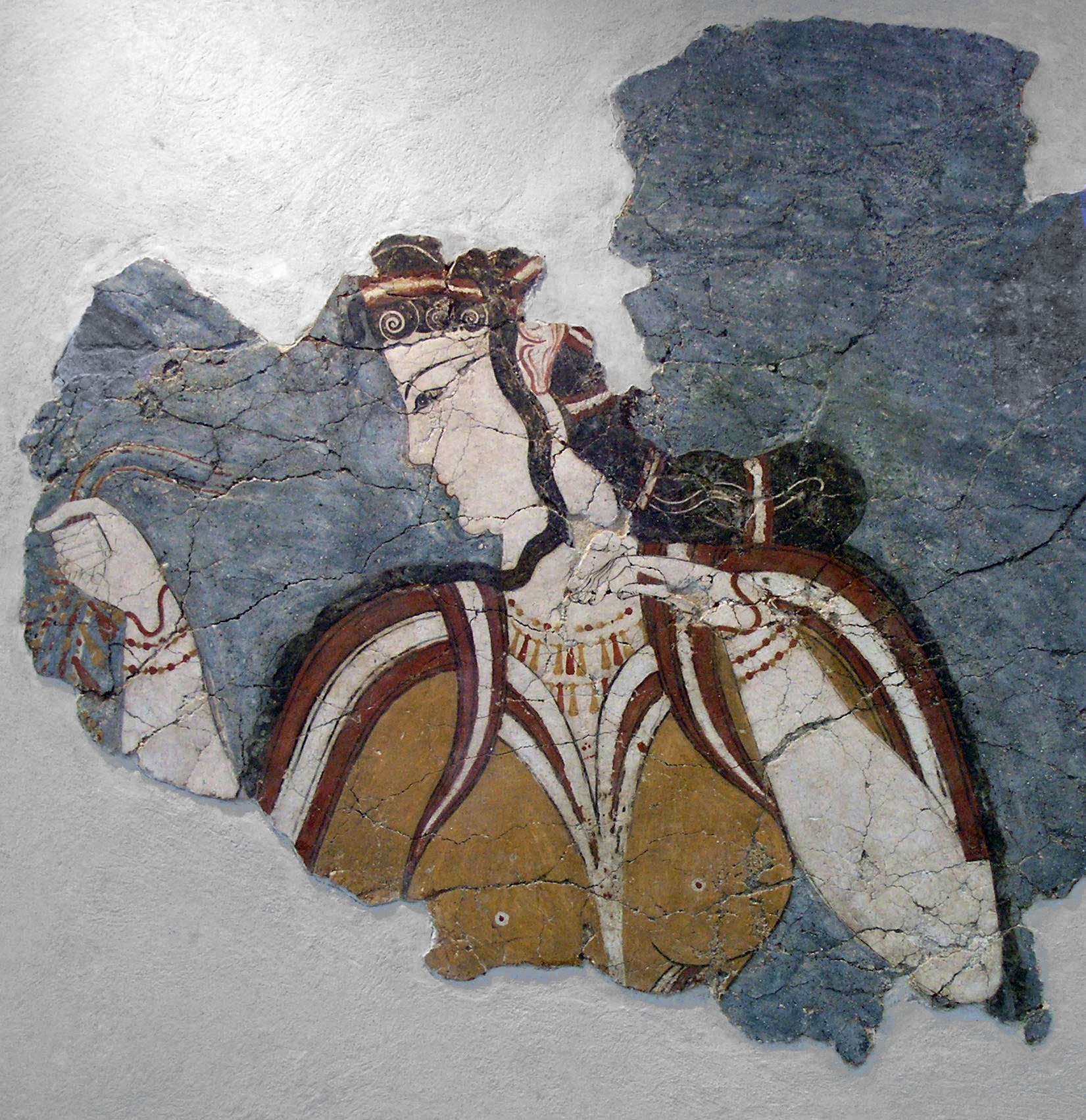
Throughout their history, the Greeks viewed their Gods as a more powerful version of themselves. In the statues (that I couldn’t use as references since they were of later periods) they look like regular fit people wearing regular-expensive clothes (with the aegis being an exception). With that thought in mind I tried to look at elite Mycenaean fashion and implement that to the Gods with some gold touches for extra luxury. For Athena I used the images of those frescoes that depict women in some kind of a festival and for Zeus I used that other fresco that depicts wealthy male figures. As you can see there is a great difference in skin color between them. That’s because Athena is wearing some kind of makeup throughout her body that makes her look whiter than Zeus' tanned skin tone. The evidence behind that artistic choice is again those frescoes that depict Mycenaean women with such aesthetics.

Moving to the accessories, I had to add the aegis on Athena to make the viewer make a visual connection with the more familiar images of the Goddess. The thing is that the more standardized appearance of it is not what Homer tells us about it. In the Iliad it is described to be consisting of a hundred golden tassels and, of course, in the center there is the terrifying face of the Gorgon Medusa. For that my references were those archaic depictions of the figure (the earliest ones that I could find). Moving to Zeus, he is holding a sceptre that I based on those depictions on Greek pottery (much later than Mycenaean period but better than my 21st century imagination) and since Homer gives us a description of it having golden suns I added those golden spheres. His throne is based on Mycenaean throne reconstructions.

For the room behind them, I looked at how Mycenaean throne rooms looked. They consisted of a throne, a fireplace in the center (with a ceiling opening for the smoke to escape) and four columns holding the immense weight of the roof. So, for the only one of those columns that is visible, my reference were those elaborate Mycenaean columns from “Atreus’ tomb”. For the wall patterns I created a scene in which a griffin hunts a deer based on similar depictions from Mycenaean palaces.

A small excerpt from the Odyssey that mentions this scene:

Athena said:

“Aegisthus deserved the punishment he received. Yet it is not his fate that troubles me. My heart grieves for Odysseus, who remains stranded on the lonely island of Ogygia, far from his home and friends. There, the nymph Calypso keeps him against his will, hoping he will forget Ithaca. But all he longs for is to see his homeland once more. Have you forgotten the countless sacrifices he offered you during the Trojan War? Why do you still allow him to suffer?”

Zeus answered:

“How could I ever forget Odysseus, whose wisdom and devotion to the gods surpassed that of other men? It is Poseidon who stands in his way. Odysseus blinded the Cyclops Polyphemus, and ever since, the sea god has sought revenge by preventing his return. Yet if we stand together, Poseidon will eventually yield. Let us decide how we may help him.”

u/DPap_Art — 15 hours ago
▲ 132 r/classics+4 crossposts

Hermes adoring Calypso's cave

I illustrated the moment Hermes arrives at Calypso’s island and adores the beautiful landscape. 

As with every Odyssey related illustration, I tried to take every archaeological evidence and Homeric description there is into consideration to come up with something that is close to the original vision of the ancient Greeks. 

Here, that was really straightforward regarding the landscape. It is one of the most detailed descriptions that Homer gives us in the Odyssey and so I didn’t have to speculate that much. When depicting Hermes on the other side, it was a totally different situation.. The Odyssey and the Iliad do not give us much physical description of the God other than him being athletic, young adult looking, wearing golden sandals and carrying his golden wand (the kerykeion or caduceus). That meant that I had to come up with skin and hair color, clothes shape and color and also choose how to depict the sandals and the kerykeion properly. 

For the hair and skin, I decided to choose the average Greek appearance road since I thought that if the God was imagined as having any rare characteristic (being blonde, having blue eyes etc) that would have been mentioned (as with other similar cases in the epics). That’s why I painted a tanned skin tone and dark brown hair. 

For the clothes, I chose the main shape to be similar to the one that we find on the Mycenaean frescos. To decide on colors I tried to find ancient colored depictions of the God but failed to find any Mycenaean, Archaic or Classical ones. The closest I could get to the time period were those Macedonean tomb frescos and mosaics (I know that’s many centuries later but it’s definitely better than me painting something coming completely from my imagination) where he is depicted wearing mostly reddish and yellowish fabrics. To add some complexity, I’ve given him a fabric to cover the upper part of his body. The motif that exists on that piece of clothing is coming from an archaic pottery painting of the God and probably is the most anachronistic thing you will find on this illustration. 

For the sandals and kerykeion I chose the simplest design possible because there is no mention of intricate details and because I believe that the wings on the sandals and the wand were additions that appeared centuries later in Greek art. 

A small excerpt from the Odyssey that mentions this scene:

Hermes took up his staff, fastened his sandals, and soared above Pieria, descending from the heavens to the sea. There he skimmed over the waves like a cormorant, crossing the Ocean and making his way to the distant island of Calypso.

He immediately set out toward the cave, but the wondrous sight before him struck him with awe and halted his steps for a moment as he stood admiring it. Before him stretched a dense grove of alders, poplars, and fragrant cypresses. Among the trees nested owls, hawks, and sea crows. The nymph’s cave was draped with a luxuriant vine heavy with clusters of grapes, while four streams of crystal-clear water wound their way here and there across the land, nourishing meadows adorned with violets and lush vegetation that covered the ground.

u/DPap_Art — 20 days ago

What would you change or improve on this illustration?

I've recently finished this illustration of Hermes adoring Calypso's cave. This is one of the most complex drawings I've ever done and I had to include many different elements such as trees birds flowers canals. I think that I've spend too much time on details though when I should have done more on overall cohesion. What is your opinion? What would you change or improve here?

u/DPap_Art — 24 days ago
▲ 47 r/classics+1 crossposts

Young Odysseus hunting a Boar

I illustrated the moment young Odysseus receives the scar that would later reveal his identity in the Odyssey. According to Homer, he got the wound during a boar hunt on Mount Parnassus near the house of his grandfather Autolycus.

I tried to take an approach that is closer to the Mycenaean origins for the clothes and weapons.

A small excerpt from the Odyssey that mentions this scene:

When young Odysseus had grown old enough, he traveled to Parnassus to visit his grandfather, Autolycus. The elder welcomed him warmly and honored him with a rich feast. At dawn the following day, Odysseus and the sons of Autolycus took their dogs and went hunting through the cool valleys of the mountain.

The first rays of the Sun led them to a ravine where a massive wild boar lived. Its lair was surrounded by dense bushes, while the ground was covered with fallen leaves. The beast sensed that someone was approaching and immediately took on a threatening posture, raising the bristles on its neck and staring at the intruders with a fiery gaze. The next moment, it charged towards them and clashed with Odysseus.

The young man received a heavy blow from the boar’s tusk above his knee, but he managed to thrust his spear into the creature’s right shoulder. The strike proved fatal, and moments later the wild boar collapsed dead upon the earth.

The sons of Autolycus took care of the carcass and helped Odysseus return to their home, where they treated his wound. The injury, however, was deep and left behind a scar that would remain on his leg forever.

u/DPap_Art — 25 days ago

Young Odysseus hunting a wild Boar

I illustrated the moment young Odysseus receives the scar that would later reveal his identity in the Odyssey. According to Homer, he got the wound during a boar hunt on Mount Parnassus near the house of his grandfather Autolycus.

I tried to take an approach that is closer to the Mycenaean origins for the clothes and weapons.

A small excerpt from the Odyssey that mentions this scene:

When young Odysseus had grown old enough, he traveled to Parnassus to visit his grandfather, Autolycus. The elder welcomed him warmly and honored him with a rich feast. At dawn the following day, Odysseus and the sons of Autolycus took their dogs and went hunting through the cool valleys of the mountain.

The first rays of the Sun led them to a ravine where a massive wild boar lived. Its lair was surrounded by dense bushes, while the ground was covered with fallen leaves. The beast sensed that someone was approaching and immediately took on a threatening posture, raising the bristles on its neck and staring at the intruders with a fiery gaze. The next moment, it charged towards them and clashed with Odysseus.

The young man received a heavy blow from the boar’s tusk above his knee, but he managed to thrust his spear into the creature’s right shoulder. The strike proved fatal, and moments later the wild boar collapsed dead upon the earth.

The sons of Autolycus took care of the carcass and helped Odysseus return to their home, where they treated his wound. The injury, however, was deep and left behind a scar that would remain on his leg forever.

u/DPap_Art — 28 days ago
▲ 11 r/ancientgreece+1 crossposts

Young Odysseus receiving the famous scar above his knee — Illustrating Odyssey with Bronze Age Greece and Homeric accuracy in mind

I illustrated the moment young Odysseus receives the scar that would later reveal his identity in the Odyssey. According to the epic, he got the wound during a boar hunt on Mount Parnassus during a visit to his grandfather Autolycus.

Since everyone depicts Greek Mythology with Roman/Spartan/Classical Athenian aesthetics I tried to make something more accurate than that and use Mycenaean frescos to figure out the appearance of clothes and weapons.

Odysseus and the Boar at mount Parnassus

reddit.com
u/DPap_Art — 1 month ago