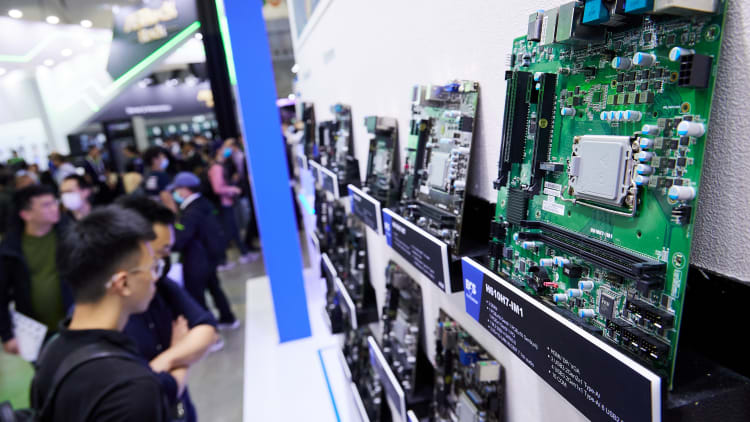
New strix halo box: GMKtec EVO-X3, superior cooling to avoid thermal throttling, $3,600

New strix halo box: GMKtec EVO-X3, superior cooling to avoid thermal throttling, $3,600

https://www.gmktec.com/products/gmktec-evo-x3-ai-mini-pc-amd-ryzen-ai-max-395

Features: USB 4. Adds a dedicated OCuLink port. OCuLink provides a direct, high-speed cable connection to a desktop graphics card, minimizing data loss and improving external GPU (eGPU) performance compared to USB4.

Price : More than double what I paid for my first strix halo that cost $1,600 for 128gb machine.

That box looks ready for gorgon halo to be released in the next 3 months.

u/Terminator857 — 9 hours ago
Poll: AMD promised Gorgon Halo in Q3... it's July, where's my 192GB beast?

https://www.amd.com/en/blogs/2026/amd-powers-next-generation-agent-computers-with-new-ryzen-ai-hal.html

Warning: grok assisted content. Fellow local LLM degenerates,

Remember when AMD was Q3 2026, Gorgon Halo dropping with that sweet 192GB unified memory so you can finally run your 300B parameter waifu simulator at home without the cloud judging you"?

Well, it's officially Q3. My refresh button is getting carpal tunnel. My Strix Halo setup is feeling like last-gen trash.

AMD: stop "optimizing yields" or whatever corporate excuse du jour you're using and ship it!

Roast me for coping, but at this point I'm starting to think "Gorgon" was named after how long it's taking to ship — turning us all to stone with anticipation.

While we wait for the Halo gods to deliver, what should I do? (serious answers also welcome, I'm losing it)

Drop your coping mechanisms and hopium levels below. Let's suffer together.

View Poll

u/Terminator857 — 3 days ago

Software engineering best practices in the age of LLM coding

It is important to document requirements, capture key decisions, and record design goals.

Best practices:

  1. Requirements doc stored in repo.
  2. Store plan files created by LLM in repo. Store in plans/<date>-<summary>.md
  3. Store session summaries in repo. Sometimes need to inform llm to include all prompts. Store in summaries/<date>-<summary>.md

What are your best practices?

reddit.com
u/Terminator857 — 6 days ago

Tip for better antigravity cli experience. Use plan mode.

Before any prompt enter the following:

Create a detailed implementation plan first and wait for approval before code changes.

reddit.com
u/Terminator857 — 8 days ago

Tip for better antigravity cli experience. Use plan mode.

Before any prompt enter the following:

Create a detailed implementation plan first and wait for approval before code changes.

reddit.com
u/Terminator857 — 8 days ago

sk hynix reallocating some hbm production to dram

SK hynix is reportedly delaying the transition of some fifth-generation HBM (HBM3E) production lines that were originally scheduled to be converted to HBM4. It is intended to increase the general-purpose DRAM market responsiveness, which currently has a higher operating profit margin than HBM, to secure additional revenue. https://biz.chosun.com/it-science/ict/2026/06/23/2MHN5N2NGBF53O4T7CMXUJL3VA/

https://x.com/jukan05/status/2069207211239477660

u/Terminator857 — 14 days ago
▲ 2 r/TechHardware+1 crossposts

Future DRAM production - by claude

A wave of new DRAM fabs is ramping (Samsung P4/P5, SK hynix M15X + Yongin, Micron Idaho + NY, China's CXMT). Wafer capacity grows ~33% by 2028 and ~47% by 2029 — but bit demand (~26%/yr, AI-driven) keeps outrunning bit supply (~21–24%/yr) because HBM eats ~3× the wafer area per GB. Real relief: 2028–2029.

(Images: capacity bar chart, supply-vs-demand chart, world map of fabs, and China's share chart — in the gallery above.)

New DRAM fabs coming online

Fab Owner / Region First output Target (wafers/mo) Focus
P4 — Pyeongtaek Samsung 🇰🇷 Q4 2025 → '26 ramp 100–120K 1c DRAM / HBM
M15X — Cheongju SK hynix 🇰🇷 H2 2026 40K → 80K by '27 DRAM / HBM
CXMT expansion CXMT 🇨🇳 through 2026 300K → 400K+ Commodity DDR5/LPDDR
Idaho (Boise) Micron 🇺🇸 mid-2027 ~100K (phased) Leading-edge DRAM
Yongin cluster SK hynix 🇰🇷 equip '27 → MP '27–28 +360K over time DRAM / HBM (mega-site)
P5 — Pyeongtaek Samsung 🇰🇷 build done H1'27 → MP late '28 100K+ (phased) Advanced DRAM
Clay, NY Micron 🇺🇸 2028+ very large (phased) Leading-edge DRAM

SK hynix is targeting ~1M wafers/month total DRAM by 2030.

Capacity vs. demand (estimates)

Wafer capacity: ~1.80M wpm (2025) → ~2.39M (2028, +33%)~2.65M (2029, +47%).

But measured in bits (the unit that actually matters), supply trails demand:

Year Bit demand Bit supply Gap
2026 +26% +21% ~14%
2027 +32% +23% widening
2028 +28% +24% ~15%, still short
2029 +25% +22% narrowing

Why wafers ≠ bits: HBM (the memory AI chips use) takes ~3× the wafer area per GB vs DDR5 (~4× for HBM4). HBM is ~23% of DRAM wafers in 2026 (up from 19%). Every wafer shifted to HBM yields roughly a third of the bits. So capacity can grow nicely while the bit shortage lingers.

China's share — volume vs. value

China = essentially CXMT, now the world's #4 DRAM maker. Two very different numbers:

  • By bit/capacity: ~12% (2025) → ~15% (2027e)
  • By revenue: ~8% → ~10% (Big Three still hold ~91% of revenue)

The gap is HBM — China makes lots of cheap commodity bits but is locked out of the high-margin AI memory. CXMT roughly tripled capacity (100K → ~290K wpm) in 2024–2025, with 400K+ planned.

Sources / method: Synthesized from TrendForce, SK hynix/Samsung/Micron disclosures, UBS, Gartner, Tom's Hardware, Digitimes. Charts made with Python/matplotlib + Plotly. Capacity totals and the supply/demand index are my own guesstimates built from the above — directional, not investment advice. Happy to share the breakdown in the comments.

u/Terminator857 — 19 days ago

How the brains learn [R]

Abstract: A sufficient account of how the neocortex learns must meet three criteria:

  1. Computationally, it must approximate a powerful, general-purpose learning algorithm known to scale to human-level intelligence;
  2. Algorithmically, it must be implementable using known, well-established neural circuits within the neocortex and associated brain structures;
  3. Implementationally, there must be a detailed account for how all of the algorithmic mechanisms actually function at a neurochemical level.

At present, there is only one framework that meets all of these criteria: error-driven predictive learning via temporal derivatives, driven by corticothalamic circuits, based on competitive kinase synaptic plasticity induction mechanisms. This has been implemented in the Axon neural simulation framework using spiking neurons, and demonstrated to learn across a wide range of challenging cognitively motivated tasks.

arxiv.org/abs/2606.08720

Something like this will lead to something better than back propagation and improve training times substantially.

u/Terminator857 — 21 days ago

Semafor says the reason for Mythos restriction is because China Government had access

Quote: The White House imposed export controls on Anthropic’s powerful Mythos AI model partly over suspicions that a China-linked group had accessed it, a person familiar with the matter said.

The Trump administration on Friday directed Anthropic to limit access to Mythos, and its consumer version, known as Fable 5, to US citizens.

https://www.semafor.com/article/06/13/2026/white-house-move-to-limit-anthropic-linked-to-concerns-about-chinese-access-to-mythos

u/Terminator857 — 22 days ago

MLID claims nova lake-ax not cancelled just renamed razor lake-ax

Since these are code names, I find it humorous that a product is not cancelled just that the code name has been changed. I suppose it does imply a later release date than had earlier been rumored. Nova Lake ax was due early 2027. The video suggests 2027 h2.

https://www.notebookcheck.net/Detailed-Intel-desktop-and-laptop-CPU-roadmap-reveals-resurrection-of-dead-feature-with-2nd-gen-Unified-Cores.1303066.0.html

https://youtu.be/hicLIeott6E?si=1ev5PxFPFiSGLePD&t=157 Relevant monologue starts at 2:40 into the video.

Previous discussion on this topic: https://www.reddit.com/r/LocalLLaMA/comments/1swiylm/comparison_of_upcoming_x86_unified_memory_systems/

u/Terminator857 — 1 month ago

DRAM relief calendar

Was wondering about when DRAM pricing relief is coming. Read an article that I could not picture it in my mind, so I asked claude.ai/design to create a relief calendar. Prompt:

Create a DRAM relief calendar that shows major new dram factories coming on line and estimated wafer output per month. You can use this as a reference: https://openmetal.io/resources/blog/leading-indicators-of-when-ram-and-nvme-supply-will-match-demand/ . Feel free to search for more data on the web. The calendar should be quarterly and contain 2028. Use bold colors and black background.

Summary: according to claude, won't see major uptick in DRAM supply until 2028, 40% more dram than produced today.

u/Terminator857 — 2 months ago
▲ 125 r/StrixHalo+1 crossposts

Gorgon Halo is 6.7% faster than predecessor Strix Halo

Gorgon Halo: 8533 MHz memory, Strix Halo 8000 MHz. AI workloads are typically memory bottlenecked. 8000 Mhz * 1.06625 = 8533 Mhz. Conclusion: Not a worthy strix halo upgrade, best to wait for Medusa Halo, summer of next year for 50% increase in AI performance.

Previous discussion: https://www.reddit.com/r/LocalLLaMA/comments/1swiylm/comparison_of_upcoming_x86_unified_memory_systems/

AMD has not released details yet on memory bandwidth for Gorgon Halo. https://www.tomshardware.com/pc-components/cpus/amd-ryzen-ai-max-400-gorgon-halo-packs-up-to-192gb-of-unified-memory-refreshed-apu-uses-zen-5-and-rdna-3-5-and-can-clock-up-to-5-2-ghz

u/Terminator857 — 2 months ago

Memory expert suspects RAM price drop in 2027'H2 due to china heavy investments

Quote: ..., the former executive remarked that Chinese companies are investing aggressively to boost their memory chip production. According to him, if these investments are successful and lead to an increase in output, then the surge in supply could cause prices to fall a year from now in the second half of next year. https://wccftech.com/ex-samsung-chip-boss-says-chinas-dram-blitz-could-crush-the-414-ddr5-price-spike-within-a-year/

From google AI: https://www.google.com/search?q=CXMT+capital+expenditure Quote:

ChangXin Memory Technologies (CXMT) had a massive Q1 2026 profit surge of 1,688%, the company is investing in HBM packaging and advanced DDR5, aiming to increase capacity from ~280,000 to over 300,000 wafers per month. [1, 2, 3, 4, 5]

Key Capital Expenditure and Expansion Details (2025-2026)

  • Expansion Funding: CXMT is using funds from a planned $4.2 billion Shanghai IPO to fund expansion.
  • Investment Focus: Proceeds are allocated towards phase II wafer fabrication, technical upgrades, and next-generation R&D.
  • Production Growth: The company is expanding capacity to 300,000+ wafers per month to support the AI-driven "memory chaos" demand.
  • HBM Development: CXMT is investing in HBM back-end packaging in Shanghai, aiming for 30,000 wafers per month in initial HBM capacity by late 2026.
u/Terminator857 — 2 months ago

Asus shipped 15 million motherboards in 2025. Only expected to ship 10 million in 2026. CPU prices are also rising.

https://www.digitimes.com.tw/tech/dt/n/shwnws.asp?CnlID=1&Cat=40&id=0000754394_2M94CB7W8M7OAA5Z4THE5

DIY = Do it yourself, build your own PC.

Excerpt:
NVIDIA GPU upgrade slowdown coupled with CPU and memory shortages causes PC motherboard manufacturers' shipment targets to collapse across the board.

NVIDIA GPU updates are slowing down, and both CPUs and memory are experiencing shortages and price increases. PC motherboard manufacturers are also lowering shipment forecasts across the board for 2026. (Photo by Li Jianliang)

The surge in AI demand has led to a squeeze on chip production capacity, resulting in severe shortages and price increases for memory and central processing units (CPUs). Sales of branded notebook and desktop (DT) products have declined, and the PC DIY market is in dire straits. PC supply chain sources revealed that the four major Taiwanese motherboard manufacturers have all lowered their 2026 shipment targets set at the end of 2025, and almost all of them have experienced a "collapse."

The situation is worse than during previous financial crises and the first year of the COVID-19 pandemic. This is not only due to shortages and price increases of the two key components, memory and CPU, but also because of reports that NVIDIA GPU updates and upgrades have slowed down, leading to a significant decrease in gamers' willingness to purchase.

Among them, ASUS is facing its first battle to defend its 10 million motherboard units, while MSI and Gigabyte are confirmed to have fallen below the 10 million unit mark, a year-on-year decrease of about 25%, and ASRock's decline is estimated to exceed 30%.

The shortage of memory and CPUs has directly impacted consumer demand. Multiple shipment forecasts warn that the global PC market, which had just begun to recover, will once again enter a recession in 2026.

Supply chain sources indicate that in the PC market, memory costs have surged from approximately 15% to over 30% of the Bill of Materials (BOM). Major brands have raised prices by 10-20% or reduced specifications to pass on the costs, which has suppressed sales since the beginning of the year. Currently, apart from ASUS and Apple, many brands are expected to see a decline in notebook shipments throughout the year.

The PC DIY market is even more sluggish. In addition to the soaring price of memory, there is a shortage of many Intel and AMD CPUs, which have already increased in price twice. There are also reports that NVIDIA's GPU update speed has slowed down, and professional gamers are less willing to upgrade their machines.

Supply chain sources point out that with the rise of agentic AI, the role of CPUs in AI inference architectures has been elevated, leading to significant changes in production capacity allocation. Intel and AMD, both in the x86 camp, are experiencing supply shortages and are prioritizing the allocation of production capacity to higher-profit data center platforms, such as the Xeon and EPYC series, resulting in a substantial increase in the delivery time of consumer-grade CPUs.

In addition, affected by the rising costs of upstream materials, manufacturing, and packaging, Intel and AMD have also raised CPU prices since the end of 2025. AMD CEO Lisa Su bluntly stated that out-of-control component costs have directly suppressed the shipment performance of its Ryzen series in the PC market, and PC and gaming demand will decline significantly in the second half of 2026.

NVIDIA, which leads the supply and demand trend of gaming PCs, has also seen its RTX 50 series not receive any further updates or upgrades since the beginning of the year, due to the fact that the gross profit margin of AI GPUs is much higher than that of gaming GPUs. Considering factors such as production capacity configuration and memory, the next-generation RTX 60 series is rumored to be delayed until 2028. The mid-to-high-end gaming PC market lacks technical specifications that stimulate upgrades.

Supply chain sources revealed that due to three major factors—memory, CPU, and GPU—coupled with economic inflation weakening consumer spending, the shipment decline of branded motherboards in 2026 exceeded expectations. The four major manufacturers have all lowered their annual shipment targets set at the end of 2025 and the beginning of 2026. Rising costs have also affected gross profit margins.

ASUS, the industry leader, shipped approximately 14 million motherboards in 2024 and grew to 15 million in 2025 against the trend. However, it only shipped about 5 million in the first half of 2026. Facing a sharp drop in the market in the second half of the year, it has retreated to a battle to defend 10 million units.

u/Terminator857 — 2 months ago