Image 1 — I admit I made an RPG, but I can explain
Image 2 — I admit I made an RPG, but I can explain
▲ 19 r/NSRRPG

I admit I made an RPG, but I can explain

I made a one-page RPG, or better to say, the game kind of made itself.

Let me explain: I have been playing a lot of OSR and NSR games since I began this blog about a year ago (OSE, Knave 2ed, Shadowdark, Into the Odd, Mörk Borg, Pirate Borg). While playing, I felt like tweaking the rules to make them something that just felt right.

Now, I do like all those games very much, or I wouldn’t be playing them so much! But I found myself tinkering and molding them to my taste until the following emerged:

  • Two levels of success on the d20 roll, adding the PbtA thing “you make it, but” to the traditional crisp fail/success dynamic
  • Combining attack and defense in a single roll that determines damage dealt and received
  • Having more than 6 stats, separating for example what normally is dexterity into agility, quickness, and precision
  • Combining two stats depending on the action for a better granularity. So using an axe might go with agility and strength, while a rapier might go with agility and precision
  • Weapons with simple key differences besides the damage die
  • Enemies with a super simple stat bloc, but each also capable of a unique special bad thing they do to you when you fail badly

More about the game, including the free download:

https://kindofold.substack.com/p/i-admit-i-made-an-rpg-but-i-can-explain

I am very much open to your feedback.

u/_kind_of_old_ — 15 days ago
▲ 24 r/osr

I admit I made a 1-page OSR-inspired RPG, but I can explain

I made a one-page RPG, or better to say, the game kind of made itself.

Let me explain: I have been playing a lot of OSR and NSR games, including OSE, Shadowdark, Borg systems, and Knave 2ed. While playing, I felt like tweaking the rules to make them something that just felt right.

Now, I do like all those games very much, or I wouldn’t be playing them so much! But I found myself tinkering and molding them to my taste until the following emerged:

  • Two levels of success on the d20 roll, adding the PbtA thing “you make it, but” to the traditional crisp fail/success dynamic
  • Combining attack and defense in a single roll that determines damage dealt and received
  • Having more than 6 stats, separating for example what normally is dexterity into agility, quickness, and precision
  • Combining two stats depending on the action for a better granularity. So using an axe might go with agility and strength, while a rapier might go with agility and precision
  • Weapons with simple key differences besides the damage die
  • Enemies with a super simple stat bloc, but each also capable of a unique special bad thing they do to you when you fail badly

(Conceived and written by a human, no AI.)

Free download on itch.io: https://kindofold.itch.io/inverecondo; and on rpg trader: https://rpg-trader.com/products/8128/inverecondo

Blog: https://kindofold.substack.com/p/i-admit-i-made-an-rpg-but-i-can-explain

u/_kind_of_old_ — 15 days ago
▲ 3 r/rpg

Playing a whole war, solo! [Agile Review of "This Means War"]

This is a narrative game to play what happens to your characters during a war.

I have been playing the playtest version of “This Means War” solo, with the goal of generating some background stories for a Into the Deep Country campaign. I bothered the author (Ben Robbins, also known for stuff like Microscope) with my first play report (2 game turns), and he graciously replied. It turns out I made a couple of mistakes in my first go, even if the rules are pretty simple. Well, that’s how playing new games is like. Here is how the war went, and a review of the game.

[I have not been paid nor I receive any compensation to play and review this game. I got the game and played it because I was curious.]

The war dynamic seems quite realistic

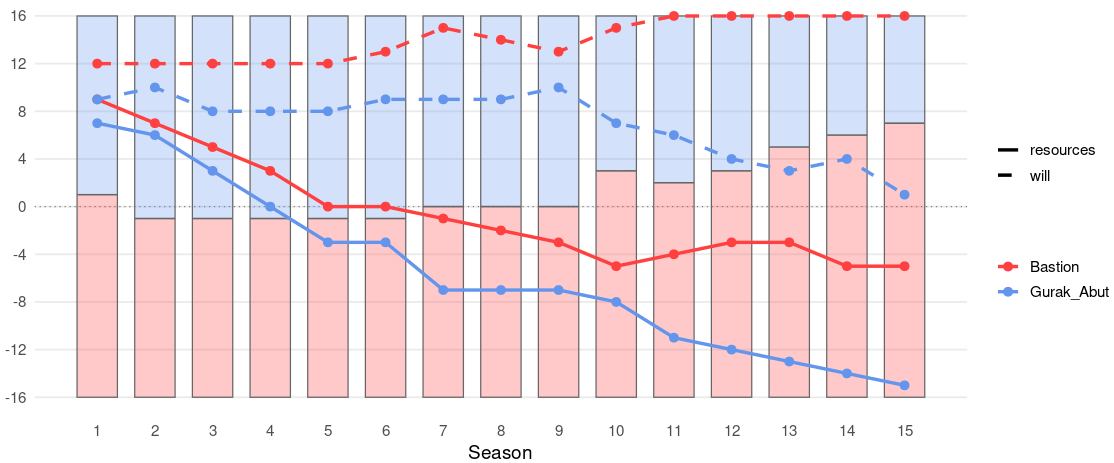
I rolled and scribbled and cursed and stopped to think and scribbled again. Bastion won the war, as expected. But it lasted almost 4 years.

Looking back, we can split the war into three parts:

  1. Gurak Abut, the weakest country, kept getting small wins at very beginning, but those victories did not put a real dent into Bastion’s morale and resources, which were plentiful to begin with.
  2. This led to a phase in which the war was stuck; positions danced between -1 and 1 until season 8, with 2+ needed for a country to have proper initiative. Plans and actions from both powers became less and less ambitious as the war attrition wore them down. There were two chances for the war to be over, for example when both countries “retreated and regrouped”, but it never crystallized.
  3. Finally, Guark About’s resources got so low it began to seriously affect its rolls (seasons 10 to 15), which compounded badly with the winter seasonal modifier. This meant Gurak Abut could bog down or even win the battles in the summer, but winters took a dark turn. Even with quite some luck in a couple of seasons, resources were eroded slowly but steadily, until it cracked fast. This felt very like a very real war to me.

The rest of the review here: https://open.substack.com/pub/kindofold/p/playing-thought-a-whole-war-solo?r=6ggs3z&utm_campaign=post-expanded-share&utm_medium=post%20viewer

open.substack.com
u/_kind_of_old_ — 2 months ago
▲ 12 r/TTRPG

Agile review of "This Means War", by Ben Robbins (author of Microscope)

This is a narrative game to play what happens to your characters during a war.

I have been playing the playtest version of “This Means War” solo, with the goal of generating some background stories for a Into the Deep Country campaign. I bothered the author (Ben Robbins, also known for stuff like Microscope) with my first play report (2 game turns), and he graciously replied. It turns out I made a couple of mistakes in my first go, even if the rules are pretty simple. Well, that’s how playing new games is like. Here is how the war went, and a review of the game.

[I have not been paid nor I receive any compensation to play and review this game. I got the game and played it because I was curious.]

The war dynamic seems quite realistic

I rolled and scribbled and cursed and stopped to think and scribbled again. Bastion won the war, as expected. But it lasted almost 4 years.

Looking back, we can split the war into three parts:

  1. Gurak Abut, the weakest country, kept getting small wins at very beginning, but those victories did not put a real dent into Bastion’s morale and resources, which were plentiful to begin with.
  2. This led to a phase in which the war was stuck; positions danced between -1 and 1 until season 8, with 2+ needed for a country to have proper initiative. Plans and actions from both powers became less and less ambitious as the war attrition wore them down. There were two chances for the war to be over, for example when both countries “retreated and regrouped”, but it never crystallized.
  3. Finally, Guark About’s resources got so low it began to seriously affect its rolls (seasons 10 to 15), which compounded badly with the winter seasonal modifier. This meant Gurak Abut could bog down or even win the battles in the summer, but winters took a dark turn. Even with quite some luck in a couple of seasons, resources were eroded slowly but steadily, until it cracked fast. This felt very like a very real war to me.

The rest of the review here: https://open.substack.com/pub/kindofold/p/playing-thought-a-whole-war-solo?r=6ggs3z&utm_campaign=post-expanded-share&utm_medium=post%20viewer

u/_kind_of_old_ — 2 months ago
▲ 22 r/solorpgplay+1 crossposts

Playing a whole war, solo! [Agile Review of "This Means War", by the same author of Microscope]

This is a narrative game to play what happens to your characters during a war.

I have been playing the playtest version of “This Means War” solo, with the goal of generating some background stories for a Into the Deep Country campaign. I bothered the author (Ben Robbins, also known for stuff like Microscope) with my first play report, and he graciously replied. It turns out I made a couple of mistakes in my first go, even if the rules are pretty simple. Well, that’s how playing new games is like.

[I have not been paid nor I receive any compensation to play and review this game. I got the game and played it because I was curious.]

The war dynamic seems quite realistic

I rolled and scribbled and cursed and stopped to think and scribbled again. Bastion won the war, as expected. But it lasted almost 4 years.

Looking back, we can split the war into three parts:

  1. Gurak Abut, the weakest country, kept getting small wins at very beginning, but those victories did not put a real dent into Bastion’s morale and resources, which were plentiful to begin with.
  2. This led to a phase in which the war was stuck; positions danced between -1 and 1 until season 8, with 2+ needed for a country to have proper initiative. Plans and actions from both powers became less and less ambitious as the war attrition wore them down. There were two chances for the war to be over, for example when both countries “retreated and regrouped”, but it never crystallized.
  3. Finally, Guark About’s resources got so low it began to seriously affect its rolls (seasons 10 to 15), which compounded badly with the winter seasonal modifier. This meant Gurak Abut could bog down or even win the battles in the summer, but winters took a dark turn. Even with quite some luck in a couple of seasons, resources were eroded slowly but steadily, until it cracked fast. This felt very like a very real war to me.

The rest of the review here: https://open.substack.com/pub/kindofold/p/playing-thought-a-whole-war-solo?r=6ggs3z&utm_campaign=post-expanded-share&utm_medium=post%20viewer

u/_kind_of_old_ — 2 months ago

I playtested solo "This Means War", by the author of Microscope

“This Means War” is a fresh game by Ben Robbins, and is now out, freely distributed for playtesting: https://lamemage.itch.io/this-means-war-playtest.

The game simulates war and the characters caught up in it. You don’t control the war, which evolves on its own, but you control the characters involved in it.

I decided to play this game for some world building: Let’s figure out a past war in my solo hexcrawl campaign based on Into the Odds + Into the Deep Country.

We start by rolling for the characteristics of the two countries at war:

  • Both were preparing for war
  • Country One: Past grievance with Country Two
  • Country Two: Weak industry

Alright, so Country One needs to be Bastion, the megacity-based nation of Into the Odds, which I see a sort of London in the (weird) 1800s, with an imperial thirst for exploration and trade. Here, the Institutes of Geography are militaristic organizations, and the army members are called geographers.

Country Two is Gurak Abut, a mountain kingdom with a generally low tech level. The past grievance" of Bastion is that Gurak Abut, with the aim of protecting its economy, closed his borders and commercial routes.

Setup of the war theaters

For each country we need to come up with two areas/regions, with one of them being the shadow of war, i.e., close to being directly involved. Bastion:

  • [Shadow of war] Sector 19K: Rural maritime region in the Deep Country with fishing villages and lots of small islands
  • Mills of the Veragan Dams, Lake region not far from Bastion with lots of hydromechanical mills

Gurak Abut:

  • Mines of Shebal Payyum: Copper and iron, low quality
  • [Shadow of war] Cotrosca coast: Massive production of olive oil, the only access Gurak Abut has to the sea

After this, we have to set up three other regions that are war fronts, i.e., not controlled by any of the two countries and at great risk of being involved in the war.

And at this point, I have zero ideas and would really need a spark table. Even better: Random tables for country description in terms of government, economy, etc. I use random tables from Mythic 2 (Tana Pigeon, World Mill Games) and get:

  • Guascal Badlands: Ruled by local violent warlords, target for proxy wars
  • Bulum Valley: Jungle and rivers, small independent theocracy with semi-autonomous monasteries administrating villages and cities nearby; confines with Gurak Abut
  • Arghawat Region: Steppe with nomad people, borders with the Deep Country of Bastion

The war breaks out!

Wait, who’s the good guy here? None of them: “Nations do not have friends, only interests” (Charles De Gaulle); and “There are no good powers” (Fabrizio De André).

Season roll: Summer. I decide Bastion is the attacking nation, they have that grievance, after all. Casus belli roll: They are preparing to attack us. Oh oh oh!, I can see the Bastion newspaper titles already.

The rest here: https://open.substack.com/pub/kindofold/p/this-means-war-solo-playtest?r=6ggs3z&utm_campaign=post-expanded-share&utm_medium=post%20viewer

u/_kind_of_old_ — 3 months ago
▲ 331 r/rpg

EDIT FOR THE KIDS WHO THINK A MAGE GUILD WITH BUREAUCRACY IS JUST WRONG: You don't have to use it. I mean it. It's your world and you can have it work in any way you want. I am not saying you should run it this way. Truth is thou, that this kind of stuff is present in many, many worlds and scenarios of our beloved games, so I think what I explain here might be a nice a idea for a game. That's all.

- - -

Characters need help with magic, and they have money and fame, so they go to the head of the Mage Guild or whatever magic-user institution, and what do they find? A politician. I know, it might sound counter intuitive, but hear me out.

IRL dynamic in academic research

In real-world research universities, the department chair isn’t the brilliant researcher running experiments at 2 AM. Au contraire, they’re the person who figured out how to navigate faculty meetings, secure funding, and befriend all the different (and many times rival!) departmental claques, and maybe the staff union. The misanthropic nerd loner, 100% invested in advancing science? They’re probably in a windowless lab, avoiding committee assignments like the plague.

This structure replicates scaling down: Consider a research lab. The head professor spends time crafting a funding proposal (i.e., a sales pitch), plans the budget, deals with admins and bureaucracy; meanwhile, the students and postdocs that do not even know exactly from which project their salaries comes from are the ones developing the actual science.

Hospitals work in a similar way. The Chief of Surgery might spend more time in boardrooms than operating rooms to keep that title. Meanwhile, the surgeon who can perform miracles with a scalpel is scrubbing in for their fourth procedure of the day, muttering about “administrative nonsense”. Brilliant practitioners might find politics tedious, and self-promotion awkward and exhausting.

What if Magic guilds or schools mirror this dynamic?

I do see a strong parallel. The obsessive wizard who spent sleepless nights to craft a new spell probably hates dealing with apprentice applications and guild politics.

The person running your Mages’ Guild is likely someone who mastered the social game: Building alliances, managing resources, understanding what different factions want. They’re likely a competent spellcasters, sure, but their true talent lies in organization and influence. So when designing mage guilds and schools, I would factor this dynamic in.

When the players need help from the best mage to investigate the artifact they just snatched from that forlorn crypt, well, they can go to the master wizard and, disappointingly, find a politician. The master wizard is all worried about maintaining the status quo and the problems that the artifact can cause: How to report this discovery to the king? Wait, are there taxes to be paid on unearthed magic artifacts?, etc. The mage that the players need, the one that would obsess over the artifact and help them understand its powers and how to control it, is likely a foul-mouthed recluse loner (and super fun to play).

Original link and shameless plug, if you want to subscribe to my blog: https://open.substack.com/pub/kindofold/p/the-real-archmage-is-probably-not

(RPG contents for NSR, OSR, and PBTA systems; solo actual play; agile reviews of indie games; and very occasionaly, rants)

u/_kind_of_old_ — 4 months ago