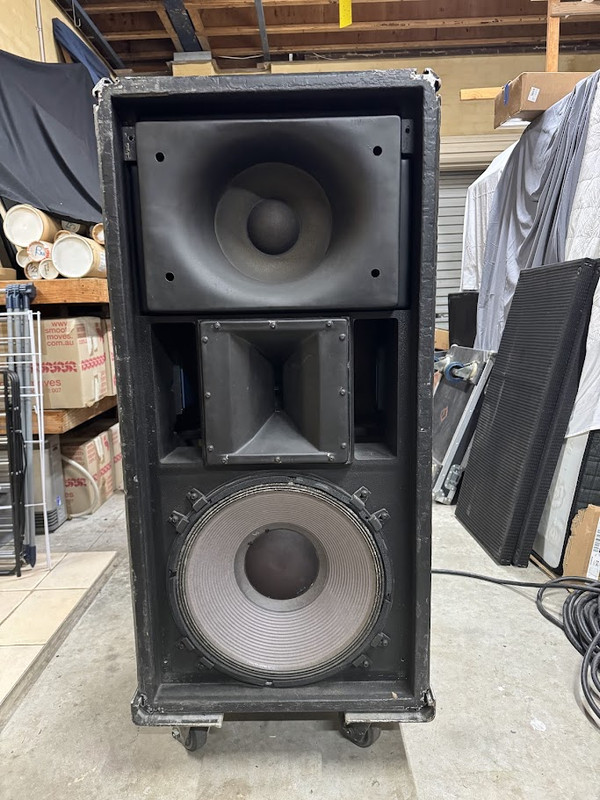
Phase 1 (tops) done on a Clair R4-III build, need sub advice, WSX vs SKRAM vs F218

Just fired up the top half of a rig I've been building for a few months. Wanted to lay out the setup and get some sub thoughts from the heads here.

Tops: Clair R4-III, bi-amped per box (LF plus a combined mid-high leg per side, four amp channels). The HF is a JBL 2446J on a CD horn and it is the standout. Even at low level the whole thing has a character I have rarely heard from newer cabinets. No regrets going old and characterful over new and convenient.

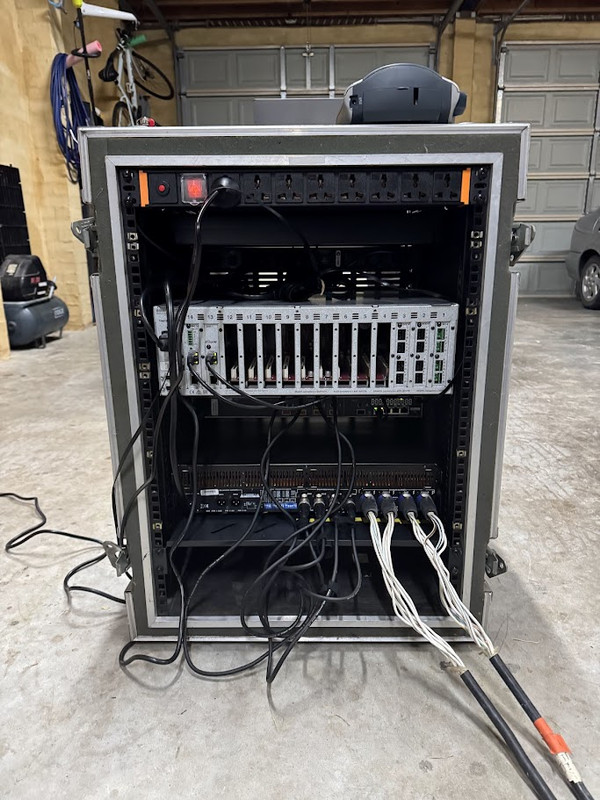
Signal chain, Dante the whole way to the amp:

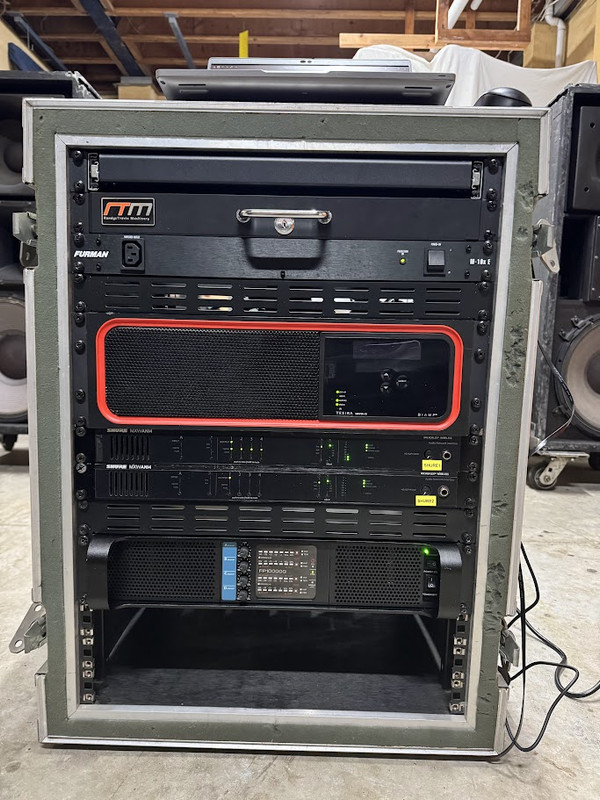
Laptop running Dante Via and/or other Dante channels, into a Biamp Tesira Server-IO where all the processing lives, out over Dante to two Shure MXWANI4 units doing Dante to analogue into an FP10000Q (4x1350W) into the Clairs.

The whole audio side sits on an isolated subnet, no gateway, no DHCP, so the Dante clock stays clean and it behaves the same at home or at a venue. Laptop is dual homed, wired to the audio island and wifi for internet and control. 4x analogue inputs and 8x analogue outputs available also if required or as backup.

DSP and amp as commissioned:

The Tesira does the two way crossover, sums MF and HF with a phase corrected inverted HF path through the 1.5kHz region, plus tiered limiter presets. FP10000Q is at 32dB gain, four independent channels, Soft clip. Per channel hardware voltage clip limiter as a backstop, 47V on the mid high channels to protect the compression drivers, 83V on the lows. One channel per Clair leg, patched straight across from the Shure outputs.

Headroom is big. Amp at quarter juice, source barely up, already loud enough to get the neighbours moving.

My question. Subs.

This is a techno/trance rig, so the bottom end needs to do the heavy lifting. Hearing the tops come alive has sharpened my take on what I want out of the low end. Deep, into the 30Hz and under range. High output, enough to keep pace with tops this efficient. Fast and articulate, because the Clairs have real character and I don't want slow boomy subs fighting them.

That keeps pointing me at horn loading. Three things I'm weighing, but open wide to other suggestions:

Four Martin WSX. Folded horn, the right profile, but I need a used set to turn up. Last one sold before I could move on it. (Sydney, Australia, and not a lot of decent subs turn up secondhand here sadly.)

SKRAMs, which I'd build. Deep, efficient, fast. Ticks every box on paper, just takes a build.

Funktion One F218. Fast, punchy, clean, built like a tank, exactly the character end of the spectrum. The catch is these are punch more than deep dig. F1 even sell a separate IB218 as low end extension below them, they want to be coupled in numbers to come alive, one or two in a room just sounds dry. So it would come down to running enough of them. And getting four F1 boxes at a sane price (especially in Australia)... who am I kidding.

The ported dual 18s I've looked at do deep and loud fine but don't seem to have the transient speed to sit under these particular tops.

What I'm after from the r/soundsystem hive mind:

WSX vs SKRAM vs F218 under efficient horn tops, real-world experience? Other/better suggestions?

Anyone run tapped horns or F1 bass under vintage pro tops, how did the character match land?

Where do you actually cross your WSX? I know it wants to go low given the folded path, curious where people settle.

Sub speed is real and audible. A horn or tapped horn sits under characterful tops better than a ported box because the transient response and lower distortion actually match. Keen to hear from anyone who has A/B'd horn vs ported under tops like these and can confirm or push back either way.

Happy to answer anything on the Dante or DSP side. Cheers and thank you in advance.

https://i.postimg.cc/5Nd6rrFB/IMG-4679.jpg

https://i.postimg.cc/sDdvLLZJ/IMG-4680.jpg

https://i.postimg.cc/dtPLffTB/IMG-4682.jpg

u/coax_k — 1 day ago

How Propaganda Works in 2026 (World Cup Version)

We beat Turkey 2-0. Three insane performances won that game. Watch which one you're allowed to know about.

Nestory Irankunda scored the opener. Good goal, good night, no argument from me. Connor Metcalfe scored the second, the one that sealed it. Patrick Beach, 22, kept goal on debut because the coach dropped the captain to play him. Turkey had thirty shots and three-quarters of the ball. He let nothing past. Clean sheet on debut at a World Cup, in for the skipper. Any other week that's the massive headline on its own.

Now do this yourself. Takes thirty seconds. Go to the ABC. Or SBS, the very same mob who actually broadcast the game. Search the keeper's name. Patrick Beach. Watch what comes back. Two results, maybe, then the page fills up with Irankunda. You searched for the keeper and the website handed you someone else.

I ran it on three newsrooms. News.com.au, the ABC, SBS. Same thing every time. Search the guy who kept the clean sheet, get back a page about the other one with the “story”. Look for Metcalfe, who scored the goal that won it, and he barely exists.

That's not one outlet. That's three. Two of them taxpayer-funded. One the actual broadcaster. All reaching for the same angle, all losing the same two performances, and not one phone call between them. They aren't coordinating.

Here's the part people can't get their head around. Read it slow. Nobody sat in a room and decided to hide the keeper. No meeting. No memo. Every newsroom reached for the same story at the same time because they all run off the same template, and the two blokes who won the match got crowded off the page in the rush. Not suppressed. Stampeded over. The desk wasn't frothing to hide Beach. It was frothing over the refugee angle, and the keeper was standing behind it when the whole industry charged.

That is what propaganda is. Not a man in a ministry handing down orders. You're picturing the cartoon version, because the cartoon version is easy to wave off. Nobody sent a directive, so it can't be propaganda, right. Wrong. Propaganda is what you get when every outlet independently reaches for the same frame, picks the same story, drowns out the same facts, and nobody coordinates a thing. Three newsrooms. Same angle. Same two players lost. No phone calls. That's not the system failing. That's the system working exactly as built. A press that reaches, every time, for the story it wants to tell, and lets the event come third.

I'm not having a go at Irankunda. He's the raw material, not the culprit. Run the test. Same match, same goal, but the bloke who scored it isn't Irankunda. He's Bazza from Newcastle. Scores the identical opener on the identical night. No story attached. Now who's on your front page tomorrow.

The keeper. Beach. The bloke who kept a clean sheet on debut in for the captain and saved EIGHT goals. With no story bolted onto the scorer, the front page falls back to the best performance on the night, and that was the keeper. You'd know his name. You'd know it cold. But you don't.

So what changed the front page wasn't the goal. Bazza scored the same goal. It was the story that came attached to the man who scored. That's the whole game. The football was the delivery van. The story was the cargo. The moment the scorer comes with the cargo the desk wants, the bloke who actually had the best game vanishes off the page.

And here's the kicker. You don't have to take my word that the keeper won that game. Take Irankunda's. The goalscorer, the bloke on every front page, said it himself in the press conference. “If it wasn't for him, the scoreline could have been different. He saved us. He kept us in the game.” The hero they crowned pointed straight at the keeper and said he's the reason we won.

They ran every other word out of his mouth. The celebration, the inspiration, the camp. That one sentence, the one where he handed the night to Beach, didn't make the cut. The man at the centre of the story told them who actually saved it, and they kept running the story anyway. That's the tell. When even your chosen hero points at the bloke you left out, and you still don't move, you were never covering the match. You were covering the story you came to tell.

And it works. That's the bit that should bother you most. The clean sheet doesn't move you, because nobody lit it up. The goal moves the whole country, because it got wrapped in the arc and run on every front page at once. You weren't watching sport. You were watching a story get reached for, aimed, and fired, landing exactly where it was pointed, and an entire country cheering it home like they picked it. They didn't pick it. They were handed it. The cheering is the product.

You live on the headlines. They're your source of truth, and I get why. Only so many hours in a day. But the headline isn't the event. It's the version of the event somebody chose to hand you.

Go and search the keeper's name. Watch the machine refuse to show him to you. Then ask what else you've swallowed this week, just because it was the version that landed in front of you.

u/coax_k — 22 days ago
▲ 8 r/radarr

Subarr: a UI for driving subgen across your Radarr library (plus more)

If you run subgen for local Whisper subtitle generation, you already know it works, but there's no real front end for it. You're either scripting it or kicking it off by hand. That got old, so I built subarr. It's a GUI that points at your Radarr (and Sonarr) library, shows you which movies are actually missing a subtitle, and lets you generate them with subgen in a couple of clicks.

The part I really wanted to get right is that it doesn't just trust the metadata (where I was getting tripped up on a lot.). Before it calls a movie a gap, it probes the file, so it won't queue something that already has an embedded sub. It also listens to the actual audio to check the language, because "English" in the metadata is wrong often enough to matter. The classic case is a foreign original film with an English dub set as the default track. subarr can tell a mislabelled track from a genuinely bilingual one, and from "honestly not sure," and you confirm with one click.

The rest, quickly: it won't hammer your GPU into the ground (scheduling with backpressure), it runs on amd64 and arm64, and it lives beside Bazarr rather than replacing it. Bazarr still downloads real subs. subarr is for the gaps where nobody has a sub to download.

It's free, self hosted, no account, no nonsense. It does send anonymous usage stats by default (version, a rough library-size bucket, that kind of thing, never paths or filenames). One click turns it off, and Settings shows you the exact payload it sends.

Repo, screenshots, and a five-minute compose install are here: https://github.com/coaxk/subarr

I built it to scratch my own itch, so I'd genuinely like to hear what's missing or what else you'd maybe want it to do.

Disclaimer: Built with AI assistance. If that's not your thing, I understand and respect your viewpoint. I'm not tyring to evangelise, just build a good and useable product that users will hopefully find helpful. All PR's are human reviewed and authorised and the security approach, etc. is detailed in the README. Hit me with any questions or concerns, I'm here.

u/coax_k — 25 days ago
▲ 36 r/unRAID

[Community Apps] Subarr - The GUI Bazaar wishes it had (and the one Subgen never has had)

We have just launched Subarr through the CA channel. Check it out! Any issues can be logged via the Unraid Forum Subarr Support Post , a Github Issue/Bug Report or just hit me right here in this post.

Subarr decides what subtitles are actually missing across your library, which providers are worth your time, and when it is worth running Subgen (Whisper) across them. Bazarr finds and downloads. Subgen transcribes. Subarr coordinates (plus a fair bit more).

README and full detail before you jump in.

Screens:

Dash

Queue

u/coax_k — 1 month ago
▲ 58 r/sonarr+1 crossposts

Subarr - the GUI Subgen never had

GitHub: https://github.com/coaxk/subarr

Subarr - the GUI for subgen that subgen lacks and Bazarr wishes it had..., as well as providing a whole library view of missing subs that the rest of the stack is lacking. It provides a queue UI where you can select a file, a directory, or a full series, hit go, monitor the progress live, and cancel or re-queue if needed. It also verifies each file before registering a missing subtitle, and identifies the actual language of the audio, so Whisper does not end up transcribing it incorrectly.

Detailed descriptions and screenshots are all located within the repo. I happily receive any comments or feedback, they are most welcome, especially if the program behaves unexpectedly on certain setups, bugs, etc. Check it out. If you are a heavy subs user I think you'll like it.

u/coax_k — 21 days ago
▲ 10 r/bazarr

Subarr - Built a coordination layer beside Bazarr and Subgen. Catches wrong language detections, surfaces what's actually missing, gives you a real queue UI.

Heads up: built with heavy Claude interaction - code's open, every PR human-reviewed, so judge it on the product, not the buzzword. (AI-slop complaints - /dev/null.) Security a concern? It's ours too - our approach is in the README.

Bazarr excels at finding and downloading subs. Subgen excels at transcribing when nobody can. The thing that kept biting me was everything in between: subgen burning Whisper minutes on the wrong audio language because the first 30 seconds of the file weren't representative; subs getting re-searched when I already had them on disk; no good view of “what's the biggest gap in my library right now.”

I built **Subarr** as the layer that ties Bazarr and subgen together. It sits beside both, not on top of either.

**Two ways to use it.** Pick whichever fits how you work:

- **Simple.** Treat Subarr as a real queue UI for subgen. Install it, open the Library tab, tick a file or a folder or a whole series, hit “Queue for transcription.” Watch it run. Re-queue, cancel, see what failed and why. Same way you'd use Sonarr's queue for downloads. No coverage walks, no rules, just “give me a working frontend for subgen.”

- **Advanced.** Open the Coverage tab. Subarr has already walked your library and sorted gaps by score with reason chips per row (no track, embedded-only, bazarr-wanted, audio-mislabel, low-score, unmonitored). Apply a rule, queue 50 things at once, set up a schedule that respects Tautulli playback signal. This is the “let Subarr decide” path.

Most people start with simple, end up using advanced once the install has been collecting signal for a couple of days.

What's actually in v1.0:

- **Calibrated audio language detection.** Three Whisper chunks across each file (at 10%, 50%, 90%), majority vote, confidence is the minimum probability across agreeing chunks. The motivating cases were files where the first 30 seconds aren't representative: foreign-language openings on dub releases (anime is the obvious one, but Spanish-dub Korean drama, French-dub Italian thriller, English-dub historical drama all do the same thing), silent cold opens, music-only intros. Whichever your library hits, you get a manual review queue with chunk evidence visible and one-click confirmation that propagates back to Sonarr.

- **Whole-library coverage view.** Per-language gap list across your full Sonarr + Radarr library. Sorted by score. Reason chips per row. Bulk select, apply rule, queue.

- **Verifies before it queues.** Subarr probes a file before calling it a gap, so it never double-works something an embedded sub or existing track already covers. It cross-checks the wanted list against what's actually on disk rather than mirroring it blindly; files it hasn't probed yet wait in a visible “Analysing” bucket and are never silently dropped.

- **Scheduler with back pressure.** Tautulli playback signal influences priority. NOW PLAYING, just-imported, airing-soon all boost.

- **Provenance ledger.** Which provider gave you which sub, when, why. Survives Bazarr score-profile changes.

- **Embedded subs first-class.** SDH, forced, PGS, full are all distinguished, not collapsed.

About the patch story: Subarr drives Subgen through 13 small auditable patches over upstream `mccloud/subgen`, published as `ghcr.io/coaxk/subarr-subgen`. You don't have to swap. Compat mode covers vanilla; you miss calibrated multi-chunk detection and queue cancel. Decision table at the top of the README.

Known limits, transparent: no built-in multi-user auth (reverse proxy required), queue reorder/promote/demote depends on a Subgen patch that hasn't landed yet (v4.9), no auto-update by design, SQLite only, single-host, Jellyfin/Emby not yet, arm64 not yet published.

On the roadmap, the v1.1 hero feature: global provider success leaderboard from opt-in telemetry. The “which providers actually deliver per-language” question that comes up here every couple of weeks. Aggregation work is in progress.

GitHub + compose snippet: https://github.com/coaxk/subarr

Looking for feedback on edge cases I haven't hit, reverse-proxy configs that break, and whether the “beside Bazarr” framing actually reads that way to long-time Bazarr users. Genuine question on the last one.

Some screens:

Dash

Gaps (sorry that screen is a bit chopped)

Queue

Library selection view

Settings/Integrations

Subgen live log

reddit.com
u/coax_k — 1 month ago
▲ 3 r/Shure

MXW Software v1.2.0 - Shure's Cleverbridge delivery has completely failed. Anyone able to share the installer?

Hey all, hoping someone here can help with what's turned into a genuinely ridiculous situation.

I picked up an MXWANI4 to interface my Tesira Forte's Dante network with an analog amplifier signal chain. Unit is on the network, alive, fully discoverable via Dante Controller, passing audio at the Dante level. The hardware is perfectly healthy.

The problem: I can't configure the Shure side of it because I cannot obtain Microflex Wireless Software v1.2.0. The original Flash-based web UI is dead (obviously), and Shure's replacement desktop app is the only configuration path. Without it, the unit is essentially a brick from a configuration standpoint.

What I've tried over the last several hours:

  • Shure US site download → Cleverbridge registration → confirmation email (ref 540860793) saying "you'll receive your product directly from Shure" → no Shure delivery email has ever arrived
  • Shure Asia regional site → same Cleverbridge dead-end
  • Shure software archive page → every Download button → Cleverbridge → same loop
  • Cleverbridge Purchase Lookup tool with reference number → no working link
  • Softpedia, Softonic, FileHippo, FreeDownloadManager, Software Informer → none of them carry v1.2.0 (they all have SUU because that's been freely distributed since 2014, but the newer MXW Software is locked down)
  • Wayback Machine on Shure download pages → no direct file captures
  • Various site: and inurl: searches on Shure's own CDN subdomains → only documentation surfaced, no installer
  • Spam folder, promotions folder, every filter checked → nothing

SUU works fine (got that, used it, firmware is current). Dante Controller works fine. The block is purely the Shure-side configuration software.

Background - why this is genuinely broken:

Shure killed the Flash UI when Adobe killed Flash in 2020. Built a replacement desktop app. Locked the replacement behind a Cleverbridge-gated registration flow that fails for international (AU in my case) customers. There is no documented alternative path. The product I paid for cannot be configured because Shure's distribution chain has failed to deliver the only software that can configure it.

Multiple Cleverbridge support pages document this as a known issue requiring manual support intervention. I'll be emailing Shure Asia support, but their turnaround is business hours US time and I'd really like to get this commissioned tonight.

The ask:

If anyone here has the MXW Software v1.2.0 installer sitting on a build USB or in a downloads folder, would you be willing to share it via DM? I'm not looking to bypass any licensing — the software is freely distributed by Shure, I just can't access their distribution. I'll independently verify the file hash against any official source I can find before installing.

Alternatively, if anyone knows a working direct download URL that doesn't route through Cleverbridge, that would be equally welcome.

Cheers, and thanks for reading this far. Welcome to roast me if I'm missing something obvious.

reddit.com
u/coax_k — 2 months ago

Built a signal flow diagram for my Clair R4-III + Biamp Tesira Forte build - what would you change?

https://preview.redd.it/9nv1bn9xgzzg1.png?width=3720&format=png&auto=webp&s=62ec580805324361682b1c98139f7f16ca3c49f7

Long time lurker. Finally building something worth posting.

Picked up a stereo pair of original Clair R4-IIIs a while back. Lititz-shipped, all original JBL components inside (2242H LF, 2020H MF, 2446J HF on horn). Spent the last few weeks documenting the signal flow as a working bible for the build. Posting for critique.

Build context: lives at home as the primary listening rig but goes out to gig 5-6 times a year. Architecture has to work for both, which shapes some of the choices below.

Architecture

Source side is a PC running playback plus REW, going Dante into a Biamp Tesira Forte DAN CI. The Tesira is doing all the heavy lifting: active crossover, EQ, delay, polarity, limiters, the lot. R4-III preset was originally a Lake factory module called "10000Q · R4III_EA". Have translated it across to Tesira with the topology fully preserved. LR4 LPF at 289.2 Hz on the LF/MF split, LR2 HPF at 251.8 Hz on the mid, LR4 HPF at 1600 Hz on the high. Per band delays at 1.20 / 0.89 / 0 ms. HF polarity inverted.

Network is a pair of Shure MXWANI4s. They're doing triple duty: Dante endpoints, 4 port PoE switches, and analog conversion. PC and Tesira both sit on the Dante network as peers through the Shure switching. Audio stays digital end to end and only gets converted to analog right before the amp. Patch between the two MXWANI4s makes the whole thing one network.

Amplification is currently an MC2 Audio Delta 40 (4 channel, 500W into 8Ω) driving the Clair pair. NL8 fan out at the amp end, single cable run to each cabinet. Pins 1+/1- carry LF, pins 2+/2- carry M+H to the internal passive crossover at 1600 Hz. Sub amp and mid amp are planned, but the model is TBC.

Cabinets are the Clair pair installed. Sub layer planned as either an F221 horn loaded or a DIY SKRAM build with B&C drivers. Haven't decided. Mid layer cabinet model also TBC. Will sit between the subs and the R4-III LF section as a kick / mid bass band. Although not entirely sure this will be required, but might be fun anyway, would just introduce more work recalibrating the whole build again.

Tier 1 limiter values shown on the diagram are conservative for first audition. LF at 0.0 / +3.0 dBu RMS/Peak, M+H at -8.0 / -5.0. Will graduate to Tier 2 once the system is verified to be working. RMS time constants on the M+H band are 5ms attack and 150ms release after looking into how Powersoft, EAW and MC2 do it.

The obvious

Yes, the Delta 40 is underspec'd for what R4-IIIs can actually take. But it's what I have lying around. Spec sheet wants something in the 1500-2000W/4Ω class for full output. The Delta 40 puts out about a quarter of that.

This is intentional for phase one. SPL targets at home are well below where the cabinets get stressed. Limiters are calibrated to the Delta 40 clip ceiling rather than the thermal limit of the drivers, so the system stays clean within the amp's headroom.

Upgrade path is identified. Looking at Powersoft X8 or K series, etc., once the broader system is fleshed out. Dante direct preferred, so the Shure D/A stage drops out of the Clair feed (or at worst stays in to help the other non Dante amps). Bonus for the gig deployments where headroom actually matters.

Open questions

Sub cabinet, F221 vs SKRAM. Looking for genuine sub-30 Hz extension, ideally flat to 25 Hz at -6 dB, with horn loading for efficiency around the 100 dB / 1W / 1m mark. F221 saves time on assembly but $$. SKRAM is the same driver class but DIY build from published plans, total control over fabrication quality, but a serious shed project. Cost is roughly the same all in. If you've gone either way, what would you do with hindsight? Particularly interested in whether the SKRAM build actually hits its predicted response in real-world rooms or whether the F221 is a more reliable performer.

Mid layer cabinet. Trying to figure out if it's even worth adding, but if I do, I'd want it covering roughly 80-100 Hz up to 250-300 Hz. The thinking: take the kick band off the Clair LF section so the 18" 2242H isn't doing both deep LF and upper bass, and add some punch in the upper bass / lower mid range that horn-loaded mid bass cabinets do better than direct radiator 18s. Looking for horn loaded, high efficiency (around 104 dB to match the Clair sensitivity), reasonably compact for the gig deployments. Funktion-One F1201 is the obvious reference, but open to other options. Or is the whole layer overkill given the R4-IIIs handle the band fine on their own?

Eventual amp upgrade. Dante direct preferred so the Shure D/A stage drops out of the Clair feed. Powersoft X8 or K series, Lab.gruppen FP series, Linea Research all on the radar.

Heretical to even mention I know, but having looked closely at the Chinese tour-grade amp scene, some of the gear genuinely impresses on paper. Sanway DT18K4 / DA18K4 / DA24K2 (Powersoft Ottocanali clones with Brooklyn II Dante cards) and Admark AD442 / AD42 (similar topology, GaN PSU on the higher tier) are the two that have come up repeatedly. Spec-for-spec they sit alongside the Western touring amps at roughly a third of the price, and the actual Powersoft / Lab.gruppen / MC2 / Linea Research factories are mostly all in Guangzhou anyway.

What I can't tell from desk research is real-world reliability and consistency over a few years of gigging. Marketing copy says all the right things. Forum threads are a mix of "incredible value" and "fell over after six months". Anyone running Sanway or Admark in actual touring or install service - what's the honest read? Particularly interested in QC variance unit-to-unit, support responsiveness when something does go wrong, and how the Class D output stages hold up vs the Powersoft / Lab.gruppen reference points.

Not committed to going that path. But not ruling it out either if the operational experience is solid.

Anything obviously broken that I've missed? The architecture has been peer reviewed but not fully built out yet. Tops, MC2, DSP and Shure Dante units are in hand right now, the rest is in the pipeline and to be finalised hence this post.

Cheers.

reddit.com
u/coax_k — 2 months ago

Anyone got any up and running in Australia yet?
Would love to wrap my ears around them if so.
Happy to travel to your next event etc as well.

reddit.com
u/coax_k — 2 months ago