~$5,000/month from 3 faceless YouTube channels. Real numbers, real costs, no fluff.

I'll start where it actually began for me. I've been making AI-assisted YouTube videos for a good while now. Got into it through shorts first, the popular bait stuff like "animal rescue" and "what if skeletons." I wouldn't say I blew up, since shorts need a huge amount of views to earn anything real and you can't predict what lands. But I came out of it knowing the whole process inside out: script, visuals, voiceover, editing.

Then I figured out the thing that changed everything for me. Adults prefer long-form videos, and that's where you get predictable, stable reach and predictable income. I run 3 channels now, mostly history and finance, and together they do around $5K a month.

The main problems with long-form are the cost per video and the time it takes to make. I know that pain well. When I started, I could burn $15 on a single 45-second short, and since you need plenty of attempts before anything hits, it stacks up fast. Long-form is worse on both counts. The cost per video climbs higher, and the time goes up several times over. Research, scripting, voiceover, visuals and editing on a single 10 minute doc is easily 30+ hours. That's the part that made me want to automate it.

So I went hunting for ways to make my workflow cheaper and faster. Through plenty of testing and mistakes, I found something useful: Google gives every new account $300 in free cloud credits for AI content, and almost everyone already has a Google account. Those credits realistically cover your first 6-10 full videos before you pay anything out of pocket. After that, you're running on your own cloud at real cost, which for me lands around $35 to $55 a video, depending on length.

So I built a system that runs the entire pipeline automatically on your own Google account. Research, script, voiceover, scenes, animation, final video. I spent about seven months building it. That's OpenVidi.

These days I can make 3 videos for my channels in a single day while I'm at the gym. Obviously, you can produce complete slop with this. The output is only as good as your topic and script. But if you have a system, you can earn real income without sitting at a computer all day.

Honest caveat, since this sub has seen every AI money claim there is: the tool doesn't make the money. The topic and the consistency do, not the software. AI just removes the 30 hours per video wall that makes most people quit before they ever monetize. Treat it like a real content business, not a press-button-get-money scheme.

One more honest thing, because it's the part people actually get stuck on. It's not fully hands-off. To run it you connect your own Google Cloud account, and that's how you get Google's $300 and pay them directly, with no markup from me. I did everything I could to make that step simple, but it's still there and I won't pretend it isn't. It looks intimidating the first time you see it. But if you push through it, I think the result will genuinely surprise you.

If you want to poke at it: https://openvidi.com

Question for the community: for those of you doing long-form or faceless YouTube, what do you actually spend per video right now, in time or money? Curious where everyone's getting stuck.

Happy to answer anything. AMA.
reddit.com
u/InitialAd1231 — 3 days ago

Pivot question: my pricing model is the cheapest one for users and the worst one for my revenue. Do I switch?

I'm at a pivot point and I honestly can't decide which way to go. More revenue for me, or lower cost for my users.

I built OpenVidi, a tool that turns a single prompt into a full-length YouTube documentary: script, voiceover, scenes, animation, finished file. I originally built it for myself, so I made it as cheap to run as I possibly could. That's how I ended up with the model I have now: users connect their own Google Cloud account, they get Google's standard $300 new-account credit, and they pay Google directly for compute. Zero markup from me. As it stands, a user can produce roughly 50 minutes of finished video on a $29 subscription. Whether that's cheap is for you to judge.

The problem: not many people connect. The setup is unfamiliar, and it scares them off before they ever get to see what the product does.

The part that keeps me up at night: among the people who DO connect, 28% go on to buy a subscription, and they tell me the product is genuinely great. So the model itself isn't the issue. The doorway is.

The temptation: moving to a standard credit system, the one every competitor in this market runs. It would almost certainly raise revenue and pull in more users, because they already understand how it works. It would also make the product noticeably more expensive for them, since I'd be reselling compute at a margin instead of letting them buy it at cost.

Where my head is right now: make credits the default, and keep the bring-your-own-cloud setup as a separate option for anyone who wants the cheapest possible run.

What I can't settle: whether that makes me pragmatic, or whether it destroys the one thing that separates me from everyone else in this category.

For anyone who's faced some version of this: did you keep the model that was better for users, or the one that was better for the business? What actually happened afterwards?

reddit.com
u/InitialAd1231 — 13 days ago

~$5,000/month from 3 faceless YouTube channels in 2026. Full breakdown, real costs included.

I'll start where it actually began for me. I've been making AI-assisted YouTube videos for a good while now. Got into it through shorts first, the popular bait stuff like "animal rescue" and "what if skeletons." I wouldn't say I blew up, because shorts need a massive amount of views to earn anything real and you can't predict what lands. But I came out of it knowing the whole process inside out: script, visuals, voiceover, editing.

Then I figured out the thing that changed everything for me. Adults prefer long-form videos, and that's where you get predictable, stable reach and predictable income. I run 3 channels now, mostly history and finance, and together they do around $5K a month.

The main problems with long-form are the cost per video and the time it takes to make. I know that pain well. When I started, I could burn $15 on a single 45-second short, and since you need a lot of attempts before anything hits, it adds up fast. Long-form is worse on both fronts. The cost per video climbs higher, and the time goes up several times over. Research, scripting, voiceover, visuals and editing on a single 10 minute doc is easily 30+ hours. That's the part that made me want to automate it.

So I went looking for ways to make my workflow cheaper and faster. Through a lot of testing and mistakes, I found something useful: Google gives every new account $300 in free cloud credits for AI content, and almost everyone already has a Google account. Those credits realistically cover your first 6-10 full videos before you pay anything out of pocket. After that, you're running on your own cloud at real cost, which for me lands around $35 to $55 a video, depending on length.

So I built a system that runs the entire pipeline automatically on your own Google account. Research, script, voiceover, scenes, animation, final video. I spent about seven months building it. That's OpenVidi. Not dropping a link since this sub is strict about that, but happy to answer anything about the setup in the comments.

These days I can make 3 videos for my channels in a single day while I'm at the gym. Obviously, you can produce complete slop with this. The output is only as good as your topic and script. But if you have a system, you can make real income without sitting at a computer all day.

Honest caveat, because this sub will smell BS: the tool doesn't make the money. The topic and the consistency do, not the software. AI just removes the 30 hours per video wall that makes most people quit before they ever monetize. Treat it like a real content business, not a press-button-get-money scheme.

One more honest thing, because it's the part people actually get stuck on. It's not fully hands-off. To run it you connect your own Google Cloud account, and that's how you get Google's $300 and pay them directly, with no markup from me. I did everything I could to make that step simple, but it's still there and I won't pretend it isn't. It looks intimidating the first time you see it. But if you push through it, I think the result will genuinely surprise you.

Question for the community: for those of you doing long-form or faceless YouTube, what do you actually spend per video right now, in time or money? Curious where everyone's getting stuck.

Solo founder. AMA.

reddit.com
u/InitialAd1231 — 15 days ago

I make full 10-minute YouTube documentaries from one prompt while I'm at the gym. Full system below, prompts included, free.

One year ago a 45-second AI short was costing me around $15 once you count the failed attempts. Today one text prompt produces a finished 10-minute history documentary: script, voiceover, ~95 scenes, animation, final 1080p file, for $35-55 in compute, and the first 6-10 videos run on Google's free $300 instead of my own card. This post is the full system: the pipeline, the exact prompt templates I use, and every rule I learned by burning money. Take all of it.

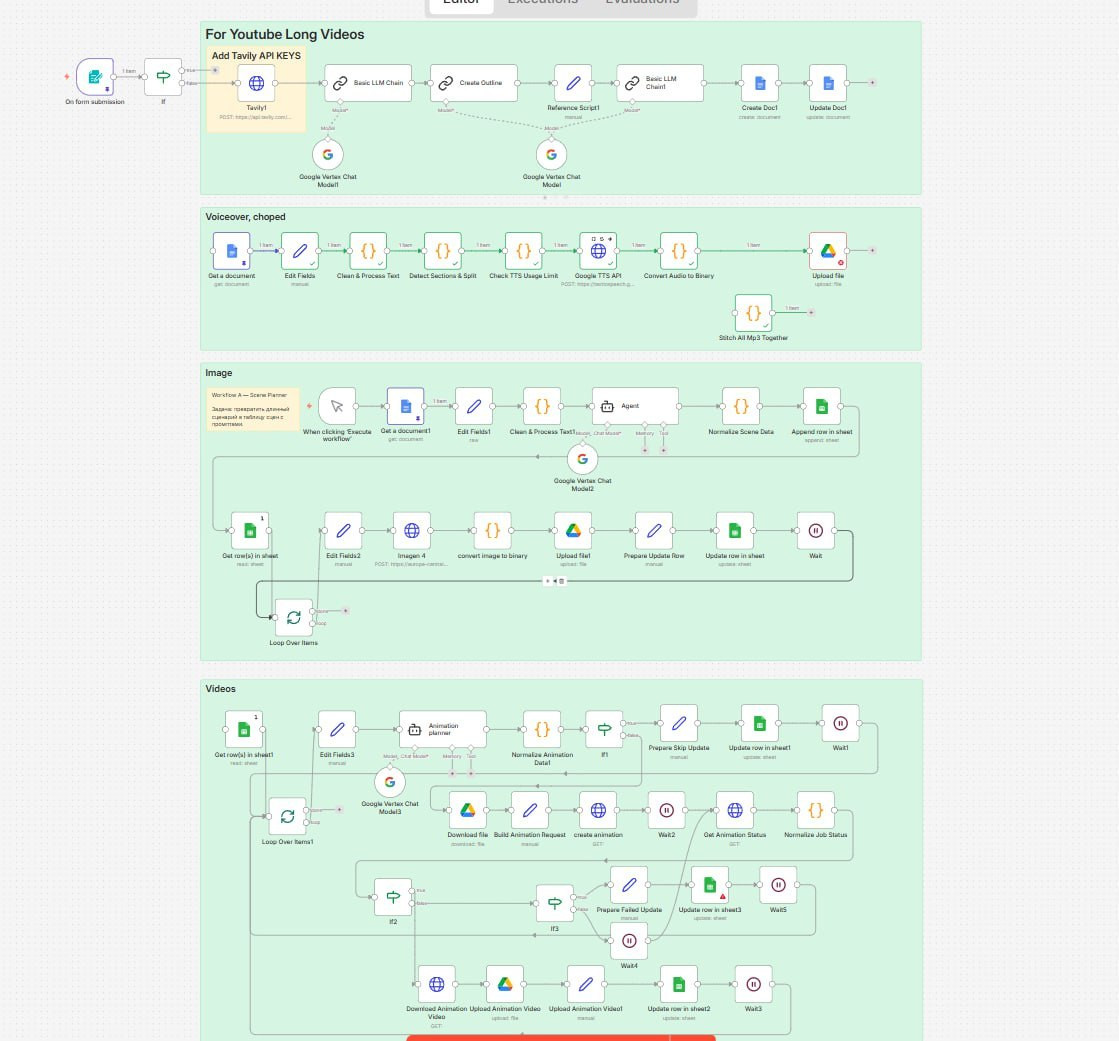
Quick context so you know what I'm selling and what I'm not. I run a faceless history channel and I built the tool this system runs on, so bias fully disclosed. But everything below works without my tool. My first version was a duct-taped n8n workflow, here's the actual screenshot: https://i.postimg.cc/tg76DJ5Y/photo-2026-07-22-13-28-43.jpg. With some patience you can rebuild that for free over a weekend. I later spent seven months moving it into code because my build kept dying at scene 41 of 95, but the prompting system is identical either way, and the prompting system is what makes or breaks the output.

What you need

  1. A Google account. Google gives every new account $300 in free cloud credits. That's your first 6-10 full videos with nothing out of pocket. It runs out, then it's $35-55 per video at real cost.
  2. A pipeline. Either build one yourself (n8n prototype above, expect pain at scale) or use mine: https://openvidi.com — it's the same system productized, you connect your own Google account and pay Google directly, no markup from me.
  3. The prompt templates below. This is the part that cost me a year of failed videos, and it's the part everyone skips.

The three-block prompt system

Every video runs on three reusable blocks. Between videos I only touch the topic line and one cold-open sentence. Everything else stays frozen, which is why quality stays consistent.

Block 1, Topic. One sentence, under 400 characters, with explicit exclusions. Exclusions matter more than the topic itself, they're the difference between a focused doc and a Wikipedia tour. Example:

"The Bronze Age Collapse, focusing on the final 50 years: the sea peoples, the fall of Ugarit, and the palace economies that never recovered. Exclude: general Bronze Age history, Egypt's survival, modern archaeology debates."

Block 2, Narrative Style. Paste-ready template:

"Documentary narration for a 7-12 minute history video. First 3 seconds: calm voiceover stating the key date and event name ('The Bronze Age Collapse. 1177 BC.'), then cut into a dramatic cold open mid-catastrophe. Structure the script as Hook, Mystery, Stake, Reveal, Implication. Insert a micro-cliffhanger every 60-90 seconds, an unanswered question or an interrupted scene. Follow named individuals wherever sources allow, with sensory detail: what they smelled, carried, feared. Banned: em dashes, the words delve, leverage, robust, seamless, any perfectly balanced three-part sentence, any paragraph that opens with 'However' or 'Moreover'. Verify every date and number against the research layer, if unverifiable, cut it."

Block 3, Visual Style. Paste-ready template:

"Cinematic realism. Every image prompt must contain a period-lock line naming the era, materials, architecture and clothing, e.g. 'Late Bronze Age, circa 1200 BC, mudbrick and cedar, bronze only, no iron, no medieval elements'. Every scene gets one clear motion event frozen mid-action plus atmospheric secondary motion: smoke, ash, embers, dust, fabric in wind. Compose diagonally, subject off-center. Forbidden: glowing orbs, lens flares, fantasy armor, empty centered portraits."

How I failed into every one of these rules

The $15 shorts era. I started with "animal rescue" and "what if skeletons" bait. Failed generations piled up faster than views. Lesson: cost per attempt decides how fast you learn, which is why the $300 runway matters more than any single video.

The era-drift disaster. My Roman scenes kept growing medieval armor mid-video. Image models drift periods constantly. That's where the period-lock line comes from, it goes in every single image prompt, no exceptions, and the drift mostly stopped.

The dead-stills problem. Early videos looked like a slideshow of paintings. The fix wasn't more animation, it was kinetic composition plus secondary motion baked into every still. Smoke and embers make a static frame feel alive before animation even touches it.

The robot script problem. My early scripts were correct and unreadable. The banned-words list and the forced sensory details on named individuals came out of rewriting those by hand and noting down everything I kept deleting.

The topic mistake nobody warns about. Ancient history with abstract dates underperforms modern history with named characters, consistently. And audiences accept cinematic renders for antiquity but expect archival footage for modern events, so match your visual promise to your era.

The rescue pass

Batch generation gets 90% of scenes right. The last 10%, usually high-dynamics scenes like a collapsing wall or a cavalry charge, need a manual pass in Higgsfield or OpenArt. Plan for it mentally. It's normal, not failure, and pretending otherwise is how AI-video tools lie to you.

Honest caveats

You can produce complete slop with this exact system, the templates don't pick your topic. YouTube's monetization policy now explicitly targets generic repetitive AI content, so the bar keeps rising. And the cloud connection step, whichever pipeline you use, looks intimidating the first time. It takes about 10 minutes and it's still where most people freeze.

Example of what the current stack produces, one prompt in, including scenes I regenerated: https://youtu.be/I14cLPOQ70o

If you build a video with these templates, with a tool or your own n8n monster, tell me how it went. I read everything.

Solo founder, happy to answer anything. AMA.

reddit.com
u/InitialAd1231 — 16 days ago

~$5K/month from 3 faceless YouTube channels, built solo with AI. Here's the whole operation.

Disclosure first, since this sub asks for it: I run these channels, and I also built the tool that produces them. Bias applies to everything below.

I'll start where it began, because the ending sounds cleaner than the path was.

I got into YouTube through shorts. Animal rescue, what-if-skeletons, the bait stuff. I never blew up. Shorts need enormous view volume to earn anything real, and once you count the failed generations I was burning about $15 per 45-second clip. What I walked away with was the whole production process learned by hand: research, script, voiceover, visuals, editing.

The switch that changed the economics was long-form. Adults watch it, RPMs are higher, and reach gets predictable, which is the only thing that makes income predictable. Today I run 3 channels, mostly history and finance, doing around $5K a month combined.

The part that matters for a solo operation is the unit economics.

Cost per video: $35-55 in cloud compute for a finished 10-minute documentary. Before that, Google's standard $300 new-account credit realistically covers your first 6-10 videos, so the learning phase costs nothing out of pocket. The credit runs out, and that moment is exactly where most people quit, because nobody warns them there's a real bill after.

Time per video: 30+ hours if you do it manually. Research, scripting, voiceover, visuals, editing. That wall is what kills channels, not talent. I spent about seven months building a system that runs the entire pipeline automatically on my own Google account, which is how I now produce 3 videos in a day while doing other things. That's the tool: https://openvidi.com. It runs on your own cloud account, you pay Google directly, I take no cut of compute.

What no automation fixes: topic selection and consistency. YouTube's monetization rules now explicitly target generic repetitive AI content, so the quality bar rises every quarter. The system removes the 30-hour wall. It does not choose what people want to watch. Treat it as a content business, not a machine that prints money.

One honest friction point, because solo founders here will appreciate it: my own product's biggest drop-off is the step where users connect their Google Cloud account. It takes about 10 minutes, it's how they get the $300, and it still scares off most signups. Best pricing model I could design, worst onboarding step I could have picked.

Question for the sub: for those running AI-assisted content operations, what's your actual bottleneck right now, production or distribution? Mine stopped being production a year ago and I still haven't fully solved the second one.

Solo founder. AMA.

reddit.com
u/InitialAd1231 — 17 days ago
▲ 81 r/n8nforbeginners+3 crossposts

I make full 10-minute YouTube documentaries from one prompt while I'm at the gym. Full system below, prompts included, free.

A year ago, a 45-second AI short cost me about $15 once you count the failed attempts. Today one text prompt produces a complete 10-minute history documentary, script, voiceover, ~95 scenes, animation, final 1080p file, for $35-55 in compute, and the first 6-10 videos run on Google's free $300 instead of my card. This post is the entire system: the pipeline, the exact prompt templates I use, and every rule I learned by burning money. You can copy all of it.

Quick context so you know what I'm selling and what I'm not. I run a faceless history channel (Ashes of Empires) and I built the tool this system runs on, so bias fully disclosed. But everything below works without my tool too. My first version was a duct-taped n8n workflow, here's the actual screenshot: https://i.postimg.cc/tg76DJ5Y/photo-2026-07-22-13-28-43.jpg. If you have the patience, you can rebuild that for free this weekend. I eventually spent seven months rewriting it in code because n8n kept dying at scene 41 of 95, but the prompting system is identical either way, and the prompting system is what makes or breaks the output.

What you need

  1. A Google account. Google gives every new account $300 in free cloud credits. That's your first 6-10 full videos or 25-30 shorts with zero out-of-pocket. It runs out, then it's $35-55 per video at real cost.
  2. A pipeline. Either build one (n8n prototype above, expect pain at scale) or use mine (openvidi.com, it's the same system productized, you connect your own Google account and pay Google directly, no markup from me).
  3. The prompt templates below. This is the part that took me a year of failed videos, and it's the part everyone skips.

The three-block prompt system

Every video runs on three reusable blocks. Between videos I only change the topic line and one cold-open sentence. Everything else stays frozen, which is why quality stays consistent.

Block 1, Topic. One sentence, under 400 characters, with explicit exclusions. Exclusions matter more than the topic itself, they're the difference between a focused doc and a Wikipedia tour. Example:

"The Bronze Age Collapse, focusing on the final 50 years: the sea peoples, the fall of Ugarit, and the palace economies that never recovered. Exclude: general Bronze Age history, Egypt's survival, modern archaeology debates."

Block 2, Narrative Style. Paste-ready template:

"Documentary narration for a 7-12 minute history video. First 3 seconds: calm voiceover stating the key date and event name ('The Bronze Age Collapse. 1177 BC.'), then cut into a dramatic cold open mid-catastrophe. Structure the script as Hook, Mystery, Stake, Reveal, Implication. Insert a micro-cliffhanger every 60-90 seconds, an unanswered question or an interrupted scene. Follow named individuals wherever sources allow, with sensory detail: what they smelled, carried, feared. Banned: em dashes, the words delve, leverage, robust, seamless, any perfectly balanced three-part sentence, any paragraph that opens with 'However' or 'Moreover'. Verify every date and number against the research layer, if unverifiable, cut it."

Block 3, Visual Style. Paste-ready template:

"Cinematic realism. Every image prompt must contain a period-lock line naming the era, materials, architecture and clothing, e.g. 'Late Bronze Age, circa 1200 BC, mudbrick and cedar, bronze only, no iron, no medieval elements'. Every scene gets one clear motion event frozen mid-action plus atmospheric secondary motion: smoke, ash, embers, dust, fabric in wind. Compose diagonally, subject off-center. Forbidden: glowing orbs, lens flares, fantasy armor, empty centered portraits."

How I failed into every one of these rules

The $15 shorts era. I started with "animal rescue" and "what if skeletons" bait. Failed generations stacked up faster than views. Lesson: cost per attempt decides how fast you learn, which is why the $300 runway matters more than any single video.

The era-drift disaster. My Roman scenes kept growing medieval armor mid-video. Image models drift periods constantly. That's where the period-lock line comes from, it goes in every single image prompt, no exceptions, and the drift mostly stopped.

The dead-stills problem. Early videos looked like a slideshow of paintings. The fix wasn't more animation, it was kinetic composition plus secondary motion baked into every still. Smoke and embers make a static frame feel alive before animation ever touches it.

The robot script problem. My early scripts were correct and unreadable. The banned-words list and the forced sensory details on named individuals came out of rewriting those by hand and writing down everything I kept deleting.

The topic mistake nobody warns about. Ancient history with abstract dates underperforms modern history with named characters, consistently. And audiences accept cinematic renders for antiquity but expect archival footage for modern events, so match your visual promise to your era.

The rescue pass

Batch generation gets 90% of scenes right. The last 10%, usually high-dynamics scenes like a collapsing wall or a cavalry charge, need a manual pass in Higgsfield or OpenArt. Budget for it mentally. It's normal, not failure, and pretending otherwise is how AI-video tools lie to you.

Honest caveats

You can produce complete slop with this exact system, the templates don't pick your topic. YouTube's monetization policy now explicitly targets generic repetitive AI content, so the bar keeps rising. And the cloud connection step, if you use my tool, looks intimidating the first time, it's the biggest drop-off in my funnel and I won't pretend otherwise.

Example of what the current stack produces, one prompt in, including scenes I regenerated: https://youtu.be/I14cLPOQ70o

If you build a video with these templates, with my tool or your own n8n monster, tell me how it went. I read everything.

Happy to answer anything, AMA.

u/InitialAd1231 — 21 days ago

I priced the same 10-minute faceless video 6 different ways. The honest spread is $35 to $4,000

Every week someone asks what faceless YouTube actually costs, and the answers are always either "basically free" or "thousands." Both are wrong, and both scare people off. I run faceless long-form channels (history and finance), so I sat down and priced one 10-minute video every way I know.

  1. Full DIY with free tools. Cash cost near zero. Time cost 30+ hours per video for research, script, voiceover, visuals, editing. Your time is the bill, and you need a decent pc if you want to run it locally.
  2. The subscription stack. One tool for visuals, one for voice, one for editing. $60-100/month across subscriptions, and you still spend hours stitching it all together yourself.
  3. Outsourcing. Freelancers quote $100-300 per finished long-form video. Quality is a lottery, and at 4 videos a month it adds up fast.
  4. Short-form AI clips. When I started, I was burning about $15 per 45-second short once you count all the failed attempts. Scale that math to 10 minutes and it gets ugly.
  5. Credit-based platforms. There's a review going around of a guy who spent about $4,000 on VidRush before earning anything back. Platform markup is the silent killer, you never see what the compute costs actually are.
  6. Raw compute on your own cloud. This is what I ended up building for myself. You connect your own Google account, Google gives every new account $300 in free credits which realistically covers your first 6-10 full videos, and after that a long-form video runs $35-55 in real compute. The bill sits in your own dashboard, no markup.

Honest caveat: cheaper compute doesn't make a video good. You can produce complete garbage at $35 a video if the topic and script are lazy. The cost just decides how many attempts you can afford while you learn.

If you want to look at what I built: https://openvidi.com

Question for the sub: what are you actually paying per video right now, in time or money? I think most people quoting "free" are just not counting their hours.

Solo founder, building from Ukraine. AMA.

reddit.com
u/InitialAd1231 — 29 days ago
▲ 1 r/SaaS

My best feature is also the step where I lose 90% of signups. Activation story with real numbers.

Building an AI video SaaS solo. Sharing the middle part that doesn't make it into launch posts.

Traffic was never the problem. Four story-style Reddit posts brought about 5K visits and 600 signups, visit-to-signup converts around 10%. The pitch lands.

Then the funnel hits a wall. My product runs on the user's own Google Cloud account: they connect their project and pay Google directly for compute, zero markup from me. It's the most honest pricing model I could design, it's my main differentiator, and it's exactly where over 90% of signups drop. Only 6-7% ever connect their account.

The frustrating part is what happens after the wall. Of the people who do connect, more than 8 in 10 generate their first video and about 1 in 5 convert to paid. Product-market fit isn't the issue. The barrier is purely psychological: connecting a cloud account feels like defusing a bomb, even though it takes about 10 minutes and Google's own $300 new-account credit means their card isn't touched.

What I'm trying right now: a founder walkthrough video recorded from a blank Google account to a finished video, a "set it up with me live, ~10 min" button as the primary CTA on the activation page instead of a support link in the corner, and rewriting every mention of the $300 so it reads as "Google gives you this," not "you pay this."

Question for founders here: when your core differentiator is also your scariest onboarding step, what actually moved the number for you? Did anything beat hand-holding users live?

Solo founder, building from Ukraine.

reddit.com
u/InitialAd1231 — 29 days ago

My actual stack for cinematic AI history videos, including where each tool falls short

Posted here before about the cost side of faceless video. This one is about the craft side, since "which tools" comes up in every thread. This is the real workflow behind my history channel (Ashes of Empires), realism style, where image quality makes or breaks viewer trust.

Disclosure up front: one of the tools below is mine, I built it, bias applies.

Layer 1, the backbone: OpenVidi (mine). One prompt produces the research, the script, the voiceover, a scene plan of about 95 scenes, one cinematic still per scene, and animation on selected scenes. The reason I need this layer is not just speed. A script alone never tells you what the video will actually look like. Seeing the full scene map laid out visually is how I judge structure before spending compute on animation. Images are Nano Banana 2 Pro, animation is Veo 3.1, research and script run on Gemini.

Example from the current stack, one prompt in, including scenes I regenerated: https://youtu.be/I14cLPOQ70o — cost me $38 in credits and ~45 min of compute.

Layer 2, the rescue pass: Higgsfield or OpenArt for the scenes that didn't land in the batch pass. There are always a few, usually the high-dynamics ones. A collapsing wall, a cavalry charge, anything with fast motion. Batch generation gets you 90% of the way, the last 10% needs hand work. Budget for it mentally, it's normal, not failure.

Two craft fixes for my most annoying problems:

  1. Period lock. Image models drift eras constantly, a Roman scene suddenly grows medieval armor. I now put a short period-lock line in every single image prompt (era, materials, architecture) and the drift mostly stopped.
  2. Static scene syndrome. A still that feels dead usually lacks secondary motion. Asking for smoke, ash, embers, fabric in wind, one clear motion event per scene, made stills feel alive even before animation touches them.

Honest caveats, same as always. The tools don't pick your topic, and YouTube's monetization rules now explicitly target generic repetitive AI content, so the bar for "not slop" keeps rising. Cost reality if you're new: Google's $300 new-account credit covers roughly 6-10 full videos, then it's $35-55 per video in real compute.

Link if you want to poke at the backbone: https://openvidi.com

Question for the people actually making stuff here: what's in your stack for the scenes batch generation ruins? Curious if anyone found something better than a manual rescue pass.

Solo founder, building from Ukraine. AMA.

u/InitialAd1231 — 30 days ago

I set up 5 total beginners on faceless YouTube myself. The thing that almost stopped every one of them wasn't skill, it was nobody being honest about cost.

Something I've noticed running faceless channels for a while: the people who never start aren't the ones who can't make content. They're the ones who got scared off before they began, and almost always for the same reason.

It's not the difficulty. It's that nobody is straight about cost. People either expect it to be free forever, or they assume it costs way more than it actually does, and both of those kill the motivation before they even try.

So here are my real numbers. Google gives every new account $300 in free credits, and that genuinely covers your first stretch of videos before you spend anything of your own. It really is cheap to get going. But it stops being free after that. Once those credits run out, a long-form video runs me somewhere around $35 to $55 in real compute. That second number is the one people never see coming, and it's usually the exact point where they quit.

I got tired of watching people I know bounce off this, so I sat down with five of them and set the whole thing up myself. Walked them through the cloud setup, helped them make their first videos with a tool I built, and showed them the real cost up front so nothing blindsided them later. All five paid for it, and all five are running their own channel now. One of them showed me a video he made, a story in an anime style, and I was honestly floored by how good it came out for a first attempt.

I'm not going to pretend the tool is magic. You can make complete garbage with it if your script is lazy, and nothing can promise a video takes off. The topic and the consistency are what carry it. All the tool does is remove the 30 hour editing wall and show you the honest cost instead of hiding it.

Real question for the people here who actually do this: how many of you wanted to start sooner and didn't, because the "cheap and easy" version turned out to be neither? I think the dishonesty about cost pushes more people out than the actual work ever does.

The tool I built is linked below if you want to poke at it. But mostly I want to hear from people who quit right when the real bill showed up.

https://openvidi.com

Solo founder, building from Ukraine. AMA.

reddit.com
u/InitialAd1231 — 2 months ago

How I make ~$5,000/month from long-form YouTube videos in 2026 (3 faceless channels)

I'll start where it actually began for me. I've been making AI-assisted YouTube videos for a good while now. Got into it through shorts first, the popular bait stuff like "animal rescue" and "what if skeletons." I wouldn't say I blew up, because shorts need a massive amount of views to earn anything real and you can't predict what lands. But I came out of it knowing the whole process inside out: script, visuals, voiceover, editing.

Then I figured out the thing that changed everything for me. Adults prefer long-form videos, and that's where you get predictable, stable reach and predictable income. I run 3 channels now, mostly history and finance, and together they do around $5K a month.

The main problems with long-form are the cost per video and the time it takes to make. I know that pain well. When I started, I could burn $15 on a single 45-second short, and since you need a lot of attempts before anything hits, it adds up fast. Long-form is worse on both fronts. The cost per video climbs higher, and the time goes up several times over. Research, scripting, voiceover, visuals and editing on a single 10 minute doc is easily 30+ hours. That's the part that made me want to automate it.

So I went looking for ways to make my workflow cheaper and faster. Through a lot of testing and mistakes, I found something useful: Google gives every new account $300 in free cloud credits for AI content, and almost everyone already has a Google account. Those credits realistically cover your first several full videos before you pay anything out of pocket. After that, you're running on your own cloud at real cost, which for me lands around $35 to $55 a video, depending on length.

So I built a system that runs the entire pipeline automatically on your own Google account. Research, script, voiceover, scenes, animation, final video. I spent about seven months building it. That's OpenVidi.

These days I can make 3 videos for my channels in a single day while I'm at the gym. Obviously, you can produce complete slop with this. The output is only as good as your topic and script. But if you have a system, you can make real income without sitting at a computer all day.

Honest caveat, because this sub will smell BS: the tool doesn't make the money. The topic and the consistency do, not the software. AI just removes the 30 hours per video wall that makes most people quit before they ever monetize. Treat it like a real content business, not a press-button-get-money scheme.

One more honest thing, because it's the part people actually get stuck on. It's not fully hands-off. To run it you connect your own Google Cloud account, and that's how you get Google's $300 and pay them directly, with no markup from me. I did everything I could to make that step simple, but it's still there and I won't pretend it isn't. It looks intimidating the first time you see it. But if you push through it, I think the result will genuinely surprise you.

If you want to poke at it: https://openvidi.com

Question for the community: for those of you doing long-form or faceless YouTube, what do you actually spend per video right now, in time or money? Curious where everyone's getting stuck.

Happy to answer anything, AMA.

reddit.com
u/InitialAd1231 — 2 months ago

Shorts vs long-form for faceless YouTube, my honest take after doing both

Saw a few people here asking about faceless YouTube for side income, so figured I'd share what I actually learned doing both, because the gap is bigger than people expect.

I started with shorts. Animal stuff, "what if" content, the usual bait. Upside is they're fast and cheap to make and the algorithm can hand you a million views out of nowhere. The downside nobody warns you about is that it's a slot machine. You need crazy view volume to earn real money and you have almost no control over which one hits. I made a pile of them and most went nowhere for reasons I still can't explain.

Long-form was the opposite for me. Slower, way more work per video, but the reach and the income are predictable. A 10 minute video that does fine keeps earning quietly for months instead of spiking once and dying. Adults actually sit and watch it, and the ad money per view is a lot better than shorts.

If I had to give a beginner one line: shorts are great for learning the craft fast, but if you want stable income, long-form is where it adds up. The trap is that long-form takes so long to make that most people quit before they post enough to find out.

Curious what everyone else found. Anyone earning more from shorts than long-form? And for the long-form people, how long does one video actually take you start to finish?

reddit.com
u/InitialAd1231 — 2 months ago

How I make ~$5,000/month from long-form YouTube videos in 2026 (3 faceless channels)

Let me start from the beginning. I've been making AI-assisted YouTube videos for a while now. I started in shorts — popular stuff like "animal rescue" and "what if skeletons" type content. I can't say I blew up, because shorts need a huge volume of views to earn real money and it's hard to predict. But I learned the whole process cold: script, visuals, voiceover, editing.

Then I figured out something that changed everything for me: adults prefer long-form videos, and that's where you can get predictable, stable reach — and predictable income. I now run 3 channels, mostly history and finance, and together they do around $5K/month.

The main problem with long-form content is the cost per video and how long it takes to make. I know that pain well. When I started, I could burn $15 on a single 45-second short — and since you need a lot of attempts before anything hits, it adds up to a serious number fast.

So I went looking for ways to make my workflow cheaper and faster. Through a lot of testing and mistakes, I found something useful: Google gives every new account $300 in free cloud credits for AI content, and almost everyone already has a Google account. Those credits realistically cover your first several full videos before you pay anything out of pocket — after that you're running on your own cloud at real cost, which for me lands around $35–55 a video depending on length, but realistically, you may have several Google accounts.

So I built a system that runs the entire pipeline automatically on your own Google account — research, script, voiceover, scenes, animation, final video. That's how OpenVidi was born.

These days I can make 3 videos for my channels in a single day while I'm at the gym. Obviously you can produce complete slop with this — the output is only as good as your topic and script. But if you have a system, you can make a real income without sitting at a computer all day.

Honest caveat, because this sub will smell BS: the tool doesn't make the money. The topic, the consistency, and the channel do. AI just removes the 30-hours-per-video wall that makes most people quit before they ever monetize. Treat it like a real content business, not a press-button-get-money scheme.

If you want to poke at it: https://openvidi.com

Question for the community: for those of you doing long-form or faceless YouTube — what do you actually spend per video right now, in time or money? Curious where everyone's getting stuck.

Happy to answer anything — AMA.

reddit.com
u/InitialAd1231 — 2 months ago

How I make ~$5,000/month from long-form YouTube videos in 2026 (3 faceless channels)

Let me start from the beginning. I've been making AI-assisted YouTube videos for a while now. I started in shorts — popular stuff like "animal rescue" and "what if skeletons" type content. I can't say I blew up, because shorts need a huge volume of views to earn real money and it's hard to predict. But I learned the whole process cold: script, visuals, voiceover, editing.

Then I figured out something that changed everything for me: adults prefer long-form videos, and that's where you can get predictable, stable reach — and predictable income. I now run 3 channels, mostly history and finance, and together they do around $5K/month.

The main problem with long-form content is the cost per video and how long it takes to make. I know that pain well. When I started, I could burn $15 on a single 45-second short — and since you need a lot of attempts before anything hits, it adds up to a serious number fast.

So I went looking for ways to make my workflow cheaper and faster. Through a lot of testing and mistakes, I found something useful: Google gives every new account $300 in free cloud credits for AI content, and almost everyone already has a Google account. Those credits realistically cover your first several full videos before you pay anything out of pocket — after that you're running on your own cloud at real cost, which for me lands around $35–55 a video depending on length, but realistically, you may have several Google accounts.

So I built a system that runs the entire pipeline automatically on your own Google account — research, script, voiceover, scenes, animation, final video. That's how OpenVidi was born.

These days I can make 3 videos for my channels in a single day while I'm at the gym. Obviously you can produce complete slop with this — the output is only as good as your topic and script. But if you have a system, you can make a real income without sitting at a computer all day.

Honest caveat, because this sub will smell BS: the tool doesn't make the money. The topic, the consistency, and the channel do. AI just removes the 30-hours-per-video wall that makes most people quit before they ever monetize. Treat it like a real content business, not a press-button-get-money scheme.

If you want to poke at it: https://openvidi.com

Question for the community: for those of you doing long-form or faceless YouTube — what do you actually spend per video right now, in time or money? Curious where everyone's getting stuck.

Happy to answer anything — AMA.

reddit.com
u/InitialAd1231 — 2 months ago

~100 people signed up for my tool. Only the ones who pushed past one scary step actually paid — and 50% of them did.

A few weeks ago, I posted here about building OpenVidi — a tool that runs the whole faceless-video pipeline on your own Google Cloud account, so you spend Google's free $300 first. (That post is here if you missed it: POST #1.) A lot of you tried it. Thank you for that.

But the numbers told me something I didn't expect, and I think it's worth sharing because it's not really about my tool — it's about how people actually adopt anything new.

Here's the brutal part: ~100 people signed up. Most of them never finished. They hit the step where you connect your own Google Cloud account, and they stopped.

So I started talking to them. And the reason almost nobody quit was "the product is bad." It was fear.

One guy told me straight up he didn't go through with it because connecting a cloud account to an unknown tool felt risky — a security worry, not a difficulty one. Others said the Google Cloud setup just looked complicated, so they froze and put it off.

Now here's the flip that genuinely surprised me:

The people who were scared but read through my comments — watched how I actually answer people, what the setup really involves — went back and did it. Every single one of them then made a video. And of the ones who pushed through, half ended up subscribing. A 50% conversion to paid, from the group that got past that one wall.

So the product isn't the problem. The wall is psychological, not technical. The setup is genuinely a bit tedious, but it's fear and "I'll do it later" that kills it — not the actual difficulty.

Two honest things, because this sub will smell BS:

  • I still haven't fully solved this. I'm working on making that step less scary, not pretending it's fixed.
  • Yes, you can make slop with the tool. The output is only as good as your topic and script.

So my question to you all: when a new tool asks you to do something that feels technical or risky early on — what actually gets you to push through instead of bouncing? What would have made YOU finish?

If you want to see the tool itself: https://openvidi.com

Solo founder, building from Ukraine. Tear into it. AMA.

reddit.com
u/InitialAd1231 — 2 months ago
▲ 8 r/YT_Faceless+1 crossposts

A week ago I posted about burning $15/short before building a tool around it. Here's what 90 of you taught me — and what I shipped because of it.

Last week, I posted here about how faceless video doesn't have to cost a fortune, and how I built a tool (OpenVidi) around that idea after watching someone burn ~$4,000 on it. [Original post here.]

That post did way more than I expected — 42K views, around 90 of you signed up, and a few even subscribed. I genuinely didn't see that coming, and I want to say thank you. Knowing it was actually useful to people in this niche means a lot.

But the real value to me was the comments and DMs. You asked sharp questions and pointed out things I was completely blind to as the person who built it. So I spent the week acting on that instead of just nodding along. Here's what changed:

Shorts are now supported. A bunch of you said long-form wasn't your format and asked for short-form generation. It's in now. So the tool isn't just for 7–15 min documentaries anymore — you give it a topic, and it'll build either a full long-form video or a short.

Fixed a pile of bugs and rough edges. Several of you hit friction I never saw because I wasn't testing with fresh eyes. Patched the bugs, smoothed a few small things in the flow. Not glamorous, but it's the difference between "works for me" and "works for you."

Quick recap for anyone who missed the first post: OpenVidi is an AI generator for full videos — long-form and now shorts. You give it a topic, it handles the pipeline (research, script, voiceover, scenes, assembly) and helps you turn the idea into a finished video.

One honest caveat I'll keep repeating, because this sub will smell BS otherwise: the output is only as good as your topic and your direction. You can absolutely make slop with it. It's a tool, not magic.

Two things I'm opening up:

I'm looking for a few ambassadors. If you're an active faceless creator, I'll give you a paid plan for free — the only ask is that you actually make videos with it and credit "Created with OpenVidi." No script, no required talking points, your honest take. If it's not good, say so.

And soon I want to run a contest: $1,000 to the creator who starts a channel with OpenVidi and grows it to the most subscribers. Still working out the details — would love your input on what would make it fair and worth entering.

If you want to poke at it: [openvidi.com]. And as before — tear into it. What's missing? What would make you not trust a tool like this? That feedback is the whole reason the last week was worth it.

Solo founder, still building from Ukraine. AMA.

reddit.com
u/InitialAd1231 — 2 months ago

I burned $15 per short before I figured out faceless video doesn't have to cost anything. Built a tool around that.

Saw a review going around where someone spent ~$4,000 on VidRush and couldn't earn it back (the writeup). I'm not here to dunk on them — that was almost me. The math of AI video just gets brutal fast, and I think most people quote it wrong.

When I started faceless YouTube I was doing "animal rescue" and "what if skeletons" shorts. 45 seconds of video could cost me $15 once you count all the failed attempts — and you need a lot of attempts before anything hits. I never really blew up, but I learned the pipeline cold: research, script, voiceover, scenes, editing. Now I run a faceless history channel (Ashes of Empires) doing long-form documentaries.

The whole time I kept hitting the same wall everyone here knows: the tools are fragmented and the costs stack. OpenArt for visuals, ElevenLabs for voice, CapCut for editing — you stitch it together for hours and still pay for each piece.

Then I noticed something. Google gives every new account ~$300 in free cloud credits. Basically, everyone has at least one Google account. So I built a system that runs the entire pipeline on your Google account — research → script → voiceover → 95 scenes → animation → final 1080p MP4, from a single prompt. You connect your GCP project, spend Google's free $300 first, and that covers roughly 8 full videos before you pay a cent out of pocket. No markup from me — you see the exact cost in your own dashboard. Called it OpenVidi.

Here's an actual one it made — a 7-min Pompeii documentary on my channel, generated from 8 words of input: https://youtu.be/4rfdJEaJULU

The part I like: a real run — including the scenes I had to regenerate, which you always do — cost me about $35 in credits and ~47 min of compute. The guy in that review spent $4,000.

Honest caveats, because this sub will smell BS:

  • You can absolutely make slop with this. The output is only as good as your topic and script.

I built this for people exactly like me a year ago — wanted to try faceless YouTube, no editing skills, no budget to throw at a hobby that might become a business.

If you want to poke at it: https://openvidi.com/. But mostly I want feedback from people actually in the niche — what would make you not trust a tool like this? What's missing? Tear into it.

Solo founder, building from Ukraine. AMA.

reddit.com
u/InitialAd1231 — 3 months ago