
u/Pumpkin_Sushi
▲ 293 r/ResidentEvilRequiem
So.... what's up with Victor Gideon?
The dude has snake theming coming out the wazoo. I was waiting the whole game for him to become Yawn 2.0. Not only does he not do this, what he does turn into is a clone of the RE3R Nemesis boss?
Also, in his boss fight, Leon says "A Nemesis? That explains why you wont stay down"
But like... when was he down? Let alone multiple times? He crashed his motorbike a few hours ago and came back all broken up.
It really seems like they planned something else for him and it just didnt make it into the final game for some reason.
u/Pumpkin_Sushi — 2 days ago
▲ 1.4k r/RedLetterMedia
"Yes, MANDOLORIAN AND GROGU looks like a TV special slapped into theatres. But I think whats genius about that decision is it really makes you FEEL at home while in the cinema."
"As a Star Wars fan, new things scare me. So its really important I felt like I could get the same experience watching via the Disney+ app on my phone"
u/Pumpkin_Sushi — 7 days ago
▲ 195 r/AlanPartridge
Seeing this place morph into a thinly veiled political propaganda sub
u/Pumpkin_Sushi — 7 days ago
▲ 0 r/books
I wouldn't mind Hunger Games being a rip-off of Battle Royale if it was a better execution of the concept
Plagiarism exists in literature, this is not a surprise. "We Stand on the Shoulder's of Giants" and all that. While "Kids kill each other on an island" can be traced back to Lord of the Flies, the comparisons between the two stories gamifying the concept to control society is too numerous to ignore. Still, it happens. Authors borrow ideas. I got a kick out of Squid Games despite it copying Kaiji's homework liberally. So the concept itself doesn't bug me. (The author's insistence that she's never heard of Battle Royale kinda does. She should pay dues where they're deserved, but that's beside the point).
If you take an idea and build on it, or remix it in an interesting direction - that's one thing. Hell, its a pretty great thing. The problem I have with Hunger Games is it takes a fascinating plot concept and astroturfs it. Devolves it's execution and dissolves it's layers for a more traditional, less challenging narrative. But mostly I wanted to go over the differences in their approaches to elucidate on why BR readers have an issue with Hunger Games despite HG readers believing its just jealousy.
I will say before going in that I'm not saying you can't enjoy Hunger Games. Especially as a lot of people have nostalgia from reading it as kids, its target demo. I would just like it's inspiration to be better understood and appreciated in the West. especially as yet another example of a Western artist taking Eastern art and "Americanising" it to great success.
The Human Condition - Or, what would you do in the games?
One of Battle Royale's greatest strengths is it spends time with so many of the class members as an avenue to examine the different ways humans would react to being in a Death Game. Some half heartedly decide to take part, some full heartedly, some choose suicide as an escape, some escape into denial, some try to fight back against the system, some choose to abstain until the opportunity to get a "win" presents itself and they can't resist, some give up but use the situation as a place to act freely outside the restrictions of regular society, and so on. It's a thorough exploration of the human condition when placed in a life or death situation.
On the other end of the aisle, I think it was a big mistake to make HG take place (almost) entirely from Katniss' POV for a couple of reasons. Firstly, it just tethers us to one person's reaction, exposure, and psychology to the situation. There's a whole army of kids out there but we only get to see inside of Katniss' head. Secondly, Katniss' head is not the most interesting to be in in this situation. She's a good person who is reluctant to kill anyone. She resists the game and never "truly" takes part. That's... fine I guess. She's "da good guy".
Battle Royale has a similar "protagonist" we spend a decent amount of time with. The difference is Shuya's optimism is criticised AND punished. Katniss "resolve" is criticised, but never really punished. again, she is "the hero". Shuya does not have the hero's journey on his side. He has to grow up and defend himself, despite his wishes for a more traditional "Good guys win" conclusion like HG. He wants to be better than the games, but when push comes to shove and you have your friend swinging at you with an axe, you have to bite the bullet and accept the situation. Shuya suffers a lot of physical and mental anguish from this.
Speaking of opposition, I really cannot stress enough how big an issue it is that Hunger Games has an "evil team" of rich kids. It makes the whole situation feel less like a living hell, and more like a hyperbolic version of high school drama. Which, yeah, I know is a huge part of Hunger Games elevator pitch. Taking High School tropes like awkward romance, cliques, bullying, etc. and turning them up. There's a reason BR is M and HG is YA by design. But the strength of a teen death game is it's serving you morally grey themes on a silver platter. Hunger Games goes out of its way to avoid the harsh reality of these kids being forced to kill to survive by having a group of unambiguously evil teens who just LOVE the games. Katniss barely has to reckon with the implications of killing someone in the same situation as her because she's given villains she doesn't have to feel bad about icing as they're just SO comically evil. The cherry on top is making them well trained as emotionless killing machines. Ultimately this results in the Hunger Games being less a Battle Royale and more one of those "Rich Safari men hunting humans" tropes; almost wasting the entire premise.
It also introduces an logical issue. Why are the bad guys teaming up? They know they have to kill each other at the end, yet they're still making a mini-team of stormtroopers. The "leader" even kills one of his subordinates for messing up like a James Bond villain, to no reaction from the other members. It askew delving into themes of psychology and portraying the characters as living people in favour of giving Katniss her own group of Stormtroopers.
BR is much more clever with the topic of alliances. In its game the ones who engage with the killing are solo. They don't trust the other players because they know its kill or be killed. alternatively, the ones that do team up are the most scared, and do so out of a desire to survive. It's a defensive tactic, and born from trying avoid the situation. In a famous chapter, a group of girls hole up in a lighthouse and live in denial that they'll be saved somehow. Yet we see they're all one small push away from snapping and killing the others.
In Hunger Games? It's less "We're all in this hell. How do we cope? Do I defend myself or run away? I feel bad for my friends but I have to protect myself" and a more vanilla "I have to defeat the comically 2-D villains".
I could go on, such as how HG kinda gets bored of it's own premise 2/3rds in and introduces mutant dogs to kill off the remainder of the kids. A device used to speed things up / offer another avenue to let Katniss off the hook of participating - but let's move on.
Pulled Punches
The horrors of Battle Royale are not sugar coated. The kids are killed and it's never presented as anything less than horrific and tragic. In Hunger Games its REALLY hesitant to engage with the darker elements of the premise. Most of the deaths happen off page and are announced via speaker (an element taken wholesale from BR). So the grizzliness of kid death is mostly implied, not explored. Again, it goes to great lengths to establish a set of "villains" we don't have to feel conflicted about seeing kill or be killed. What that leaves us with is Battle Royale being an emotionally draining read, chapter after chapter showing the many different facets of the dark reality of the situation. Hunger Games instead has one. When one of the evil baddies kills Rue, its like the author is hitting pause and telling us "Okay guys, here's the chapter where I'll show how bad the games are". My God, is it melodramatic. Tears flowing as Katniss giving her a dramatic burial. These games are evil, when will we learn?? You can almost hear the swelling orchestral score.
Battel Royale's death are much more effective gut punches from how quiet and matter of fact they are. I'm sure Shuya, of all people, would love to bury and honour his dead friends - but a huge part of the tragedy of the situation is he just can't. There's no time, and in an hour they'll be more dead friends. In Hunger Games it spend most it's narrative side-eyeing and alluding to tragedy. When it has some, its screamed from the rooftops. For Battle Royale its tragedy after tragedy. And when you start to feel a bit desensitised to it, that's when it hits you. That's the point. The mundanity of it. The expectedness of it. This is why the games are run. The biggest tragedy in Battle Royale isn't some comically innocent girl dying as our protagonist bawls over her dying words. It's the cruel, unspoken roteness of death.
Social Commentary
Which brings us the the "bigger picture" I don't think anyone will disagree that the commentary in HG is very on the nose and not the series' strongest element. I mean big surprise, the book that has "Evil murder-jocks" isn't exactly being subtly about the people running things. It's a pretty barebones "Have vs have nots" conflict. The evil rich people vs the pure hearted poor people.
Why are the games run in HG? Its vague. It "establishes power" and "keeps the districts under oppression". Of course, in reality there'd be no quicker way to instigate a rebellion than martyring kids on TV. But, again, Hunger Games is a very cartoony world. And, I guess suitably for such a world, the "establishment" is very "Star Wars Empire" in HG. A bunch of smarmy rich people twirling their moustaches going "Mmm yes, all according to plan".
In Battle Royale, "The Program's" purpose is fleshed out to a much greater degree. Firstly, there is still an element of it being a show of power. Once a year the government murders a class of kids and anyone who tries to stop them doing it (seen through the Orphanage manager and class teacher). But wouldn't this too cause a revolt? Here's where it again delves into human psychology. Firstly, its important that the combatants all know each other. Watching friends kill each other, as opposed to strangers being offed by a group of psycho-jocks, is done to install social paranoia in Japan's public. They grow up seeing concepts of trust and comradery being violently delegitimised on TV. Its harder to trust your fellow man when you're regularly shown what you closest friend could do to you with a gun to his head (or bomb on his collar).
This is also when the volunteer system differs. In Hunger Games we're told to believe Katniss volunteering is this super rare, unheard of thing. It's a cartoony world, so you have to try and accept that no one would step up to protect someone as young as Rue from taking part - such as a family member. I digress. That's the process in HG, its an altruistic act of a hero. Battel Royale's Program LOVES volunteers. You can't save anyone from taking part, but hey! If you're the right age and fancy it, you can join up! We see two people do that in BR. One is a kid looking for a safe space to indulge in the killing he's always wanted to. Another is pretending the same, though hiding the fact he just wants to get close to the host. Katniss's bizarrely rare sacrifice is an act of heroism that's confusing to allow. Volunteers in BR help foster that innate paranoia in your neighbour, and the true nature of humans as a whole.
You can see this in how the element of "unfairness" is treated in both stories. In Hunger Games the already overpowered evil rich assassin kids are gifted deadly weapons and other useful tools by other evil rich people. The commentary is evil rich people are bad. In Battle Royale, unfairness is used as another demoralising tactic to keep the population down. The kids are given random tools and weapons. In a cruel joke, half of these are useful (like a crossbow) and half are seemingly useless (like Shuya's pot lid). The commentary is life is unfair, especially in the kids' current society. Advantage and luck is doled out arbitrarily. Yet there's a nugget hidden beneath that first layer. Our leads (Given a pot lid and a compass), and two of the most troublesome competitors (Given a taser and a paper fan) all make it far into the game despite starting with such huge disadvantages. This shows the power of perseverance to the reader. I've ruminated hard on how real and dark Battel Royale is, but it is by no means misery porn. It is a story of hope in the face of the darkest of times. Of carrying on despite the weight you have to shoulder. This core theme is a summed up in the tool system of the game.
But how are these games justified in-universe? In Hunger Games, the games are sold to the public as entertainment cause the government is evil. In Battle Royale, the games are run by the fictional The Republic of Greater East Asia. This totalitarian government is a criticism of Japan's then current regime. A paranoid government is at the heart of the book's criticism, hyperbolising the author's view of Japanese politics to that of a regime that is a slave to its paranoia of an attack - whether from outside forces in a post-Hiroshima world, or from it's own people. TRoGEA sells the games as an important way to test military tactics and build fighting resolve in the countries youth. Arguing how essential this is when they could be nuked again at a moments notice. It inflicts its own paranoia onto its people, and infects them with it like a disease. The criticism was so cutting that the Japanese Diet themselves condemned the book upon it's release. Its hard not to then look at Hunger Games commentary of "Rich people bad. Evil people bad. Just be nice to each other and share." and not feel its pretty childish in comparison.
Conclusion
I do want to give dues where it's deserved (unlike the author). "Playing to the audience" was a unique addition that BR didn't have, and an avenue to explore the death game from a new angle. I wish more was done with it. In particular I think its really odd the system seems to understand the effect "underdogs" have on the public but can't seem to put 2+2 together - especially in light of (and I'm sorry to keep harping on about them) the stupid Evil Popular kids. Still, there's new potential there, maybe some commentary in how the competitors have to manipulate the public just like the government, and maybe what could be learned from that. Again, barely anything's done with it, its mostly a tool to facilitate a love triangle, but its a neat addition in comparison to the stories other detractions.
But other than that, I want to repeat that if you like Hunger Games, great! I dog on it, but name me a YA novel that isn't easy to dog on. I just hope that you can see why people wish it was more open about where it got its ideas, and how good those ideas were done in the original. Hell, if you like Hunger Games but always wished they explored the game in a more complex way, I really hope I convinced you to give Battle Royale a go!
EDIT:
Guys if youre gonna disagree with me that's fine,. Hell, I welcome it. I didn't make the post not to discuss it further. But please, ACTUALLY READ THE POST FIRST.
Its obvious from all the comments thinking this is a big explanation on how they're the exact same have not done this. 90% of my essay is on the differences between the two.
u/Pumpkin_Sushi — 8 days ago
Wild Arms 3: A Hidden JRPG Diamond
When you think of PS2 JRPGs, you're really spoiled for choice. Persona 4, Dragon Quest VIII, Dark Chronicle, Final Fantasy X AND 12, Tales of the Abyss, and I could go on!
One series you don't see talked about much, even though it trucked along with steady releases on the PS2, are the Wild Arms games. If you're like me, you were always aware of there being a franchise called Wild Arms. You'd know it had a Western theme, a decent reputation, along with a decent number of releases for a while. But that's where it'd stop. Maybe in another life it could have been allowed to shine brighter, but it had to exist on THE JRPG powerhouse.
So when PS Classics recently announced Wild Arms 4 was being released, it made me want to finally check out the series. From the small but loud fanbase, they were all saying the same thing: "4s good, it just feels underwhelming coming right after 3". Well, this might be the only chance I give the franchise, might as well try the best, I thought.
I went in expecting Final Fantasy but with Cowboys. What I surprisingly got was one of the most unique JRPG experiences I've ever had, and a game that's up there as one of my favourites in the genre.

One of the things that strikes you with Wild Arms 3 right away is how atypical it is from conventional genre trappings. It takes so many chances, and for my money, most pay off. I wanted to outline all the different ways Wild Arms impressed me with its cool ideas:
- Puzzles
Here's one I didn't know going in - the game is a JRPG/Puzzle hybrid. Every character is given a set of tools to use, such as a boomerang that can be thrown around corners, a water spray that puts out fires, a doll that lets you open chests from a distance, etc. While most dungeons in JRPGs are little more than mazes, maybe with some light puzzles like moving blocks, Wild Arms dungeons are full on test chambers. They ask you to use your head and tools creatively, often mixing more than one together to progress further. As an example; one riddle talks about returning a crystals shine to open the door. I figured this meant getting a light on it. So I backtracked, found a way up to the rafters, and used the boomerang to break the wooden door blocking the window. Still no good. I then realised that the water spray, which had only been used to put out fires until now, could be used to clean the window and viola! I loved figuring all that out. There's also passwords, key items, minigames and so on top.
There's a great moment where you find half a photograph. The games leaves it to you to remember the other half you've had in your inventory the whole game, making you go into menu and select yourself. That kind of confidence in the player to clock puzzles is unheard of in JRPGS now. These dungeons were so fun I was actively looking forward to each one, which I don't think I've ever felt before in an RPG. Apropos, a surprisingly considerate touch for a PS2 JRPG: whenever you reach a puzzle room, encounters turn off so you won't be interrupted while figuring them out.
- Encounters
Speaking of encounters, the game introduces a unique system to give more autonomy to the player. Whenever an encounter is about to hit, you will be notified by a "!". A Green ! means you can skip it entirely before it starts, and red means its too high level to avoid. Most will be white !s however. You play the game with an encounter metre, and depending on the difficulty of the upcoming battle, you can see how much of your bar you can spend to skip it. So, you can choose to avoid the harder encounters and just smash out the little ones. Or you can skip the easy ones and only engage with the tougher ones. Or, like me, just play it by ear based on your mood. You cant abuse it or you'll run out and have to fight. Fortunately, your bar is refilled via fighting or finding white crystals in dungeons while exploring. It means the pace of combat is not totally, but very much largely in your hands. The meter can also be increased (making more encounters green and less red) by finding a collectable called "Migrant Seals", which encourages further exploration.
Maybe its a bit much to learn at the start, but its such a cool idea, especially at a time when games would just crank up encounters and call it a day.
- The Opening Adapts As You Play.
Firstly, the intro is amazing. The only other thing I had heard about Wild Arms is the games all have killer introduction cutscenes, and that's certainly true here. I'd kill for a figure of Virginia slinging her piece. There's more however! It may seem odd at first that the game plays its intro not before the title screen, or after choosing New Game, but every time you load a file. Of course this is easily skipped, but it's worth rewatching now and again as it will change as the plot progresses. Immediately, once you unite all four protagonists, lyrics are added. Once three villains make themselves known, the "showdown" section of the opening changes. I believe it's meant to feel like an anime changing as you shift into different arcs. Partly because if you ever "quit" after saving, it'll play an anime end credits sequence with the character stats in lieu of staff. I love it.
- The Game Lets You Rename Anything
I mean that. When I say the game let's you rename anything, you can rename everything. Using the "Name Tag" item, you can choose to change Character names, skill & ability names, item names, NPC names, etc. I don't even know why you'd want to, but come on! It's cool that it lets you.
- Exploration
YMMV on this one, but I adore how WA3 treats exploration. There are no waypoints or markers. There is a map but its expensive and updates as you explore. Wild Arms 3 wants you to feel like you are actually exploring this world, not going from checkpoint to checkpoint. So, nothing on the map is visible until you scan the area for it. To know where to scan, you need to talk to citizens and listen for nearby places of interest. A NPC might tell you there's an abandoned lab to the northeast by a leyline, with a second citizen saying the lab is at the base of a mountain. So you go northeast from the town, follow the leyline until you reach the base of a mountain and scan.
Again, that's so cool to me. You have to actively pay attend to find where you're going. Its also a very forgiving system. Your scan area is massive and can be spammed a bit, and if you've gone off track they'll often leave signposts pointing you back to the right direction.
One of my favourite examples was being told about an old Lighthouse nearby from when the sea was still around. So you survey around the town, notice a path leading to a cliffside overlooking a large aera of deep sand. Scan the peak of it and there's your Lighthouse. Making sure you talk to people is also a way to find secret dungeons and aeras.
I already know some people will just want to be told "there's the town, go to it" - but this kind of immersive puzzle solving is what I live for. Really makes you feel like a bonafide explorer.
- Combat
The combat's fun! It's based around juggling the four characters abilities to maximise the most damage in the shortest amount of time. You start with 0 FP (basically MP) and earn it by inflicting/taking damage. FP can then be spent on your combat abilities, with an emphasis on buffs/debuffs. The game is also very status effect heavy, with 10 separate statuses to throw and receive. Make sure you learn what they all do and how to cure them! Each one has its own requirement so stock up. "Cure Alls" are very rare for a reason. Its a big part of the combat loop, and thankfully bosses are never immune to more than a few.
Honestly, there's a hell of a lot under the surface to dig into, too much to go over it all here. While I would argue very little of it is explained in-game, and that could be seen as a negative (they expected you to read the manual). But I cant pretend all the info isn't easily available online via a quick google search.
Character stats and abilities change based on what guardians you give them (think FF8 functioning summons, but with multiple of em). Shooting gives FP, but you will have to reload when you've run out, but this can be offset by upgrading your guns BLT stat. I could go on and on. There's a lot of meat here, like the personal skills you can invest point in (ATT Block is so useful).
All I'll say is don't neglect LUCK. It's usually a bit of a dud stat in JRPGS, but it is super important both in and out of combat in WA3. It'll affect critical hits, rate of red encounters, quality of items found, etc. I keep seeing people online say the treasure chest you can disarm after fights is cooked, but success is based on the luck stat! Give one character a beefy amount and you'll be golden!
- Gimel coins
Again, YMMV on this. You can save all you want in towns, but outside of them you need "Gimel Coins". These are like ink ribbons in Resident Evil: saves you need to ration out. In my experience, you always have plenty so the number is not strict. Still, the fact they are limited means you're careful of when and where to use them. It's just another factor at play to work with. There were a couple of times I had neglected to save, and managed to sweat out a tough boss fight because I didn't want to go back (they also also be used to retry any loss to a Boss). Really satisfying imo.
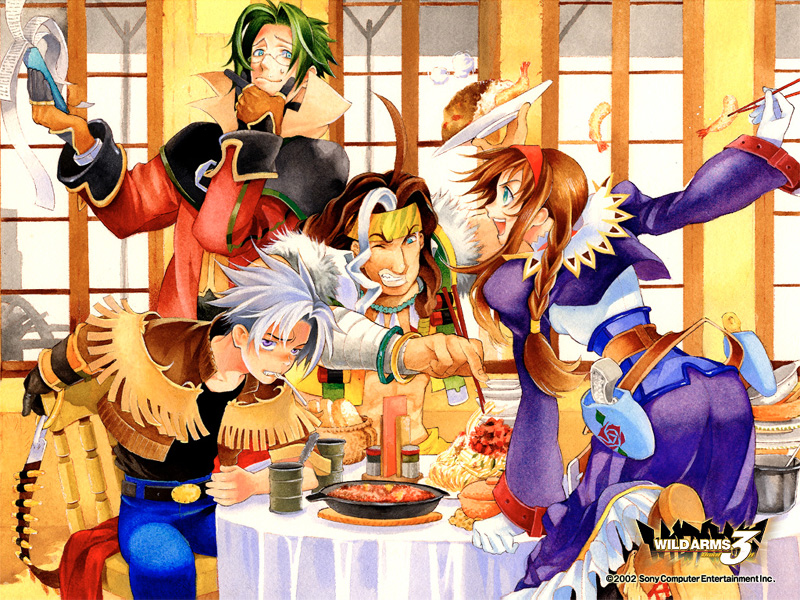
Outside the meat of what makes WA3 so good (the gameplay elements), I wanted to also shout out the story and presentation.
Firstly, the game is gorgeous. It takes the JSRF approach of true-cel shading and adds a pencil filter on top. This has allowed the visuals to age extremely well. It could honestly be released to today as AA or indie title and no one would notice. I had recently played Star Ocean: Till The End of Time, which had released not long before, and the difference is striking.
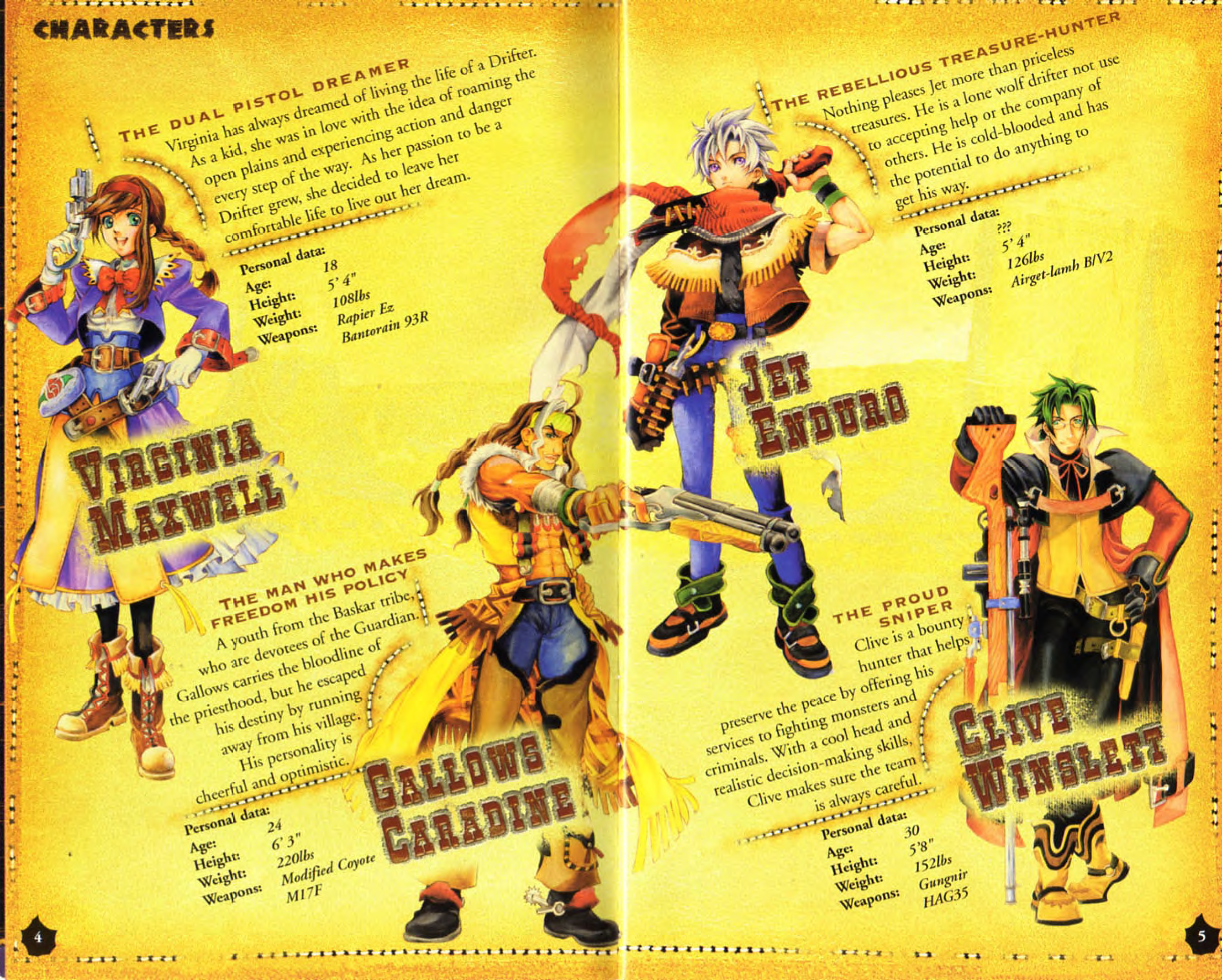
In, from what I gather, a staple of the series, our four leads quick-draw on one another in the opening set piece; from here, we can flashback to an introductory chapter for each of them in any order we want. It's a very stylish way to establish our small, but focused, JRPG cast. By spending about 40mins with each solo, we come to understand their motives, personalities, and combat quirks before they have to work as a team. We know going in that Jet is adapt in evasion, and will struggle to get along with the others. We know that Virginia is a naïve leader and good all rounder. That Gallows is a irresponsible slacker but good with magic thanks to a heritage he's disinterested in. Offset by Clive's experience, responsibility, secrecy, and role as a powerhouse. WA3 goes to great lengths to develop these four, and by the end they were one of my favourite casts I've gotten to play as. They really play off each other well!

This extends to the world-building too. The world of Filgaia is fascinating, both geographically and sociologically. Again, I was expecting a straight forward final fantasy JRPG world but with cowboys. The idea that the world is literally a living being and human's exist on it in a manner similar to bacteria in a human body, or those small spiders that live in our faces, was really engaging. In WA3, the world should be all green and fantastical as you'd expect from a JRPG. Unfortunately, the human "parasites" have grown too destructive for their own host, resulting in it both slowly dying (seen through the spreading desert), and fighting off its harmful invaders like white blood cells on a disease (a comparison the game itself makes). What can be done about this situation makes up the heart of the game's conflict; with one side trying to cut its losses at the cost of many lives to save a few, and the other choosing to have faith in seeking a better outcome. This ties into a reoccurring metaphor of "flying without wings", or moving forward without any reassurance that things will be okay.
This extends to the nature of "Drifters". The closest analogy I can think of would be how One Piece presents the idea of pirates. Drifters aren't hunters or peacekeepers or thieves. In Filgaia's culture, a drifter is someone who sets off into the desert looking for purpose. Its very ethereal what that means. A drifter being someone who cuts ties with their home and takes faith they can live a fulfilling life travelling the potentially deadly desert. While a drifter can be friend or foe, or even switch on the fly; the people in settlements have learned to accept and even rely on these drifters to survive. So there's this great mixture of weariness, pressure, and hopeful burden you get from settled civilians. There's almost a "travelling monk" like element to them, though if monks were allow to be greedy and shoot people. What exactly it means to take a leap of faith to be a "true" drifter is something Virginia has to struggle to learn as the newest one of the four. It's also something the other three have to re-evaluate as they progress. With Jet having used the title as a means to keep a safe distance from other people, while Gallows became one as an escape from the responsibilities his family put on his shoulders. Even the rival villain becomes disillusioned after a life with no roots or possessions, seeking to find away to leave a legacy to be remembered. This all, again, ties into the grander theme of how humanity moves forward in the face of extinction. Its all really solid, focused stuff.
And ultimately, the characters are just so damn likeable, especially our lead. I'd buy a Wild Arms 3-2 in a heartbeat just to get more of them.
CONCLUSION
I don't want to explain much more of the story or other gameplay elements I dig, liking having to build your airship yourself. I'm just blown away over how quirky and high quality this game was. Top 5 for me, easily.
u/Pumpkin_Sushi — 8 days ago
▲ 147 r/Scoobydoo
Can we finally clear up the confusion with Return to Zombie Island?
Return to Zombie Island is by far the most over hated film in the series. Not that its good. At best its okay. Very standard. Instead, there's a weird fan rumour (taken as fact) that it "rewrites the events of Zombie Island 1 to be non-supernatural". That it turns out all the cat people and zombies and ghosts were actually just a set of costumes used in a traditional SD scheme.
It does not do this. Velma claims its an "unsolved case" at the start as she still doesn't believe the supernatural stuff happened. Other than that, its a story of an unrelated man doing an unrelated plan on the island to capitalise on the first film's legacy to run a scam. The only REAL connection is it ties up Captain Moonscar's lost treasure, a red herring in the first film.
The actual events of the first film? Totally untouched. Still very obviously supernatural, despite Velma still being in denial (which, tbf, is totally in character). Very basic, very bleh, but ultimately inoffensive.
u/Pumpkin_Sushi — 9 days ago