Renault FT Tank
Minfigure scale, 193 parts.
Built following the former livery of the vehicle displayed at the Bovington Tank Museum.
u/Serendipitian — 5 days ago
Minfigure scale, 193 parts.
Built following the former livery of the vehicle displayed at the Bovington Tank Museum.
Among the efforts to curtail an arms race following World War One, the 1922 Washington Naval Treaty - signed by the British Empire, France, Italy, Japan and the United States - limited the construction of warships among its signatories, specifically for battleships, battlecruisers and aircraft carriers (which were an emerging concept at the time).
However, the first version of that treaty did not explicitely limit the construction of submarines (save for a maximum displacement of 10000 tons) and soon enough the French authorities ordered the construction of a "submarine cruiser", as a way to circumvent some of those limitations (and mostly because French shipbuilders were already quite experienced with designing cutting-edge submarines).
The "Surcouf" was designed following the requirements that it should be able to carry provisions for 90 continuous days of high-seas deployment, and feature firepower comparable to that of a battlecruiser. Indeed, the submarine was built around a turret sporting two 203mm guns - which were the largest caliber allowed by the Washington Naval Treaty. According to the specifications, it could fire up to a distance of 16 kilometers with its own instruments, and 26 kilometers with aircraft support. To this end, the Surcouf was also the first submarine to carry a reconnaissance aircraft. Initially an improved version of the Besson MB.35 floatplane designated MB.411 was chosen for that task {images 3 and 4}, but a bespoke gyroplane was later devised to replace it in the form of the Dorand G.20 {image 5} - although development for it never came to fruition with the fall of France in 1940.
Launched in 1929 and commissionned in 1934, the Surcouf would remain the largest submarine in the world until the launch of the Japanese I-400 class in 1944 - namely because the 1930 London Naval Treaty specifically regulated submarine warfare in order to address the topics that the Washington Naval Treaty did not cover. In particular, submarines were now limited to 2000 tons - with each major nation allowed to operate three units of up to 2800 tons. However, the Surcouf and its 3250 tons of displacement was exempted by the terms of this treaty as the sole exception, mostly on the basis that it was already operational at this point.
At the time of the Battle of France in 1940, Surcouf was being refitted in France and managed to escape to the United Kingdom and ultimately remained under the control of the Free French forces. In February 1942, the submarine departed Halifax, Canada, with the intent of rallying Australia and was sunk on the way to the Panama Canal during the night of the 18th to 19th of the same month. The circumstances of her sinking are unclear, although the most likely scenario points towards American forces being responsible after confusing her with an enemy ship.
Sources :
- Covert Shores : Surcouf, The Ultimate Interwar Cruiser Submarine
- Drachinifel : MN Surcouf - Guide 136 (Extended)
Images :
- (1) Marine & Océans : Chronique Navale du 18 Février
- (2) Aviation Navale Française 1939 - 1940 : Sous-Marin Surcouf
- (3) & (4) Aviation Navale Française 1939 - 1940 : Besson MB.411 "Petrel"
- (5) Old Machine Press : Dorand Gyroplane G.20 (G.II)
Let's tread the border between this sub and r/WeirdWings.
Here is the "Waterplane", designed in 1929 by Russel and Milton Robertson : a ground-effect glider propelled by an outboard motor fitted to an articulated arm. This video was filmed in 1930, but little further information about this contraption seems to be available.
I feel it still qualifies as a bonafide watercraft given its conceptual necessity to remain in contact with a water surface ; in a sense it could be equated to a weird hydrofoil variant.
Sources :
American engineer Robert Fulton is somewhat famous for his seminal career : he is usually credited with pioneering steam propulsion on ships with the 1807 "North River Steamboat", and developing the modern torpedo as early as 1797.
Indeed, Fulton had started to officiate as a civil engineer in France in 1796 and given his support for the ideals of the then-ongoing French Revolution intended to develop new technologies to curtail the naval supremacy of the United Kingdom in order to help the French war effort.
Chief among his innovations was the concept of a submersible vessel, nicknamed the "Nautilus", designed to stealthily affix explosives to enemy vessels - in a very similar fashion to Bushnell's 1775 "Turtle". It consisted in a tapered cylinder of about 7 meters of length with a small propeller activated via a handcrank. Submersion was ensured by a secondary compartment associated to a mechanical pump similar to those found on some wells. A retractable mast enabled regular sailing when not the ship was not submersed.
The first test was conducted on the river Seine in May 1801 during which the Nautilus managed to move in submersion both with and against the current for about 30 minutes. Further tests were conducted in Brest throughout June and August, during which Fulton demonstrated that his invention could stay underwater at a shallow depth for over 5 hours without adverse effects to its two-men crew.
However, in spite of these encouraging trials, French authorities requested a demonstration of the offensive capabilities of the Nautilus to actually vouch for the concept. Given that Fulton never had the opportunity to approach a British vessel to illustrate his claims, his further request for financial aid was denied and Napoleon himself dismissed his efforts as quakery - something the memoirs of marshall Marmont claim he ultimately came to regret.
Fulton pursued his naval research in France until 1809, when he departed for the United Kingdom (where his submarine concept had been similarly dismissed by the Royal Navy) and ultimately returned to the United States. There he kept refining his Nautilus further {image 4} - going as far as to fit it with a viable underwater cannon - until his death in 1815.
Sources :
- Le Nautilus (Le premier bateau sous-marin) {most information I have found about this ship is in French, so I have mostly adapted the content of this article}
Images :
Air-Sub-Drone "L’histoire des véhicules sous-marin" (1/2 scale model displayed in Cherbourg's "Cité de la Mer")
Scan from "Submarines in Colour" by Bill Gunston
Meisterdrucke - "Dessin original du Nautilus, le premier sous-marin, présenté par son inventeur Robert Fulton (1765-1815) au Sénat américain en 1806."
Named after privateer Marc-Joseph Marion du Fresne (1724 - 1772), the "Marion Dufresne" is the supply vessel assigned to the French Southern and Antarctic Lands (or TAAF for "Terres Australes et Antarctiques Françaises).
The current ship is the second one to bear that name, replacing her former and smaller namesake that had been active from 1973 to 1995. Its main mission consists in the resupply of the TAAF throughout the Indian and Antarctic Oceans, from its base of operations on Réunion Island, in the form of four annual rotations throughout these territories - totaling 120 days a years.
Due to an increase in research interest during the late 1990s, 217 additional days a year are now devoted to other oceanographic activities under the supervision of the IFREMER ("Institut Français pour l'Exploitation de la Mer", meaning "French Institute for the Exploitation of the Sea"). To this end, the Marion Dufresne embarks 650 square meters of laboratory equipment along a heavy winching system and a core drill for geological samples - besides all its supply load.
Sources :
- TAAF : Le Marion Dufresne (in French)
- French Oceanographic Fleet : Marion Dufresne
I will not let asinine arguments such as "This is an extremely basic colour scheme" or "The bands are not oriented in the same direction" or "The order of the stripes swaps the red and yellow between those examples" get in the way of the realisation that Lego's logo from 1964 to 1972 features the flag of the Republic of China under the Beiyang government (1912 - 1928).
Was John Lego an agent of China's influence from the onset?
Old model I built and photographed back in 2014.
This is a quite old model I built and photographed in early 2015.
Adaptation of the work of Kory Hubbell (aka Koryface) : Planet Hopper
This is a quite old model I built and photographed in early 2015.
Adaptation of the work of Kory Hubbell (aka Koryface) : Planet Hopper
Le techno-optimisme inhérent au Giscardpunk évoque souvent l'aérospatiale, mais il convient de ne point négliger l'immensité océanique. Voici donc le Nautile, sous-marin de poche de submersion profonde capable de plonger à 6000 mètres, mis en service par l'Ifremer en 1984.
Les deuxième et troisième photographies le représentent en cours de déploiement par le navire hauturier Nadir pour effectuer la première exploration de l'épave du Titanic en 1987, suite à sa découverte deux ans auparavant.
Sources :
- Ifremer : 40 ans dans les abysses avec notre mythique sous-marin jaune
After establishing a new land speed record with his "Œuf de Pâques" in 1902 at 120 km/h, Léon Serpollet kept developing new prototypes of steam-powered racecars with the intent of demonstrating the superiority of steam engines compared to internal combustion ones - which was a claim he vehemently defended.
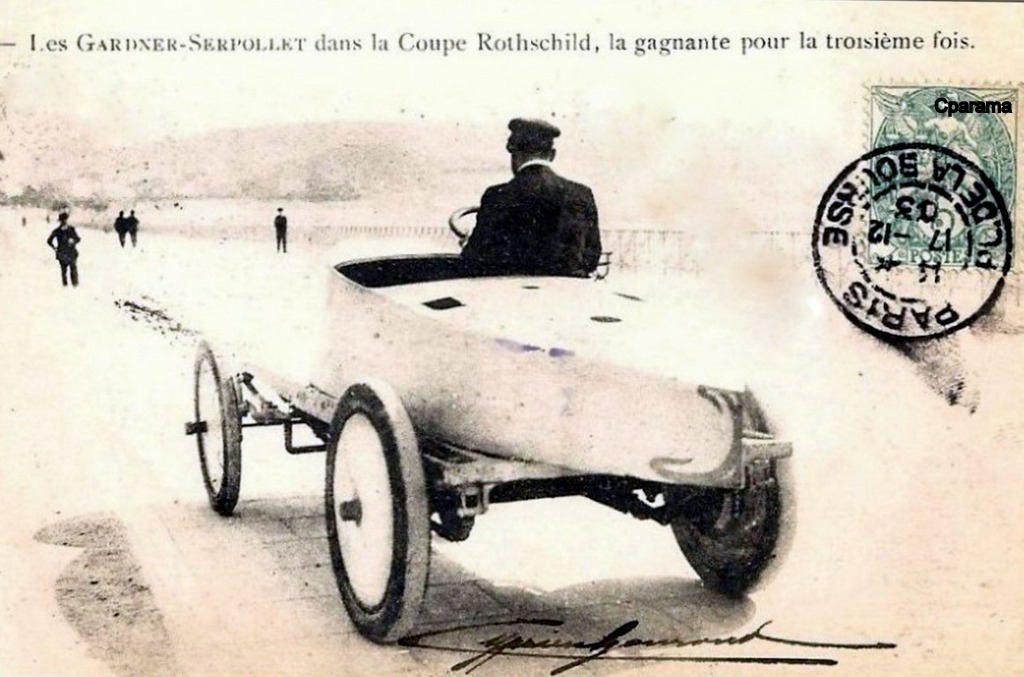
Although history would ultimately prove him wrong, Serpollet had a few successes in the context of the early automotive industry. For instance, the car featured in this post was the one with which he won the 1903 Rothschild Cup. However there is very little overall information about this vehicle (besides the fact that it was steam-powered) : the French-language Wikipedia article about Hubert le Blon calls it the "Gardner-Serpollet coupe-vent" - a name that is partially corroborated by a 1903 postcard {image 2 seems broken so here it is}.
Sources :
- Photograph by Jules Beau via Wikimedia Commons
- Cockpit - L'Œuf de Pâques, détentrice du record en 1902 (in French)
- Auta5p - Serpollet Record (in Czech)
Just an overall concentrate of (sensible) weirdness : here is the smallest nuclear submarine of the US Navy, capable of deep diving (up to 724 meters), and equipped with tandem wheels to "drive" on the seafloor for maximal discretion.
Sources :
- First image courtesy of Defense Imagery via Wikimedia Commons (primary source link broken)
- Second image courtesy of H. I. Sutton via Covert Shores, alongside most of the available information about the NR-1.
HMS Furious was odd from the start, but became increasingly so. It was initially intended as the third ship of the Courageous class, designated as a "large light cruiser". This classification may appear oxymoronic, however the concept of "light cruiser" was not dependent on displacement but on the number of main guns ; since the ships of the Courageous class were fitted with only two turrets sporting a single barrel each they fell under that category - in spite of their 240 meters of length and 20,000 tons of displacement.
It is precisely because of this curious combination of size and weapons arrangement that the Furious was selected to be refitted as an aircraft carrier during its construction : her forward turret was removed and replaced by an inclined deck stretching from the central superstructure to the bow {image 1}. This cumbersome architecture meant that while it was somewhat easy for a plane to take off, landing on the deck required pilots to approach at an angle from behind and violently swerve at the last moment after passing the superstructure. Surprisingly, one pilot was brave enough to attempt the maneuver : Edwin Harris Dunning managed to land on the moving Furious on the 2nd of August 1917. Tragically his second attempt on the 7th of the same month would prove to be fatal : at touchdown, a sideways gust of wind lurched his Sopwith Pup on the starboard side of the ship {image 2}. After this incident, no pilot would attempt to land on a ship for the rest of the First World War.
Still the Furious kept operating as an aircraft carrier, and in November 1917 her aft turret was also removed to accomodate for a second, larger deck intended to carry more planes and serve as a platform for airships {image 3}. Note that the central superstructure remained in place, which forced the parked planes to cross from one deck to the other on lateral ramps. Perhaps surprisingly the Furious actually carried out an aeronaval operation during WWI with the Tondern Raid in July 1918 (targeting airship hangars near Tønder, in southwestern Jutland). Although the aircrafts were not supposed to (and did not) return to the ship, it was considered a tactical success worthy of replication.
The lessons learned from the structural issues of HMS Furious helped develop a better architecture for aircraft carriers as early as 1918 with the launch of HMS Argus - the first carrier to feature a continuous flight deck (even though its size limited its capabilities to the training of pilots at sea). Ultimately the Furious itself would be retrofitted with a continuous deck from 1921 to 1925 {image 4}.
Although there is some leeway to interpret what the notion of an "aircraft carrier" entails, as a ship intended to launch and recover aircraft with a wheeled landing gear, HMS Furious is historically the first aircraft carrier, even if not a very successful one at first.
Sources :
- Maritime Quest - HMS Furious
- Naval Encyclopedia - HMS Furious (1917)
- Samil History - Edwin Harris Dunning
There seems to be a slight difference of curvature, which is consistent across all colours.
Partial recreation of this cutaway poster.
From top to bottom :
- Bloch MB.220
- Dewoitine D.338
- Lioré et Olivier LeO H-246
- Lioré et Olivier LeO H-470
As Mongolia is a landlocked nation, the Sükhbaatar III patrols lake Khövsgöl and offers tours to the public to cover its expenses. Its crew consists of seven sailors - of which it is said that only one can swim - making it the smallest naval force in the world.
(Limited) Further reading here : Shipshub - Mongolian Naval Force
Further reading : Kustomrama - Ed Roth's Road Agent
Back in 1672, the Belgian jesuit priest and mathematician Ferdinand Verbiest (1623 - 1688) designed a prototype of a steam-powered carriage relying on a "water wheel"-like mechanism. Although this solution provided only a limited amount of power, Verbiest presented a working prototype to the Chinese emperor Kangxi in 1678, which is occasionnally hailed as the first example of a motorised vehicle - even though it never amounted to anything more than a curious novelty.
Sources :
- Museo Galileo - Ferdinand Verbiest’s Steam Cart
- The fourth slide is an 18th Century print of the machine, taken from Wikimedia Commons
Nicknamed "la boîte à sel" ("the salt box") in France due to its inclined hood that was reminiscent of the kitchen appliance.
.jpg)