
▲ 12 r/AncientAmericas
The Pre-Contact Dogs That Were Wiped Out By Colonizers #animals #evoluti...
Zeke Drawin
u/Comfortable_Cut5796 — 8 days ago
Zeke Drawin
This session is the second class of the Basic Zapotec Course (2026-B). Instructor Rayo leads students through a conversational warm-up, an explanation of the Zapotec base-20 numbering system (1 to 20), interactive sentence and verb exercises, and a historical lecture on ancient Zapotec glyphs and writing systems.
Key Topics Covered:
1. Zapotec Numbers (1 to 20) & Base-20 System:
* Vigesimal System: The instructor emphasizes that Zapotec utilizes a vigesimal (base-20) numerical system rather than a decimal system. As a result, counting is structured around units from 1 to 19 before reaching the base of 20.
* Pronunciation of Numbers:
* 1–5: tu (1), txupa (2), tsuna (3), tapa (4), gayu (5).
* 6–10: xupa (6), gadxi (7), xunu (8), ga (9), txi (10).
* 11–15: txineaj (11), txínu (12), txi’inu (13), txidaa (14), txìnu (15).
* 16–20: txixhupa (16), txini (17), txixhunu (18), txenaj (19), galaj (20).
* The Concept of Zero (Tibi): Historically, speakers used Spanish loanwords or phrases like ni tú (“not one”) for zero. For pedagogical purposes, the instructor adopts the word tibi (meaning “no” or “nothing”) to signify zero.
* Student Introductions: Students practice answering core questions about their names, origin, current city, age, profession, and spoken languages in Zapotec.
* Sentence-Building Exercises: Using digital matching games, students practice ordering question structures like Gax bi’i lii (“Where are you from?”) and Bix dxin runu (“What do you do for work?”).
* Key Verb Matching:
* Neda zwaa = “I live”.
* Neda runa dxin = “I work”.
* Neda Ruseda= “I learn”.
* Neda rinea= “I speak”.
* Neda reja= “I go”.
* Earliest Mesoamerican Writing: Zapotec is one of the few Mesoamerican cultures to develop a formal written language.
* Glyph Structure: The instructor explains that abstract symbol glyphs — such as the “1 Earthquake” (Uno Terremoto) symbol beneath the figure — mark the transition from pictorial art to actual written language.
* Numerical Glyphs: Zapotec numeral glyphs share similarities with Maya and other Mesoamerican systems, using dots for units (1–4) and horizontal bars for 5s.
* Decipherment Challenges: Zapotec glyphs are not yet 100% deciphered because glyph writing gradually ceased following the decline of Monte Albán (around the 8th century AD), centuries prior to Spanish arrival in 1521.
* Resource Recommendation: The instructor suggests Javier Urcid’s book, Zapotec Writing: Knowledge, Power, and Memory in Ancient Oaxaca, for further study on the subject.
Coca Leaves in Inka Rituals in Tambo Viejo, Acarí Valley, Peru: Ñawpa Pacha: Vol 46 , No 2 - Get Access
By Ancient Americas
What books would you recommend for studying what life was like for various cultures in what we now call the North American region from the 12-16th centuries?
TL;DR: Two thousand years ago the Adena and Hopewell in Ohio grew and smoked Nicotiana rustica, a tobacco up to a dozen times stronger than a modern cigarette with some psychedelic qualities that was strong enough to cause hallucinations and out-of-body trips. They did this in order to reach the spirit world. To find out what that actually felt like, archaeologist Alexander von Gernet grew the plant, cured it the indigenous way, and smoked it for five months straight. He threw up for weeks, then acclimated and started hallucinating on schedule. Science!
Photo Credit: A broken Hopewell effigy pipe, likely a hawk, taken from Mound 8 at Mound City, OH. British Museum.
--------------------------------------------------------
People wonder why I read academic papers for fun.
Because it turns out, academics are a bunch of neurotics, and neurotics are fucking weird. And sometimes, people fund the weird stuff. Like testing Paleoindian bog caching theories by eating swampy horse meat for six months. Or having your volunteers ingest ancient mirabilite to test their pants-shitting theories.
And then sometimes, you get to just smoke some good shit. Or bad shit. Or both, in this case.
In 1992, an archaeologist named Alexander von Gernet planted a crop of Nicotiana rustica, cured and prepared the tobacco leaves as closely as he could manage to the way the indigenous Huron people had done it, packed them into a pipe built to look like a Huron pipe, and smoked it. On purpose. For science.
He promptly threw up.
Then he did it again, and kept doing it, for five months. Because science.
The first stretch went the way you would expect a five-month experiment in smoking insecticide to go. Poorly. It went poorly. He was extremely nauseous and with what the literature records in the tone of a man being as professionally discreet as possible about his sudden evacuation of bodily fluids as "other unpleasant symptoms."
Then his body adjusted, and once the nausea cleared the hallucinations stayed, and they persisted consistently through the rest of the trial. His own description of what the plant did to him runs from vertigo, to sensations of flight, to out-of-body sensations and mild hallucinations (von Gernet 1992b, 177).
This wasn’t an intentionally bad cigar, by the way. It was completely intentional.
The question he was answering was about the Huron and their Haudenosaunee cousins, which is why he cured the tobacco the Huron way. But von Gernet had a bigger argument he was attempting to make. The high point of the whole vision-seeking, tobacco-smoking complex in eastern North America, he argued, came during the Middle Woodland periods. That is Ohio, two thousand years ago, and the people getting blazed were the Adena and Hopewell. They grew the same plant and carved animals onto their pipe bowls that looked back at them while they smoked.
But riding the green dragon was not recreational. The pipe itself was a spiritual vehicle. And when they were done with the pipes, they broke them by the hundreds and buried them under mounds you can still visit today.
Because ancient Ohio was chock full of drugs lords.
I don’t mean current Ohio drugs. Sorry, no opiates in Hopewellian Ohio. No, our Breaking Bad moments started early.
Let’s talk about tobacco for a second. No, this isn’t DARE. Do drugs, kids. Do all the drugs. Do the dirtiest, nastiest, hardest drugs you can. In fact, start with some Nicotiana rustica, because you won’t ever want to do drugs again.
Reverse psychology, parents. Works every time.
First, the tobacco in a cigarette is Nicotiana tabacum, and it contains about 1.5 percent nicotine (Winter 2000, 307). At that dose nicotine is a stimulant. The documented effects are increased alertness and improved psychomotor performance, which is (sorry, DARE teacher) equivalent to a chemical pat on the head. It’s the pharmacological profile of a strong coffee, and like coffee, it eventually accounts for a colonial empire, with all the slavery. Unlike coffee, it also comes with a Surgeon General's warning and four generations of people getting soaked outside of the back of a Wendy’s for their fix.
But the tobacco indigenous people grew across Eastern North America was an entirely different species, Nicotiana rustica, and rustica is a different animal. Chemical analysis of rustica grown by the Huichol of Mexico found nicotine concentrations running from 1.9 percent all the way up to 18.7 percent (Winter 2000, 307). The top of that range is twelve Marlboros in one cigarette! "Weed tobacco," as it is commonly called, has been grown with as much as 10 percent nicotine in the leaf, many times over what a commercial cigarette carries (Robicsek 1978, 46). And the profile was different, too.
Nicotine, in case the word has been sanded smooth by four centuries of familiarity, is a poison, and rustica is where you go to get it in bulk, quite literally: as of the late 1970s its only use in the United States was in the manufacture of insecticide, and farmers kept an eye out for it in the pasture because it fucking kills cattle and sheep if they eat it (Robicsek 1978, 46). But the Natchez knew exactly what it did. They gave it to people they were about to sacrifice and to stupefy them before the strangling (Robicsek 1978, 46).
So, the plant's résumé, in order, is pesticide, livestock hazard, pre-execution sedative, and finally as a sacrament.
Now that sounds like a fun Friday night.
And it may not even be only the nicotine doing the work! Francis Robicsek points out that tobacco smoke carries a couple of other chemical passengers: harman and norharman, alkaloids of the harmala group (Robicsek 1978, 46). Those are β-carbolines. If the word rings a faint bell, it is because the same class of compound is the trippy bit of ayahuasca, where it shuts down the enzyme that would otherwise break a hallucinogen apart and lets the trip run. Nobody has measured how much of it sits in native-grown rustica, and it varies plant to plant, but what went into a smoker’s lungs was a whole chemistry set that included a Marlboro pack and some psychedelics.
Now, because rustica was grown for its alkaloids and not for anything you would want to eat, von Gernet argued, “the original domestication process may have involved a gradual artificial selection of those plant populations which, when consumed, manifested the greatest potency or spiritual power” (von Gernet 1995, 67). By this point, that should be obvious. The racoons are not the ones self selecting this shit, even though clearly Meeko was on something (or rabies. Actually, it was probably rabies).
None of this was a local Ohio invention, by the way. The same plant, rustica, was picietl to the Aztecs, the sacred herb of their rituals, and Francis Robicsek calls it “the divine tobacco of the Indians of the eastern woodlands” and the petum (tobacco) of Brazil (Robicsek 1978, 46). Down in the Maya world, tobacco was so tangled up with the supernatural that they carved their gods smoking it. Robicsek’s entire book is built around one of them, God K, filed under the chapter heading “the Deity with the Smoking Cigar.” So when a Hopewell carver set an animal on a pipe bowl and pointed its face at the smoker, he was participating in a hemisphere-wide idea: tobacco is not a recreational crop for the indigenous peoples of North America, but rather a way to get a god or spirit’s attention.
And “drug” is a modern word for this. The whole category, a thing you take that isn’t food and that the state gets opinions about, is an invention of the industrial age; Andrew Sherratt, opening the very volume von Gernet’s chapter sits in, files tobacco and its cousins under an older and stranger heading of “peculiar substances,” the sort of thing a society weaves into its ritual and social life instead of fencing off (Sherratt 1995, 1-10).
It is also a long way from home! The parent species of rustica overlap in the central Andes, and botanists generally think it spread north as a crop into the highlands of Mexico. How it got from there to Ohio is a question with three candidate answers and no settled one (Heiser 1992, 54-55). Obviously, nobody hauls a South American highland plant into the Ohio Valley by accident, and the plant does not make it easy once it arrives. A tobacco plant has to have its leaves picked singly as they come to size, which means a grower visits each plant 170 times over its life, and the crop strips the soil as it goes (Gramly 2022, 137; Gately 2001, 367). Carl Sauer's guess about why anyone bothered, which Heiser repeats, is that "the stronger species was preferred for certain purposes" (Heiser 1992, 55). Yeah, what certain purposes, Sauer? What certain purposes, hmmmm?!
Because at low doses rustica does the coffee thing, but at higher doses it produces, in von Gernet's own words, "altered states of consciousness and even hallucinations if ingested in significant doses" (von Gernet 1995, 67). Joseph Winter's summary of the pharmacology is that nicotine is a biphasic drug: small doses sharpen you, and large doses "produce visions, hallucinations, trances, seizures, color blindness, catatonia, and even death." It reaches the brain within seven seconds of the smoke going in (Winter 2000, 327). Which is why the early European record of Native smoking is just numerous accounts of people in North and South America who smoked until they were "as drunk" (Gramly 2022, 137). Explorers who watched group smoking sessions recorded the results as fainting and sickness; the object, in the summary of Richard Michael Gramly, was for the smoker "to become inebriated, to have visions, and to have his mind leave the body" (Gramly 2022, 136). Coincidentally, his 2022 article on the subject is titled "The Hopewell Connection: Drug Lords Along the Ohio." Subtle, Gramly is not.
Johannes Wilbert, whose 1987 study of tobacco shamanism in South America is the book the whole North American argument has been conducted around ever since, wrote that nicotine "is exceptionally well suited to manifest the continuum of dying, which begins with initial nausea, heavy breathing, vomiting, and prostration (illness); continues with tremors, convulsion, or seizure (agony); and ends with peripheral paralysis of the respiratory muscle (death)." If the dose is right, "the shaman is granted safe return thanks to the prompt biotransformation of nicotine in the body" (Wilbert 1987, 157).
Now put von Gernet's five months next to it, his weeks of nausea and misery, then acclimation, and finally reliable hallucination. Strong tobacco, in other words, requires bodily conditioning, and the conditioning almost certainly required guidance from others in its use, exactly as Wilbert documented for the South American shaman (Wilbert 1987, 158).
Von Gernet had just put himself through a similar experience an indigenous shaman in Ohio would have undergone.
To be clear, Wilbert argued that South American tobacco shaman is not some guy getting high by himself (see: me most weekend evenings). He is taught over months and years, by older shamans who walk their apprentices right up to a nicotine death and count on the vomiting to drag them back; if the vomiting does not come, the student can fucking die (Wilbert 1987, 158). Again, this is quite literally a rehearsal of dying. Wilbert quotes an eyewitness who watched a Cuicuru shaman named Metse work through cigarette after cigarette until his leg started to shake, then his arm, then he was groaning on every breath and retching, until he “died,” flinging his arms out and going rigid while three men held his stiff body off the ground and his tendons snapped, before he came back around fifteen minutes later (Wilbert 1987, 157). That is the experience von Gernet reverse-engineered with a garden and a lighter, and the one a Hopewell smoker was after with a stone campfire the size of a bar of soap. It was never a novelty. It was sacred.
So, you hear that, DARE teacher? No one is getting high recreationally here. It's serious religious business.
In summation, don't do drugs, kids. Unless it's at church.
And then, there are the pipes.
Sean Rafferty and Rob Mann, who edited the standard volume on the archaeology of tobacco pipes in eastern North America, open it with a sentence most archaeologists would have softened into "ceremonial," because most archaeologists are fucking cowards. “Ceremonial” is the word the discipline reaches for when it means "we have no idea." But Rafferty and Mann are not cowards.
"Smoking pipes are essentially drug delivery devices," they wrote. Smoking "instills varying degrees of altered states of consciousness," and the pipes' "function is in no way utilitarian" (Rafferty and Mann 2004, xiii).
The object literally exists to move a psychoactive compound across the lining of your lungs. Everything carved on the outside is a design choice about how that should feel.
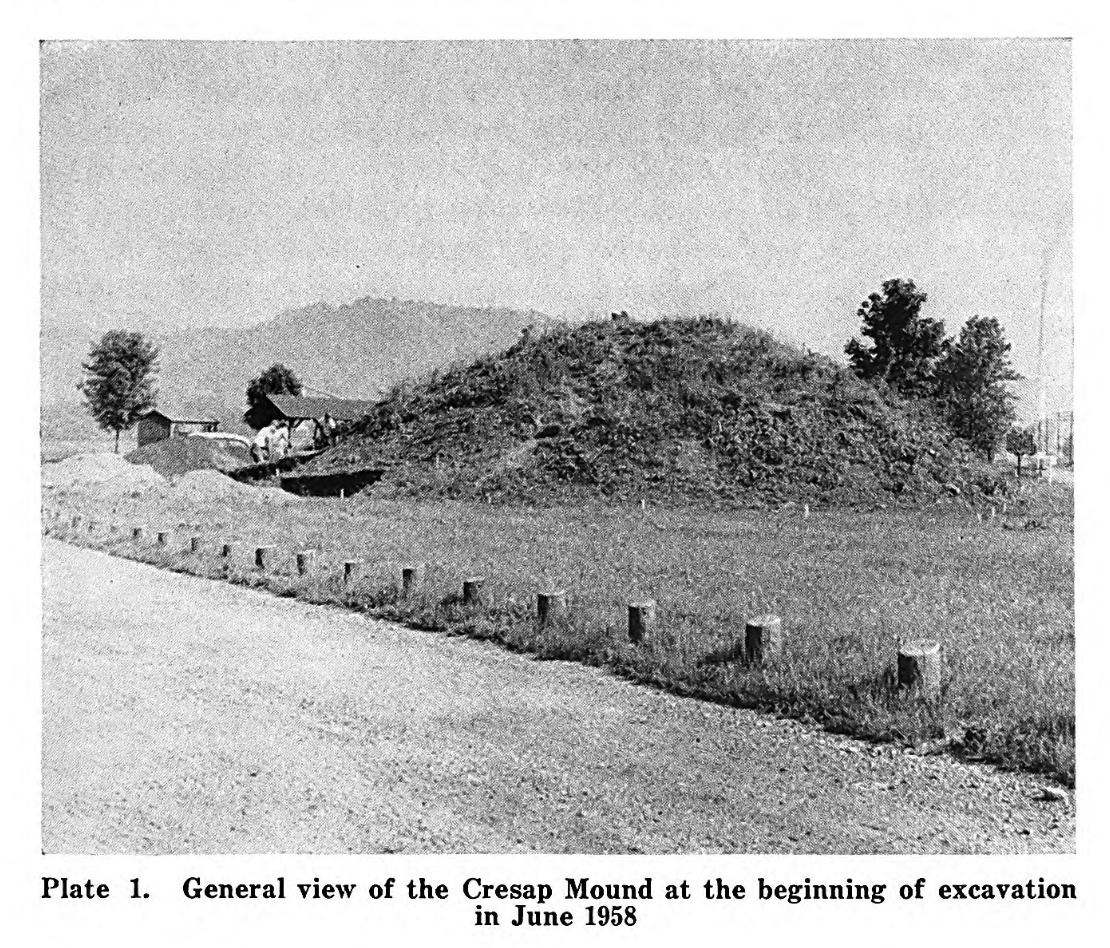
Unfortunately, nobody has published a residue analysis of a Hopewell pipe. Romain, whose book is the most thorough treatment of Hopewell religion in print, says so plainly (potential Ph.D thesis, anyone?). The chemistry we’re discussing comes from their neighbors. In Vermont, a pipe from the Boucher site, a Middlesex-complex site dated to about 300 BCE, went through gas chromatography and mass spectrometry and produced nicotine decay products (Rafferty 2006, 453); the site's artifacts included pipes identified as Ohio pipestone. Closer to home, the Cresap Mound in West Virginia was built by Adena people across the last few centuries BCE, its lower zones dated by a run of five radiocarbon samples to an average of about 578 BCE, about sixty-five miles northeast of the Hopewell earthworks at Marietta (Dragoo 1963, 290-291). Rafferty ran the same test on a blocked-end tube pipe from Cresap that had been burned and broken and buried between the knees of the man in Burial 48, an extended burial whose own bones were never cremated (Dragoo 1963, 66), and it came back positive for nicotine. His conclusion is careful, with him saying the results are "equivocal in regards to the specific plant," but "whatever plant was smoked, it was the psychoactive properties of nicotine that were sought by the smoker" (Rafferty 2002). Somebody's toxicology report is literally older than the Roman Empire.
For the Hopewell themselves, the evidence is mostly agricultural, and it is small, because, well, tobacco seeds are really fucking small. You could lose one in the grain of a tabletop! A compilation of every reported tobacco find across the Eastern Woodlands, the Plains, and southern Ontario turned up just over a hundred sites and a few thousand seeds in total (Barrier 2020, 151, citing Wagner 2000), and for the Middle Woodland period the seeds come "in very small numbers from a few sites" (Barrier 2020, 162). The first of them were five carbonized seeds from the Smiling Dan site in west-central Illinois, in use around 150 CE, assigned to N. rustica on the basis of size (Haberman 1984, 271).
Ohio has two finds of its own. At the Strait site in Fairfield County, carbonized tobacco seeds came out of a pit radiocarbon-dated between 220 and 260 CE (Dancey and Burks 2006; Burks 2001). And at Brown's Bottom #1, a Hopewell house site on the Harness Farm about eleven kilometers south of Chillicothe, on the same property as the Liberty Earthworks (Pacheco, Burks, and Wymer 2020, 71), DeeAnne Wymer's flotation samples produced verified seeds of Nicotiana cf. rustica from an earth oven and a shallow basin dug right beside the house (Wymer 2020, 292). Whatever else the plant was, it was processed at home, next to dinner, within walking distance of an earthwork.
And the bowls are still black from soot, two thousand years later! In 1954 the collector Earl C. Townsend Jr. described a glossy green pipestone effigy pipe from Ross County whose bowl "still contains a thin, black, charred lining" (Townsend 1954, 47).
Now, a typical Hopewell platform pipe sits in the palm of your hand. It is normally a flat or gently curved pipe with a stone base a few inches long, with the bowl rising from the middle of it. The bowl stands upright instead of running level with the stem the way a cigar does, so the smoke goes straight up, and the base is a hand rest. The archaeologist James A. Brown points out that a small burning thing on a flat surface, sending a column upward, held in the hand, "replicates in miniature a fire constructed on a horizontal surface" (Brown 2006, 481). You are holding a campfire the size of a bar of soap. And that’s important, because as we’ve talked about, the campfire was a space created by the indigenous peoples of Eastern North America to facilitate the crossing to other worlds.
So, too, was the Hopewellian effigy pipe, except now it was Animorphs.
On effigy pipes, the bowl is carved into an animal. Ephraim Squier and Edwin Davis, who dug the first great cache of them in 1846, listed what they could recognize "at first glance": a panther, bear, wolf, beaver, otter, squirrel, raccoon, hawk, heron, crow, swallow, buzzard, paroquet, turtle, frog, toad, rattlesnake, and a number of carved human heads (Squier and Davis 1848, 152-153). The carving was "executed with strict fidelity to nature, and with exquisite skill." For example, the otter holds a fish in its mouth. The heron is eating another on the ground. The hawk grips a small bird in its talons and tears at it with its beak. Squier and Davis also identified a toucan, "a tropical bird, and one not known to exist anywhere within the limits of the United States," and, to their credit, gave it a question mark (Squier and Davis 1848, 260).
A modern inventory sorts the same menagerie by where the animals live: the sky (hawks, falcons, owls, ducks, herons, cranes), the ground (squirrels, raccoons, rabbits, wolves, bears, panthers, opossums), the water (otters, beavers, turtles), the jumpers (frogs and toads), and very few snakes. Gramly, for his part, suggests the squirrels "may have reminded smokers of that animal's notorious appetite for tobacco. As we know today, any cigarette butt discarded in a public park is fair game for this wily scavenger!" (Gramly 2022, 136).
You hear that, Buc-cee’s? Your fucking mascot can’t hold a candle to our chain-smoking squirrels. Buc-off.
Now, the important part is that the animals face the smoker. On most Hopewell effigy pipes, the creature sits at the far end of the platform looking back down its length at the person drawing on it. Townsend noticed in 1954 that on every one of the effigy pipes he described "the mouthpiece is in front of the face of the animal" (Townsend 1954, 47). Jordan Paper's rule for Native pipes generally is that an effigy on a pipe passed around a group faces away from the smoker, toward the company, and an effigy on a pipe made for one person faces that person (Gramly 2022, 136). So these effigy pipes are for one person. Many of the animals are carved sitting down, which Romain reads as two people sitting across from one another in a relaxed conversation.
So the otter is not on the pipe. The otter is at the table with you. He’s smoking the same shit you are. You two are vibing. I’ve described the “why” of this in a separate post about Adena “werewolves,” if you’re curious, but here’s the short version: Romain states that the bowl and the stem hole meet inside the effigy, so the smoke channel runs through the animal's body. When the smoker inhales, the breath is drawn from the outside world down through the animal and into the person, and in the Native traditions Romain surveys, where breath is the substance of the soul, that means the smoker animates the effigy and takes the animal's life essence into their own body with the same pull (Romain 2009, 199). The drug and the animal arrive together, through the same hole, seven seconds later in your brain.
Now, across the Eastern Woodlands, the cosmos had three levels: an Upper World, This World, and a Lower World, connected by a vertical axis that could be pictured as a tree, a ladder, a ray of sunlight, or (crucially!) a column of smoke, and it was along that axis that a shaman traveled to the other worlds. Giant serpents and underwater panthers belonged to the Lower World; thunderbirds, eagles, and falcons belonged to the Upper World. Smoke rising from a pipe was that axis made visible, the road by which the smoker's thoughts and prayers reached the Upper World. Von Gernet, cataloguing how eastern indigenous peoples used the leaf at contact, found tobacco offered to the spirits everywhere, the gifts "sent either directly to their terrestrial and underwater dwellings, or indirectly to the sky-world in the form of smoke" (von Gernet 1995, 69).
The creatures on the pipes are the ones a traveler on that elevator would meet. Giles reaches concludes the falcon pipes "probably functioned as materializations of totems, spiritual guardians, tutelary spirits, and/or Manitou," and their use "might have stimulated hallucinogenic visions and experiences, associated with the sensation of flying that were linked to shamanistic soul flight" (Giles 2020, 88). When Von Gernet reported sensations of flight, one has to imagine a Hopewell smoker reporting the same thing was imagining looking at a hawk. Or, conversely, one reporting sensations of swimming might be looking at a frog.
Even better, Mississippian and historic pipes have stem holes wide enough to take a long wooden stem, which holds the bowl well away from the lips and dilutes the smoke on its way in. But Hopewell platform pipes have stem holes so narrow that only the slenderest reed could fit, which means the stone went directly against the mouth. That puts the smoker's lips right at the burning tobacco, and it puts the smoker directly in front of the animal effigy, often eye to eye with it, an intimacy that could only sharpen the hallucinogenic effect. Bretton Giles says exactly this of the falcon pipes, which were "placed directly in smokers' mouths, often eye-to-eye with the falcon" (Giles 2020, 88). The Hopewell puts the fire against your face, which is what you do when the smoke is the point and not something to pass around.
How far up did they go? In 1977 the anthropologist Marlene Dobkin de Rios proposed that the colossal earthworks of the Adena and Hopewell, the Olmec, and the Nazca were all built by people who had seen the ground from above, because the "aerial gaze" is standard equipment on an out-of-body trip. "One need not fly in the air to really fly," she wrote; the giant earthworks, "difficult for the Westerner to conceptualize visually outside of an airplane voyage," are "the projection by the shaman of the animal or totem familiar from the heights of ecstasy through which he soars" (Dobkin de Rios 1977, 237; 1987, 246-247). Brown takes it seriously enough to build on it. I am telling you this because Ohio has a lot of enormous geometry that is easiest to appreciate from the air, and this is the one explanation that involves a pipe. I think it's kind of nuts, personally, but then again, I'm not an archaeologist or ethnographer, and I'm not writing this while tripping.
One pipe from Mound City goes a step further than a hawk. Its bowl is a face that seems to combine human and feline features, a person partway into the shape of a cat. I've written up a post already on the were-creatures of indigenous religions of Eastern North America, so I won't go too deep into detail, but Romain explains what kind of thing a were-panther is by reaching for the clearest examples he can find of beings whose abilities violate the normal rules: "Comic book characters such as Superman, Spider-Man, and Falcon are counterintuitive agents," he writes, and so are ghosts, witches, and vampires.
This is a scholarly monograph, by the way. Again, what did you expect? Academics are fucking nerds.
And then, they broke them all.
In 1846 Squier and Davis opened a small mound at Mound City, on the Scioto River at the edge of Chillicothe, that "in its structure exhibits nothing remarkable" and in its contents "far exceeds any hitherto explored" (Squier and Davis 1848, 152). In the basin at its heart, "intermixed with much ashes," lay "not far from two hundred pipes, carved in stone," along with pearl and shell beads and copper ornaments covered with silver. "The pipes were much broken up," they wrote, "some of them calcined by the heat, which had been sufficiently strong to melt copper, masses of which were found fused together in the centre of the basin." They pieced a large number back together "at the expense of much labor and no small amount of patience" (Squier and Davis 1848, 152). Then, no museum in the United States would buy the collection (or could afford to) and the whole thing went to a British collector (Woodward and McDonald 1986, 73). Like a bunch of other appropriated artifacts, the pipes are in the British Museum today, where a team from the University of Illinois photographed and sampled them in 2005 (Emerson et al. 2013, 59). No, Indiana Jones, not every artifact belongs in a museum.
The fire was originally Squier and Davis's explanation for the breakage. Then, seventy years later, William C. Mills disagreed: the "melted" copper was pieces stuck together by oxidation, and the pipes "were broken intentionally when placed in the cache" (Mills 1916, 286).
He was in a position to argue, because he had just dug the other one.
In 1915 Mills excavated the Tremper Mound, on the west side of the Scioto near where it meets the Ohio (Emerson et al. 2005, 195), and took 145 pipes out of it: 136 from a single great cache in a crematory basin at the east end of the mortuary building, and nine from a smaller cache set higher in the mound as it was built (Mills 1916, 288; Emerson et al. 2005, 195-196). Every pipe in the great cache had been broken, and every pipe in the small cache was "in perfect condition" (Mills 1916, 289). Mills was satisfied the fire had not done it; the pipes had been smashed deliberately as they were laid down (Emerson et al. 2005, 195-196). Only 106 could be pieced back together, and at least sixty of them were effigies (Emerson et al. 2005, 195). A radiocarbon date on charred white oak from the floor puts the deposit between about 50 BCE and 79 CE (Emerson et al. 2005, 195). Mound City's caches came later, by several generations at least, and there were more of them: Mills's own excavations there, published in 1922, added about a hundred smashed pipes from Mound 13 and eight intact ones from Mound 18, for a site total of well over three hundred (Emerson et al. 2013, 58, 60). Mound 13 also held five thousand shell beads in a bag, possibly of animal skin, that had been set on a hard surface and beaten with a stone hammer. That’s right, the Hopewell even killed the beads, too.
And then, there’s the newest theory, which is a literal fucking fireworks show.
Brown reports research by James Gundersen showing that the cache pipes "were not simply smashed; rather, they were deliberately allowed to explode." "The mode of destruction alone," Brown writes, "suggests a show, one that would work well in a shamanistic performance" (Brown 2006, 482). The fireworks theory fits better than you’d expect, because when the Illinois team ran its spectrometer over the Mound City pipes, more than a third of the pieces had been burned too intensely to give a readable signal (Emerson et al. 2013, 59).
Archaeologists call the deliberate termination of an object with a life force in it a ritual killing, and the Hopewell effigy pipes are the best-known Hopewell case of it. So picture the last act of some of the finest carved objects in eastern North America, whichever version you prefer: a man with a hammer working down a pile of two hundred hawks, or two hundred hawks set in a crematory fire and bursting one by one in front of a crowd that had come to watch.
Either way, to the Hopewell, they were literally killing the spirits of these effigy pipes. And their ancestors remembered, 2000 years later.
Long after the last Hopewell pipe went into the ground, and a long way north of the Scioto, the indigenous peoples the French met still carried the pipe-breaking in their mythology. In 1603, on the St. Lawrence, a Montagnais chief named Anadabijou told Samuel de Champlain that once there was a man with a good supply of tobacco, and God came to him and asked for his pipe. God smoked it a long while, and when He had smoked His fill, He broke the pipe into many pieces. The man protested that he had no other. So God handed him one of His own, told him to carry it to his chief and guard it, and promised that as long as it was kept the people would want for nothing; the chief eventually lost it, which is why famine still comes (von Gernet 1995, 71). Champlain asked whether he actually believed all this. The chief said yes, and that it was true.
The Hopewell left no story like it. But somewhere on the same continent, the memory of the right thing to do with a sacred pipe once the smoking is finished survived. The answer was that you break it.
Where the pipes came from is also a part of the story that’s changed recently. Mills originally found that every restorable Tremper pipe but one was "Ohio pipestone native to the region adjacent to the mound" (Mills 1916, 289); the Feurt Hill quarries sit directly across the Scioto from Tremper (Emerson et al. 2005, 196), and for a century the story was that the Scioto Valley quarried its own stone, carved its own pipes, and sent them out across the Hopewell world. Then, in 2013 a team from the Illinois State Archaeological and Geological Surveys put 398 pipes and fragments from the two caches under a near-infrared spectrometer. Of the Tremper pipes that could be sourced, 65 percent were Sterling pipestone from northern Illinois, about 800 kilometers west, and 18 percent were catlinite from Minnesota, about 1,500 kilometers west. Sixteen percent were local. Among the effigy pipes the Illinois figure was 80 percent, and none were catlinite. Feurt Hill, across the river, supplied 11 percent (Emerson et al. 2013, 57, 59). The Mound City pipes, carved generations later, went the other way: they were 99 percent local, most of them limestone from the Scioto and Ohio valleys, with a single catlinite bird (Emerson et al. 2013, 59). The authors' own summary was that "our analysis turns the story of Hopewell pipe exchange on its head" (Emerson et al. 2013, 59).
Their explanation is that the Tremper pipes arrived in Ohio as finished objects, carved near the quarries in Illinois and Minnesota, and that the later local-stone pipes at Mound City were Ohio's own imitations of them (Emerson et al. 2013, 60). Good evidence of this is that pipe-making debris and repaired pipes turn up routinely in Illinois Hopewell house sites, while in the Scioto Valley the pipes are rare outside the big caches and no one has found a place where a stone pipe was carved (Farnsworth, Emerson, and Hughes 2021, 696; Emerson et al. 2013, 60-61). The one well-documented Scioto Hopewell craft site, North 40 on the outskirts of Mound City, was making mica, chert, and copper objects (Everhart and Ruby 2020, 279). David Penney's interpretation of the style is that "a relatively small group of artists created hundreds of individual pipes closely conforming in scale, technique, style, and image, even to the extent that the Mound City and Tremper sets include pipes that virtually duplicated their effigy in pose, attitude, and detail" (Everhart and Ruby 2020, 282). In Illinois, where the pipes were made, they were personal possessions that occasionally went into a grave with their owner. In Ohio they were "communal sacra" (Farnsworth, Emerson, and Hughes 2021, 696).
If Penney is right about the hands and Emerson is right about the stone, then a few carvers working hundreds of kilometers from the Scioto produced a standardized instrument in quantity, and the Tremper community imported it, from quarries 800 and 1,500 kilometers away, while a perfectly good quarry sat across the river. And then, at the appointed moment, they destroyed the entire stock and buried it under a mound.
Clearly, the tobacco wasn’t just a fucking fun drug to these guys. If part of the process to getting high is to systematically import or personally carve ritual objects that possess (in the indigenous mind) a soul, and then sacrifice them all by the hundreds after (at least in some cases) being used, the psychedelic tobacco was a driving force of this experience.
Of course, not everyone in the field of archaeology accepts the rustica trip. Joseph Winter, who edited the standard reference on Native tobacco, dismissed the transfer of South American tobacco shamanism into North America, at least in historic times: "Most medicine men and women and other leaders in North America do not . . . ingest such large amounts of nicotine that it produces hallucinations, visions, trances, and other states of altered consciousness," and the average practitioner "does not use tobacco to enter a trance state, although he or she does use it for many other purposes" (Winter 2000, 266-267). Jordan Paper's position is that Native smoking was "offering smoke," a gift sent upward, and nonhallucinatory (Gramly, 136).
Paper did not get the last word here. Von Gernet, the man who grew the plant and smoked it, had already reviewed Paper’s book and gone straight at the central claim: native North Americans did not run a “pipe-centered religion,” he wrote, and treating the pipe as its own belief system gets the whole thing backwards (von Gernet 1995, 68). The pipe is not the indigenous faith of the Hopewell, but an example of one late, democratized expression of a much older shamanism. The bird effigies that keep surfacing on pipes from Ontario to the Gulf are, in his interpretation, less about one culture copying another than about all of them being bent by the same animistic worldview that seems to bind many of indigenous Eastern North America together. Which is, conveniently, the entire argument of this post.
And no offense to Winters and Paper, but I’m not convinced. Winter himself does not dispute that visions were "intimately connected with the pipe-smoking complex in precontact times," and von Gernet's argument is that the vision-seeking version of the complex peaked in exactly the Adena and Middle Woodland centuries when the effigy pipes were carved. And as smoking spread from the specialists to everyone, in von Gernet's phrase a "democratized shamanism," the tobacco itself got weaker (von Gernet 1995, 68). What was missing was a literal, physical body, because the Hopewell bodies are two thousand years gone and the experience happened inside them.
Von Gernet supplied one, because Von Gernet did some actual fucking research. He grew the plant, cured it, lit it, spent weeks sick, acclimated, and hallucinated on schedule for the rest of the trial.
The one thing the Hopewell did not leave us was the trip. So an archaeologist went and got it. It took him five months, and he threw up for the first several weeks, but eventually he flew.
You’ve probably heard of Caral…but have you heard of Huayto? Or Potao? Learn more today!
Hello!
I have just hit a dead end with Google but it is still driving me nuts. I am interested in the Lewiston Mound but there is so little information available... I guess the main thing I am curious about is HOW it was discovered as a Hopewell Mound? It is an incredibly remarkable place but certainly not remarkable geographically? To me, it just looks like a hill like any other... was it somehow known to oral tradition for all that time? Did someone dig there and realize what it was? I just can't even guess, the sources are all very vague.
Also, wouldn’t the skeletons all be totally gone after all that time? How do they seem to have such specific information?
Thank you in advance for any information, I struggled with anywhere appropriate to address my question lol




)_(17972314750).jpg)


